
In my last post, I used a prompt to offer a personalized portfolio analysis to identify discrepancies. But that doesn’t explain the causes of the discrepancies.
With that in mind, I wanted to follow up with an article on investment mistakes to avoid.
Let’s say you’ve found some good companies that will outperform ETFs; that doesn’t necessarily mean you’ll outperform the market.
Avoiding these mistakes is a simple way to improve your returns.
This article is based on academic research, and insights from some of the world’s most successful investors to support and challenge my analysis.
But these are not universal rules. Academic studies have limitations or contradictions, and even legendary investors disagree on important questions.
1. Selling Too Early
What the Research Says
Odean (1998) analyzed 10,000 individual investor accounts. They showed a tendency to sell winners too quickly and hold on to losers for too long. He called it the disposition effect.
Even professional investors are subject to selling too early. Akepanidtaworn et al. (2023) found that fund managers make better buying decisions than selling decisions and rarely repurchase stocks they have sold.
Finally, Bessembinder (2018) showed that between 1926 and 2016, the top 4% of companies alone account for all of the net wealth creation in the U.S. market (for results beyond the return on Treasury bills).
The remaining 96 percent, taken collectively, simply matched that return.
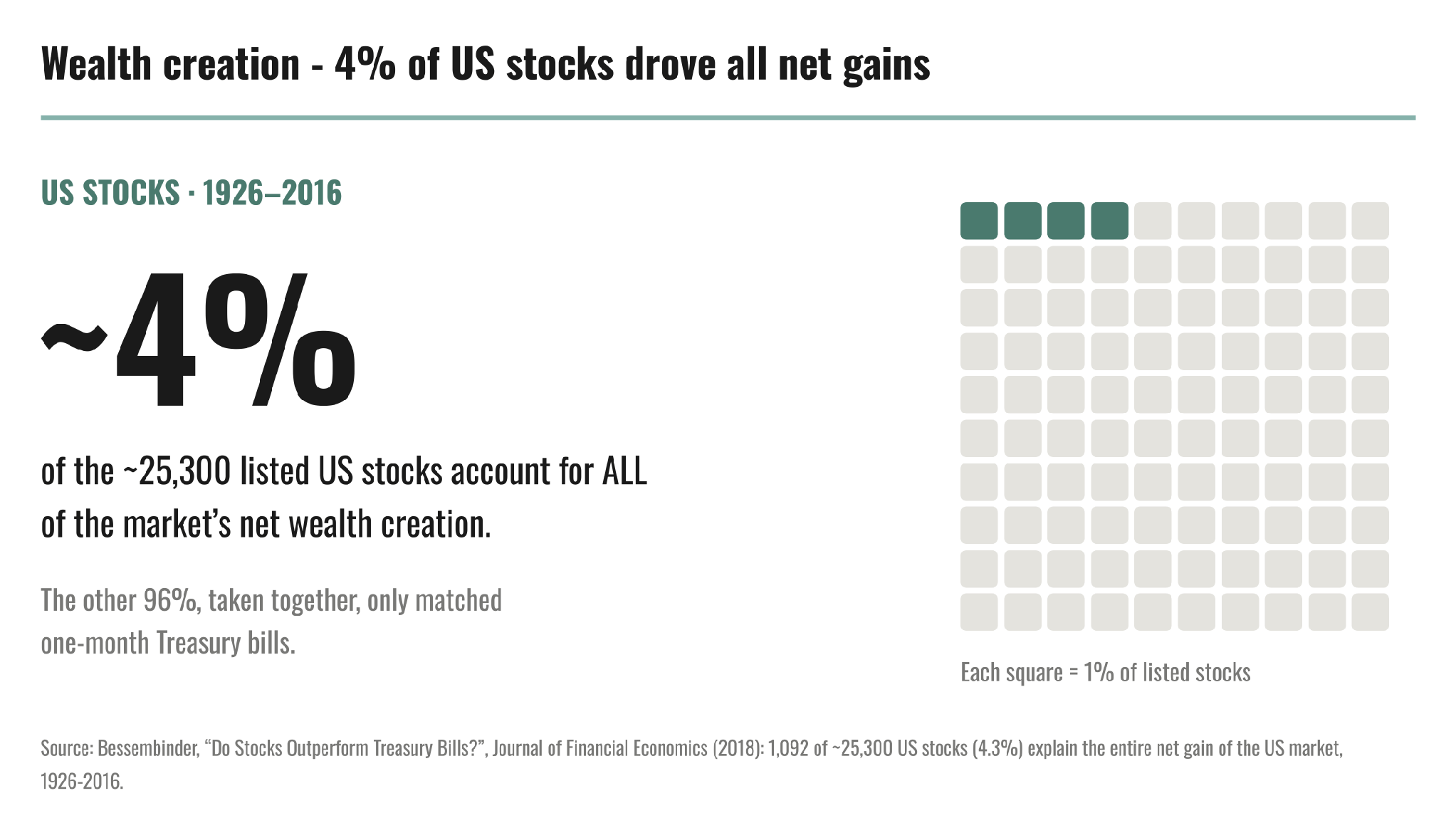
It seems that holding these companies is even tougher than finding them at a great price.
What Superinvestors Say
“When we own portions of outstanding businesses with outstanding managements, our favorite holding period is forever.”
— Warren Buffett, Berkshire Hathaway, 1988 letter to shareholders.
Bessembinder showed that this strategy is for a minority of stocks, and Buffett is talking about companies that truly possess these two characteristics.
And over time, the portion of returns attributable to the initial investment decreases, so that the majority of returns come from earnings growth.
My Take
The companies I consider Category Definers are generally the ones we regret selling the most.
We tend to underestimate the longevity of their competitive advantages, their ability to find new growth opportunities, and ultimately their potential to create value over several decades.
Before selling one of these companies, ask yourself three questions:
Is my investment thesis still playing out?
Has the valuation become excessive relative to its long-term growth prospects?
Is there another investment opportunity (especially another category definer) with better outlooks?
Rotating between Category Definers can be a very good strategy, especially within a tax-deferred account.
However, selling a great company simply because its stock price has risen significantly is a rather losing strategy. Look at its relative valuation instead (P/E or P/FCF).
Take a look at the table below, which shows the ten best-performing stocks over a twenty-year period.
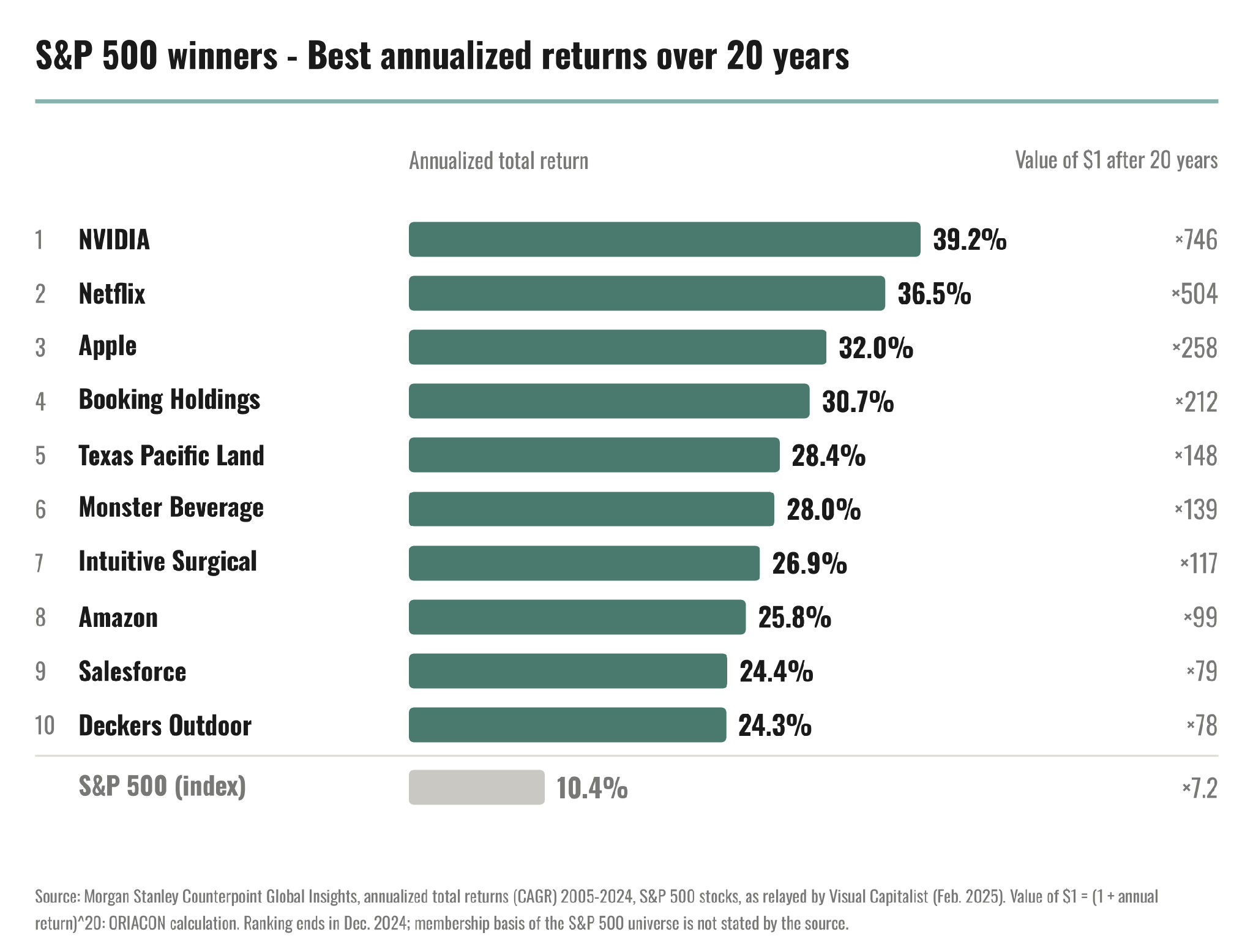
These companies defied all expectations. How many of us would have been able to hold on to them after doubling, tripling, or even multiplying our initial investment tenfold?
Don’t sell a great company because of how much it has already returned. Sell it if you found something better elsewhere.
2. Buying the Dip, Then Selling Before the Recovery
What the Research Says
Giglio et al. (2021) surveyed Vanguard investors before, during, and after the COVID-19 market crash. The investors who were most optimistic before the crash experienced the largest decline in expectations and sold the most equities. Meanwhile, long-term expectations across the surveyed investors were mostly unchanged.
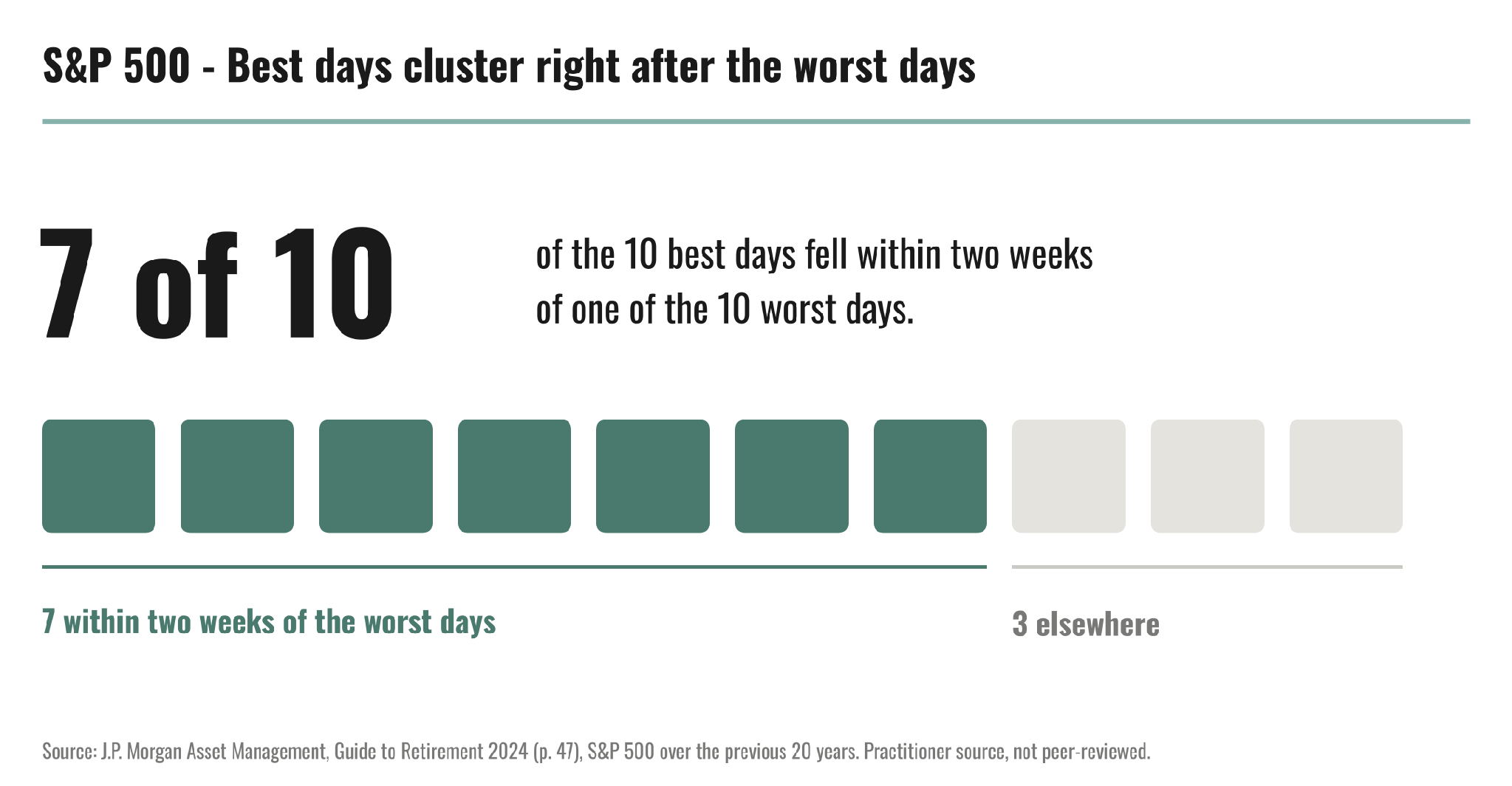
J.P. Morgan (2024) has shown that seven of the ten best trading days for the S&P 500 occurred within two weeks of one of its ten worst days over the period studied. Recoveries can happen much faster than expected.
What Superinvestors Say
“Doing so has the potential to convert a short-term fluctuation into a permanent loss by causing any subsequent recovery to be missed.”
— Howard Marks, What Does the Market Know?, 2016.
“A price drop in a good stock is only a tragedy if you sell at that price and never buy more.”
— Peter Lynch, One Up on Wall Street, 1989.
The important part here is “a good stock.” It supposes the fundamentals aren’t deteriorating.
My Take
Buying the dip sounds easy when looking at a historical chart. It is much harder when you don’t know where the stock is going.
When I buy the dip, I try to treat the stock as if it were illiquid for the next 6 to 18 months. That’s the time I am prepared to give my investment thesis to play out.
In the short term, the price is driven mostly by the multiple, which is market sentiment, itself a reflection of expectations.
So I look for catalysts, which are specific events that trigger a significant movement in a stock’s price, or in the market as a whole. The price adjusts toward the news as the catalyst becomes clearer and clearer, not at the moment it actually occurs. Once they are identified, I can sleep on it, just waiting for the catalysts to happen.
If the thesis is broken, sell, because it will be worse later. This only works if I noted, at the time of purchase, what would make me sell.
The key to investing is time, because it is time that will prove you right or wrong. It can last months or years.
3. Falling Into a Value Trap
On paper, a stock at five times earnings beats one at twenty times: with the current earnings, you get your money back in 5 years instead of 20.
A value trap is a company that looks undervalued on its current numbers. Often, if a company is undervalued, it’s because there’s a problem: the business is deteriorating, and the low valuation is justified.
What the Research Says
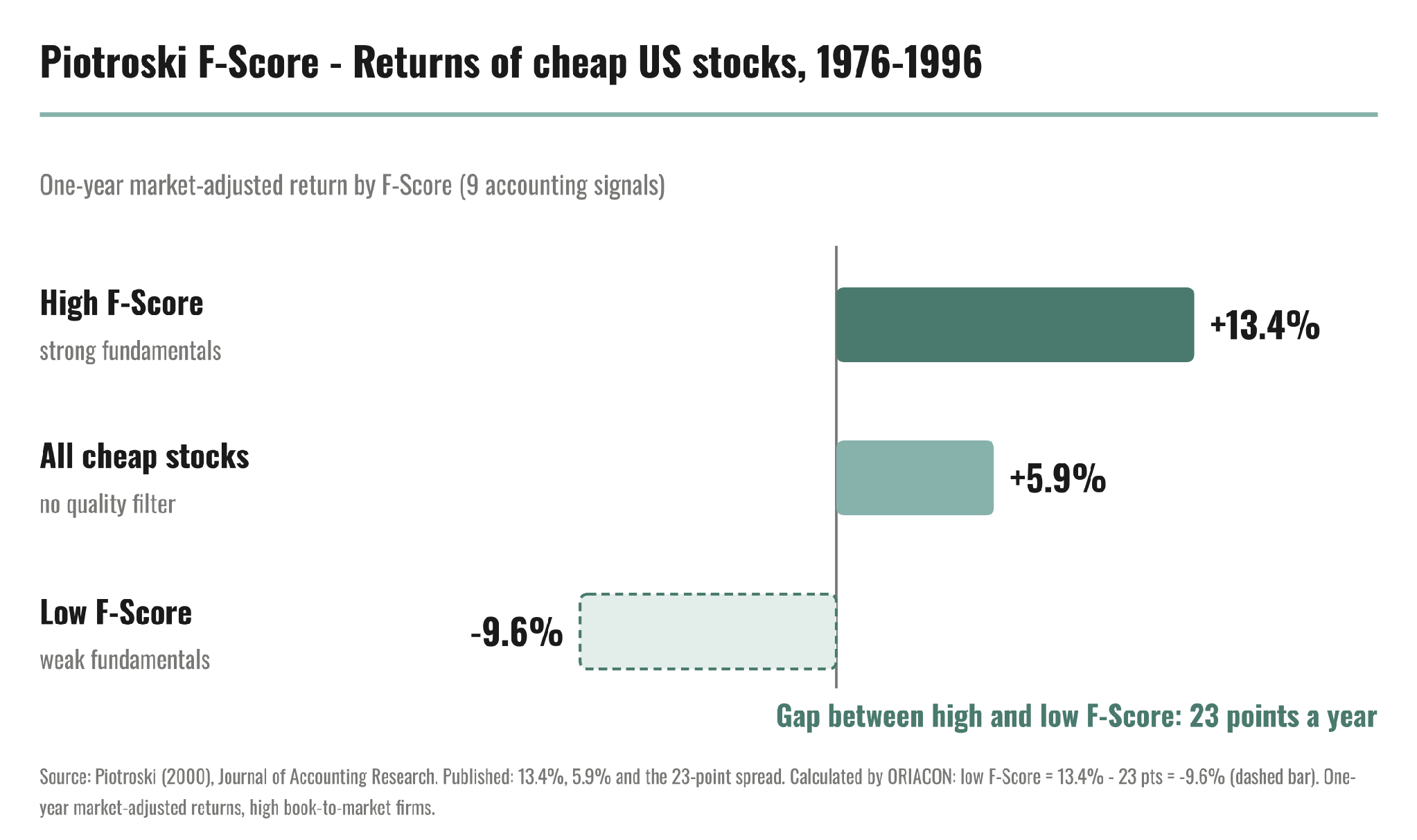
Piotroski (2000) took cheap US stocks between 1976 and 1996 and scored each one from 0 to 9, based on their financial strength.
Those with a score of 8 or 9 outperformed the market by 13.4% percentage points over one year.
Those with a Score of 0 or 1 underperformed the market by 9.6 percentage points.
An amazing spread of 23 percentage points between two groups of cheap stocks.
What Superinvestors Say
“Time is the friend of the wonderful business, the enemy of the mediocre.”
— Warren Buffett, Berkshire Hathaway, 1989 letter to shareholders.
The very name “Berkshire Hathaway” serves as a reminder of this maxim: Buffett bought a struggling textile business at an attractive price, and the bargain turned into a long-term capital allocation problem.
Then he turned to quality stock with the success we all know it has had.
My Take
French investor William Higgons pays particular attention to declining revenue, and noted that this indicated a value trap. When it starts falling, margins fall because fixed costs are spread over fewer sales, earnings fall faster than revenue, and the market pays a lower multiple for those earnings.
Take a stock at $100, with earnings of $10 per share: a P/E of 10. Earnings fall to $5 and the market now pays 6 times: the stock is at $30.
It looked cheap at $100, and it may still look cheap at $30, after a 70% loss.
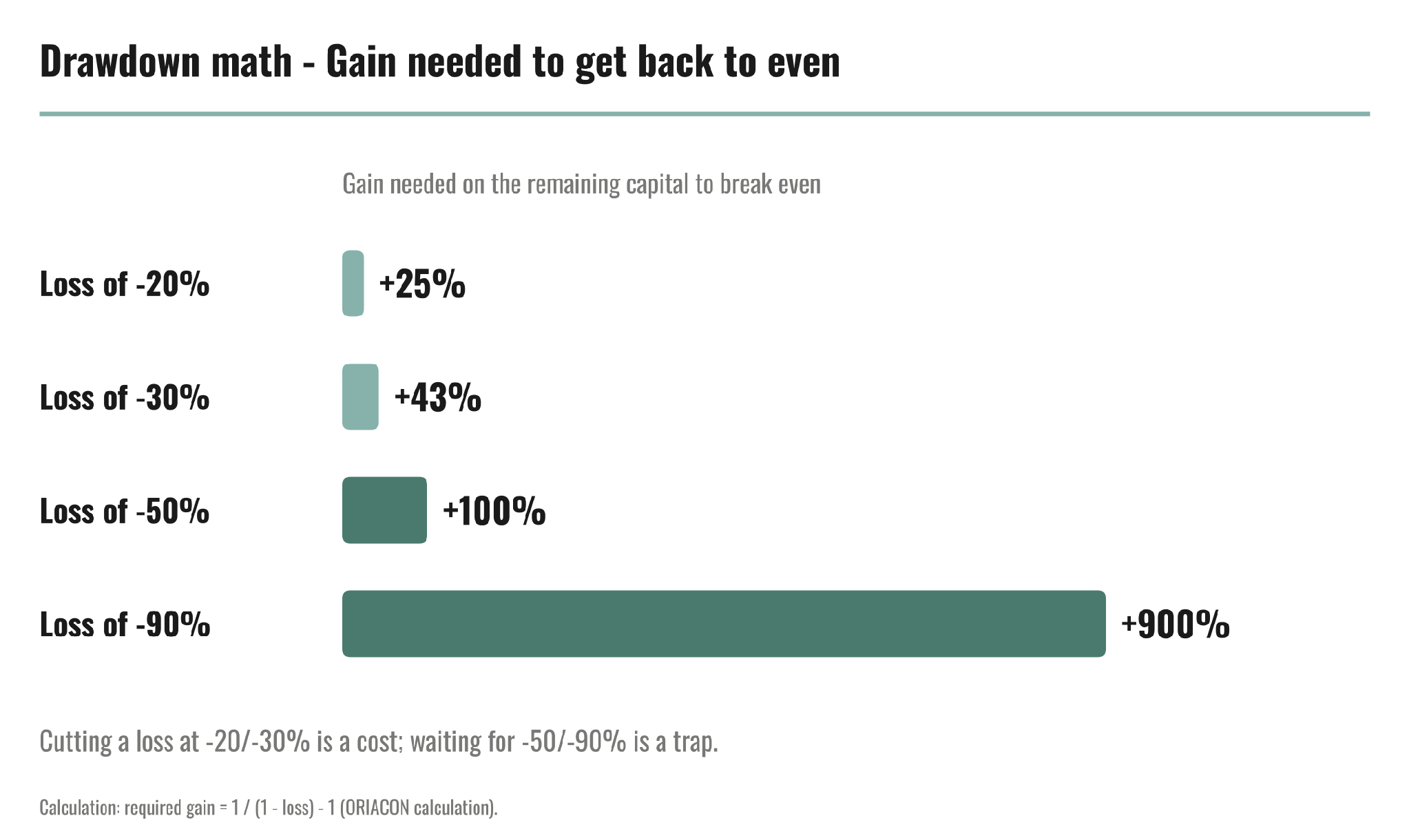
If the original thesis is broken, get out. You’re not sure you’ll recover.
A low multiple protects nothing while the business keeps shrinking.
Seven More Investing Mistakes And How to Avoid Them
We’ve covered three potentially costly mistakes so far: selling great companies too early, giving up on valid investment theses, and mistaking cheap companies for attractive investments. In the rest of this article, we’ll look at seven other mistakes.
At the end, you’ll find a summary of the ten mistakes, with questions to add to your own investment process.
Subscribe to ORIACON for free to read the remaining seven mistakes and access the full summary.