
Most companies grow by selling more products or services. These businesses are known as serial acquirers. They use the cash from their operations to acquire new companies, providing more cash to acquire new companies and so on. Over time, it can become a powerful compounding machine.
I looked across 20 Western countries, and 32 companies passed.
Some of them have delivered amazing returns
Let’s look at a few examples:
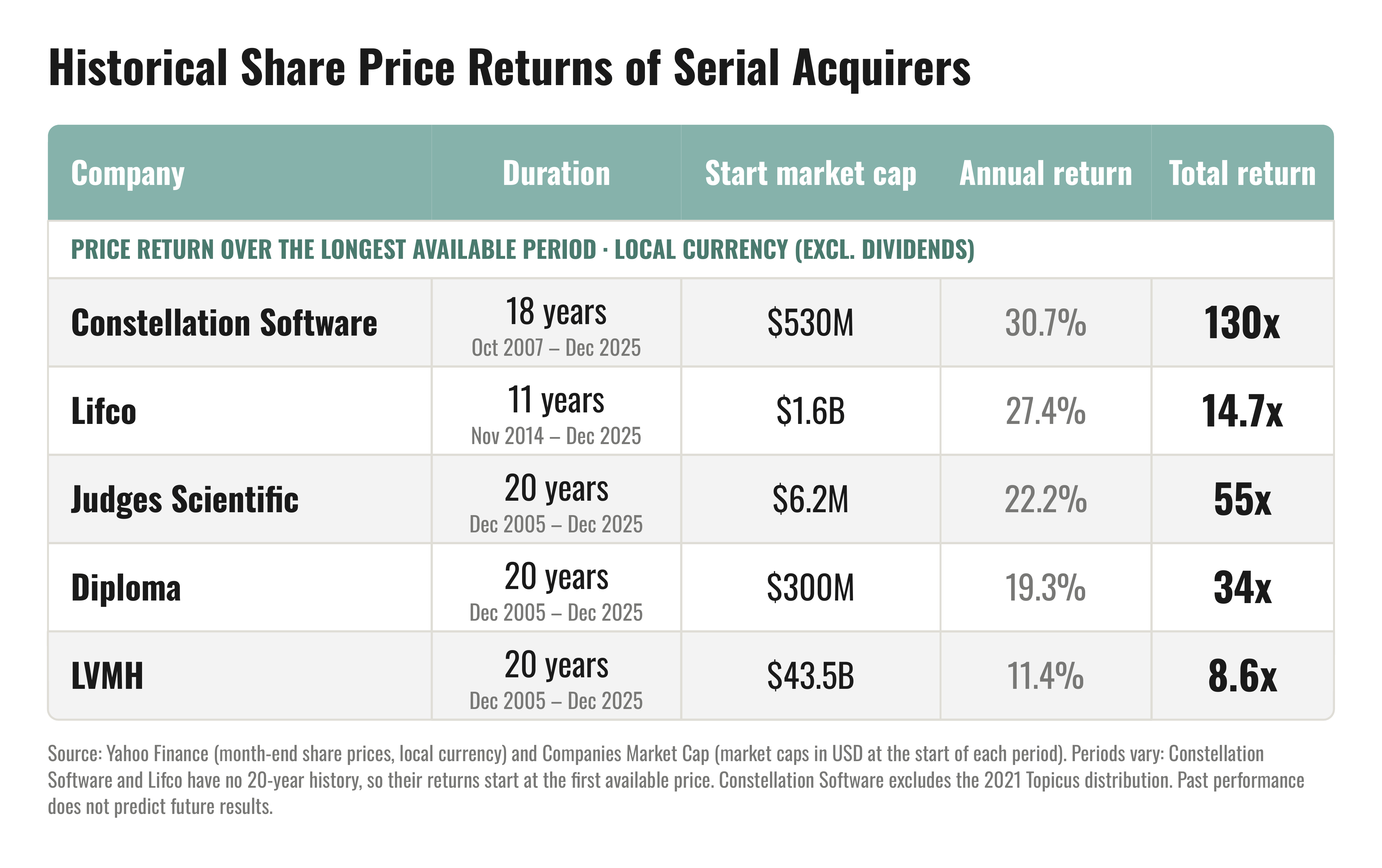
For the most part, these are exceptional long-term returns.
The studies
In terms of stock market performance, Bain & Co compared in 2025 companies’ annualized total shareholder returns (TSR) according to their acquisition frequency. The firm defines frequent acquirers as companies making more than one acquisition per year.
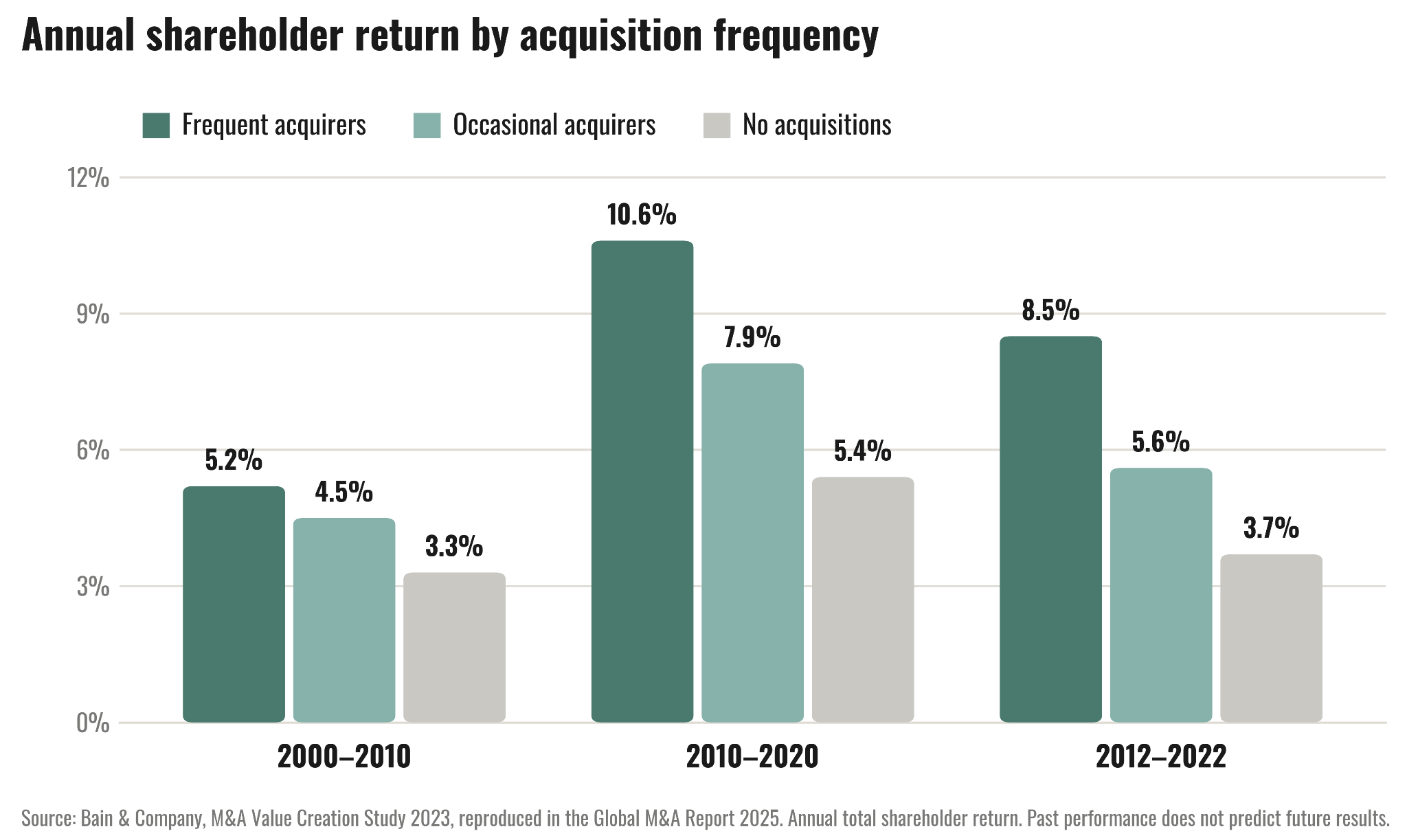
The gap is large: from 2012 to 2022, frequent acquirers achieved 8.5% per year, compared with 3.7% for companies that made no acquisitions.
It is not the acquisition itself that drives performance, as will be shown in the studies later in this article. The initial quality of the companies, their size, or their industry can also play a role.
McKinsey compares acquisition strategies among large global companies. The firm defines programmatic M&A as repeated small or medium-sized acquisitions, generally at least two per year, cumulatively representing a significant share of the market capitalization.
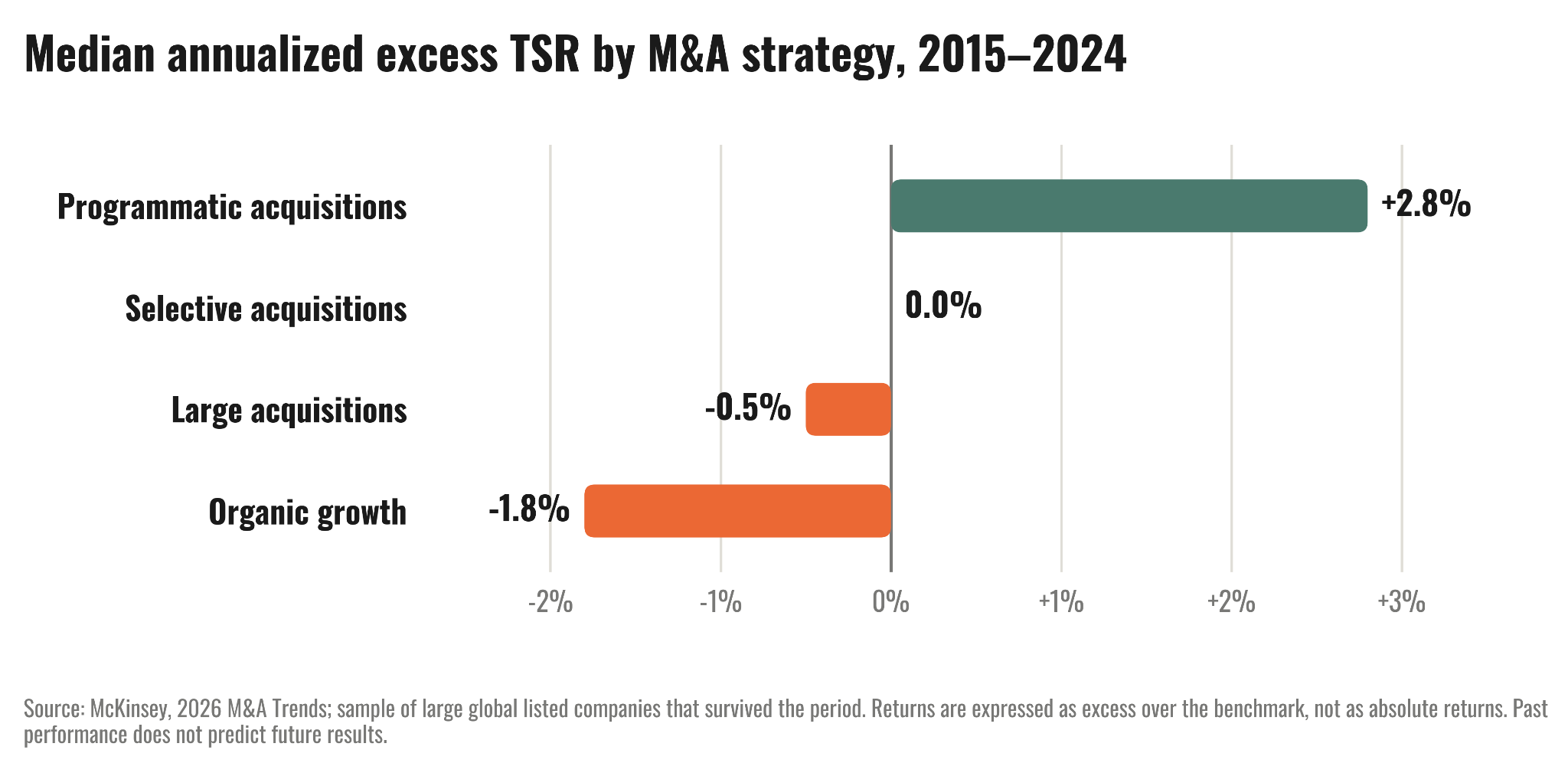
This suggests that acquisition discipline and regularity matter more than a few exceptional large deals. The latter are often harmful to shareholders.
There is a potential survivorship bias: companies that were no longer publicly traded at the end of the period are not included in the study’s sample.
In a study published in 2025 in The Review of Corporate Finance Studies (Solving Serial Acquirer Puzzles), on 55,482 acquisitions carried out by 8,640 publicly traded US companies, between 1989 and 2018, Macias, Rau & Stouraitis identified four profiles:
Loners: one or two acquisitions.
Occasional acquirers: infrequent acquisitions.
Sprinters: acquisitions concentrated over short periods.
Marathoners: regular acquisitions, practically without interruption.
Their main results:
17.5% of acquirers carried out 60% of acquisitions.
The most frequent acquirers were more likely to acquire private companies.
After adjusting for market expectations, the returns associated with the marathoners’ acquisitions do not decrease over successive acquisitions.
Marathoners accumulate significant economic gains thanks to numerous small transactions.
In a study published in the Journal of Financial Economics (Extraordinary acquirers), Golubov, Yawson & Zhang found that:
The abnormal returns at acquisition announcements vary considerably from one company to another.
The best companies show some persistence in their strong performance.
This persistence does not necessarily disappear when an executive is replaced.
Company-specific characteristics explain a significant part of the differences in performance.
This provides academic evidence supporting the idea of organizational skill in making acquisitions.
I also found studies that challenge the outperformance of serial acquirers:
Laamanen in 2008 (Performance of serial acquirers: toward an acquisition program perspective) found that frequent and irregular acquisitions were associated with poorer performance.
Hossain, Pham and Islam in 2021 (The performance and motivation of serial acquisitions: Evidence from Australia) suggest that serial acquirers obtain lower stock-market returns around announcements, with higher risk. Saccuman & Schraa report similar findings in Europe in their 2024 study, The Impact of Deal Frequency and Acquisition Blocks on Bidder Performance.
What Makes a Good Serial Acquirer?
I see six characteristics specific to a good serial acquirer:
-The acquisition strategy is clear and disciplined. It knows what type of company it is looking for, consistent with its business model, and what price it is willing to pay. It also knows when to walk away if the price becomes excessive.
-The return on invested capital is high. The acquisitions must generate sufficient profits relative to the amounts invested. The incremental return on invested capital (ROIIC), which can reflect both acquisitions and organic investments, remains high over time.
-The company can finance its acquisitions internally, which helps limit new share issuance and shareholder dilution. Here, we look at the growth in earnings per share and FCF per share.
-Debt remains under control. With high debt levels, the company can accelerate its growth, but at the cost of greater vulnerability if interest rates rise or the economy slows down. The ability to weather difficult periods without endangering the whole group is essential.
-The acquired companies must continue to function well. They must at a minimum maintain their activity, and ideally continue to develop their sales and their margins. Persistently negative organic growth can hide operational problems.
-The serial acquirer must be able to reinvest for a long time and on a large scale. As it grows, it must also deploy more capital to maintain the same pace of growth. This is why small serial acquirers operating in very fragmented markets can offer particularly attractive potential.
The central principle: a good serial acquirer is not the one that carries out the most acquisitions, but the one that consistently reinvests substantial amounts at high returns, for the benefit of shareholders.
For readers who want to learn how to evaluate these companies themselves, I strongly recommend FluentInQuality’s article:
Here’s How to Spot and Evaluate a Great Serial Acquirer in 10 Minutes.
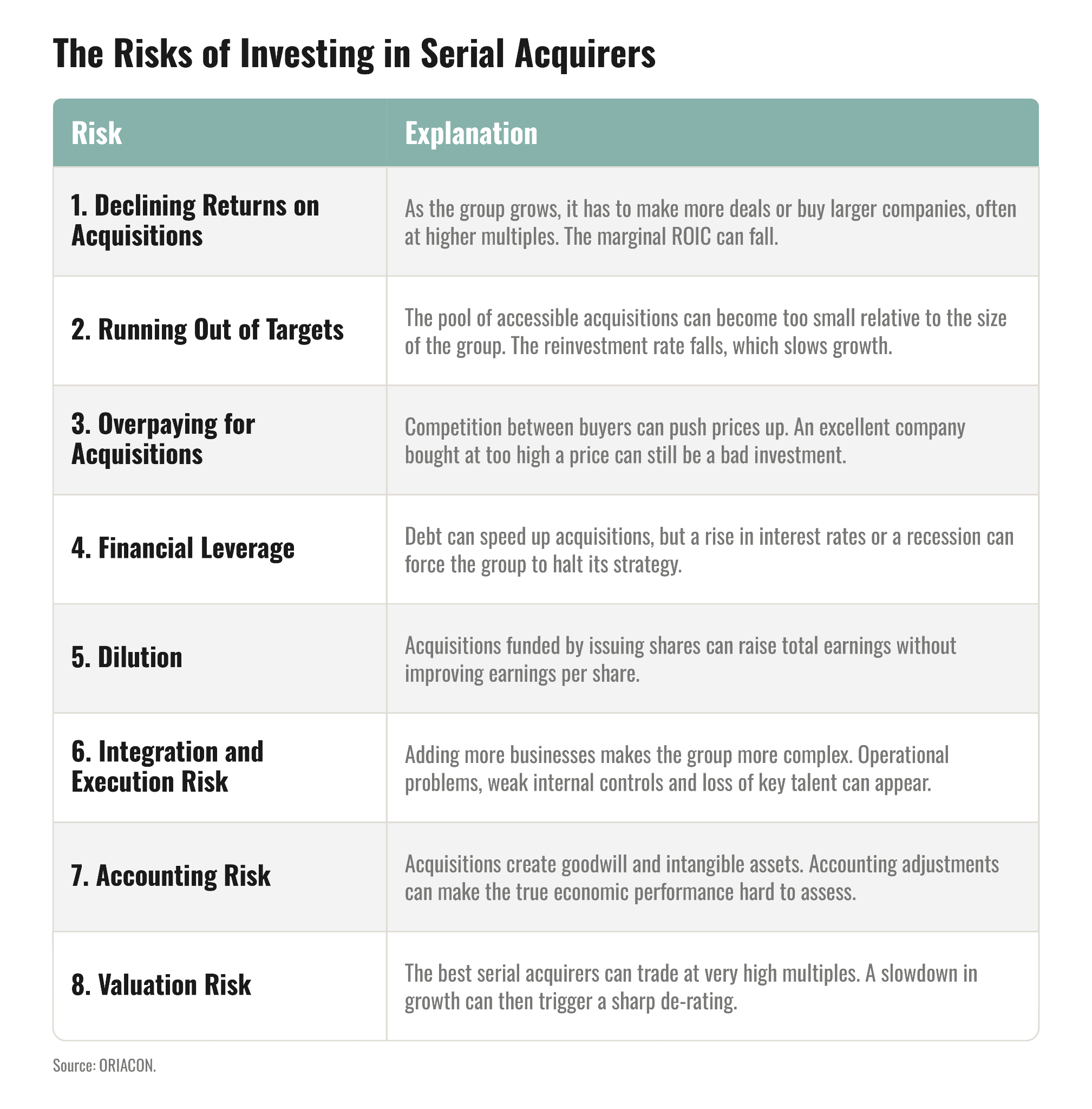
But buying companies is not a guarantee of success. Acquisitions can also destroy considerable value. The risks are the negatives of the points mentioned above, with operational consequences.
What’s Included in My List
A conventional stock screener cannot identify serial acquirers reliably. I therefore identified historical serial acquirers, companies that follow similar models and companies that regularly make acquisitions, even when acquisitions are not the sole driver of their growth.
Once I had identified an initial pool of companies, I applied the following filters:
I added a Serial Acquirer score, comprising six criteria. Each criterion receives a score from 0 to 3, for a maximum score of 18. The criteria are the following:
Capital Returns
M&A Discipline
Balance Sheet
Funding
Organic Growth
Reinvestment Capacity & Runway
I have also included a few companies that do not strictly fit the definition of a serial acquirer, but whose acquisition strategies are interesting enough to fit in this list.
SUBSCRIBE FOR FREE TO SEE THE FULL LIST