1. Quarterly verdict
1.1 Reinforced on fundamentals. One new variable to monitor.
The three pillars of the bull case hold without exception. The fortresses — PDF, professional imaging — continue compounding at +16% and +13% respectively. The Stock Cannibal is running: 8.5 million shares repurchased in the quarter, diluted count down from 429M to 402M in twelve months, a 6.3% reduction. Total ARR growing at +12.5%. Revenue hit a record. None of the three invalidation triggers defined in the deep dive has been pulled.
What is new — and was not anticipated in the deep dive — is the freemium pivot. Adobe has made an explicit strategic decision to stop routing Acrobat and Firefly traffic toward direct-to-paid journeys and instead accelerate MAU (Monthly Active Users) acquisition through friction-free freemium funnels. Management acknowledged this will compress individual subscriber ARR growth in the second half deliberately. The early signals are strong — Acrobat MAU grew from 700M to 850M year over year, Creative freemium MAU from 50M to 90M, Firefly ARR up 50% quarter over quarter — but the conversion velocity from MAU to paid at scale remains unproven over a full cycle.
This is a timing nuance, not a thesis change. The Reader trojan horse logic — hundreds of millions of free users converted progressively into paid tiers — was always the foundation of the Acrobat bull case. Adobe is now applying the same playbook to Firefly and Express at scale. The logic is coherent. The proof will arrive in Q3 and Q4.
One other note: CFO Dan Durn departs June 15. He came from Marvell Technology, stayed less than five years, and is returning to the semiconductor sector. The profile is that of a transitional CFO recruited for a specific phase — post-Figma M&A discipline, margin communication during the multiple compression period. Nothing in the numbers suggests a forced exit: RPO clean, cash flow intact, no accounting adjustments. The more likely read is that Durn anticipates the incoming CEO will install his own CFO and departs on his own terms. Steve Day, 20 years at Adobe, takes over as interim. Operationally, continuity is not at risk.
At the time of writing and publication, Adobe is trading premarket at $206.88, down $11.92 (-5.45%). The decline is a sentiment reaction, not a fundamental one.
Verdict: thesis intact with one new variable. The freemium conversion velocity is the single open question. Q3 results in September 2026 are the next decision point.
1.2 My reaction with a 10% Adobe portfolio
I’ll be transparent: I’m pissed off.
I initiated my position on March 19, 2025, and reinforced throughout the decline — every dip, every bad headline, every “Adobe is dying” narrative. My average cost is €295.5. With the premarket at $206.88, I’m sitting on a loss of approximately 36% — probably closer to 40% by the time the session opens. Adobe still represents approximately 10% of my portfolio. That’s not inertia — that’s a deliberate choice to maintain full weight on a thesis I believe in.
And yet the numbers are good. Revenue record. Fortresses intact. AI-first ARR tripling. Stock Cannibal running. None of the three invalidation criteria touched.
That gap — between what the business is doing and what the price is doing — is exactly what the deep dive was built around. The market priced a dying business. It got a fortress. I wrote that on June 10. The Q2 results confirmed it on June 11. The price went down anyway.
It’s frustrating. It’s also, if I’m being analytically honest, a feature rather than a bug. Markets that overreact on the downside create entry points that rational pricing never would. The same mechanism that is hurting my P&L today is the one that will produce the asymmetric return when sentiment normalizes. I’ve seen it with Novo Nordisk. The pattern is not new.
I’m holding. Not because I’m anchored to my cost basis — that would be the wrong reason. But because the thesis is intact, the business is compounding, and the buyback is running at prices management itself considers deeply depressed. Those are the right reasons.
If you’re reading this with Adobe in your portfolio, sitting on a similar loss, asking yourself whether to exit — that question is worth taking seriously. The emotional pull to stop the bleeding is real. But the answer has to come from the invalidation criteria, not from the price action. None of the three has moved. That’s the only compass that matters here.
The market’s overreaction is both annoying and a blessing. Annoying for those already in. A blessing for those who aren’t yet.
It reminds me of a Charlie Munger’s thought on this:
2. The Numbers
2.1 Q2 FY2026 at a glance
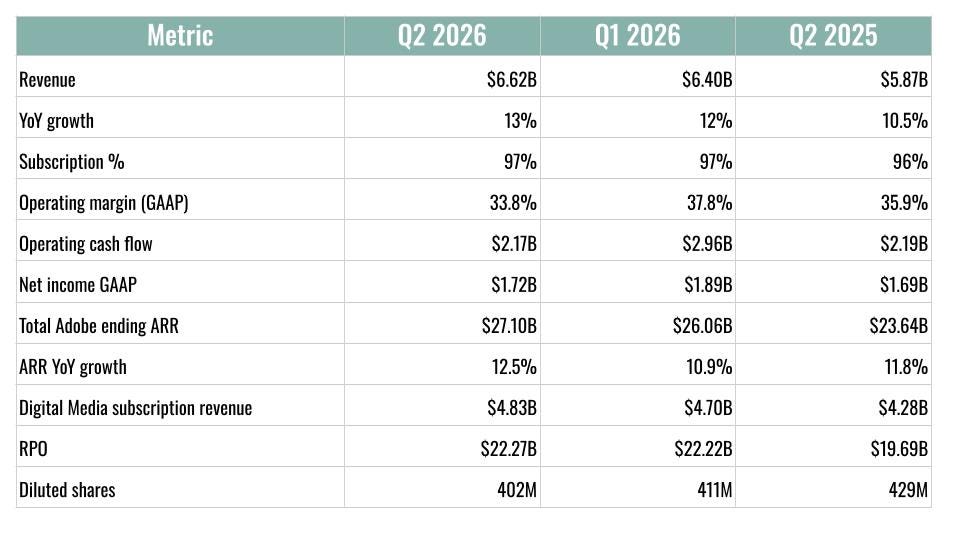
This table summarizes the key metrics from Adobe’s Q2 FY2026 earnings release : https://www.adobe.com/cc-shared/assets/investor-relations/pdfs/11606202/bu45teegrf.pdf
2.2 Commentary
Top line. $6.62B is a record. The +13% YoY marks a slight acceleration on the prior two quarters (+12% Q1, +10.5% Q2 2025). There is no revenue deceleration story here — and that matters, because the bear thesis requires the fortresses to be visibly eroding. They are not.
ARR. The +12.5% headline includes approximately $480M from Semrush, which closed in April. Organic ARR growth is therefore closer to +10.5% — consistent with prior quarters, no organic acceleration. This is the number the market focused on, and the deliberate H2 freemium pivot implies it will soften further before the conversion effect shows up. Management’s FY26 total ARR growth target of 10.2% — Semrush included — signals this explicitly. The market read “deceleration.” The correct read is “deliberate short-term trade-off for long-term MAU foundation.”
AI-first ARR. The standout signal of the quarter. AI-first ARR tripled year over year and crossed $500M. Firefly ARR is approaching $300M, up 50% quarter over quarter. Acrobat AI Assistant ARR grew 3× year over year. These are not rounding errors — they are the early empirical validation of the double-lock thesis: the compliance moat and the workflow integration moat are deepening simultaneously. The self-cannibalization signal identified in the deep dive — Adobe replacing its own Adobe Stock revenue with Firefly generative credit subscriptions — is confirmed and accelerating.
Operating margin. GAAP at 33.8% versus 37.8% in Q1. The Q1 figure was seasonally elevated by annual renewal concentrations. The full-year FY26 GAAP operating margin target is 35% — above the 30% assumed in the base case of the deep dive scorecard, and directionally consistent with the bull case trajectory toward 35%.
Operating cash flow. $2.17B versus $2.96B in Q1. Seasonal, not structural. The trailing twelve-month figure remains above $10B. The $70M goodwill impairment on the Publishing & Advertising unit is non-cash and immaterial at $0.17 per share — a quiet acknowledgment that this segment is not a priority, consistent with the fortress concentration strategy.
RPO. $22.27B, +13% year over year. One full year of revenue already contractually committed before a single new contract is signed. This is the most underappreciated line in the earnings release. A business with eroding competitive position does not sustain RPO growth at this rate.
Stock Cannibal. Diluted count at 402M versus 429M twelve months ago: -6.3% after SBC issuance. The $25B buyback authorization announced in April is running. At the current pace, EPS grows mechanically at 16-17% annually from share count reduction alone, independent of revenue growth, independent of the freemium narrative.
Quality check. No accounting flags worth raising. The $30M loss contingency (litigation settlement) is consistent with Q1’s $62M and reflects normal legal exposure for a company of this scale. Revenue recognition is clean. No restatements. The CFO departure reads as orderly, not forced — nothing in the numbers contradicts that reading.
3. Thesis Update
3.1 Invalidation criteria — status
The three triggers defined in the deep dive as requiring reassessment to validate the bear thesis :
Digital Media ARR decelerating structurally below 5% growth → not triggered
Gross margin declining durably below 87% → not triggered
Creative Cloud retention rates visibly declining → not triggered
3.2 Bull case prerequisites — status
Fortresses holding (PDF, professional imaging) → confirmed
Stock Cannibal running → confirmed, -6.3% share count in twelve months
Firefly beginning to register in aggregate ARR → in progress, ~$300M ARR approaching, ×3 AI-first YoY
Credible new CEO named → pending, search described as “progressing well,” target before FY27 planning
3.3 New this quarter
The freemium pivot is the only variable the deep dive did not model explicitly. Adobe is institutionalizing what the Reader trojan horse always was: a massive free installed base converted progressively into paid tiers. The difference is scale and speed — 850M Acrobat MAU, 90M Creative freemium MAU, both growing fast. The short-term ARR cost is real and assumed. The long-term logic is consistent with the thesis. The proof is in the conversion velocity over the next two to three quarters.
Semrush integration closed as expected — bolt-on, cash-funded, no dilution, no antitrust risk. The exact profile of post-Figma M&A discipline described in the deep dive as a positive signal.
4. Valuation — Updated Entry Point
The deep dive scorecard was built at ~$258 (June 5, 2026). After the consecutive post-earnings declines, the entry point is now more favorable — same EPS trajectory, lower price, wider upside on every scenario.
At the current price, the base case (PE 25×, EPS ~$27.50 in 2028) and bull case (PE 25×, operating margin 35%, EPS ~$32.08) both represent a more attractive risk/reward than at the time of writing. The thesis did not weaken. The price did. That gap is the opportunity.
One honest note on positioning: the contradiction between the price signal and the fundamental confirmation makes this objectively an interesting reinforcement point. I have no more cash to reinforce the position, and I am concentrated enough, so I don’t want to sell my other positions.
A note on the decline
Adobe is trading down 5.45% in premarket at $206.88 as this article is published. The decline is a sentiment reaction, not a fundamental one. Management language that explicitly assumes short-term ARR compression — however strategically coherent — activates momentum sellers who read the headline without modeling the logic behind it.
An additional technical factor may extend the pressure in the coming sessions: SpaceX’s inclusion in the Nasdaq indices will trigger forced ETF buying of SpaceX, partially funded by mechanical sales of other constituents. If Adobe is among them, the selling pressure will have no relationship whatsoever to the quality of the business or the validity of the thesis.
The title can continue to fall for reasons entirely disconnected from what this document describes. The three invalidation criteria remain the only relevant compass. None of them has moved.
The fundamentals confirmed. The price fell. For an investor with available cash and conviction on the thesis, this week is more interesting than last week — not less.
Important Disclosure & Disclaimer
All content published by JB Peter on this platform is strictly for educational and informational purposes. It does not constitute investment, financial, legal, or tax advice, nor does it represent a personal recommendation or solicitation to buy or sell securities. This research is operated by ORIACON (SASU) and reflects independent corporate analysis. Every reader must conduct their own independent research (Due Diligence) or consult a licensed professional before making any financial decision, as financial markets involve a high risk of capital loss. At the time of writing, ORIACON or the author HOLD shares in the company analyzed in this article. Following this publication, ORIACON and the author reserve the right to buy, sell, or modify positions in any security mentioned at any time, without prior notice to readers or subscribers.