
On paper, it’s hard to do better: record revenue at $119.8B, Cloud accelerating sharply at +82%, backlog at $514B. And yet the stock lost nearly 5% after hours. This gap between the quality of the quarter and the market’s reaction is the real subject of this note.
1. Quarterly Verdict
1.1 The Engines Are Running, The Bill Is Getting Heavier
Nothing in the published numbers contradicts Alphabet’s growth trajectory. Search is up 17%, YouTube up 13%, and above all Cloud is accelerating to 82% with an operating margin that has nearly doubled year over year (20.7% → 35.6%). Twelfth consecutive quarter of double-digit growth for the group.
What has changed, on the other hand, is the scale of the investment effort management is now committing to. Leadership raised its annual capital expenditure guidance from $180-190B to $195-205B — a jump of more than $15B decided mid-year, justified by a faster pace of AI capacity delivery than previously planned, in the face of demand that still outstrips supply. The immediate consequence: negative free cash flow of -$5.9B for the quarter, a first in several years.
It’s this last point, more than growth itself, that drove the stock down after the release. The market read “cash pressure” where management is presenting a calculated bet on the future return of this investment, notably through TPU system sales, the bulk of which won’t be recognized as revenue until 2027.
Bottom line. Nothing in this quarter undermines the underlying thesis on Alphabet, but the market remains hesitant about the profitability of the investments being made. How long is it willing to fund this phase before demanding concrete proof of return? Q3, with the first effects of the shift toward third-party capacity, will give a first indication.
1.2 My Reaction With a 10% Alphabet Portfolio
I remain very bullish on Alphabet given the quality of their world-class products, and their impressive growth given their size. Search, YouTube and Cloud are each, taken individually, dominant positions in their category — few companies can claim three engines of this scale at once, let alone growing them simultaneously at this pace (17%, 13%, 82%) with a revenue base already above $400B annualized. It’s this combination — product quality, addressable market size, and speed of growth despite the size already reached — that in my view justifies staying invested despite short-term volatility in the stock.
The TPU business looks like a solid growth driver. The first deliveries started being recognized this quarter, but remain deliberately marginal: management is clear that the bulk of revenue from these contracts won’t arrive until 2027, which gives visibility into a growth engine that hasn’t even started running at full capacity yet. Management frames this as an expansion of the addressable market rather than cannibalization of Cloud, which is consistent with the “full stack” strategy: the more layers Alphabet controls (chips, models, infrastructure, distribution), the more value it captures at each layer.
Investing in hyperscalers seemingly requires trusting management on the profitability of these investments — which has held true so far. As a minority shareholder, you can’t audit the return on every dollar of capex poured into a data center yourself; you can only watch whether the indirect signals point the right way (Cloud margin expanding, backlog growing, a consistent narrative quarter after quarter) and note that, so far, these investments have translated into margin expansion rather than dilution. That’s no guarantee going forward, but it’s a track record that deserves credit rather than default suspicion.
If profitability were to decline, they can halt investments, sell off assets, and the income statement and cash flows would mechanically improve. That’s a safety net you don’t necessarily get with other types of businesses: Alphabet’s capex is largely discretionary and spread over time, without being locked in irreversibly for decades. If AI capacity demand were to soften, management could slow server orders, pause new data center builds, or even offload assets to third parties (as it’s already partly doing with leased capacity) — and free cash flow, negative today, would turn positive again fairly quickly.
2. This Quarter’s Numbers
2.1 At a Glance
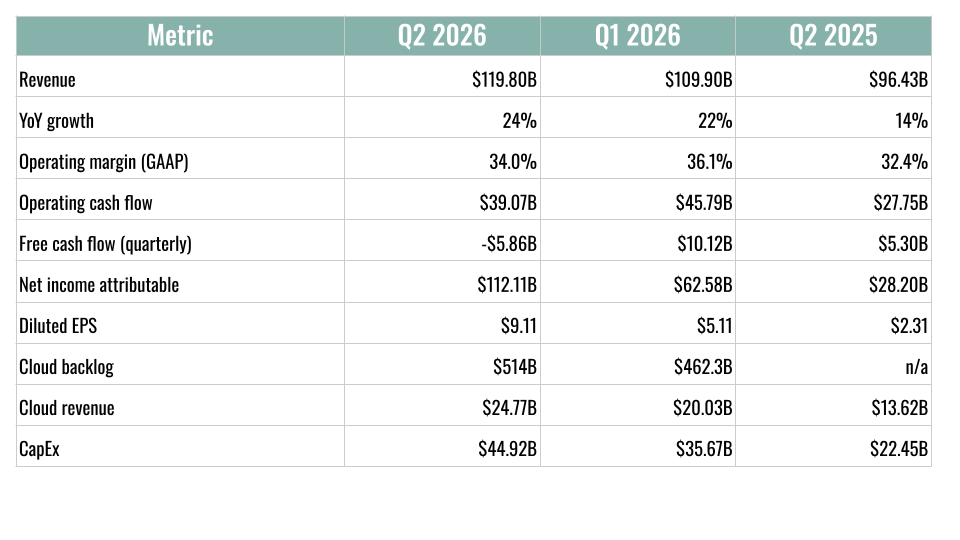
This table summarizes the key metrics from Alphabet’s Q2 FY2026 earnings release: https://s206.q4cdn.com/479360582/files/doc_financials/2026/q2/2026q2-alphabet-earnings-release.pdf
2.2 Commentary
Revenue. At $119.8B, the quarter beats consensus by nearly 3%. The 24% growth marks a clear acceleration versus Q2 2025 (+14%) — no sign of fatigue in the core advertising business.
Off-balance-sheet purchase commitments and other contractual obligations — $332.4B total (of which $138.0B short-term). This figure comes from the Q1 2026 10-Q — the Q2 10-Q hasn’t been filed yet, so this is included here as a tracking reference rather than a Q2 data point. It’s an important number to flag: it sits entirely off the balance sheet (these are future commitments, not booked liabilities), yet it dwarfs the quarterly capex figures dominating the headlines and gives a sense of just how much additional spending is already contractually locked in beyond what shows up in the P&L or cash flow statement each quarter.
— of which long-term supply agreements (>1 year), including energy and content licenses: $232.7B. Also from the Q1 10-Q. This is the bulk of the $332.4B total and covers technical infrastructure and inventory components, energy take-or-pay contracts (with payments running through 2047), and content licensing — in other words, the multi-year backbone of Alphabet’s AI buildout that sits alongside, and arguably dwarfs, the headline capex guidance figures.
Cloud, the main engine. This is the segment driving most of the positive surprise: revenue up 82%, operating margin jumping from 20.7% to 35.6%, backlog up more than $50B in the quarter alone. The first TPU system sales to customers have started being recognized, but remain marginal — management explicitly states that the majority of revenue tied to these contracts won’t show up until 2027.
Operating margin. At 34.0% versus 32.4% a year earlier, it improves year over year despite rising depreciation charges linked to capex. Viewed sequentially, the picture is different: margin declines versus Q1 2026’s 36.1%. Part of this decline is seasonal — Alphabet structurally posts a higher margin in Q1 than in Q2, as it already did in 2025 (-1.5 pt on the same transition). But the scale of the decline this year (-2.1 pt) exceeds this pure base effect: other cost of revenues (technical depreciation, YouTube content) is rising as a share of revenue, a structural effect tied to the ramp-up in capex, compounded by one-off G&A charges (compensation, litigation) that inflate that line by +50% for the quarter. Management also warns of additional pressure in Q3, tied to increased use of third-party leased compute capacity while internal infrastructure ramps up.
Free cash flow, the sensitive point. Negative for the quarter for the first time in a long while, entirely attributable to the capex level. On a trailing-twelve-month basis it remains positive at $53.3B but is down 20% year over year. This line, more than the income statement, is what dominated analyst attention on the call.
Financing — the opposite of a buyback. Rather than reducing its share count, Alphabet did the opposite this quarter: raised $49.6B in equity and convertible notes, made no repurchases (versus $13.2B a year earlier), and diluted shares outstanding rose from 12,198M to 12,309M year over year. That’s a clean reversal from the stock’s usual dynamic, entirely dedicated to funding capex.
Quality of net income. Operating income gives a faithful picture of the quarter’s real performance; reported net income, on the other hand, is massively inflated by an accounting revaluation of equity stakes, largely illiquid and unverifiable by the market.
Operating income — the part reflecting the company’s actual business — grew 30% to $40.8B. That’s a solid signal, consistent with revenue growth (24%) and Cloud margin expansion: nothing to flag there.
The portion of income coming from gains on equity securities, on the other hand, is a largely accounting artifact disconnected from operations: $98.0B in unrealized gains, which explain most of the gap between operating income (+30%) and reported net income (+298%). The detail available for Q1 2026 (the Q2 release only publishes the aggregate total) shows that this type of gain comes almost entirely from non-marketable securities — stakes in private companies, valued not at market price but revalued only occasionally upon observable transactions (typically new funding rounds). In Q1, the net gain on non-marketable securities was $36.3B versus just $105M on marketable securities — a ratio of more than 300 to 1. Of the $101.3B carrying value of non-marketable securities as of March 31, 2026, $73.6B had been remeasured during that single quarter.
For Q2, Alphabet does not break down the composition of its $98.0B in securities gains, but financial media (Fortune, among others) attribute it to two stakes in particular: Anthropic, which remained private, whose valuation rose from $350B to $965B over the quarter following a $65B funding round, and SpaceX, which went public in early June 2026 at a $1.77T valuation (versus roughly $400B at its last private valuation), and is therefore now sitting on the marketable side. This specific attribution is not confirmed by Alphabet itself — the 10-Q never names its stakes — but it’s consistent with the pattern observed in Q1: most of the gain comes from a private-stake revaluation, not a market move on listed shares.
3. Earnings Call Key Takeaways
Opening / growth. Twelfth consecutive quarter of double-digit growth; Pichai says Alphabet is still in the “very early innings” of an AI-driven secular shift. Cloud backlog at $514B (+$50B for the quarter), Gemini Enterprise adopted by ~90% of the Fortune 100. Model APIs now processing 22 billion tokens per minute (up from 16B last quarter), Gemini app at 950 million MAU.
Models / product roadmap. Gemini 3.6 Flash and 3.5 Flash-Lite launched just ahead of the call; Gemini 3.5 Pro in testing. Gemini 4 is in training — described as the “most ambitious effort yet,” needed to stay at the frontier. Management is targeting a near-monthly release cadence going forward. Coding/agentic coding flagged as a current weak spot, being actively closed (3.6 Flash: +10 points on DeepSuite vs. 3.5 Flash).
TPUs (the most-probed topic in Q&A). Allocation priority: frontier model development (AGI) first, then Search/YouTube/Cloud, particularly Vertex AI and Gemini Enterprise. Third-party capacity deals (e.g. SpaceX, Blackstone) act as a pressure valve to absorb demand without diverting internal TPUs. The CFO explicitly declined to disclose TPU sale margins specifically — only saying it “expands the TAM” rather than cannibalizing Cloud. Revenue from TPU sales to customer data centers will mostly land in 2027, not 2026.
Capex and financial structure. The guidance increase (to $195-205B) is framed as an acceleration in capacity delivery, not a change in philosophy. Funding waterfall: operating cash flow first, then debt (up from ~$16B to ~$100B in a year), then equity — the recent equity raise isn’t expected to repeat (aside from the ATM program for SBC-related taxes). Anat Ashkenazi: “we will continue to invest as long as we see an attractive return.”
Competition / moat. Pichai emphasizes the “full stack” approach (chips + models + cloud + distribution) as the differentiator rather than any single model. On the “model war” question, explicit positioning across the full price spectrum (Flash-Lite through frontier), not just the high end.
Other Bets. Waymo launched a new vehicle (”Oasis”); Pichai stayed evasive on a possible spin-off, prioritizing execution instead. Isomorphic Labs raised over $2B for its drug discovery pipeline.
Search/YouTube monetization (Philipp Schindler). Retail and finance were the largest contributors to Search growth. AI Max (out of beta): +15% average conversions for advertisers who adopt it. YouTube: 1.7B unique World Cup viewers, new “Buy with Google Pay” format on CTV.
Overall tone of the analyst Q&A: nearly every exchange came back to capex, TPUs, and ROI — relatively few questions on advertising or core Search, a sign that capex/ROI is what the market is trying to understand right now.
4. Where the Investment Thesis Stands
This kind of analysis is usually built on a full deep dive — easy to sketch in broad strokes, but very time-consuming to do properly (segment-level modeling, scenarios, precise invalidation criteria). I haven’t yet had the time to do one for Alphabet. In the meantime, here’s the thesis in summary.
I opened the position in May 2025, at a time when Alphabet, despite world-class products, was trading in “Value” territory — the market was pricing the risk of disruption from generative AI (ChatGPT and the like threatening Search) more than the underlying quality of the business. The original idea: given its financial resources and the quality of its teams, Alphabet remained one of tech’s juggernauts, capable both of reclaiming AI market share and of staying the leader in Search. The quarters since then, and this one in particular, have leaned in that direction — but absent a formalized deep dive, the points below remain a coarse-grained assessment rather than a rigorous checklist.
4.1 Warning Signs — None Triggered
Structural slowdown of Search below 10% growth → not observed (17%)
Stagnation or decline in Cloud margin → not observed (35.6%, expanding sharply)
Slowdown in Cloud backlog → not observed (+$50B for the quarter)
4.2 Bull Case Prerequisites — Status
Search and YouTube resilience against external generative AI competition → confirmed, record engagement during the World Cup
Google Cloud market share gains → confirmed, growth well above the sector’s
Ramp-up of proprietary TPU monetization → in progress, effect expected mainly in 2027
Return on capex as the business scales → to be watched closely, this is precisely what the guidance increase raises
4.3 What Changes This Quarter
The new element isn’t the strategy — the integrated chips/models/cloud approach was already known — but its pace of execution. By raising its capex guidance by more than $15B in one go, Alphabet is accepting negative free cash flow in the short term to secure capacity faster, in the face of demand it describes as durably exceeding supply. The coherence of the strategy isn’t in question; it’s the speed of execution and its immediate cash cost that are the variable to watch. In short, Alphabet is borrowing against its future cash flows to grow its present.
5. Valuation: A Gap to Watch Rather Than Resolve
The stock closed the regular session at $341.91 before giving up ground after hours to around $327. This move responds to a specific announcement — the capex increase — not to a reassessment of the quarter’s commercial momentum. This type of reaction, where the market penalizes a spending commitment before seeing its results, is typical during heavy investment phases and doesn’t prejudge the outcome.
Over ten years, Alphabet’s PE has generally ranged between 17 and 33, depending on investor sentiment through the cycle. At the time of writing, the PE sits around 26 — nothing particular to flag at this level, neither expensive nor cheap relative to history. Given the quality of the business, I’d be tempted to sell if the PE were to climb above 40.
The quarter confirms the operational trajectory. The market, for its part, chose to focus on the cost of the strategy rather than on results already visible. The next concrete checkpoint will be the materialization, over the course of 2026 and 2027, of revenue tied to the Cloud backlog and already-signed TPU contracts.
Important Disclosure & Disclaimer
All content published by JB Peter on this platform is strictly for educational and informational purposes. It does not constitute investment, financial, legal, or tax advice, nor does it represent a personal recommendation or solicitation to buy or sell securities. This research is operated by ORIACON (SASU) and reflects independent corporate analysis. Every reader must conduct their own independent research (Due Diligence) or consult a licensed professional before making any financial decision, as financial markets involve a high risk of capital loss. At the time of writing, ORIACON or the author HOLD shares in the company analyzed in this article. Following this publication, ORIACON and the author reserve the right to buy, sell, or modify positions in any security mentioned at any time, without prior notice to readers or subscribers.