
Introduction
The best investment category
AppLovin belongs to my favorite type of investment: a category definer, temporarily beaten down by the market on a below-expectations print.
A category definer is a company that created a new category and occupies the leadership seat in it, crushing the competition in its segment through its products and services.
I’m sure you already have a few names in mind, and here are some examples.
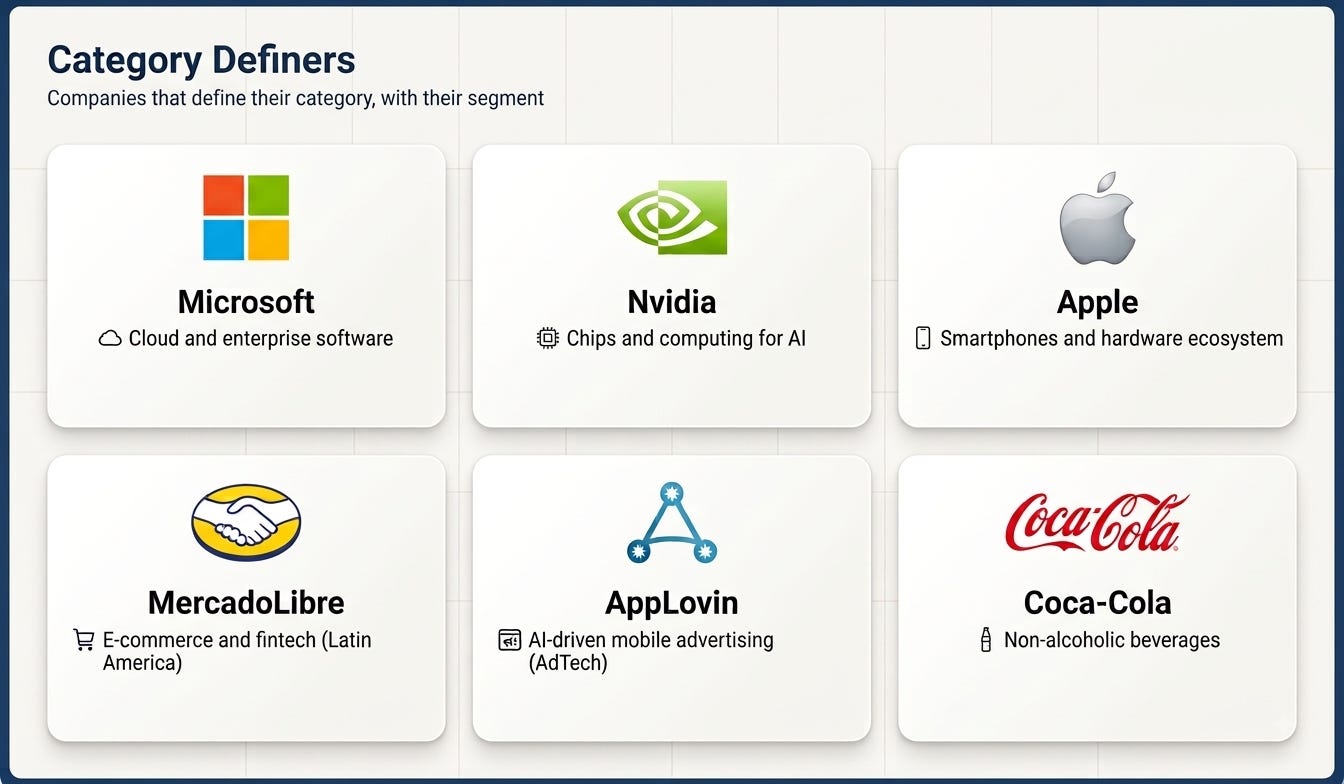
Investing in such companies offers one of the best risk-reward ratios you can find in the market. Because if a company crushes the competition, is loved by its customers, does more volume, and keeps improving relentlessly — who’s going to threaten it?
Generally, these companies are recognized by the market as very good investments and trade at a premium. The most financially interesting moments to invest in them come during a passing scare.
The tricky part is telling apart a company in decline from a giant going through a moment of doubt.
And sure enough, on August 5th 2026, AppLovin disappointed. Its Q2 revenue landed slightly below guidance, and the stock fell 19.66%. The stock has kept sliding since its all-time high of $745.61 in November 2025. Yet performance remains remarkable, with 53% annual revenue growth and net income up 78% on a trailing-twelve-month basis.
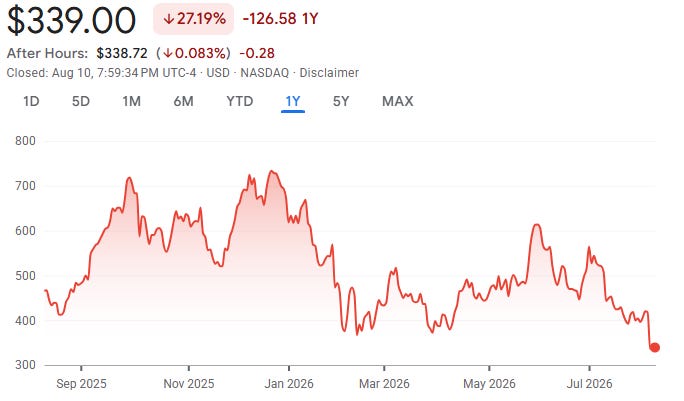
AppLovin is a great example of the virtue of patience, where waiting a year before investing would have paid off. As for me, I hesitated to enter the position back in February near its lows in case it kept falling, but the market decided to hand back part of its loss.
A few words on method and plan
I’m a former project manager with 7 years of experience (PMP certified), and I formalize my fundamental analyses like a project trajectory, from point A (starting point) to point B (destination).
Point A, in our case, is what the company does, together with its environment (competitors, suppliers) and its competitive advantage, then the financial and management side. This is a static study, and if you already know the company, you can skim through it quickly.
Point B is a forward-looking study. I don’t claim to know the future, nor what the company is worth. So instead I look for the different scenarios that could play out for the company, the way you’d run a qualitative and quantitative risk analysis on a project.
This takes the shape of weighing opposing theses — why the stock fell, the arguments for the bear thesis, and the arguments for the bull thesis. I try to make both sides as objective as possible using quantifiable criteria.
I then lay out a map of possible prices at a given target date, without a discount rate, crossing fundamental trajectories with valuation levels — stating my starting assumptions each time. Knowing which valuation multiple to apply at a given date comes down to knowing what the risks, opportunities, and therefore the narrative of the company will be. For convenience and by convention, this section is called “Valuation” even though that’s not really the right word for it.
The whole article is long because it covers a lot of ground, and short because I try to give you a synthesis of the points. So I start with a “short version” for those of you in a hurry — here it is, without further ado.
The Short Version
After falling more than 50% from its highs, notably due to a quarterly print below expectations, one can reasonably think this is an air pocket, and that growth — spectacular so far (Q3 guidance still sits at +46-48% YoY) — will trend toward 30% a year according to management. The market is punishing this result all the more because AppLovin had never posted below its own expectations since its 2021 IPO.
This looks like a classic buy-the-dip setup on a quality company momentarily tormented by the market. The results due November 11th should confirm this for us. The company could be disrupted, but that seems fairly unlikely in the near term and isn’t showing up in the numbers.
1. What AppLovin does
Business model
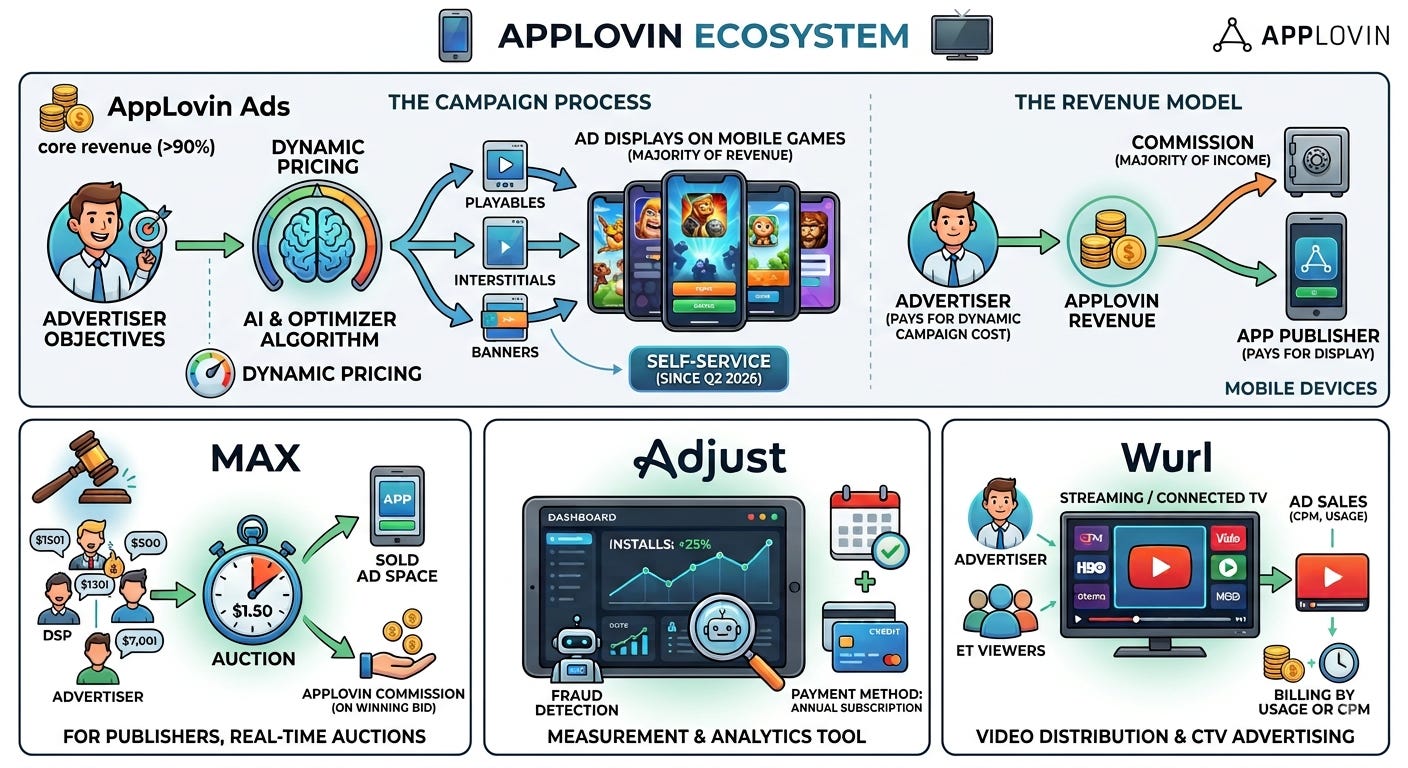
When a company wants to find customers (gamers who’ll buy inside its game, buyers on its e-commerce site), it goes to AppLovin and states its goal (“I want X users who spend at least Y”), and AppLovin’s AI places its ads wherever that’s most profitable.
This model doesn’t require an intermediary ad agency: the company itself is in the driver’s seat, and AppLovin supplies the tool and the algorithm. AppLovin gets paid by taking a commission on what the company spends.
This business model is built on four pillars:
AppLovin Ads — the core of the business. I would have liked to give you a number, but AppLovin sticks to “substantially all of our revenue” in its 10-Q and 10-K filings. The company (the advertiser) sets its campaign goal, and the AI optimizes the placement. AppLovin pays the publisher of the app where the ad was shown and keeps the rest as margin. Pricing is dynamic (as opposed to fixed, like “10 cents a click”): the algorithm adjusts in real time how much to charge based on the advertiser’s goal. Nearly all of revenue comes from mobile apps, and mostly from mobile games.
Since Q2 2026, AppLovin Ads has been available in self-service. Before that, you had to go through an ad rep.
MAX — used by app publishers to auction off their ad inventory. AppLovin takes its commission on the winning bid before passing the rest to the publisher. As with the previous product, nearly all of revenue comes from mobile apps, and mostly from mobile games.
Adjust — a measurement tool for advertisers (how many installs, fraud detection). The only product billed as an annual subscription, unlike the others which run on commission.
Wurl — distribution of video programming across streaming/connected-TV platforms, with ad sales on top. Billed on usage and/or CPM (cost per mille: the price the advertiser pays for 1,000 impressions of its ad, regardless of whether anyone clicks or buys afterward).
Suppliers
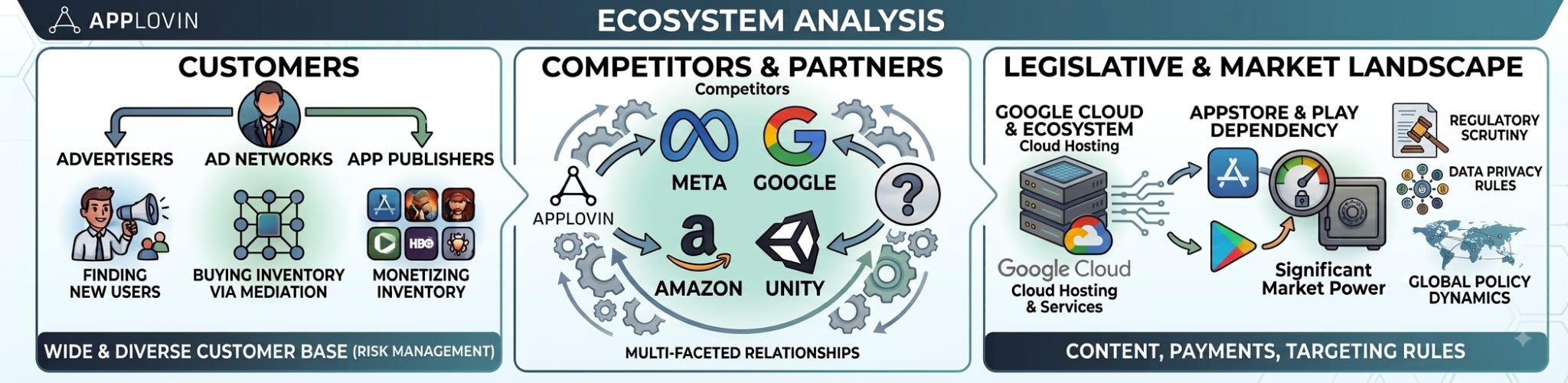
AppLovin is hosted on Google Cloud and uses its associated services. Beyond that, AppLovin is structurally dependent on the Apple App Store and Google Play for distributing its content, collecting payments, and targeting rules — and both of these players hold significant market power.
Clients
AppLovin has three customer groups, ranging from the largest companies to small independent operators:
Advertisers who use the platform to find users.
Advertising networks who use AppLovin’s mediation solution to buy inventory.
The community of mobile app publishers who use the mediation tool to monetize their ad inventory.
Having a broad customer base is an advantage from a risk standpoint. Worth noting: the advertising sector is cyclical, and all customers tend to cut spending at the same time during a downturn.
Competitors
The 10-K explicitly names Meta, Google, Amazon, and Unity Software, while making an important point: some of these “competitors” are also partners and clients of AppLovin (“several of which are also our partners and clients”) — the line between competitor and customer isn’t clean. The company also states: “We operate in a fragmented advertising ecosystem composed of divisions of large, well-established companies as well as privately-held companies.”
Here’s an illustration of the three preceding sections:
Competitive advantage
The main competitive advantage lies in the quality of the company’s products and the quality of its management.
The presence of network effects and switching costs helps reinforce the company’s lead and insulate it from competition.
On the network effect, the 10-K describes it this way:
“As more advertisers use our advertising solutions to market and monetize their content, we gain access to more data regarding users and user engagement, further strengthening our scaled distribution. As our distribution grows, we gain better insights for Axon AI, which then further enhances the efficiency and effectiveness of the Axon Ads Manager.”
This is primarily a data-scale barrier. Anyone with the same level of data would erase the competitive advantage — which isn’t currently the case.
I lack information on the company’s switching costs, and therefore on how easy it is to change advertising provider. It doesn’t strike me as especially complicated, especially since it seems possible to bring on a second provider, run comparisons based on a pilot, then progressively migrate ad campaigns over. We’re not in a Microsoft-style situation where entire teams’ workflows are so embedded that they can’t switch overnight. All the more so since the company’s contracts include clauses allowing cancellation at any time.
2. Financials
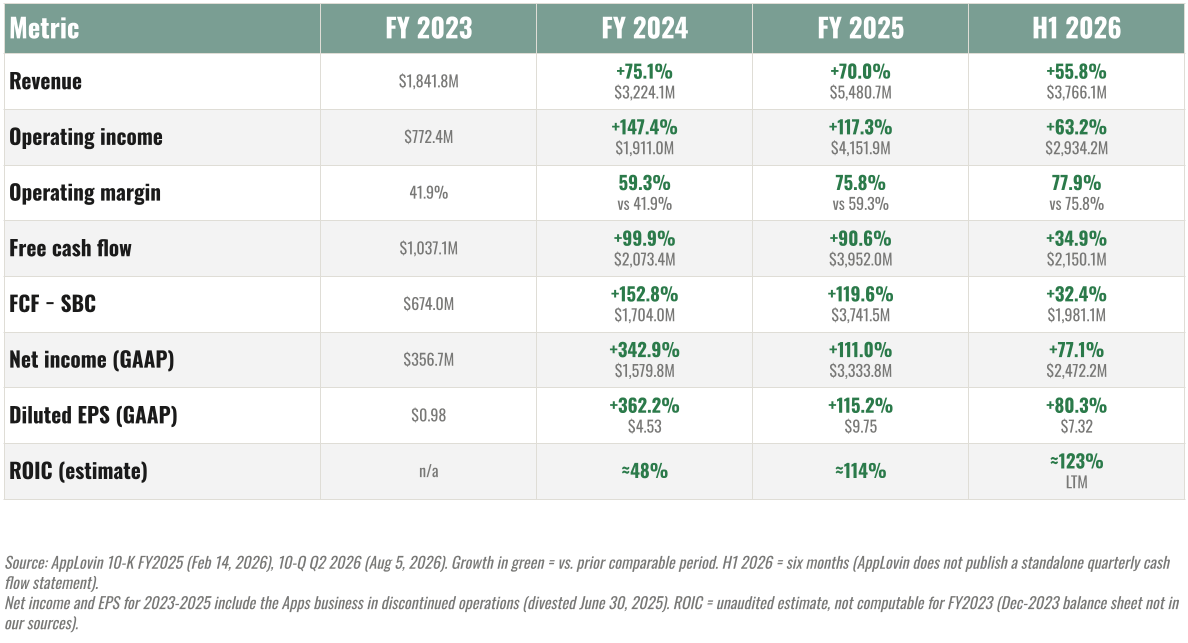
Key financial metrics
Commentary
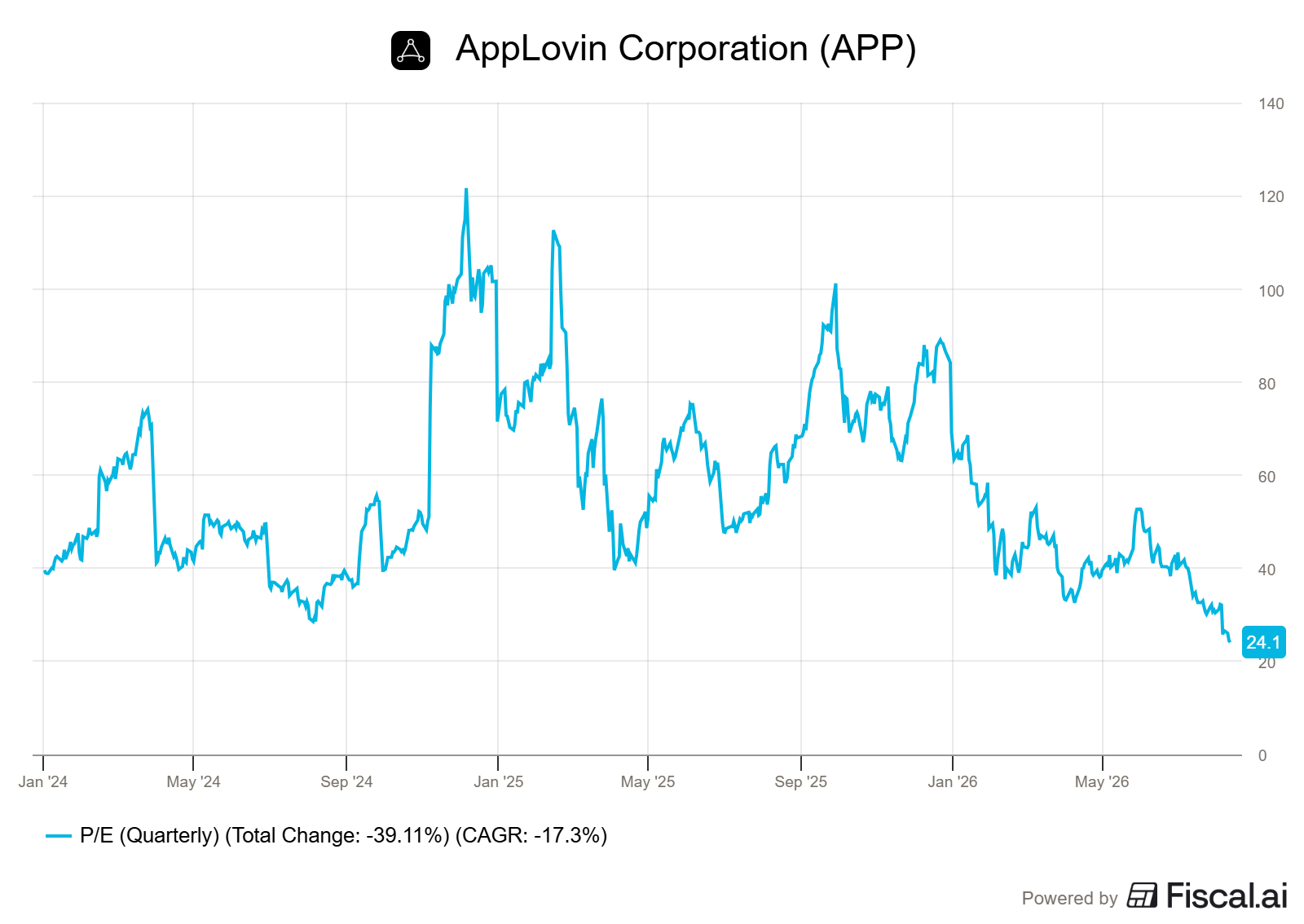
The numbers are staggering. Decelerating, sure, but staggering nonetheless — especially for a TTM PE of 26. No sign of inflation from financial shenanigans after reviewing AppLovin.
Revenue
Growth has decelerated continuously and steadily over the last five periods, going from 75% (FY ’24) to 55% (H1 ’26 YoY). AppLovin states that the composition of growth has changed in nature, and breaks its own revenue down into two factors — install volume and net revenue per install (MD&A):
FY2024: installs +50%, net revenue per install +22% → growth driven by volume.
FY2025: installs +3%, net revenue per install +72% → shift toward price/monetization.
H1 2026: installs -10%, net revenue per install +75% → volume is declining, and all growth now comes from monetization per install.
Q2 2026 alone: installs -2%, net revenue per install +58% → same read, slightly softer.
Net revenue per install is the net amount of money earned over a period divided by the total number of installs generated. The number of installs tends to mechanically shrink (you only install once), and on that shrinking base, net revenue per install climbs (which can happen repeatedly, by nature).
Worth remembering, still: continuing to grow like this at these revenue levels isn’t sustainable over time. A cumulative growth rate of 50% a year gives you roughly 57x the initial amount after 10 years. So what to make of a doubling, or 75% a year?
Operating margin
With revenue growth outpacing cost growth, AppLovin’s business is scalable and shows significant operating leverage. The rise in GAAP operating margin from 42% (FY ’23) to 78% (Q2 ’26) is spectacular. Unfortunately, since the ceiling is 100%, there isn’t much more improvement to hope for on this front going forward. Holding at these levels remains impressive in itself.
Net income and free cash flow
AppLovin’s net margin is boosted by a low tax rate — 13.1% in 2025, well below the 21% federal rate. AppLovin benefits from an FDII (Foreign-Derived Intangible Income) tax break, a US tax provision created in 2017 (the Tax Cuts and Jobs Act).
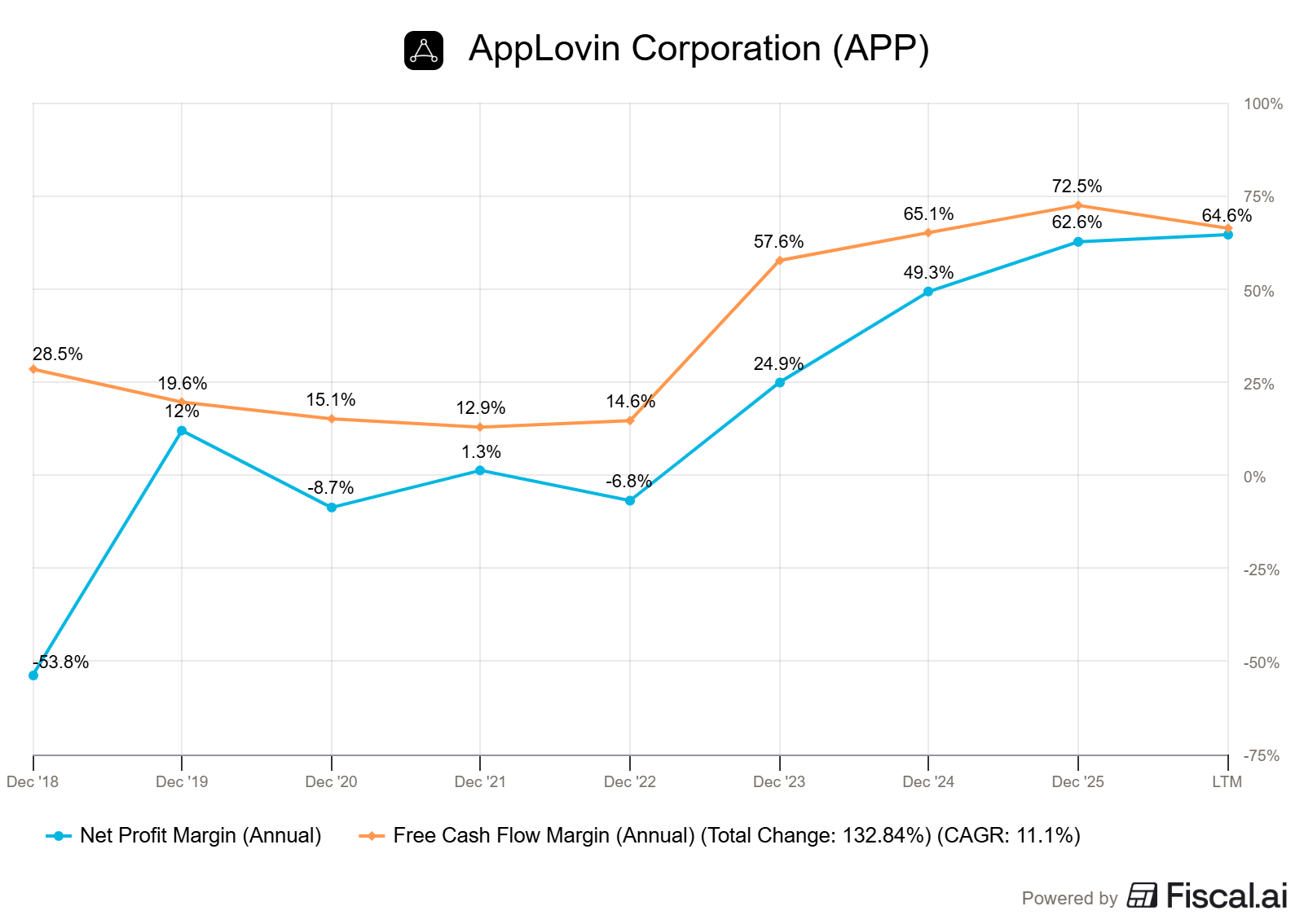
I like comparing net income and free cash flow to spot variations that might reveal hidden issues. Here, they converge toward the same figure, around 65%, which is excellent. For net income, growth outpaces revenue growth in every period, driven by a scissor effect (opex shrinking as a percentage while revenue doubles).
For FCF, I usually strip out SBC, which is a non-cash charge. Growth in this metric looks larger since it starts from a smaller base.
Balance sheet
The company is financially very solid, with a debt-minus-cash to equity ratio of 0.15x. AppLovin is holding onto its long-term debt; the ratio is shrinking through the accumulation of cash and equity, which are growing faster than everything else.
3. Management
Adam Foroughi — CEO (co-founder, since 2011)
Foroughi holds only 9% of the economic capital but 61.6% of the voting power (Class B shares carry 20 votes each), 66.9% including the voting agreement tying him to Herald Chen. This makes AppLovin legally a “controlled company,” although it doesn’t make use of the governance exemptions that status allows.

According to Forbes and Bloomberg estimates, this would represent 66% to 85% of his net worth. In terms of incentives, his salary has been capped at $400k since the IPO, with no increase since.
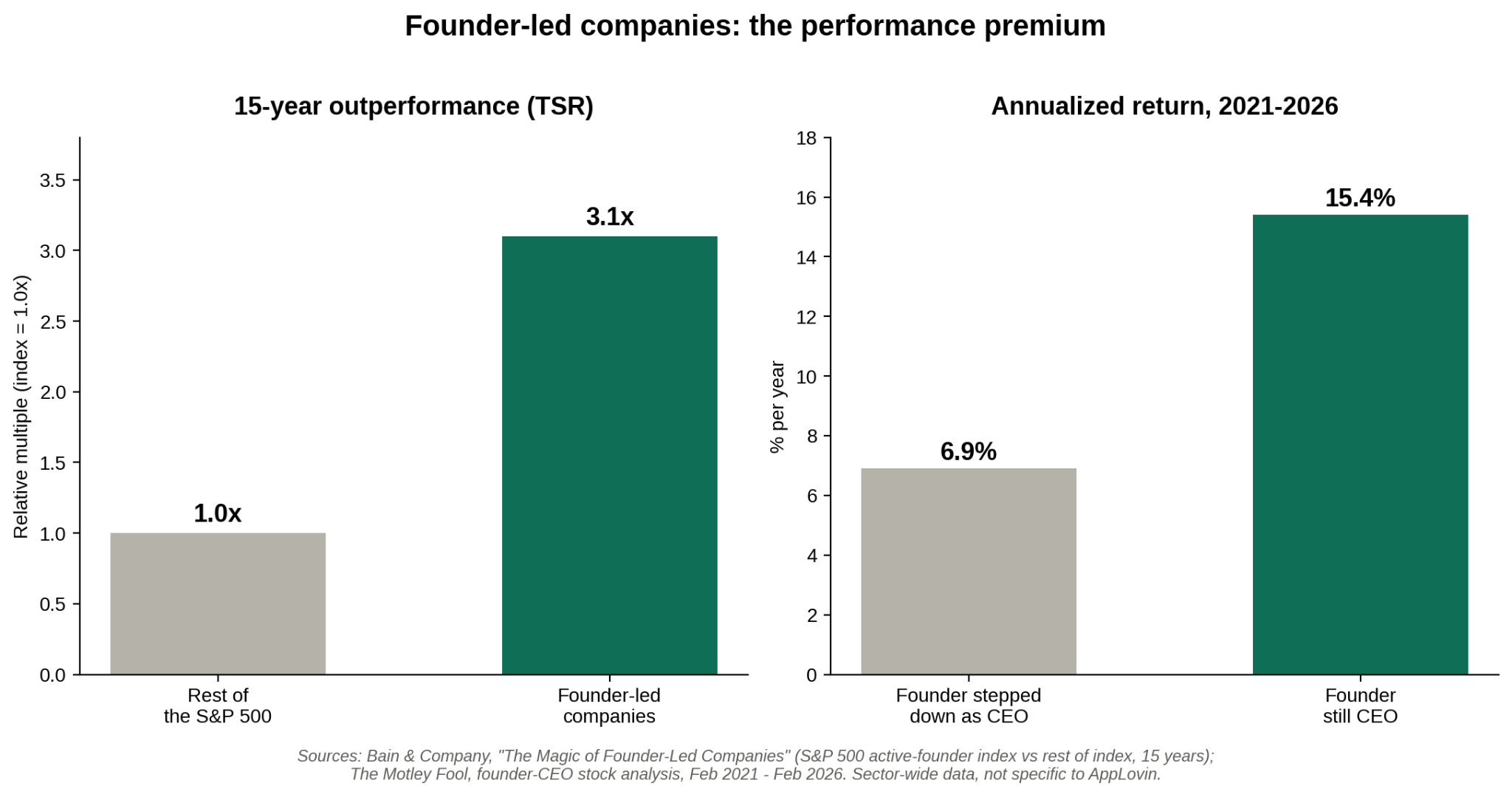
The fact that the CEO is also the founder is a very good sign, one that typically generates outperformance.
More broadly across the leadership team, the variable portion of compensation plans is paid in equity, not cash — a notable point of alignment.
Capital allocation
No dividend is currently paid. There are share buybacks, but they primarily serve to offset dilution from SBC. Beyond that, the amount repurchased remains marginal — 0.5% over 2025, and 0.9% over H1 2026. The declining share price will mechanically push this share higher.
4. The two theses
I believe the best way to decide whether an investment is sound is to pit the bullish and bearish theses against each other. That way, I know what could happen, and knowing your position well helps you endure downturns and protects you psychologically. Considering only the bear thesis is alarmism; considering only the bull thesis is wishful thinking. This section includes both the arguments and the catalysts for each version of the story.
Why did the stock fall?
Starting in February 2025, a series of short-seller reports — Fuzzy Panda Research, Culper Research, then Muddy Waters Research in March 2025 — accused AppLovin’s AXON ad system of circumventing Apple’s App Tracking Transparency framework. These allegations fed an SEC investigation that weighed on the stock in early 2026, down to a low reached around February 12th 2026 — nearly 50% below the late-2025 peak.
Next, doubts about the durability of growth. As the market re-rated software names exposed to AI disruption risk, analysts considered the ~30% long-term growth assumption against a stock still priced for more and chose to lower their price targets.
Finally, and most recently: the August 5th 2026 earnings release. Q2 2026 revenue slightly missed consensus, and AppLovin issued guidance slightly below expectations. The stock then fell 19.66% intraday, wiping out roughly $40 billion in market cap — even as the SEC closed its AXON investigation that same day with no action taken. Several downgrades and price-target cuts followed (Wells Fargo, Piper Sandler, Goldman Sachs, BofA Securities).
Bear thesis
Growth is slowing
Revenue growth has declined over the last four periods (75% → 70% → 56% → 53% YoY), and Q2 2026 marks the first guidance miss since the 2021 IPO. The market can read the combination of the two as the signal of the beginning of the end of growth.
As Peter Lynch put it, “small company, big moves, big company, small moves.” Growth is bound to mechanically shrink over time.
As growth declines, it will inevitably revert to its natural, and more cyclical pace: the model depends on the ad budgets of mobile/gaming advertisers — a sector historically more discretionary, as AppLovin doesn’t require multiannual contracts.
In gaming, a significant share of revenue, the segment is mature: growth there already comes more from existing users. Nothing rules out this slowdown continuing into Q3.
Disruption risk
Analysts explicitly cite a risk that AI tools could erode AppLovin Ads’ competitive edge, wondering if 30%+ long-term growth can hold.
Indeed, the R&D headcount remains modest given the stakes. 380 R&D employees, or 42% of the workforce, are tiny compared to the AI resources of Meta, Google, or OpenAI. The current model is mainly based on a data flywheel. If a competitor with stronger AI R&D managed to replicate AppLovin Ads with less data (via more efficient techniques), the moat could give way faster than a simple data-volume catch-up would suggest. But I don’t think it will happen in the next quarter, and the competitors have shown before a propensity to fail outside of their core products.
This point matters even more given that AppLovin’s revenue depends on essentially a single line, AppLovin Ads. Disruption is all the more likely for a single-product company.
Capital allocation
$2.19 billion was repurchased in FY2025, a year that includes the all-time high (late 2025), without a quarterly breakdown of the average price paid to confirm whether the capital was deployed in a disciplined way. This should be put in perspective, though, since the question mainly matters near highs and doesn’t really apply here.
Ongoing lawsuit
Two US law firms (Schall Law Firm and Bragar Eagel & Squire) have announced they are investigating/soliciting shareholders for a possible class action against AppLovin, over allegedly false statements or omissions of information material to investors, regarding purchases between May 10, 2023 and March 26, 2025. This is a private civil action, separate from the SEC investigation, which has just been closed.
What if the bear case were true?
In that case, management would lower its guidance and report below its own internal forecasts and analyst expectations. The indicators to watch then are revenue and net margin. Moreover, products from competitors could emerge, and claim similar results.
Bull thesis
1. A strong growth with normal deceleration
The market seems to be forgetting that the company still posted 53% revenue growth. I personally estimate this is a simple air pocket. Though I say this, it is without certainty and the decline could continue over the coming quarters.
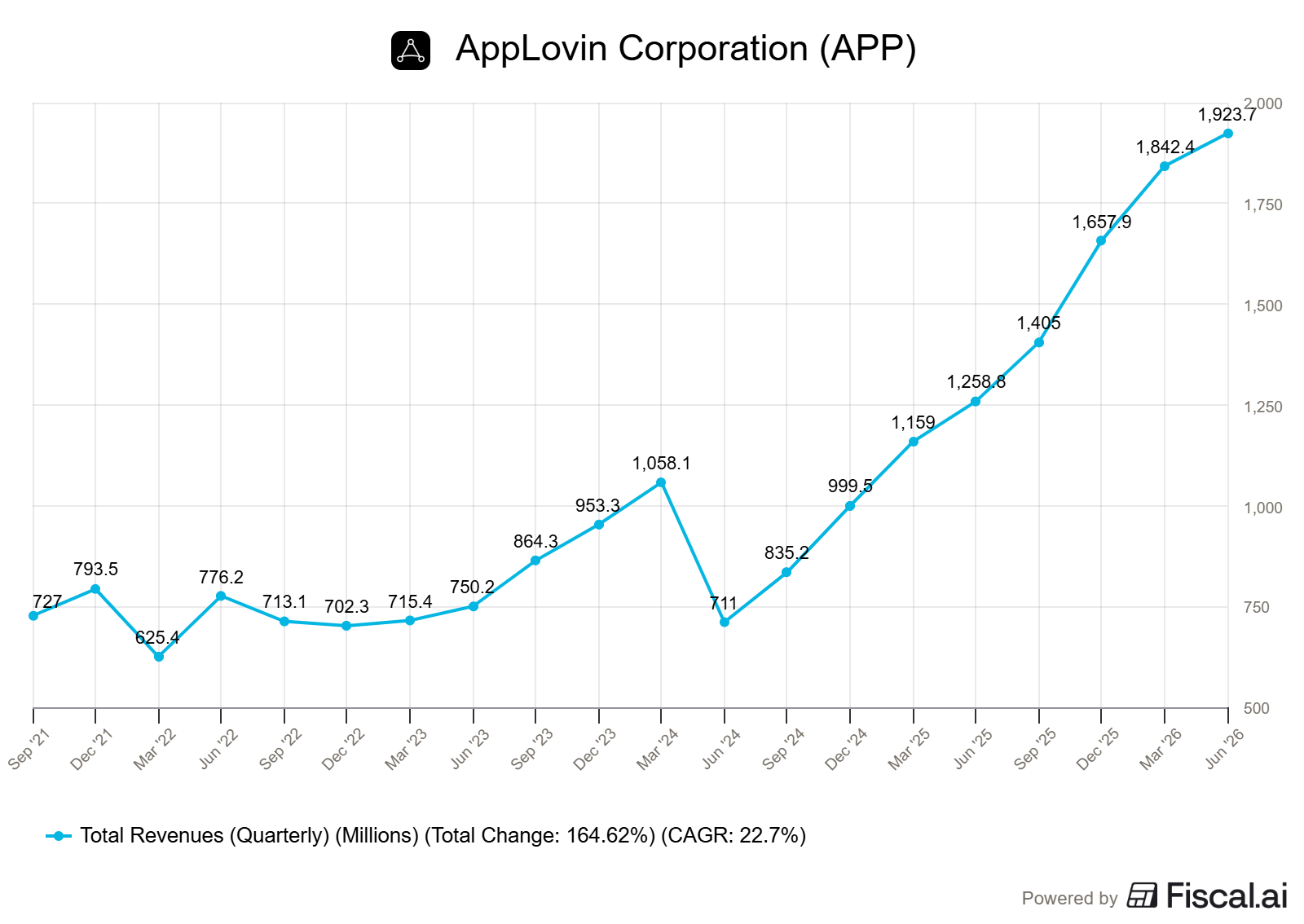
My confidence comes from the company’s track record and from its previous margin expansion, which remains impressive.
To hit these targets, the company has a growth relay in consumer/e-commerce : a self-service platform opened to the public in 2025. Revenue is seasonal, and Q2 is usually the slow quarter. Even so, advertiser spend rose 28% versus the Q4 2025 seasonal peak. The web/e-commerce vertical now runs at a record ~$1 billion annual run-rate, and management estimates this market at 5-10x the size of mobile gaming.
2. Management commentary
The miss came from an execution problem. The CEO states that the shortfall came from the timing of AI model improvements on the gaming side — “we know what happened, and it’s already been addressed.” Advertiser appetite remained healthy during the quarter.
Management maintained its long-term outlook on the August 5th call of ~30% combined annual growth for gaming + consumer.
3. A highly profitable business
The company generated $863.3 million in FCF in Q2 2026 alone, and 32% FCF growth after deducting SBC — still well above nearly the entire software/AdTech sector, with a balance sheet carrying almost no net debt. Incremental costs are minimal, since this is a scalable business.
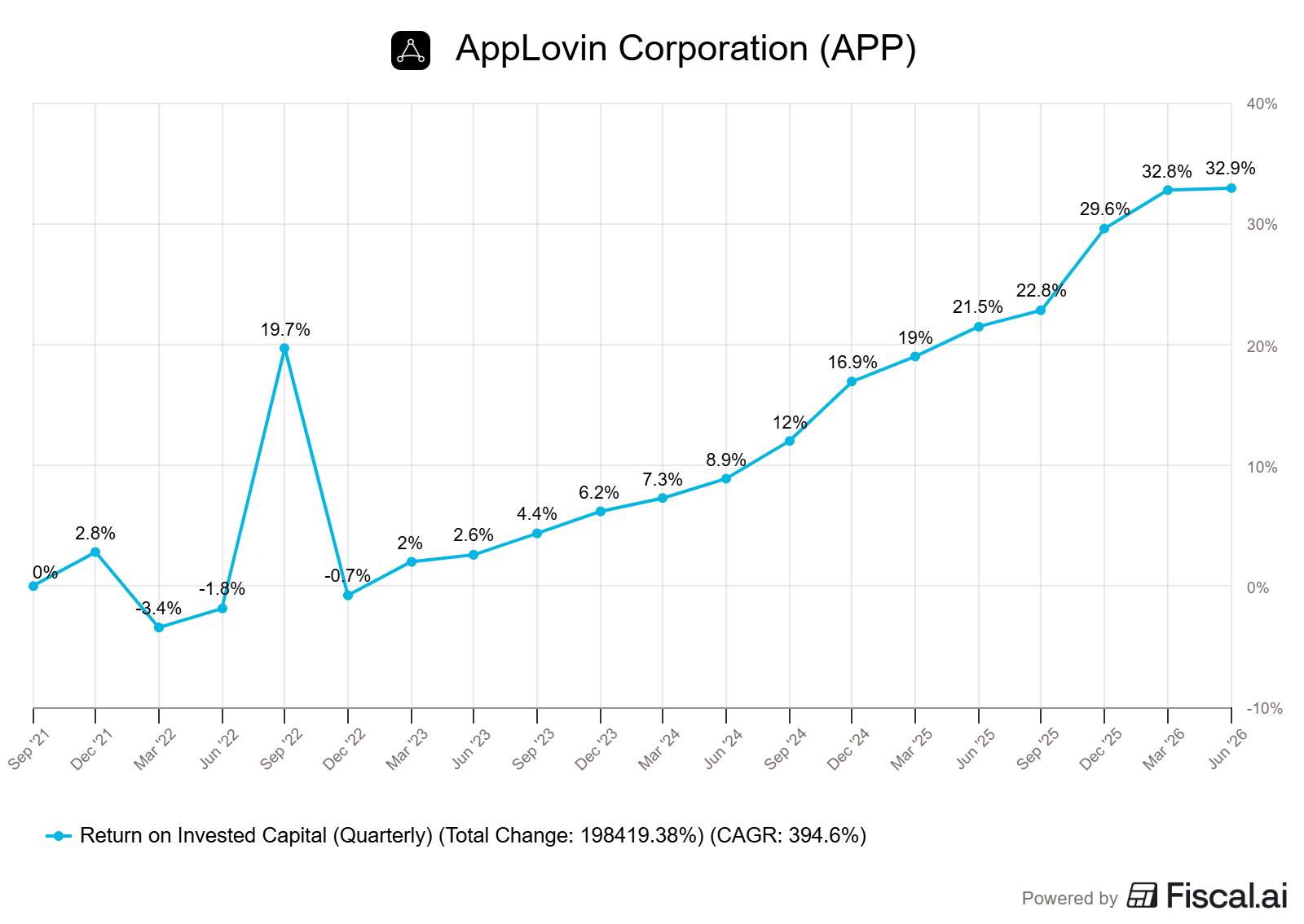
One of my favorite indicators, the ROIC, indicates a steady growth in profitability, which remains impressive for a company of that size. Every invested dollar is producing almost a third in cash. A declining company would show a fall in this metric.
4. Only one shortfall so far
Even though the company had a miss, it’s a single occurrence since the IPO. They’re only human, after all. By nature, this kind of stumble remains a weak signal, especially when it’s being closely watched by management itself heading into next quarter.
What would invalidate the bull case
Would a new quarter below guidance do it? No — because it’s always possible that a simple air pocket produces a continued decline in install volumes without offsetting price gains.
The real signal would be a confirmed slowdown in consumer/e-commerce growth, since that’s the growth relay put forward to justify the thesis beyond mature gaming.
5. Valuation
The numbers only make sense if you’ve read the two theses section. A valuation without a thesis is just a spreadsheet.
The valuation requires an important assumption, being the continuity of a normal economic environment, i.e. without recession, major credit event, market crash. Any of these could push the stock below the bear case shown here, temporarily, independent of the company’s underlying performance. All figures in the scorecard are pre-tax and pre-fees. Run the numbers for your own situation before drawing conclusions.
The assumptions are the following:
For all the cases, the margin stays flat.
For the revenue, it goes from 10% per year in the base case, to 30% per year in the central case, and 40% per year in the bull case.
The valuation scorecard map
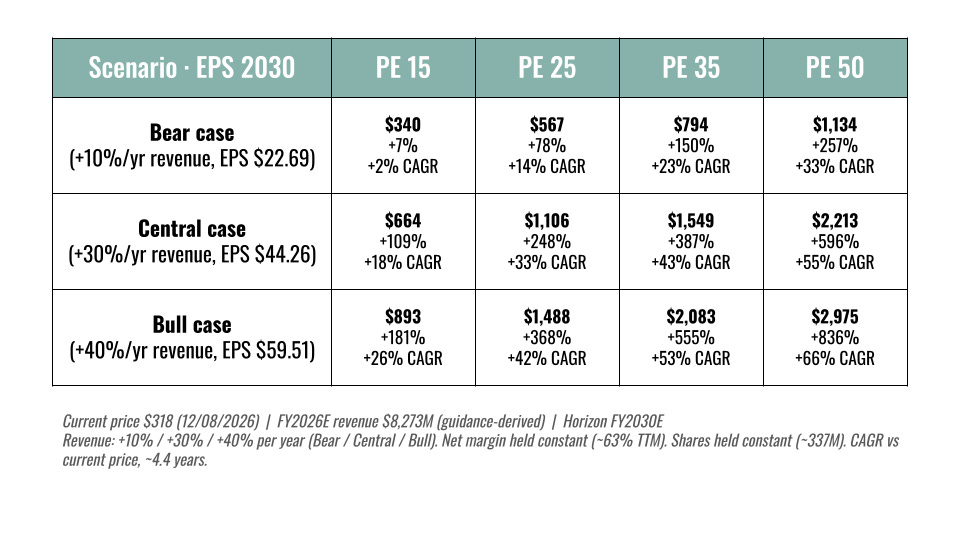
My conviction sits on the $1,549 scenario or higher.
I’d imagine that if the gap closes next year, AppLovin could once again trade at a PE of 50, under the effect of irrational exuberance — but not by 2030, if the company holds at 30% annual revenue growth.
The re-rating will mainly depend on the catalysts covered in the next section.
6. Momentum
Overall, crossing fundamentals (covered above) with momentum is an excellent way to improve your returns. You’re never right on your own, especially since a significant share of valuation comes from the multiple.
Catalysts
Q3 results (the major point):
If AppLovin reports below expectations: this would break confidence in the guidance more durably than an isolated accident. E-commerce would slow if management’s “it takes time” turns into disappointment rather than acceleration.
It’s possible the air pocket continues into next quarter, or even across a run of quarters with a focus on long-term indicators — producing a scenario similar to MercadoLibre (falling share price alongside renewed long-term prospects).
If AppLovin reports in line with expectations: the market will likely want a quarter or two of confirmation, and will gently begin a re-rating.
If AppLovin reports above expectations: the market will forget its fear, and the stock could gain 20% in a single session and keep re-pricing higher over the following weeks.
Analyst revisions will follow the Q3 results and amplify the move up or down in the share price. The sell-side consensus remains heavily bullish despite the miss: 29 buy / 0 sell / 3 hold across 30 analysts (S&P Global), with an average price target of $575 — roughly 66% above the current price ($347). The market has punished the stock more harshly than the analysts who follow the story closely. That’s generally a good signal for a buy-the-dip.
On the shareholder lawsuit: its dismissal could trigger a modest bounce in the share price, while its continuation would weigh on it.
A re-rating could also come if a superinvestor (Pat Dorsey or Steve Mandel) builds a stake, or if buybacks continue. The company could also decide to increase its allocated buyback amount as a signal of confidence.
When to enter the stock?
The market hates uncertainty and has already started a significant decline in the share price. So you need to track the price to see where it bottoms. I see three possible strategies:
Buy the dip:
I would wait for analysts to stop cutting their outlooks. The likely target zone is a PE of 20-25.
It’s hard to give a PE ratio as a support level, since the company has broken through its last support on the way down.
This works if AppLovin surprises to the upside next quarter, and fails if AppLovin disappoints or worries the market for a second quarter.
Capitulation:
It’s possible we head toward a very bearish scenario if the company reports below expectations. In that case, you have to wait for capitulation, which shows up through several signals, such as above-average volume, or RSI <20.
So far, AppLovin hasn’t shown signs of capitulation.
DCA: the way to reduce risk (the non-choice) is to run a DCA every month, if that’s your approach. As for me, I prefer to enter in one or two tranches.
As for me, I plan to open a position once the price stabilizes, and I’ll let my subscribers know when I do. I’m prepared to add to the position on further weakness or capitulation. There’s no rush — the thesis playing out will probably take 2-3 years. In Fortinet’s case, which shows some similarities, it took a year between the August ’25 decline and the re-rating over April-July ’26.
Final Thoughts
I think that starting at a PE of 22, AppLovin becomes a great buy, and starting at a PE of 16, a screaming buy. Who knows where the share price will end up falling? It depends heavily on investor sentiment. I plan to enter soon, because I’m convinced the company has only hit an air pocket. It’s possible, but in my view unlikely, that next quarter comes in below expectations. It should legitimately either be in line or beat expectations. As mentioned earlier, buying the dip can be either the best or the worst investment decision there is. I published this deep dive ahead of my investment decision, unlike with Booking and Microsoft, to give you time — and to give myself time — to properly weigh every element before making a call.
Disclaimer
All content published by JB Peter on this platform is strictly for educational and informational purposes. It does not constitute investment, financial, legal, or tax advice, nor does it represent a personal recommendation or solicitation to buy or sell securities. This research is operated by ORIACON (SASU) and reflects independent corporate analysis. Every reader must conduct their own independent research (Due Diligence) or consult a licensed professional before making any financial decision, as financial markets involve a high risk of capital loss. At the time of writing, ORIACON or the author DO NOT HOLD shares in the company analyzed in this article. Following this publication, ORIACON and the author reserve the right to buy, sell, or modify positions in any security mentioned at any time, without prior notice to readers or subscribers.
Is Applovin like The Trade Desk - but for games?