
1. Quarterly Verdict
1.1 Synthesis
Atos is coming back from a near-bankruptcy: at the end of 2024, a commercial court ordered the restructuring of its balance sheet. Today, the firm is progressing toward its 2028 objectives:
€9-10 billion in revenue
10% operating margin
An investment-grade credit rating profile
The first chapter is the cost-reduction phase of the Genesis plan, delivered ahead of schedule. The initial target was achieved within a year and has since been raised to €800M.
The second chapter is the improvement in operating margin: €190M in H1, up 43% year-on-year, from 3.7% in H1 2025 to 5.7% in H1 2026.
Management indicates that the actions behind these two chapters are complete and will continue to deliver results over the coming quarters.
The next chapter is commercial expansion, where management’s focus is now shifting.
The balance sheet is expected to improve significantly by year-end, supported by continued progress on debt refinancing.
None of the bear thesis’s warning signs have been triggered, and the bull thesis is gradually playing out.
Verdict: The company is progressing through its turnaround. The market still applies a discount, and management is advancing relentlessly toward resolving it. The price does not yet reflect the positive developments of the first half.
1.2 My Reaction
Management has been heavily focused on cost-cutting measures and will continue acting to protect the margin of the business. I’m still very bullish on Atos, and I think the market is still pricing it as though the company will remain a broken IT services business.
They have succeeded on the cost-cutting front, are well on their way to improving operating margin, and are removing black contracts wherever they can — the ones that generate extra revenue but kill the margin.
They are now focusing on revenue: the commercial pipeline is growing significantly, and the 91% book-to-bill ratio, while it looks disappointing, doesn’t include framework agreements. Some of their clients were forced to end their contracts because of Atos’s previous sub-investment-grade status, and are keen to come back as soon as they can.
I’m a bit puzzled by the -7% move on results day. Turning around a company like Atos isn’t easy, and the bull thesis is playing out in the right direction — just not as fast as the market seems to expect.
I’m still confident the stock will move upward over the coming quarters. One day, management could raise guidance, and the stock will re-rate. And I’ll be there. I don’t mind waiting two years for a 5-20x return, because I’m convinced Atos will turn around.
2. This Quarter’s Numbers
2.1 At a Glance
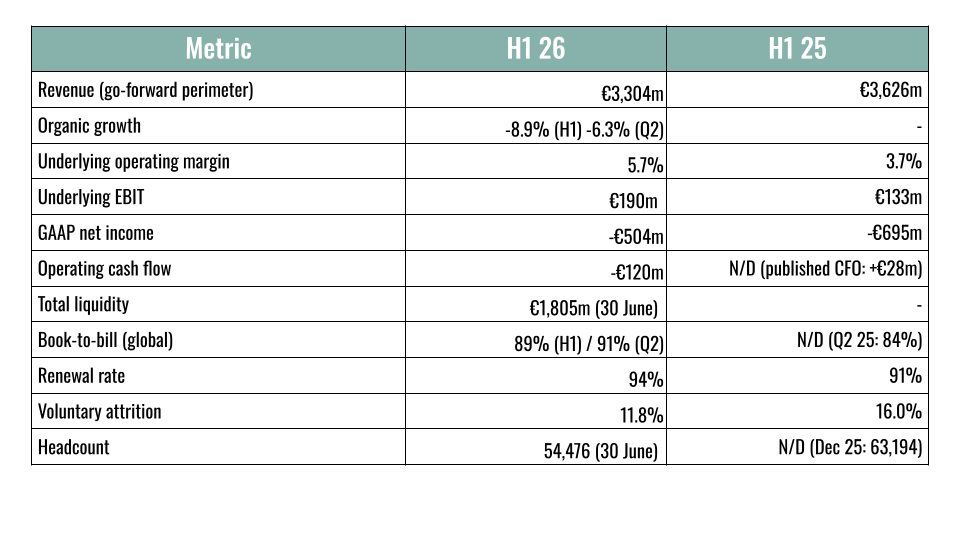
This table summarizes the key metrics from Atos’s Q2 FY2026 earnings release: https://www.atosgroup.com/en/investors/financial-results-reports/h1-2026-results
2.2 Commentary
Numbers are those of ’26 vs. ’25.
Revenue (go-forward perimeter): €3,304m vs €3,626m and operating margin: 5.7% vs 3.7%
Management is “cost-killing” and removing black contracts with two effects: the revenue goes south and the margin goes north. Revenue will improve in the next quarter, as will the operating margin. The revenue decline is decelerating every quarter since ’25.
Organic growth: -8.9% vs n/a
H1 total organic growth rate, calculated by Atos at constant scope and FX. Not applicable to H1 2025 since it’s the comparison base.
Underlying EBIT: €190m vs €133m
+43% (+€57m) year-on-year. Every improvement in revenue will drastically increase EBIT.
GAAP net income: -€504m vs -€695m
Loss narrowing by €191m year-on-year, but still heavily weighed down by one-off refinancing costs (call premium, accelerated IFRS9 depreciation) and restructuring charges — not a clean read on underlying profitability yet. Management targets a “clean” P&L by year-end 2026.
Operating cash flow: -€120m vs +€28m (published, not comparable basis)
The -€120m figure includes €127m of restructuring cash-out — strip that out and underlying cash generation is close to flat to slightly positive. The H1 2025 published figure isn’t calculated at the same current perimeter, so it’s not a clean comparison; treat both cautiously.
Total liquidity: €1,805m vs N/D (30 June 2025)
Comfortably above the €650m covenant floor. Next payments are in 2030, giving management the time it needs to turn the company around.
Book-to-bill (global): 89% H1 / 91% Q2 vs N/D (Q2 2025: 84%)
Below 100% at face value, but methodologically conservative — framework agreements (the €187m European public sector deal, the Dutch police contract) aren’t counted. The +7pt year-on-year improvement, and >100% book-to-bill in France, UK and Eviden specifically, tell a stronger story than the headline number.
Renewal rate: 94% vs 91%
Confirms the “back to normal” narrative management pushed on the call — this is roughly where renewal rates sat before the 2024 restructuring shock hit client confidence.
3. Earnings Call Key Takeaways
Genesis ahead of schedule: Phase 1 (€650M) completed in one year, by Q1 2026. Phase 2 launched, horizon 2027-2028, total target raised to >€800M. Total restructuring cost envelope confirmed at ~€700M (~€200M spent in 2026).
Margin/revenue mechanism openly acknowledged by management:
Philippe Salle, CEO:
“Whatever happen on the top line, we will deliver the bottom line”
“I have just adjusted Genesis to protect the margin”
A nice way to say that he will reduce workforce whether or not it’s needed.
Official book-to-bill is conservative: 91% (+7 pts YoY), but framework agreements (the €187M European public sector contract, Dutch police, European Patent Office) aren’t counted. France, UK and Eviden all above 100% in Q2.
Qualified pipeline: +€900M in Q1, +€760M in Q2 = roughly +€1.7bn cumulative over H1.
No net client losses in H1 2026 — a contrast with 2024-early 2025.
Management posture shift: “refocus the mind of the management to the top line” — an explicit pivot from survival to growth.
Management is now explicitly focusing on revenue expansion. It is the last chapter of the turnaround story. I’m bullish that management will make it happen.
No price deflation on renewals: margin on signed contracts close to 25%, presented as evidence against broad-based pricing pressure.
Black accounts: down from several problematic contracts to just two today; one of the two loses ~€10M/year, with a maximum remaining duration of 2 years.
Debt structure: no maturity before the 1.5L tranche (2029-2030) following the May refinancing. Debt buybacks already underway: €109M on the open market + €38M linked to the South America disposal.
4. Where the Investment Thesis Stands
The objective of this section is to confront the quarter / half against the deep dive bear and bull thesis.
4.1 Warning Signs of the Bear Thesis — None Triggered
The three signals that would have invalidated the thesis (original deep dive, “Points of failure” section):
FCF vs. reported EBIT divergence: Not triggered — the gap is almost entirely explained by the restructuring cash-out
Book-to-bill sustained below 90%: Not triggered — 91% official, likely understated (frameworks excluded)
Flat or rising Genesis charges: Not triggered — declining trajectory confirmed for H2 (€127M in H1 → guidance of ~€70M max in H2)
4.2 Bull Case Prerequisites — Status
As laid out in the original deep dive, the bull case rests on fourteen independent arguments. Most haven’t moved this quarter. Below are only the ones that have evolved since the deep dive:
Argument 2 (contract rationalization → hidden operating leverage) — confirmed: EBIT +43% on declining revenue across two consecutive half-years.
Argument 3 (judicial shield + 2031 refinancing) — confirmed. No debt maturity before 2029-2030 following the completed refinancing steps. The existential risk this argument addressed is now closed.
Argument 4 (counterparty-risk unlocking) — in progress, strengthening. Zero net client losses in H1 2026, a clear contrast with 2024-early 2025. North America book-to-bill at 115%. Management’s own posture shift — explicitly refocusing on the top line.
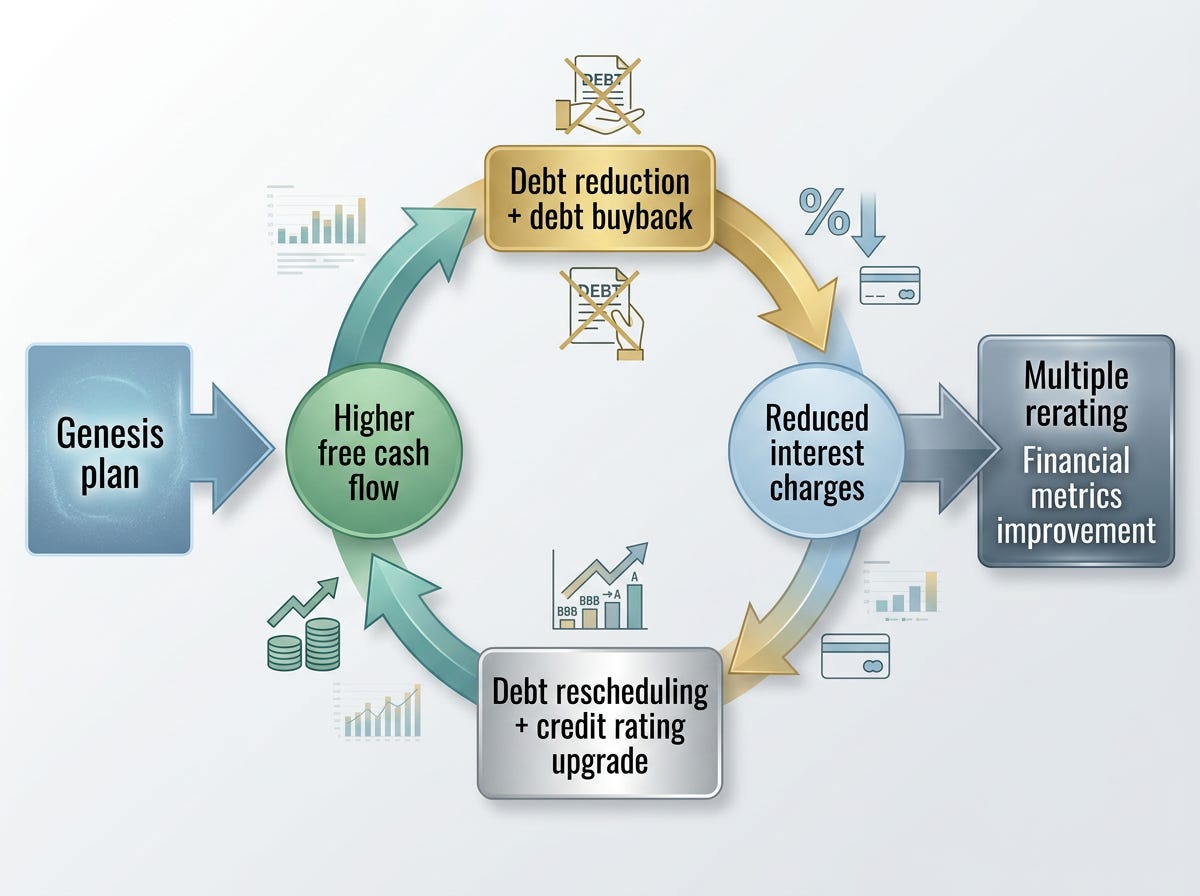
Argument 5 (deleveraging flywheel) — in progress, strengthening. Debt buybacks already executed (€109M open market + €38M from the South America disposal), and oversubscription of the refinancing from the bond market in May. I see it as the main point playing out.
Arguments 7-8 (AI doesn’t destroy the IT services model / regulated sectors need Atos) — qualitatively reinforced. New contracts with sovereignty-sensitive institutional clients (European public sector agency, Dutch police, European Patent Office) support the thesis, though this remains anecdotal.
5. Valuation
The following images provide the different scenarii embedded in the deep dive
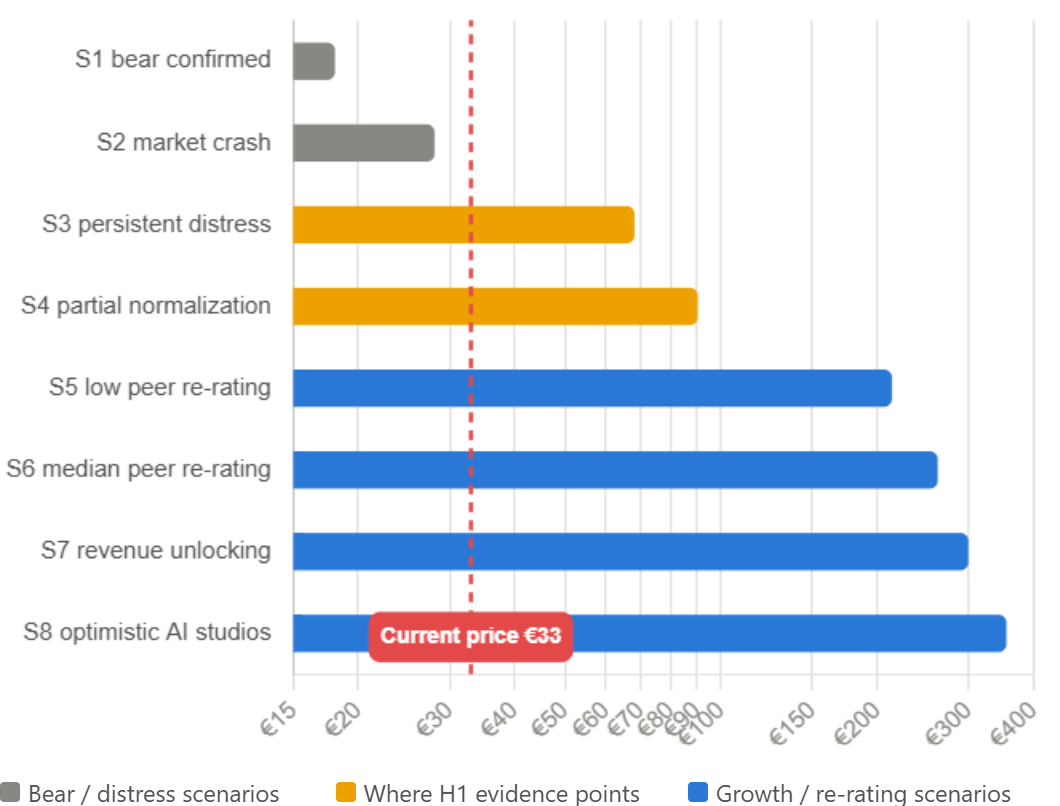
The deep dive laid out a nine-scenario scorecard, I don’t provide a unique valuation, merely scenarii . The market is still pricing Atos close to S2, the market-crash scenario, at a current price of ~€33 against an S2 target of €28. That’s roughly where the implied EV/EBIT of ~5.6-6x has sat since the deep dive was written — essentially no re-rating despite the quarter’s execution.
Out of this quarter, the price should reasonably start moving to reflect:
margin convergence over two consecutive half-years
the book-to-bill once framework agreements are counted
black-account stabilization (down to two, from several)
the absence of net client losses in H1 2026
the improving commercial pipeline (+€1.7bn qualified pipeline over H1)
any AI/sovereign optionality (MogwAI, Sovereign Cloud, AI Studios)
The rerating will certainly take place once management increases the guidance and when the market realizes that IT services won’t be disrupted by AI any time soon. It is a core assumption of the thesis that should be emphasized.
Important Disclosure & Disclaimer
All content published by JB Peter on this platform is strictly for educational and informational purposes. It does not constitute investment, financial, legal, or tax advice, nor does it represent a personal recommendation or solicitation to buy or sell securities. This research is operated by ORIACON (SASU) and reflects independent corporate analysis. Every reader must conduct their own independent research (Due Diligence) or consult a licensed professional before making any financial decision, as financial markets involve a high risk of capital loss. At the time of writing, ORIACON or the author HOLD shares in the company analyzed in this article. Following this publication, ORIACON and the author reserve the right to buy, sell, or modify positions in any security mentioned at any time, without prior notice to readers or subscribers.