
1. Quarter verdict
Despite fears of AI disruption, tourists are still booking with Booking. Room nights grew 5% YoY, the operating margin improved from 33.1 to 34%. Free cash flow minus SBC is up 17%. A pretty solid quarter, beating expectations across the board.
Verdict: I would love to add content on it, but nothing to see here, folks. Everything is fine.
My reaction
Booking is up today because such a juggernaut with a PE less than 25 times makes no sense. The numbers in the valuation section are lower to Novo Nordisk, but Booking has more love from the market, and the fears are easier to dissipate.
I think I will make a 100% return in the coming quarters and sell it for another GARP in a downturn.
As a client, I like Booking, and I really like it as a shareholder with its impressive net margin and no clear competition. Airbnb’s prices increased, so I perceive less value from it.
Booking is a clear example of “Invest in what you know” and an easy business to understand. Investing feels sometimes like an intellectual race, but the reward lies mostly in the simplest businesses.
2. The Numbers
2.1 At a glance
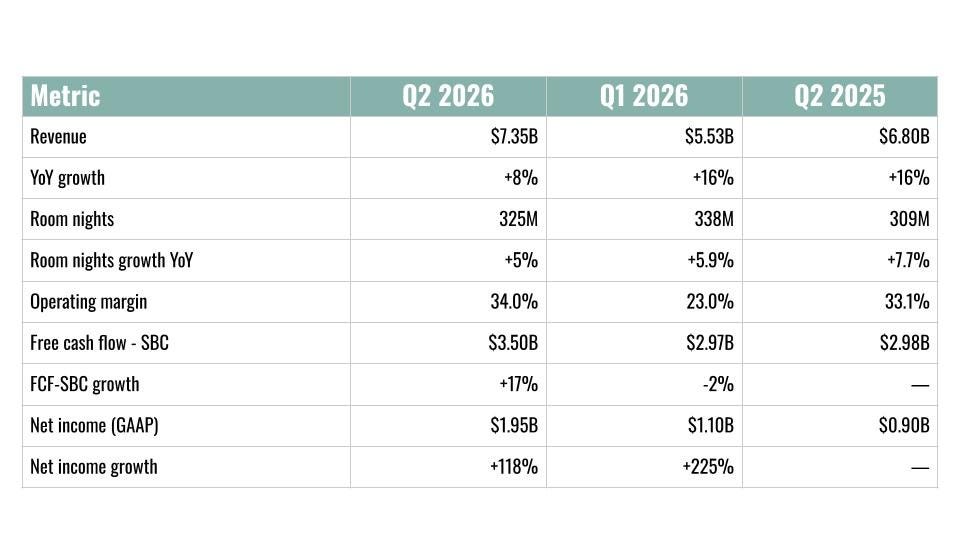
This table summarizes the key metrics from Booking’s Q2 FY2026 earnings release: https://ir.bookingholdings.com/overview/default.aspx
2.2 Commentary
Revenue :
Total revenue grew 8% YoY to $7.35B (7% FX neutral):
Merchant revenues (Booking directly bills the final client, and afterwards pays the merchant) grew 15%.
Agency revenues (Booking takes a commission on the reservation) fell 7%.
Ads : +8%
The opposite direction between merchant and agency is following the Booking business model transition. So it is going as expected, and room nights are in line with the global increase.
Margins:
Net income margin grew to 26.5% from 13.2%. The number is overrated, since a non-cash FX gain on euro-denominated debt of $195M (vs a loss of $962M a year ago) occurred this quarter. The best metric to follow is the GAAP operating margin at 34.0% (vs. 33.1%, +0.9pt) driven by fixed-cost leverage (total operating expenses +7% vs revenue’s +8%) and cost reduction.
The Transformation Program expects an annual run-rate savings raised from $550M to ~$650M, targeted by end of 2027 — confirms the deep dive’s “more capacity to invest” thesis.
Net income and free cash-flow
As mentioned above, the FX gain on the debt is distorting the net income: 118% YoY. I prefer to track the free cash-flow (with subtraction of SBC), which grew 17% YoY.
The company bought back $3.7B in shares (vs. $3.6B in Q1 2026) and paid a $0.42/share dividend.
3. Key Takeaways from the Earnings Call
AI dominated the Q&A — 5 of 9 analyst questions were AI-related. Still a concern for most.
AI disintermediation: management put a number on it. Asked directly about AI’s impact on the top line, CFO Ewout Steenbergen volunteered the most concrete data point of the call: traffic arriving from large language models — paid and unpaid combined — is “still significantly below 1% of our room nights,” and “that hasn’t moved so much recently... no material change over the last few months or quarters.”
This is the first time management has quantified the AI-referral contribution, and it lands squarely in favor of the deep dive’s bull case: the disintermediation threat remains a future risk only.
A new crack worth watching: SEO pressure, mentioned for the first time. Management acknowledged declining organic search traffic: “I do believe that some of the changes that were made in the display at Google definitely put some pressure on SEO. Putting in that AI overview probably has done it. Now, here’s an important thing to keep in mind. So, our direct, our direct mid-60s, hasn’t gone down at all.”
Management is citing Q3 as the key quarter to watch: peak European summer, the first full quarter of Transformation Program savings, and the point where Middle East headwinds finally lap their own anniversary, normalizing the base effect.
4. Theses Update
4.1 Bear Thesis Signals
Room nights declining in absolute terms on core Booking.com. Not triggered. 325M, up 5% YoY, a record.
Direct booking rate below 60% and falling. Not triggered, though the sources disagree on the number. The 10-Q says mid-fifties, flat versus last year. Fogel said mid-60s on the call, also flat versus last year. Pick whichever number you trust more, but none of them is falling.
Customer acquisition cost rising specifically on accommodation. Inconclusive. No segment-level disclosure exists. Marketing spend as a share of gross bookings ticked up 10 basis points, to 4.7%. But is going from 4.6% to 4.7% significant?
An AI agent completing hotel bookings at scale outside an OTA. Not triggered. Management put a number on it this quarter for the first time: LLM referral traffic is below 1% of room nights, and that share hasn’t moved in months.
4.2 Bull Case
FCF minus SBC growing. Confirmed. $3.50B this quarter, up 17%. Pretty solid.
Operating margin expansion. Confirmed with the GAAP Operating margin at 34.0%, up 90 basis points.
Transformation Program flowing to the bottom line. Confirmed, and moving faster than expected. The savings target rose from $550M to roughly $650M this quarter. Another $100M got identified on top of that, from B2B consolidation.
Genius as an anti-disintermediation moat. Confirmed, strengthening. Level 2 and 3 members now account for a high-50s share of room nights and more than 30% of the active customer base. Both figures are up year over year.
Aggressive buybacks at depressed prices. Confirmed, unchanged pace. $3.7B this quarter. $14.5B of authorization still on the table.
Direct channel above 60% and rising. The exact level is disputed between the 10-Q and the call. It is the same argument as bear signal #2.
5. Valuation
I’m sticking with the original deep dive assumptions. I updated the current date and the EPS. The end date stays fixed, which mechanically inflates the annualized figures, since the same target price is now spread over a shorter time horizon.
The normalized P/E is 21.6x, based on normalized earnings of $7.11B, driven by 1) adding back the $457M KAYAK impairment recognized in Q3 2025, 2) removing the $581M non-cash FX gain on euro-denominated debt that artificially inflates TTM GAAP earnings, and 3) the $25M tax benefit associated with these two adjustments.
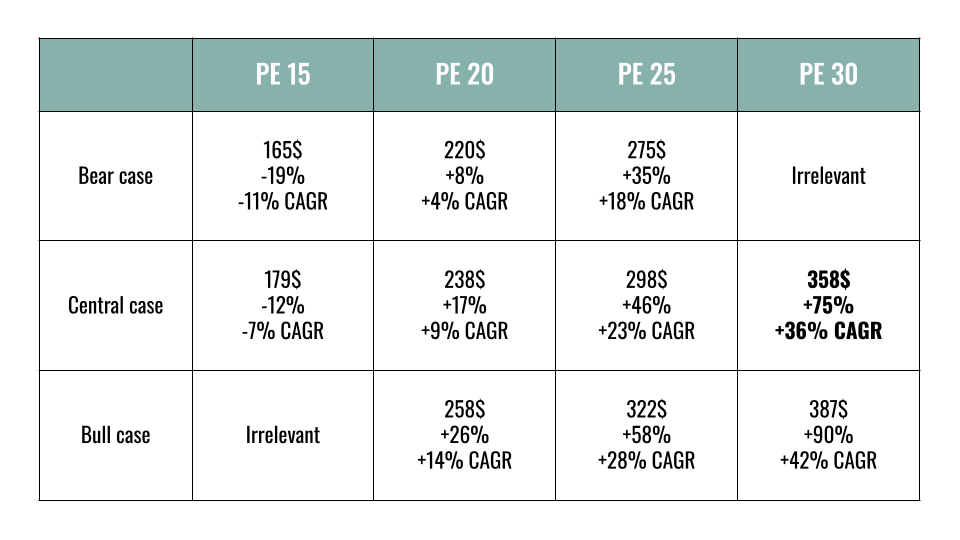
CAGR calculated from $204.1 to June 5, 2028 (1.83 years), dividends included.
How to read this table: in the central scenario at PE 30x, the price target reaches 358$ by December 31, 2028, a total return of +75% from current price, or a CAGR of 36.0% including dividends. It is the floor of my conviction, since 30 is still a quite conservative PE ratio for a business of this quality.
I’d consider selling above 35x.
Disclaimer
All content published by JB Peter on this platform is strictly for educational and informational purposes. It does not constitute investment, financial, legal, or tax advice, nor does it represent a personal recommendation or solicitation to buy or sell securities. This research is operated by ORIACON (SASU) and reflects independent corporate analysis. Every reader must conduct their own independent research (Due Diligence) or consult a licensed professional before making any financial decision, as financial markets involve a high risk of capital loss. At the time of writing, ORIACON or the author HOLD shares in the company analyzed in this article. Following this publication, ORIACON and the author reserve the right to buy, sell, or modify positions in any security mentioned at any time, without prior notice to readers or subscribers.