
Since my article “Bottlenecks 2 - Robotics”, I added two stocks to the portfolio, namely HDS and THK. Both are small positions (less than 2% each). I wanted to put 10% of my portfolio on several bottleneck stocks, as the underlying thesis can change quickly, and I want to stay “diversified” on this part.
As you can deduce from the name, the central thesis is that harmonic reducers (HDS) and planetary roller screws (THK) are in short supply, with demand exceeding supply. It gives us every aspect we want as investors: prices increases, production and guidance increases, and multiple expansion (PE ratio, Price to Sales, etc.).
I wanted to make an update since both companies beat expectations, both raised guidance and both fell after their results. This article will provide you an update on:
Why they fell
The bull vs bear part I made in the previous article
The valuation scorecard
1. Why HDS and THK fell
Sector rotation and macro
The market feared an intervention on the yen, as the currency was weakening. The government would sell dollars and buy yen: a stronger currency would weaken the industrials such as THK and HDS.
Moreover, there was a broad AI/semiconductor selloff on August 6-7. Other names in the sector, such as Kioxia, Taiyo Yuden, Murata and Tokyo Electron, were all down on the same days. THK and HDS got dragged along with the rest of the sector.
Pre-earnings rally
THK was up roughly 23% in the week before its own results, and roughly doubled over the past year. HDS was sitting near its 52-week high, already a 3-bagger YoY.
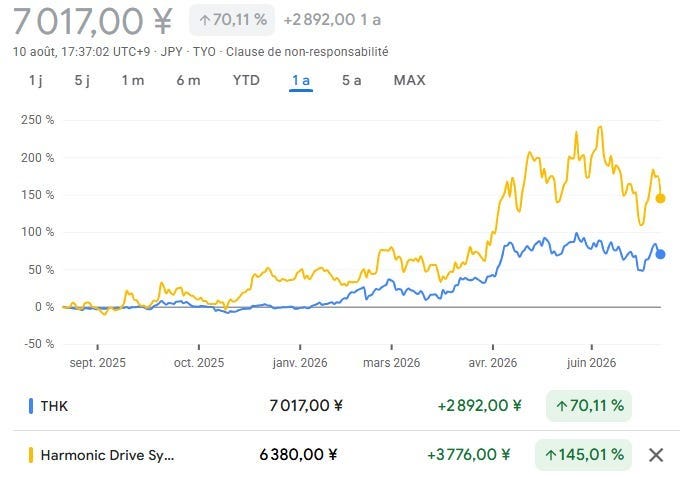
Results were below expectations
Here is a quick update on the results:
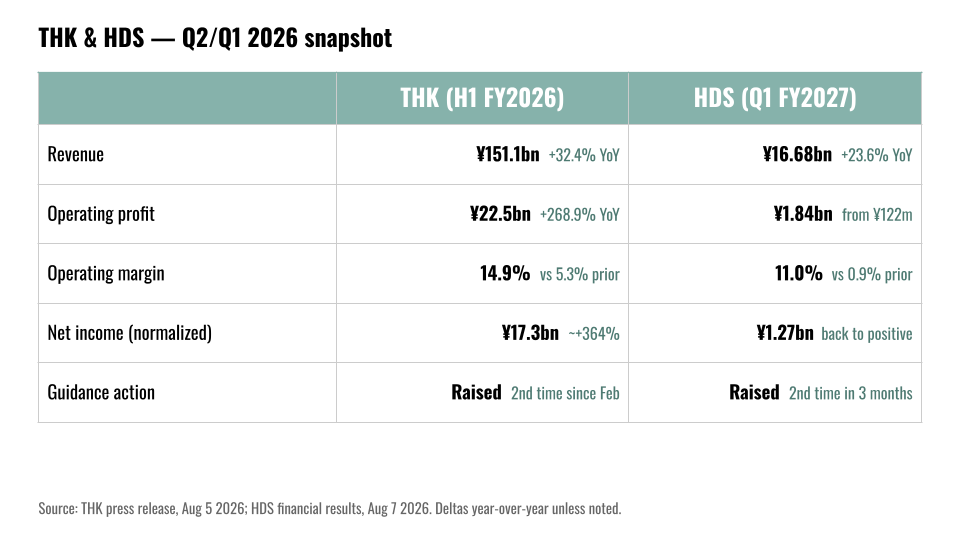
As the market rallied before the results, the expectations were obviously stronger.
THK’s net income is up 805% YoY. It was mostly a one-off gain from the divestiture of its automotive unit. The truth lies in a normalized net income closer to +364%.
There was no explicit mention of take-off in humanoid robotics, so the market feared the AI thesis wasn’t there: HDS’s guidance hike came with just “industrial robots and semiconductor manufacturing equipment”, and THK’s growth is also concentrated in “electronics and semiconductor” demand.
2. Bull vs bear update
I made a bull vs bear in the previous article, some points may have changed. It’s worth noting THK’s cost-to-sales ratio improved 4.6 points year over year. HDS’s operating margin for a single quarter already exceeds its full-year FY2027 guidance. It goes into the good direction.
Bear argument #1: China competition
Goldman Sachs conducted a field survey of 9 suppliers in China in November 2025. They planned an increase in capacity, from 100,000 to 1M units. Moreover, the direct competitor of HDS, LeaderDrive, mentioned booked capacity through 2027, with production expected to reach 1M units in 2026.
Bear argument #2: Price rally and cyclicality instead of robotics
As said before, both stocks went up significantly. The market is still cautious about evidence of bottleneck pricing, regarding the first bear point. Neither company has mentioned humanoid-specific segments. What is sure for the moment is the capex and the increase of competition on the supply side. If there is a bottleneck, nobody knows when it can stop.
Bull argument #1: Demographic tailwind / labor shortage
This point is unchanged from the previous article and certainly won’t be any different throughout the investment period. Demographics aren’t in quarters, but in decades.
Bull argument #2: Operational execution
Both companies raised the guidance, a good signal for the continuation of the thesis. The sustained execution is a necessary condition for the whole bull thesis to materialize.
Bull argument #3: Real barriers to entry
This point is unchanged from the previous article and certainly won’t be any different throughout the investment period. The qualification cycle for a new supplier is usually several quarters: by that time, the thesis will be played out.
Bull argument #4: The fragmentation of the world into blocs
I said in the previous article “each bloc (Western, and within the West, the EU, the US and Japan taken separately) will want to keep strategic suppliers tied to its own bloc rather than depend entirely on an outside supplier. This isn’t just a price or volume argument: it’s a supply-security logic that structurally leaves room for a “trusted” bloc supplier — even at a higher price, even with less volume than the cheapest Chinese option. Both HDS and THK benefit from this mechanism, independent of their pure price competitiveness. “
This argument has another confirmation in other compartments of semiconductors:
On rare earth elements, China restricted access to Japan for dual use and permanent magnets over Taiwan tensions
On chipmaking equipment, U.S. export controls target American toolmakers themselves, while Japan’s Tokyo Electron and the Netherlands’ ASML negotiated carve-outs letting them keep selling into China.
The logic is the following: if possible and for strategic sectors, the US companies would get a Tier 1 group of US companies, then a Tier 2 group of western companies (EU, Japan, Korea, etc.) and then a Tier 3 group of companies (China, rest of the world) with a focus on price.
New: Bull argument #5: The main competitor of HDS, LeaderDrive, is full until 2027
The other side of the first bear argument is that if LeaderDrive is in a supply shortage and there is room for western companies, then HDS should also be in a supply shortage for the coming quarters.
New: Bull argument #6: Despite growing capacities, the Total Addressable Market is growing significantly
HDS is adding 33% more capacity at its Beverly, Massachusetts plant by December 2026, on top of 13% already added in December 2025. In Japan, roughly ¥10bn is going specifically into humanoid-reducer production at the Ariake plant, targeting ¥10-20bn of revenue from that line in FY2027.
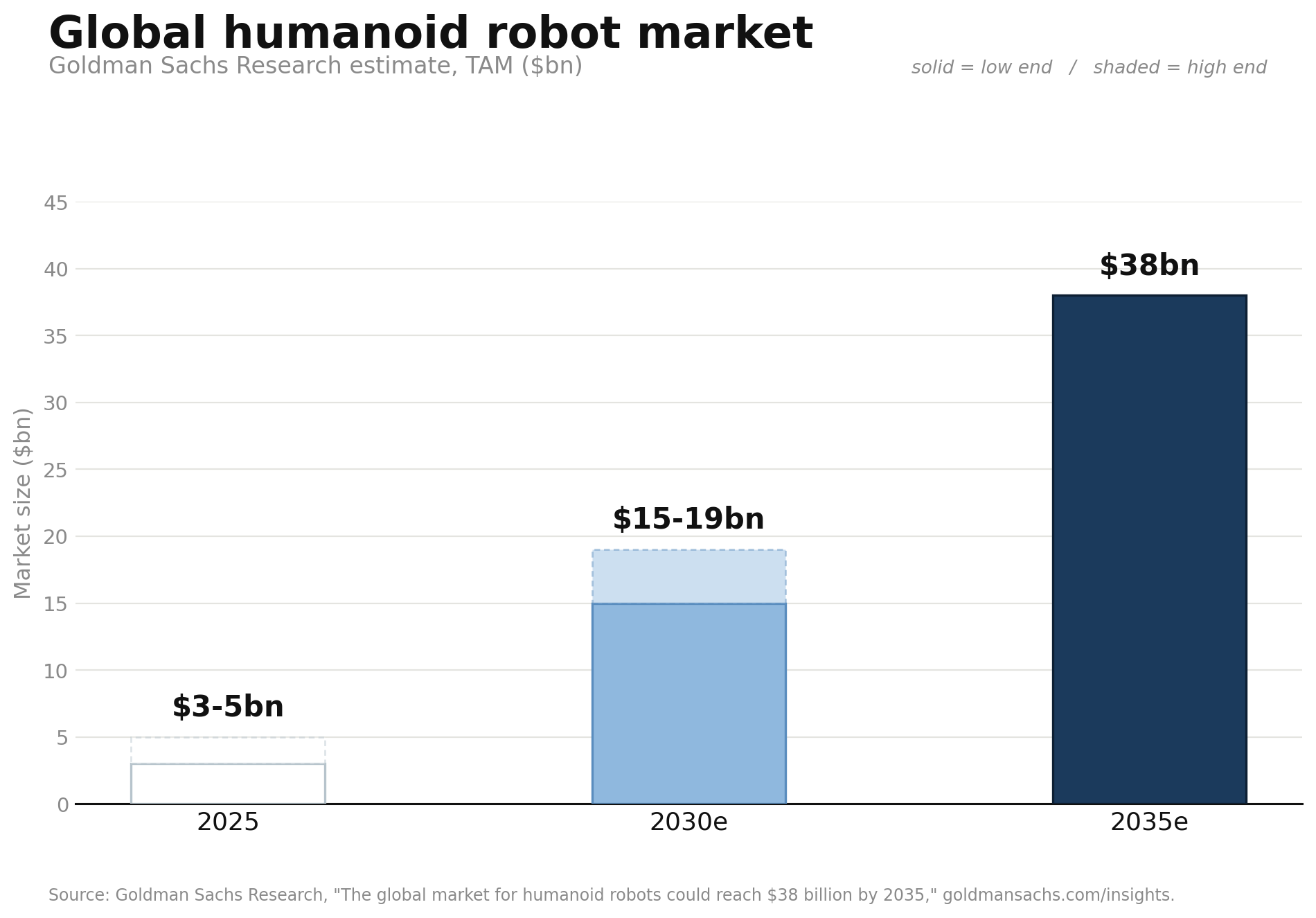
Goldman Sachs has also revised its humanoid market-size estimate upward since the original article: from roughly $3-5bn today to $15-19bn by 2030, and $38bn by 2035. The insight I want from this is that the runway until market saturation is longer than expected, allowing HDS and THK to compound for longer.
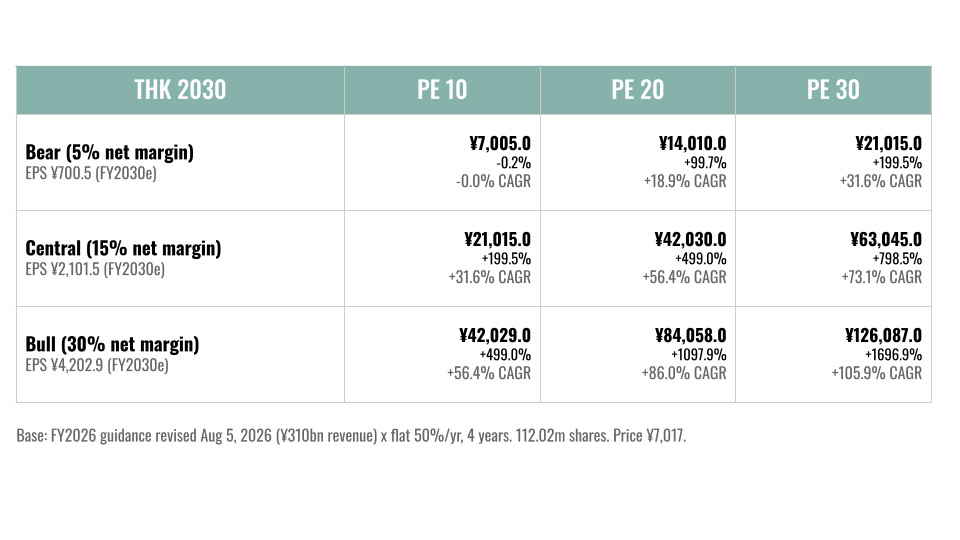
3. Valuation scorecard
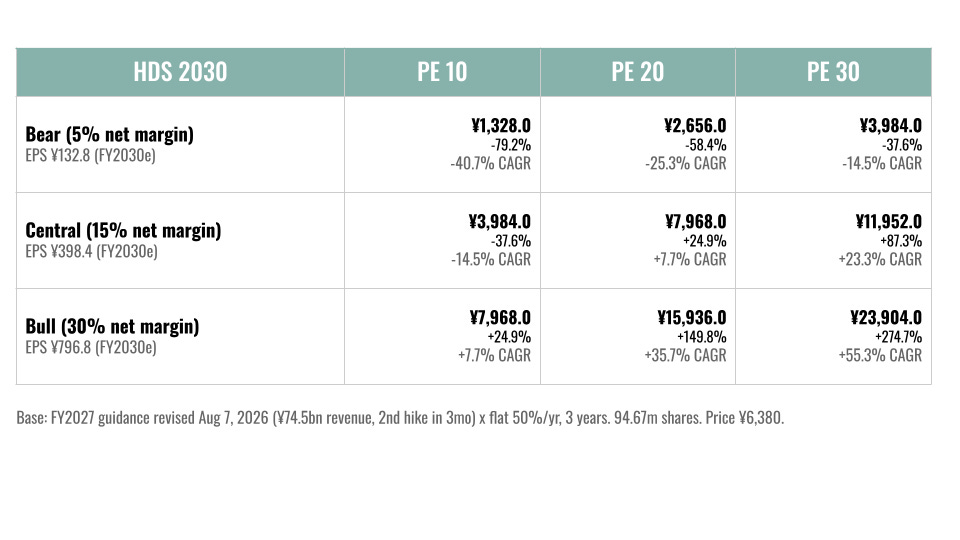
Despite revenue growth running below the +50% YoY assumption from the previous article, the net margin of THK is already running above the scorecard’s Bull case. HDS’s Q1 margin is climbing faster than expected toward the Central case. I updated the valuation scorecard to reflect the shorter horizon now that we're getting closer to 2030. I expect the price to increase several times based on sentiment in the coming quarters, then I would sell the news before the price drop. The tricky part is to know when to sell cyclical stocks: you’ll never get the perfect tops and bottoms.
Conclusion
There’s still no clean evidence of a bottleneck, but both companies are tracking their bullish-scenario margins already — what the coming quarters should settle is how much of that holds up. The low weighting of stocks in the portfolio reflects this lack of predictability, although the balance between upside and downside potential remains positive. I would consider increasing my position in both if I had additional capital to deploy, given that the fundamentals have improved faster than the price.
Disclaimer
All content published by JB Peter on this platform is strictly for educational and informational purposes. It does not constitute investment, financial, legal, or tax advice, nor does it represent a personal recommendation or solicitation to buy or sell securities. This research is operated by ORIACON (SASU) and reflects independent corporate analysis. Every reader must conduct their own independent research (Due Diligence) or consult a licensed professional before making any financial decision, as financial markets involve a high risk of capital loss. At the time of writing, ORIACON or the author HOLD shares in the companies analyzed in this article. Following this publication, ORIACON and the author reserve the right to buy, sell, or modify positions in any security mentioned at any time, without prior notice to readers or subscribers.