
The SaaSpocalypse is probably the best opportunity the market has handed investors in the software sector in years.
The pattern is familiar. A new technology emerges. The market extrapolates the worst-case scenario immediately, prices it as present reality, and sells first. The underlying business keeps compounding. Twelve to eighteen months later, the sentiment reverses — and the investors who read the narrative instead of the numbers have already missed the move.
It happened with Alphabet. In early 2025, the question on every desk was whether Google Search was structurally broken by AI. The stock traded at 17× earnings — a decade low. The business posted records. The stock is up over 100% since.
It happened with Booking Holdings. The AI agents were going to disintermediate online travel. ChatGPT would plan your holidays, Booking would become invisible, the OTA model would collapse. The stock fell 33% from its peak. Room nights hit 1.235 billion — an all-time record. The business wasn’t broken. The sentiment was.
Now it’s Adobe’s turn. The narrative has a name: the SaaSpocalypse. AI is making creative professionals obsolete. Canva has taken the consumer market. Figma took UI/UX. Midjourney generates images in two seconds. The creative software stack is being commoditized, and Adobe — the company that built it — will be its biggest victim.
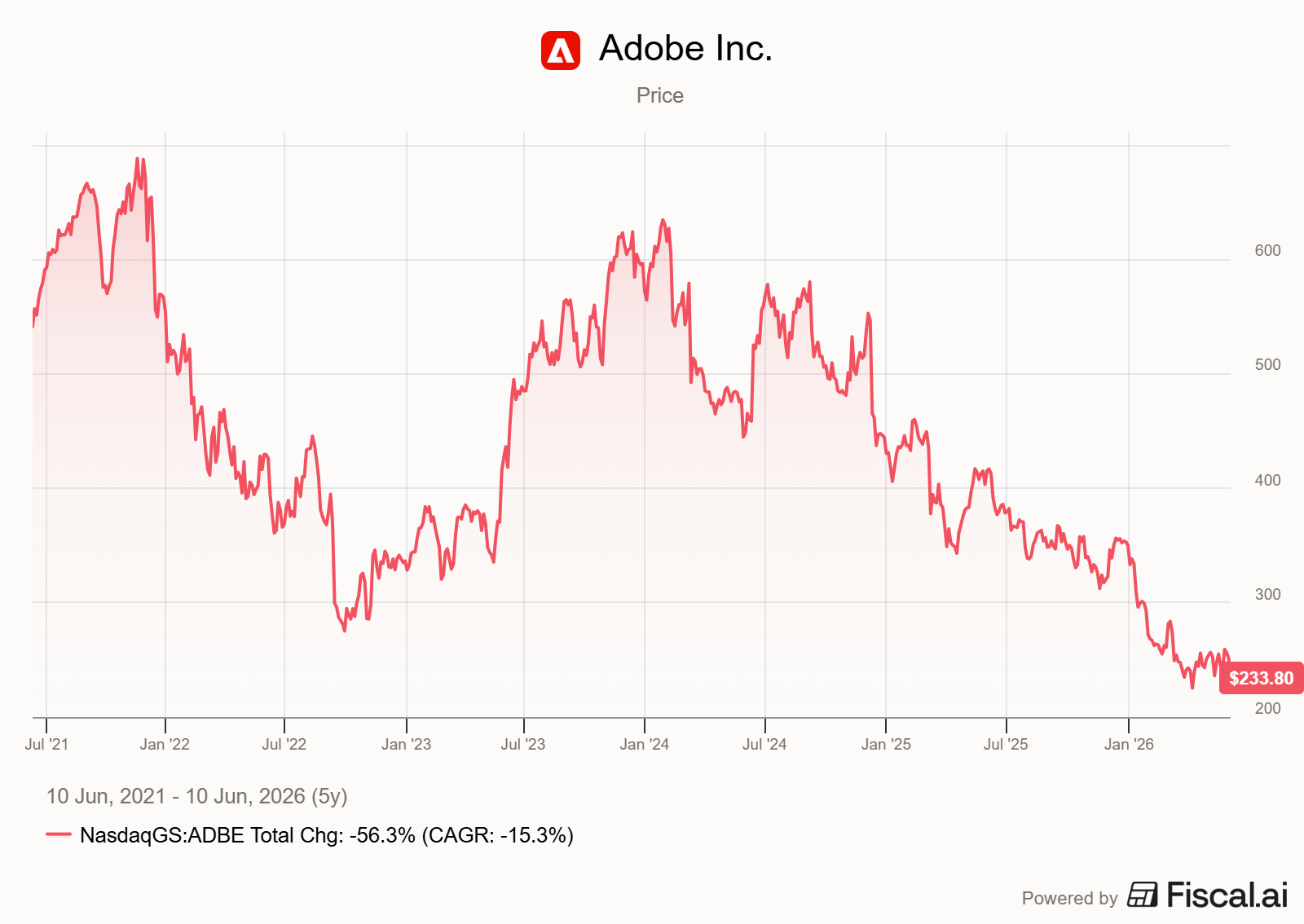
The stock is trading near its lowest PE in a decade. A franchise generating 89% gross margins, 97% recurring revenues, and $2.96 billion in operating cash flow in a single quarter.
The SaaSpocalypse is a story. The numbers tell a different one.
This article starts with the business — what Adobe does, how it makes money, and why this model is structurally difficult to displace. The competitive advantage section examines each segment individually: the moat, the competition, and the real exposure — with a summary table at the end of the section. Financials and management follow. The article then presents the two competing theses, a valuation scorecard, and portfolio considerations.
A note on length. This article is long by design. Adobe is a business that requires its products and competitive position to be understood before the investment thesis makes sense. The moat analysis is not decoration — it is the foundation of everything that follows. If you’re here for the thesis directly, the Two Thesis section is the heart of the article, and the Valuation section translates those arguments into concrete scenarios.
I know you’re busy, so I always start with a summary called The short version. If that’s all you have time for, that’s fine. The rest of this article explains why.
The Short Version
Adobe is the infrastructure of the global content economy. Photoshop. Illustrator. Acrobat. The tools that creative professionals use daily, the PDF standard that runs through every corporate document workflow in the world, the platform that manages and activates enterprise marketing at scale. $23.77 billion in revenue. 97% recurring. 89% gross margins. $10 billion in annual operating cash flow.
The stock has lost 35% from its peak. The market has a name for what is happening: the SaaSpocalypse. AI is making creative professionals obsolete. Canva has taken the consumer market. Figma took UI/UX. Midjourney generates images in two seconds. Adobe is the next victim.
My view: the market is pricing a possible future disruption as a present reality. The business is posting records. Digital Media ARR grew 11.5%. Gross margin hit 89.6% — a record. The field signals that precede structural deterioration — design schools abandoning Photoshop, enterprise procurement shifting away from Acrobat, Creative Cloud retention declining — are absent.
The confirmed casualties are Express, which lost to Canva, and UI/UX, which was surrendered to Figma. Together they represent less than 5% of revenues. The bear thesis requires the destruction of the fortresses. There is no evidence of that.
The bears are right about the edges. They are wrong about the conclusion.
At 15× trailing earnings — the lowest multiple in a decade — you are not paying for the AI optionality, the Firefly ARR trajectory, or the operating leverage. You are paying for the rents that already exist. And while the market debates the SaaSpocalypse, Adobe retires 6% of its own shares every year, growing EPS mechanically at 16-17% annually independent of everything else.
The position is 10% of the portfolio. The central valuation case puts the stock at approximately $420 over two years — +62%, approximately 28% CAGR — at a PE of 18×, simply normalizing toward the lower bound of the historical range. No heroic assumptions required. No visionary CEO required. No AI moonshot required.
My personal conviction sits on the bull case — a PE of 25× combined with operating margins expanding from the current 30% toward 35% as the AI infrastructure cost cycle stabilizes and the operating leverage embedded in the 89% gross margin structure expresses itself fully. That is not the 2021 euphoria multiple. It is simply what a quality SaaS franchise is worth when the market stops pricing it as a dying business. Adobe ran above 35% operating margins before the AI infrastructure investment cycle began. The conditions for a return to that level are already embedded in the business model.
Superior products and superior environments drive superior returns. With Adobe you got world-class products with fortress environments on most of the products — with the valuation on a dying business.
Understanding Adobe’s business, supply chain and environment
History
Adobe didn’t start as a creative company. It started with a problem about printers.
In 1982, John Warnock and Chuck Geschke left Xerox PARC with a single idea: a device-independent language that would tell any printer exactly how to render a page. PostScript solved a problem that had frustrated every computer user who had ever watched a beautifully designed document turn into garbled output on paper. Apple licensed it for the LaserWriter in 1985. The desktop publishing revolution followed. Adobe had, without fully intending to, invented an industry.
The PDF came eleven years later, in 1993. The logic was the same: a format that would look identical on every screen and every printer, regardless of the software that created it. Adobe invented the format, standardized it, and eventually released it as an open standard in 2008. They gave away the container. They kept the tooling. Thirty years later, that decision is still generating billions in recurring revenue.
The real transformation came in 2012. Adobe ended the perpetual license model for Creative Suite and moved entirely to Creative Cloud — a monthly subscription. The backlash was immediate and furious. Designers signed petitions. Forums declared Adobe dead. The stock fell on the announcement. Within eighteen months, it became clear that the transition was one of the most successful pivots in software history. Revenue became predictable. Churn became measurable. The flywheel of subscription ARR began to compound.
What followed was a decade of acquisitions that built the second half of the business. Omniture in 2009 brought web analytics. Marketo in 2018 brought marketing automation. Magento the same year brought e-commerce. Workfront in 2021 brought project management for creative teams. Frame.io brought video collaboration. Each acquisition extended Adobe’s reach from creation into the enterprise marketing stack — from the tool that makes the content to the platform that manages, deploys, and measures it.
The Figma chapter deserves its own paragraph. In 2022, Adobe announced a $20 billion acquisition of Figma — the collaborative design tool that had quietly taken 80-90% of the UI/UX market while Adobe’s own product, XD, stagnated. The deal valued Figma at roughly 50× ARR. Antitrust regulators in Europe and the UK blocked it in late 2023. Adobe paid a $1 billion breakup fee and abandoned XD. The market read this as a strategic failure. The correct reading is more nuanced — developed in the Two Thesis section.
Today, Adobe is a SaaS company with $23.77 billion in revenue, 97% of it recurring, operating across the full lifecycle of content: from the first sketch in Photoshop to the activated campaign measured in Adobe Analytics. At its April 2026 Summit, management presented what this lifecycle looks like in the era of AI agents — a vision that is coherent on paper and still early in its financial translation.
What Adobe sells, and who buys it
Adobe has decided to merge its three historical reporting segments into a single operational unit from FY2026 onward. The stated rationale is a unified platform vision. The practical consequence for anyone trying to understand the business is that granularity disappears precisely when the AI transition makes it most valuable to track. This article keeps the two meaningful customer groups as the organizing framework — it is the structure that best reflects how the business actually creates and captures value.
Creative and Marketing Professionals — $16.30 billion in subscription revenue.
This is the segment that built Adobe. Designers, photographers, videographers, illustrators, motion artists, creative directors, agency teams, and marketing professionals at enterprises. These are the people for whom Photoshop is a verb, an After Effects project file is a professional deliverable, and the Adobe suite is the assumed baseline of any creative career.
The product lines that serve this group:
Imaging and illustration — Photoshop, Illustrator, Lightroom. The historical core. Industry-standard formats (.psd, .ai), industry-standard workflows, industry-standard careers built around them.
Video and motion — Premiere Pro, After Effects, Frame.io. The post-production stack. Native integration between After Effects and Premiere locks workflows that take years to build.
3D — Substance 3D Painter, Sampler, Stager, Modeler. A technical niche in gaming, architecture, and industrial design. Solidly positioned in texturing and materials, largely insulated from the AI disruption hitting 2D imaging.
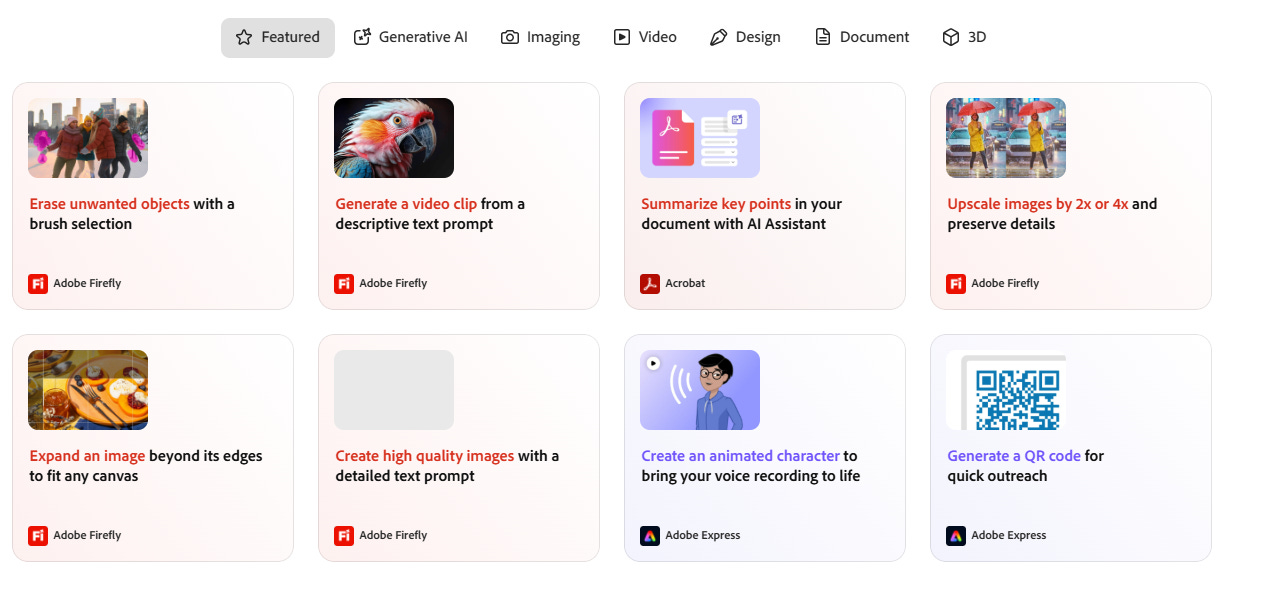
AI generation — Firefly, Firefly Foundry, Firefly Custom Models, Brand Intelligence. Adobe’s generative AI family, trained exclusively on licensed content and public domain material. The commercial safety guarantee is the product, not the generation quality. Discussed in detail in the competitive advantage section.
Collaboration and workflow — Frame.io for video review, Workfront for creative project management. Enterprise connective tissue between creative production and delivery.
Grand public and prosumer — Adobe Express. The lightweight design tool aimed at non-designers, small businesses, and marketing teams that need fast content without professional software. The segment where Canva won and Adobe is a distant challenger.
Business Professionals and Consumers — $6.50 billion in subscription revenue, +15% in FY2025.
This is the fastest-growing segment and the least discussed. It is built almost entirely around one product family and one decision made in 1993.
PDF and Document Cloud — Acrobat Standard, Acrobat Pro, Reader, Sign, AI Assistant, PDF Spaces, Acrobat Studio. Adobe invented the PDF, open-sourced the format in 2008, and has spent thirty years building the premium tooling layer above a free reader that sits on virtually every corporate machine on the planet. The monetization engine is the conversion of that installed base — hundreds of millions of Reader users — into paid Acrobat tiers. The +15% growth in FY2025 is that conversion accelerating.
Customer Experience Orchestration — Adobe Experience Platform, Real-Time CDP, Analytics, Customer Journey Analytics, AEM, Commerce, Marketo, GenStudio, Journey Optimizer, LLM Optimizer, and Semrush (closing Q2 2026, $1.9 billion, cash-funded). Management now uses the label Customer Experience Orchestration rather than Digital Experience — a deliberate reframe toward the agentic and AI-native workflows presented at Summit 2026. This bloc manages the enterprise content supply chain from creation through activation to measurement. Subscription revenue growth in FY2025: +11%. Three products within this segment have crossed $1 billion in ARR individually and are growing above 20% year-over-year — a detail buried in the aggregate figure.
Suppliers
Three dependencies worth naming precisely.
Cloud hosting and data centers. The largest material commitment: $6.82 billion in non-cancelable purchase obligations, primarily for third-party hosting and data center services. Adobe is publicly known as a large Microsoft Azure customer and uses AWS and Google Cloud Platform — the 10-K does not name the hyperscalers directly. At 89% gross margins, this cost structure is manageable. The 10-K explicitly acknowledges that rising AI inferencing costs could compress margins if monetization does not keep pace. This is the most material supplier risk in the business.
Third-party AI model providers. Adobe integrates 30+ external models — Google, OpenAI, Anthropic, Runway, Flux, Luma, Ideogram, and others — alongside its own Firefly models. The strategy is orchestration, not exclusivity. Adobe does not bet on a single model. Every new model that enters the market is a potential addition to the platform rather than a competitive threat. This dependency is simultaneously a strategic choice and a structural hedge against model obsolescence.
Talent. With 50% of employees outside the US and engineering concentrated in Bay Area, Salt Lake City, and Bangalore, Adobe’s exposure to visa and immigration policy is real and acknowledged in the 10-K. An eNPS of 76 and an attrition rate of 9.9% — low for Silicon Valley — suggest the dependency is currently well-managed.
Segments and Competitive Advantage
The standard approach to Adobe’s competitive position is to describe the moat as a single entity. That framing misses the most important analytical point: the moat is not uniform. It is deep in some segments, absent in others, and actively contested in several. Treating it as monolithic leads to the analytical error that drives both the bear overreaction and the bull complacency.
What follows is a segment-by-segment analysis — description, moat, and competition — with a summary table at the end.
1. PDF and Document Cloud — The Unassailable Fortress
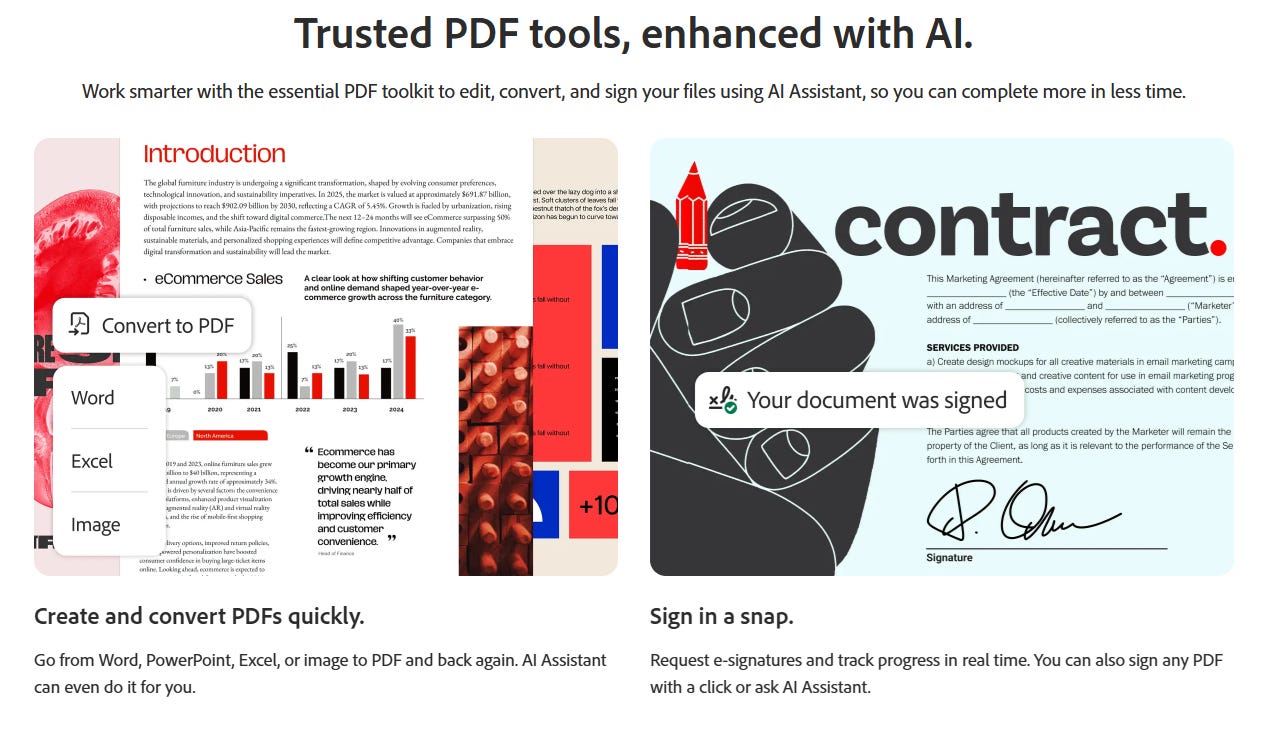
Description. The PDF is the universal language of the professional document. Contracts, invoices, financial reports, legal filings, client presentations — virtually every formal document exchanged between businesses travels as a PDF. Adobe invented the format in 1993, standardized it, and released it as an open standard in 2008. Anyone can create a PDF reader. Anyone can build a PDF export function. The format itself is free. What Adobe built — and what nobody has successfully replicated at enterprise scale — is the professional tooling layer above it: the ability to edit, sign, compare, redact, automate, and collaborate on PDFs in a corporate environment. That tooling is what generates $6.50 billion in annual subscription revenue.
The mechanics are straightforward. Adobe gives Reader away for free. Reader is installed on virtually every corporate machine in the world. Every user who opens a PDF in Reader is inside the Adobe ecosystem. The conversion to paid tiers happens the moment that user needs to do something Reader will not let them do — edit a contract, sign a document, compare two versions, redact sensitive data. The free format is the trojan horse. The Acrobat subscription is the monetization. It is the oldest and most effective freemium model in enterprise software.
Acrobat Standard and Pro are the working tools for the PDF itself. Create a PDF from any source — Word, Excel, a physical scan. Edit its content, reorganize its pages, compare two versions of a contract side by side, redact sensitive information, build interactive forms, manage accessibility compliance. Pro adds the enterprise layer: Microsoft 365 integration, advanced legal tools, document workflow automation. This is the product that legal, HR, finance, and compliance teams use daily across virtually every large organization in the world.
Acrobat Sign is electronic signature: send a contract, collect a legally valid signature in over 180 countries, manage multi-party approval workflows. DocuSign leads this segment as a standalone product — Acrobat Sign exists primarily because it is bundled with Acrobat rather than on its own competitive merits. That is a weakness in isolation and a distribution strength in the context of the suite.
AI Assistant is the conversational interface layered on top of documents. A lawyer interrogating a 300-page contract rather than reading it sequentially. An analyst querying ten annual reports simultaneously. Ask a question, get a sourced answer. This is the AI monetization layer of Document Cloud — and a meaningful contributor to the +15% growth this segment delivered in FY2025.
PDF Spaces is the collaborative workspace built around documents: real-time review, annotation, and co-editing of shared PDFs across distributed teams. The answer to document collaboration in organizations where five people need to work on the same file without emailing attachments back and forth.
Competition. Foxit is a PDF tooling competitor with a real product and lower pricing — the kind of alternative that gets evaluated during budget reviews and rarely gets selected, because the migration cost exceeds the subscription savings. The 10-K acknowledges competitive pressure without specifying where Foxit wins. Chrome and Edge now read PDFs natively — this competes on the free layer, not on the professional tooling. Smallpdf and iLovePDF serve lightweight web use cases without enterprise depth. DocuSign leads standalone e-signature but does not threaten the core Acrobat business.
Moat. Adobe no longer owns the PDF format. What it owns is thirty years of tooling built around a format that became the backbone of global business communication. The switching cost on the premium tooling is the lock.
A legal firm whose entire document workflow runs through Acrobat, whose paralegals have years of Acrobat Sign muscle memory, whose IT department has provisioned Acrobat Pro across thousands of machines — that firm is not switching to Foxit because Foxit is cheaper.
Competitive exposure: low.
2. Professional Imaging and Illustration — The Cultural Fortress
Description. Photoshop, Illustrator, Lightroom. The historical core of Creative Cloud Pro. Included in Creative and Marketing Professionals ($16.30 billion, +11% in FY2025).
Photoshop is the industry standard for image editing and compositing. Retouching a photograph, building a multi-layer advertising visual, removing a background, correcting color — these are Photoshop workflows. The software has been the baseline of professional image work for thirty years. Its name entered the dictionary as a verb.
Illustrator is the industry standard for vector graphics — logos, icons, typography, illustrations, packaging design. Where Photoshop works with pixels, Illustrator works with mathematical shapes that scale to any size without quality loss. A brand’s logo exists as an Illustrator file. A magazine’s infographics are built in Illustrator. The .ai format is the currency of the graphic design profession.
Lightroom is the standard for photo management and color grading at scale. A photographer who shoots 2,000 images at a wedding does not edit them one by one in Photoshop. Lightroom organizes the catalog, applies batch corrections, and manages the entire post-processing workflow. It is the operating system of professional photography.

Competition. Affinity (owned by Canva) is the most credible alternative — serious quality, aggressive pricing, a one-time purchase model that directly targets subscription fatigue. It has gained real traction among freelancers and small studios. Procreate dominates illustration on iPad but does not compete with the desktop suite. GIMP and Inkscape serve zero-budget users, not agencies. AI generation tools — Midjourney, DALL-E, Flux — attack creation from below but do not replace the professional imaging workflow. They are relevant to the Firefly segment discussion, not to this one.
Moat. Photoshop became a verb. That is not a marketing achievement — it is the most durable form of competitive advantage in consumer-facing software: behavioral absorption.
The switching cost is cognitive and cumulative. A senior designer who has spent a decade building muscle memory around Photoshop’s shortcuts, layer logic, and blending modes does not migrate to Affinity in a weekend. They migrate never, unless forced. The cost is not the price of a new subscription — it is the temporary regression in professional output quality, the retraining of ingrained reflexes, the risk of missing a client deadline during the transition.
The moat is self-replicating through the labor market. Design schools teach Photoshop. Job postings require proficiency in the Adobe suite. Graduate designers arrive at their first agency already captive. The muscle memory is transmitted through education and hiring before Adobe charges a single dollar.
The ecosystem reinforces the lock-in further. Files flow between Photoshop, Illustrator, InDesign, and Premiere without friction. A studio that has built its production pipeline around native Adobe interoperability is not evaluating Affinity on its technical merits — it is evaluating the cost of rebuilding its entire infrastructure.
Competitive exposure: low on the professional segment. The attack vector exists at the entry level, not at the core.
3. Video and Motion — Solid but Under Dual Pressure
Description. Premiere Pro, After Effects, Frame.io. The post-production stack for film, television, advertising, and digital content. Included in Creative and Marketing Professionals.
Premiere Pro is the industry standard non-linear video editor. Cut a film, assemble a commercial, edit a documentary — these are Premiere workflows. The timeline, the multicam editing, the audio mixing, the color correction pipeline. Used by Hollywood studios, broadcast networks, and independent filmmakers worldwide.
After Effects is the industry standard for motion graphics and visual effects. Animated titles, lower thirds, composited visual effects, explainer video animations — After Effects is where video gets its visual complexity added after the raw edit. Every broadcast package, every animated logo, every motion graphics reel is built here.
Frame.io is the cloud-based video review and collaboration platform. A director in Los Angeles sends a cut to a client in Tokyo. The client annotates directly on the frame — “tighten this cut, change this line.” The editor receives the feedback linked to the exact timecode. Frame.io removes the back-and-forth of emailed PDF notes and replaced it with frame-accurate collaboration.

Competition. DaVinci Resolve (Blackmagic Design) is the most structurally threatening competitor. Blackmagic monetizes hardware — cameras, control surfaces, capture cards — and offers the software at near-zero cost. The color grading capability in DaVinci is widely considered superior to Premiere for high-end cinema work. The business model asymmetry is dangerous: Blackmagic can sustain the software at cost because hardware margins fund it. Adobe cannot compete on price without destroying its margin structure.
Final Cut Pro (Apple) is strong but confined to the Mac ecosystem — a platform constraint that limits its competitive reach.
CapCut (ByteDance) attacks from below on short-form mobile content — a different workflow, a different user, but a real encroachment on the next generation of video creators who may never develop Premiere habits.
Runway, Sora (OpenAI), and Veo (Google) represent the paradigm shift risk: AI-native video generation that does not replace Premiere today but potentially bypasses traditional post-production on certain content types. Adobe is integrating these models rather than fighting them — coherent strategy, unproven execution at scale.
Moat. The native integration between After Effects and Premiere Pro is the primary lock. A production house that has built its template library, its motion graphics toolkit, and its color pipeline around the Adobe stack does not migrate to DaVinci without rebuilding its infrastructure. The project files, the presets, the team’s shared workflows — all of it is Adobe-native.
The switching cost is real but lower than on the imaging side. Formats are less proprietary — video files are more portable than .psd or .ai files. The muscle memory is deep but more transferable between NLE platforms than between image editing suites. A colorist who switches from Premiere to DaVinci does not start from zero the way a Photoshop designer switching to Affinity does.
Frame.io adds a collaboration layer that raises the switching cost further at the enterprise level — a production studio whose review workflow runs through Frame.io has built client habits and approval processes around it that are not trivial to migrate.
Competitive exposure: medium-high. The dual pressure from DaVinci on the high end and AI-native generation on the paradigm level is real. The fortress holds for now. It requires monitoring.
4. Adobe Express and the Consumer Market — The Open Flank
Description. Adobe Express is the lightweight design tool for non-designers. A marketing manager who needs a social media post. A small business owner who wants a flyer. A HR team that needs a presentation. No professional training required — drag and drop, pre-built templates, brand colors applied automatically. Freemium, with a paid tier for advanced features and team collaboration.
Competition. Canva owns this market. 185 million monthly active users, templates for every use case, team collaboration built in from day one, free tier generous enough that millions never pay. Canva arrived first, grew faster, and built the network effect before Adobe took the segment seriously. CapCut dominates short-form video creation on mobile. Microsoft Designer is embedded in the Microsoft 365 ecosystem that most enterprises already use. Adobe Express is a distant challenger in a market it should have owned.
Moat. Effectively none on the consumer segment. The switching cost for a Canva user is zero — the platform is free, the templates live in a browser, there is nothing to migrate. The network effect belongs to Canva.
Where Express has a more defensible position is inside the enterprise GenStudio workflow — as the last-mile editing tool for AI-generated content produced at scale. A marketing team that generates 10,000 campaign variations through GenStudio needs a simple interface to review, adjust, and approve the final assets before activation. Express fills that role. That use case is not competing with Canva — it is a different function entirely, embedded in a workflow Canva cannot replicate.
The analytical error the bears make is treating Express as representative of the whole. It represents less than 5% of revenues. A complete Express failure changes nothing material about the investment case.
Competitive exposure: maximum on consumer. Immaterial to the financial model.
5. Firefly and AI Generation — The Compliance Moat
Description. Firefly is Adobe’s family of generative AI models — image, video, audio, vector — trained exclusively on licensed content and public domain material. It is not a standalone application in the traditional sense. It is a capability layer embedded across the entire Adobe product suite and exposed as a separate product family for enterprise use.
Firefly (app and web) is the consumer-facing generation interface. Type a prompt, generate an image, edit it, iterate. The entry point for individuals exploring AI generation within the Adobe ecosystem.
Generative Fill and Generative Expand are Firefly capabilities embedded directly in Photoshop. Select an area of an image, describe what should replace it, and the model fills it in — without leaving Photoshop, without switching tools, without importing and exporting files. This is the practical expression of Adobe’s integration strategy: AI generation as a native feature of the professional workflow, not a separate step in a fragmented process.
Firefly Foundry is the enterprise model training platform. A brand uploads its own visual assets — campaign imagery, product photography, brand guidelines — and trains a custom model on that proprietary material. The output is a generation model that produces content consistent with that brand’s visual identity by construction.
Firefly Custom Models are the trained brand models themselves. Once a brand has trained its model in Foundry, it can generate unlimited on-brand content without manual brand compliance review on every asset.
Brand Intelligence is the layer that codifies a brand’s visual rules — color palettes, typography, tone, compositional preferences — and enforces them automatically across all generated content. The brand’s identity becomes a parameter in the generation process rather than a post-production checklist.
Generative credits are the consumption-based monetization unit. Every AI generation action consumes credits. Credits are included in subscription tiers and sold separately as add-on packs. Credit pack ARR grew 75% quarter-over-quarter in Q1 FY2026.
Competition. Midjourney produces more striking images. OpenAI’s DALL-E and Google’s Imagen are technically competitive on raw generation quality. Flux, Runway, Luma, and Ideogram each have specific strengths. Adobe knows this and does not claim otherwise. The competition on raw model quality is real and Adobe is not winning it.
What Adobe does not compete on is generation quality. It competes on a different axis entirely.
Moat. Adobe sells commercial safety, not generation beauty. Every Firefly output is indemnified — Adobe guarantees that the generated content does not infringe on third-party intellectual property because the training data is entirely licensed or in the public domain. For a Fortune 500 company running a global advertising campaign, the question is not which model produces the most beautiful image. It is which model does not expose the company to a Getty Images lawsuit. Adobe is currently the only scaled answer to that question at enterprise level.
This is a compliance moat, not a product moat. It is narrow but structurally defensible in a specific and lucrative segment — large enterprises with legal departments that have already said no to Midjourney.
6. 3D — Substance Suite — The Technical Niche
Description. Substance 3D is Adobe’s toolset for three-dimensional asset creation, focused specifically on materials, textures, and staging. It sits inside the Creative and Marketing Professionals segment but serves a distinct technical audience: 3D artists in gaming studios, product designers, architects, and visual effects teams.
Substance 3D Painter is the industry standard for 3D texture painting. Take a three-dimensional model — a character, a product, a vehicle — and paint its surface materials directly onto it. The rust on a metal pipe. The fabric weave on a jacket. The scuff marks on a shoe sole. Painter is where 3D objects get their physical appearance.
Substance 3D Designer is the node-based material creation tool. Rather than painting surfaces manually, Designer builds materials procedurally — mathematical recipes that generate infinitely variable, photorealistic surface appearances. A concrete material built in Designer can be adjusted endlessly: wetter, older, more cracked, differently lit. The output feeds into game engines, rendering software, and visualization pipelines.
Substance 3D Sampler converts real-world photographs into usable 3D materials. Photograph a brick wall, a wooden floor, a piece of fabric — Sampler extracts the material properties and turns them into a reusable 3D asset. It closes the loop between physical reality and digital production.
Substance 3D Stager is the product visualization tool. Place 3D models in a scene, apply materials, set lighting, render a photorealistic image — without a photographer, without a physical studio, without a product sample. An e-commerce company launching a new product can generate 500 photorealistic packshots in a day. This is the commercial application that connects Substance to the broader content supply chain.

Competition. Autodesk dominates 3D generalist workflows — Maya and 3ds Max are the industry standards for character animation and visual effects in film and television. But Autodesk does not compete directly with Substance on texturing and materials. The two toolsets are complementary in most professional pipelines — artists use Maya to build the model and Substance to surface it.
Blender is the open-source alternative that covers the full 3D workflow including texturing. It is free, powerful, and growing rapidly in adoption among independent artists and smaller studios. Blender sets an effective price ceiling on the market — it is difficult to charge premium pricing for capabilities that a well-maintained open-source project offers at zero cost. Adobe’s answer is depth, integration, and the asset library.
Maxon (Cinema 4D) dominates motion graphics — a adjacent segment where After Effects integration matters more than texturing depth.
Moat. Substance Painter is the industry standard for game asset texturing. That status was earned over a decade before Adobe acquired the Substance suite in 2019, and it has not eroded since. The switching cost is technical: production pipelines in gaming studios are built around Substance workflows, and the material libraries accumulated over years of production are Substance-native assets.
The integration with the broader Adobe ecosystem adds a layer that independent competitors cannot replicate — Substance materials flow into Photoshop, into Stager for visualization, and eventually into the content supply chain that connects to GenStudio and activation. For enterprises that use Adobe end-to-end, Substance becomes part of the same workflow rather than a separate tool.
The market is small relative to the core Creative Cloud segments, but structurally insulated from the AI disruption hitting 2D imaging. AI generation for 3D materials and photorealistic surfaces is less mature than 2D image generation, and the technical complexity of production pipelines creates barriers that consumer-facing AI tools have not yet addressed. The tailwind from gaming, AR, and e-commerce product visualization is real and long-duration.
Blender’s zero-cost model is the primary constraint on pricing power. Adobe competes on depth, workflow integration, and the professional asset library — not on price.
Competitive exposure: low. Market size is the constraint, not the competitive position.
7. Customer Experience Orchestration — Enterprise Sticky, No Dominant Pricing Power
Description. This is the segment that manages what happens to content after it is created. Adobe Experience Platform, Real-Time CDP, Analytics, Customer Journey Analytics, AEM, Commerce, Marketo, GenStudio, Journey Optimizer, Workfront, LLM Optimizer, and Semrush (closing Q2 2026). Management now uses the label Customer Experience Orchestration — a deliberate reframe from the older Digital Experience nomenclature toward the agentic and AI-native workflows presented at Summit 2026. Revenue: $5.86 billion, subscription growth +11% in FY2025.
Adobe Experience Platform (AEP) is the customer data foundation. It ingests behavioral, transactional, and demographic data from every touchpoint — website visits, app interactions, purchase history, email opens — and assembles it into unified customer profiles. Over 70 billion profiles managed. Over one trillion experiences delivered annually. The enterprise that knows who its customers are and how they behave across every channel runs that knowledge through AEP.
Real-Time CDP sits on top of AEP and activates those profiles in real time. A customer abandons a cart on a website — Real-Time CDP identifies them, segments them, and triggers a personalized re-engagement across email, paid social, and push notification simultaneously. The intelligence is in the platform. The activation is instantaneous.
Adobe Analytics and Customer Journey Analytics measure what is working. Traffic sources, conversion rates, revenue attribution, customer journey mapping across every touchpoint. The data layer that tells the enterprise whether its campaigns are generating returns.
AEM (Adobe Experience Manager) is the content management system for enterprise websites and digital properties. Virtually every major corporate website runs on AEM. It is the infrastructure layer that ensures content is published correctly, governed appropriately, and optimized for every channel — including, increasingly, the LLM channels where brand visibility now depends on how AI systems index and present corporate content.
Marketo is the marketing automation platform. Email campaigns, lead nurturing, demand generation, account-based marketing for B2B enterprises. The system that manages the relationship between a company and its prospects across months-long sales cycles.
GenStudio is the content supply chain platform. It connects creative production — the assets built in Creative Cloud — to marketing activation — the campaigns deployed through AEM, Marketo, and paid channels. A campaign brief enters GenStudio, creative assets are produced and approved within it, and the final content is activated directly to Google Campaign Manager 360, Meta Ads, LinkedIn, and Amazon Ads through native integrations. The last-mile activation layer that connects creation to distribution without manual export and re-import across disconnected tools.
Journey Optimizer orchestrates customer communications across every channel in real time — email, SMS, push, in-app, web. The system that ensures the right message reaches the right customer at the right moment across every touchpoint simultaneously.
LLM Optimizer is Adobe’s answer to generative engine optimization — the emerging discipline of ensuring that a brand’s content appears correctly and prominently when AI systems like ChatGPT, Perplexity, and Claude generate responses to consumer queries. As search behavior shifts from keyword queries to conversational AI responses, brands that do not manage their LLM presence risk becoming invisible. LLM Optimizer, combined with the pending Semrush acquisition, positions Adobe to own this new distribution channel.
Semrush (closing Q2 2026, $1.9 billion, cash-funded) brings SEO intelligence, competitive analysis, and content performance data into the Adobe stack. The combination of traditional search optimization and LLM optimization creates a unified visibility platform — manage how a brand appears in Google and how it appears in AI-generated responses from the same interface.

Competition. Salesforce Marketing Cloud and Data Cloud is the most direct competitor — comparable platform depth, comparable enterprise scale, comparable pricing. Microsoft Dynamics and Copilot benefit from Office 365 distribution that gives Microsoft a structural advantage in enterprises already standardized on the Microsoft stack. Oracle has deep roots in large enterprise accounts through its historical database and ERP relationships. Braze and Klaviyo are more agile on specific use cases — mobile engagement and e-commerce respectively — and growing faster on the mid-market. HubSpot dominates the SMB and mid-market. Shopify owns commerce for a large segment of e-commerce operators.
Adobe is not the pricing power leader in this segment. The competitive landscape is dense with well-funded, well-entrenched players. The Semrush acquisition illustrates the dynamic honestly: Adobe needs to buy capabilities to fill gaps rather than building them organically from a position of dominance.
Moat. The moat here is enterprise stickiness rather than structural dominance. Customer data embedded in AEP — 70 billion profiles, behavioral history, segment definitions, attribution models — does not migrate easily. An enterprise that has spent two years building its customer data infrastructure on AEP is not rebuilding it on Salesforce Data Cloud because the renewal negotiation was uncomfortable. The switching cost is operational and temporal: the data can theoretically be exported, but the institutional knowledge built around the platform — the workflows, the integrations, the trained teams — cannot.
Multi-year ETLA contracts add the contractual layer. The largest Adobe enterprise relationships are governed by agreements that lock in capacity commitments across the full product suite. The unified pricing model — internally called Pangea — allows enterprises to swap between Adobe products within their contract without additional paperwork, which increases adoption breadth and makes partial defection more difficult.
The cross-sell between Creative Cloud and Customer Experience Orchestration is the distinctive structural advantage Adobe holds over pure-play marketing technology vendors. A brand that creates its content in Creative Cloud and activates it through GenStudio and AEP has a workflow that Salesforce cannot replicate — Salesforce does not make the content. That integration is the argument for Adobe’s platform over best-of-breed point solutions.
Three products within this segment have individually crossed $1 billion in ARR and are growing above 20% year-over-year — a signal that the segment contains fast-growing businesses that the aggregate 9-11% growth rate does not fully represent.
Competitive exposure: medium. Enterprise sticky but no pricing power dominance. Growth in line with the market, not above it.
8. UI/UX — Total Capitulation
Description. Adobe XD was Adobe’s UI and UX design tool — the product used to design the interfaces of websites, mobile applications, and digital products. Wireframes, prototypes, interactive mockups, design handoff to developers. Adobe XD is no longer available. Adobe discontinued it following the collapse of the Figma acquisition. Revenue: zero.
Competition. Figma owns this market. Approximately 80-90% market share. $1.056 billion in revenue in 2025, growing at 41% year-over-year. Net dollar retention of 136% in Q4 2025 — meaning existing customers spend 36% more each year without Figma acquiring a single new account. 1,405 customers spending above $100,000 annually. Figma is not a challenger. It is a monopoly.
The mechanism of Figma’s victory is analytically important because it is the clearest available case study of how Adobe loses a market. Figma did not build a better version of Adobe XD. It built a different product with a different architecture — browser-based, multiplayer, collaborative by default. Designers and developers work in the same file simultaneously. Comments are attached to specific elements. Design handoff happens through a shared link rather than an exported file. The network effect is direct: every new team member who opens a Figma file is immediately productive without installation, training, or file format conversion.
Adobe XD was a locally-installed, single-player application in a world that had decided design was a team sport. By the time Adobe understood what had happened, Figma had the market. The $20 billion acquisition attempt was the acknowledgment. The antitrust veto was the consequence. The discontinuation of XD was the exit.
Moat. None. Adobe has no presence in this segment.
This is the case study the bears cite most frequently — and they are right to cite it. A cloud-native entrant with a direct network effect entered on a flanking route Adobe had neglected, won the segment entirely, and Adobe’s only strategic response was an acquisition that regulators blocked. The lesson is not that Adobe is generically fragile. It is that Adobe is specifically vulnerable when a cloud-native product with a direct collaborative network effect enters a segment Adobe is serving with a legacy single-player architecture.
The question the bear thesis must answer — and cannot yet answer empirically — is whether this pattern is replicating itself in Photoshop, Acrobat, or Premiere. The current data does not support that conclusion. But the UI/UX loss is the right reference point for what the warning signs would look like if it were.
Competitive exposure: not applicable. Adobe is absent.
Summary table
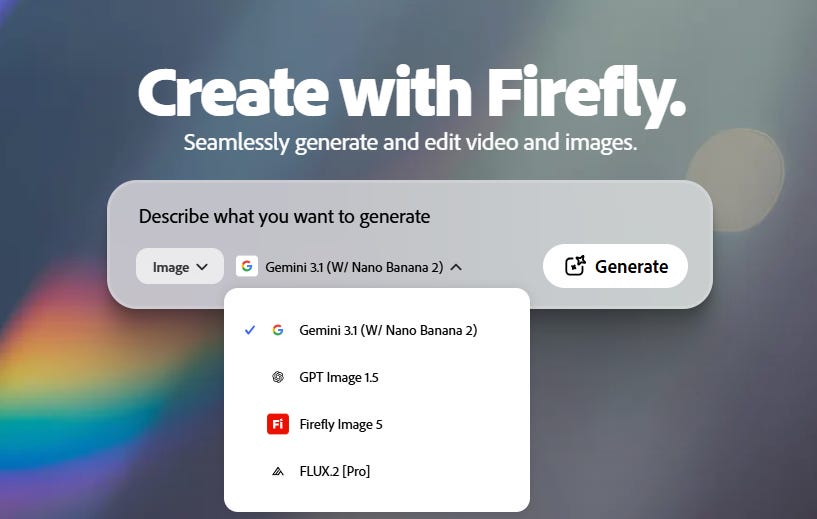
A practical demonstration of everything described above. To generate the summary table below, I asked Firefly: “Use the reference image to create a summary table, clear with colors, to illustrate an article.” The best result came from Gemini 3.1 via the Nano Banana 2 model — available directly inside Firefly without leaving the Adobe ecosystem. Fast, effective, gets the job done. The output is functional, not premium — the rendering feels a little cheap.
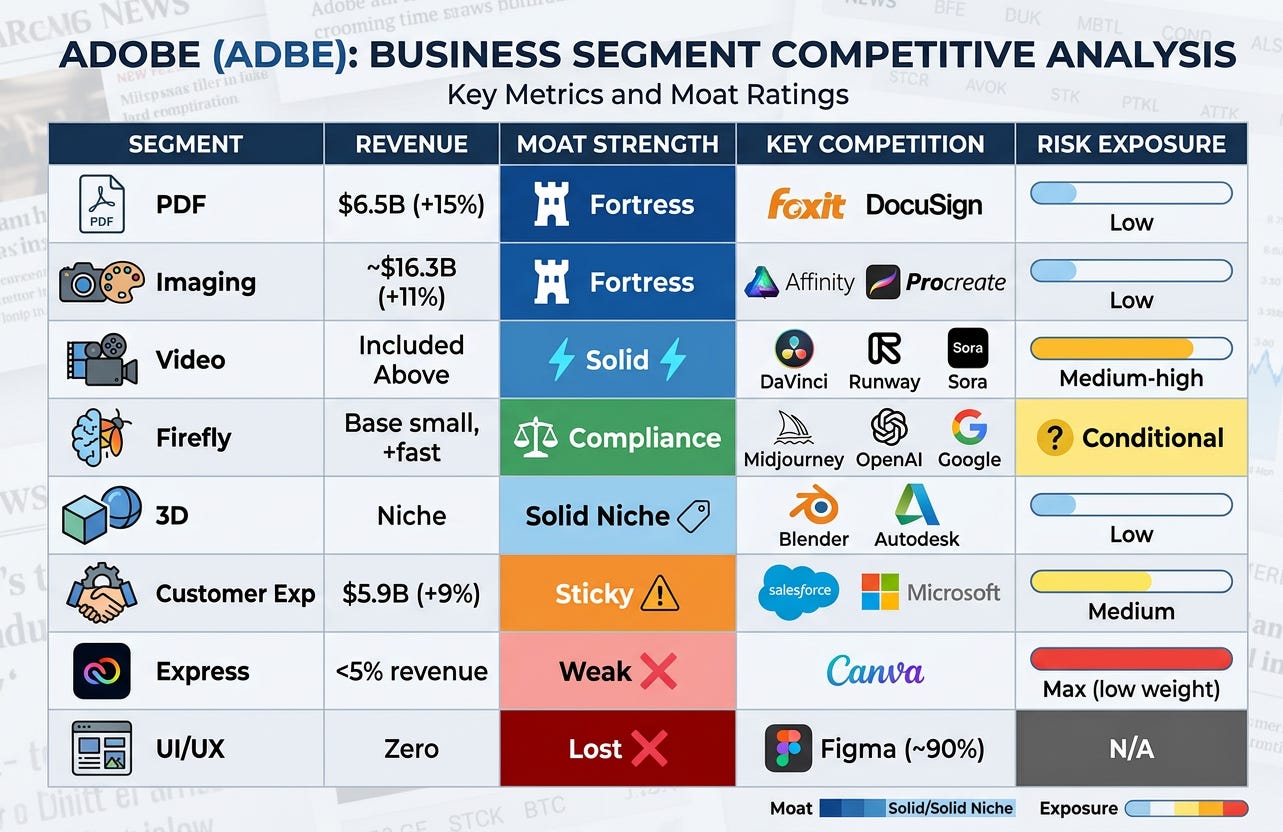
That is precisely the point. Adobe did not produce the best image. It produced the most integrated workflow. One prompt, one interface, multiple models orchestrated behind the scenes. The result is not a demonstration of Firefly’s generation quality. It is a demonstration of Adobe’s orchestration strategy — and an honest illustration of where the moat actually sits.
Financials
Key financial metrics
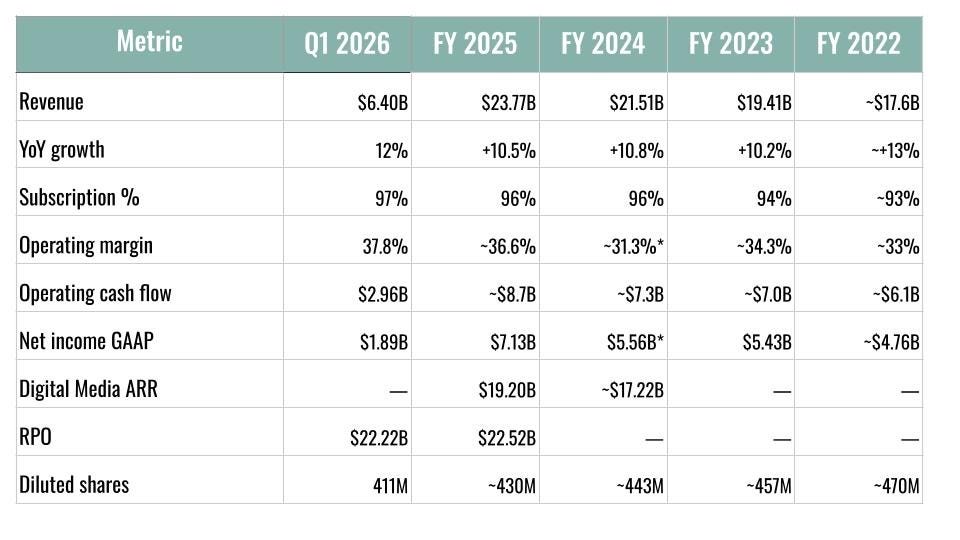
*FY2024 operating margin and net income depressed by the $1 billion Figma breakup fee.
Four comments on the numbers above.
On FY2024 and FY2025 net income. FY2024 was penalized by the $1 billion Figma breakup fee recorded as an operating expense. FY2025 shows +28% net income growth — real, but amplified by the depressed FY2024 base. The underlying organic growth trend is in the 10-12% corridor. Do not read the FY2025 jump as an acceleration in operational performance. It is a normalization.
On gross and operating margins. Gross margin runs at 89% — structurally above peers. Microsoft runs at approximately 70%, Salesforce at approximately 75%. The operating leverage is real: R&D and marketing are largely fixed costs. Every incremental dollar of subscription revenue falls through to operating income at a high rate. The emerging pressure is on the cost of goods sold line — AI inferencing costs (GPU compute, cloud hosting for generative workloads) are rising faster than the generative credit revenue they support. The 10-K acknowledges this explicitly. It is not yet a margin problem. It is a trend to monitor.
On operating cash flow. Q1 2026 operating cash flow of $2.96 billion grew 19% versus Q1 2025 — significantly outpacing the 4% growth in net income. The divergence reflects strong receivables collection, not a structural change. Do not annualize the quarterly figure. The relevant number is the trailing twelve-month operating cash flow, which runs above $10 billion for FY2025 per the Summit disclosure.
On ROIC, buybacks, and the ROE distortion. NOPAT for FY2025 approximates $7.14 billion (operating income of $8.71 billion multiplied by one minus the 18% effective tax rate). Invested capital approximates $11.24 billion (debt of $6.21 billion plus equity of $11.62 billion minus cash of $6.60 billion). ROIC approximates 63% — six to seven times the weighted average cost of capital of approximately 9-11%. This is a business that finances its growth with its customers’ money: deferred revenue of $7.03 billion is a free float, and capital expenditure of $179 million represents less than 1% of revenues.
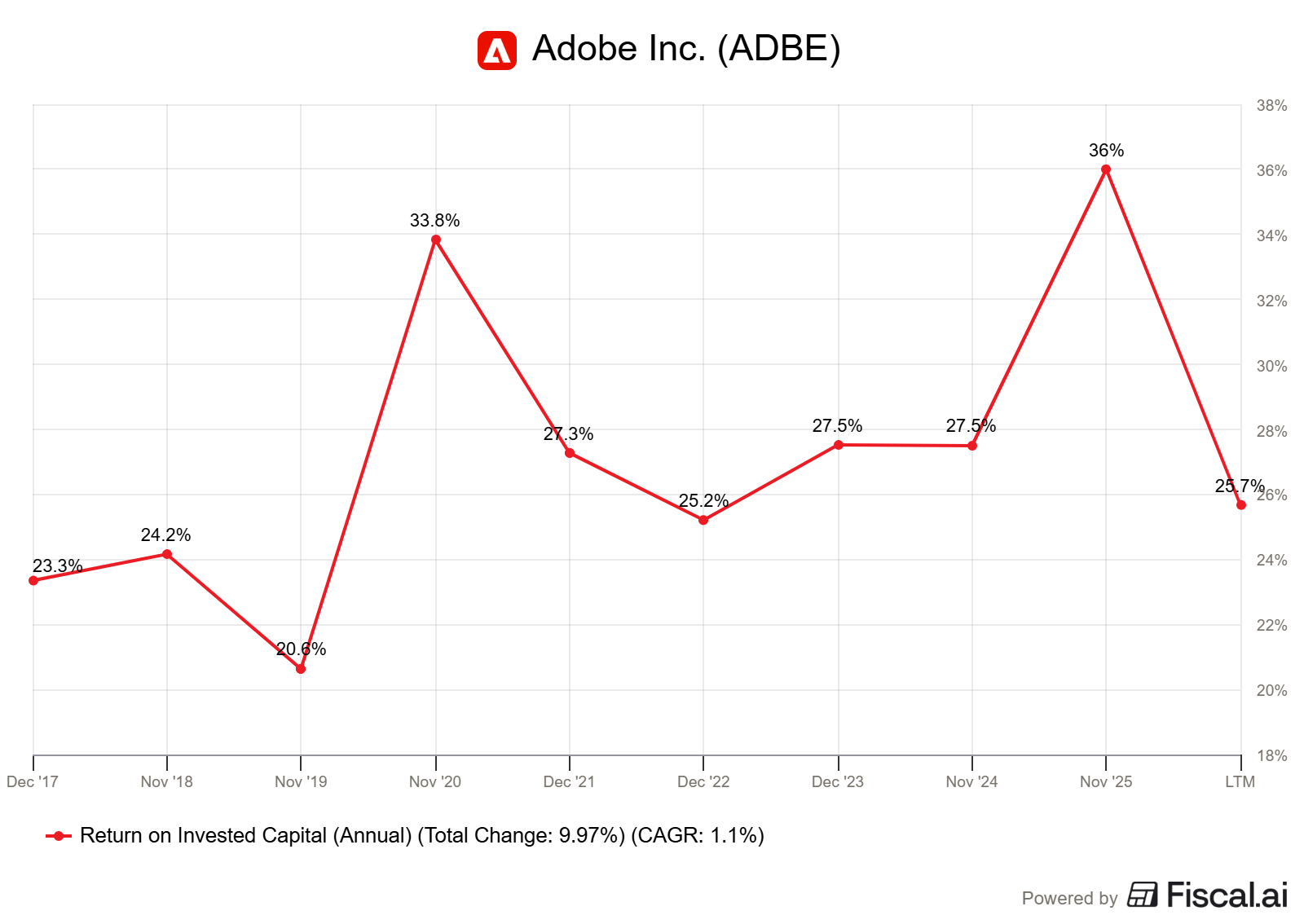
(The y-axis does not start at zero. This exaggerates movements and misleads the reader. A chart that does not respect this basic principle should not be trusted. )
The buyback program translates this directly into per-share value. Diluted shares fell from 438 million in Q1 2025 to 411 million in Q1 2026 — a reduction of 6.16% in twelve months. At $2.48 billion deployed in Q1 alone, the mechanical EPS growth from share count reduction runs at 16-17% annually independent of revenue growth. A $25 billion buyback authorization announced at Summit 2026 signals management’s explicit view on the undervaluation.
A note on ROE: the accumulated treasury stock of $48.8 billion makes the reported book equity figure ($11.43 billion) economically misleading and the resulting ROE astronomically high. Ignore the ROE. The relevant metric is ROIC and its direction — structurally stable to rising, with the FY2024 to FY2025 improvement partially explained by the Figma base effect and the mechanical reduction in invested capital from buybacks rather than purely operational improvement.
The recent quarterly filings show no accounting flags worth flagging — clean revenue recognition, no unusual adjustments, no restatements. The balance sheet is straightforward: $6.89 billion in cash and short-term investments, $6.23 billion in total debt, revolving credit facility of $1.5 billion undrawn, commercial paper program of $3 billion undrawn. The Semrush acquisition at $1.9 billion closes in Q2 2026 and is fully cash-funded without debt issuance or equity dilution.
Management
Shantanu Narayen — CEO since 2007, departure announced
Narayen did not found Adobe. He inherited a dominant business at an inflection point and made the most consequential decision in the company’s history since the invention of PostScript.
In 2012, he ended the perpetual license model for Creative Suite and moved the entire product portfolio to a monthly subscription. The backlash was immediate — designer communities organized boycotts, petitions circulated, the stock fell on the announcement day. Narayen held the line. Within eighteen months the model was clearly working. Within five years it had transformed Adobe from a cyclical software vendor into one of the most predictable recurring revenue machines in enterprise software. That is the track record that matters.
The Figma chapter is the more complicated entry on his ledger. The $20 billion acquisition attempt valued Figma at approximately 50 times ARR — a price that reflected strategic panic as much as strategic vision. Regulators blocked it. Adobe paid $1 billion to walk away. The market read it as a failure of judgment. The correct reading is more nuanced, developed in the Two Thesis section.
His departure is the central uncertainty of this investment in June 2026. The market prices it as a risk. It is also a potential catalyst — the new CEO’s first act will almost certainly be a conservative reset of expectations, a purge of near-term cost visibility, and a re-anchoring of guidance to beatable levels. That Kitchen Sinking dynamic — depressed expectations followed by modest outperformance — is a well-documented pattern in CEO transitions at large software companies. It tends to be the starting point of a rerating, not the continuation of a decline.
Dan Durn — CFO
The CFO is the more analytically useful signal in this management team. Durn has been transparent about the infrastructure cost increases associated with AI workloads in every recent earnings call — no varnish on the GPU spend, no inflation of the timeline for cost normalization. ARR, RPO, and buyback volumes are presented as raw figures without embellishment. The $25 billion buyback authorization announced at Summit 2026 came with explicit language: a direct expression of confidence in the long-term cash flows and intrinsic value of the business.
Capital allocation
R&D investment. $4.29 billion in FY2025, 18% of revenues, concentrated on the segments with the highest ROIC. XD was discontinued and the engineering resources were redeployed toward Photoshop, Acrobat, and Firefly. No budget spreading across dying products for organizational comfort. The allocation follows the returns.
Buybacks. No dividend — correct for a business trading at 11 times forward earnings. The first available dollar goes to repurchasing shares at a price management considers depressed. $2.48 billion deployed in Q1 2026 alone. 6.16% of shares retired in twelve months. $25 billion authorized through April 2030.
Skin in the game
Executive compensation is structured around performance RSUs tied to recurring revenue growth, operating margin, and relative total shareholder return over multi-year periods. Management has meaningful equity exposure to the outcomes they are describing.
On the SBC cost: stock-based compensation runs at approximately $800 million annually — roughly 9-10% of operating cash flow. This is in line with industry standards for a software company of this scale and complexity, and is acceptable given the talent retention imperative in AI and engineering. The FCF minus SBC figure is the honest measure of cash generation available to shareholders after the dilution cost of retaining talent is accounted for. At the current buyback pace, Adobe is repurchasing shares materially faster than it is issuing them — the net share count reduction of 6.16% in twelve months is after SBC issuance, not before.
The Two Thesis
Bear
Why the stock has fallen
The decline is not explained by a deterioration in fundamentals. Revenue grew +10.5% in FY2025, operating cash flow grew +19% in Q1 2026, Digital Media ARR grew +11.5%. The stock fell because the market repriced the risk of a future that has not yet arrived.
Five factors combined:
The UI/UX capitulation — a visible, quantified loss, revenue = zero, that gave the bear thesis a concrete data point.
The weakness of Express against Canva — a segment Adobe should have owned and didn’t.
The uncertainty around AI monetization — inferencing costs rising faster than generative credit revenues, a genuine near-term margin question.
The announced departure of Narayen — a management risk premium layered on top of everything else.
The antitrust veto on Figma — the removal of the historical defense mechanism that had protected Adobe’s competitive position for two decades. Adobe’s playbook for handling threatening entrants was to acquire them before they became existential: Macromedia, Omniture, Marketo, Magento, Workfront, Frame.io. Figma was the first time that playbook failed. The market concluded — reasonably — that Adobe can no longer defend its borders through acquisition. That constraint is permanent.
The bear arguments
AI horizontal disruption. The value in the content creation stack is migrating toward the model layer — and Adobe does not own the best models. Midjourney, OpenAI, and Google produce superior generation quality. If the model becomes the product and the interface becomes a commodity, Adobe’s decades of tooling investment become a legacy liability rather than a competitive asset. The installed base protects nothing if users stop needing the installed base.
The generalist weakness. Adobe defends many fronts simultaneously — imaging, video, design, PDF, customer experience, consumer — with finite R&D of $4.29 billion. Each attacker concentrates everything on a single front: Canva on consumer design, DaVinci on high-end video color grading, Runway on AI video generation, Midjourney on image generation. A specialist with all its resources focused on one battlefield consistently outperforms a generalist spreading its attention across many. The UI/UX loss is the empirical proof of this dynamic. Figma concentrated everything on collaborative browser-based design. Adobe had XD as one of many priorities. Figma won completely. The question is not whether this pattern exists — it does. The question is which front is next.
Vertical to horizontal. Adobe is a vertically integrated stack — ideation to creation to production to activation, all proprietary, all Adobe. The disruption dynamic pushes toward modular horizontal architecture: best-of-breed point tools connected by open APIs, with AI models as a pluggable horizontal layer. If enterprise buyers shift from suite purchasing to best-of-breed assembly, the integrated stack advantage erodes into a coordination cost.
The trust narrative is not a moat. Narayen frames Adobe as the trusted partner enterprises turn to when they are anxious about AI proliferation. That is CEO positioning — the kind of thing you say on stage at your own conference. Enterprises do not pay 89% gross margin software because a brand reduces their anxiety. If the operational and legal lock-in erodes — if compliance standards around AI training data become commoditized, if activation integrations become open APIs that any tool can plug into — the trust narrative evaporates with it. A moat built on emotional preference is not a moat.
What if the bear thesis is really true?
If AI disruption is genuinely underway on the core segments, the warning signs would appear in the field before the financials. Competitive share losses become visible twelve to eighteen months before they show up in revenue — Figma had won the UI/UX market in the design community before Adobe’s revenue line showed anything. The field signals worth watching:
Design schools dropping Photoshop from their curriculum in favor of AI-native tools.
Enterprise procurement shifting Creative Cloud standardization to best-of-breed alternatives.
Job postings no longer requiring Adobe proficiency as a baseline.
Creative agencies publicly migrating workflows away from the Adobe stack.
None of these signals are present today. When they appear, the financial deterioration will follow within twelve to eighteen months. Positioning on the field signal — before the financial confirmation — is the entire point. Waiting for Digital Media ARR to decelerate below 5%, for gross margin to fall durably below 87%, for retention rates to visibly decline — by then the entry point at 11 times earnings is gone. The market will have moved twelve months earlier.
Bull
The business the market is ignoring
The bear thesis is being priced as present reality. It remains a future risk. Digital Media ARR grew 11.5% in Q1 2026. Gross margin came in at 89.6% — a record. Operating cash flow grew 19%. RPO stands at $22.22 billion — one full year of revenue already contractually committed before a single new contract is signed. 97% recurring. The field signals that would precede a structural deterioration are absent. This is not the financial profile of a business in structural decline.
The mathematical invalidation
The bears focus on the attacked segments. The numbers tell a different story. Acrobat growing at +15% and professional imaging growing at +10-11% represent approximately 81% of total revenues. The segments under attack — Express and the abandoned UI/UX — represent less than 5% of revenues combined. A complete collapse of both changes nothing material about the financial model. The bear thesis requires the destruction of the fortresses, not the periphery. There is no evidence of that.
The moat remains globally intact
The bear narrative conflates two very different realities: Adobe is losing on the edges, and Adobe is losing everywhere. The revenue map does not support that conclusion.
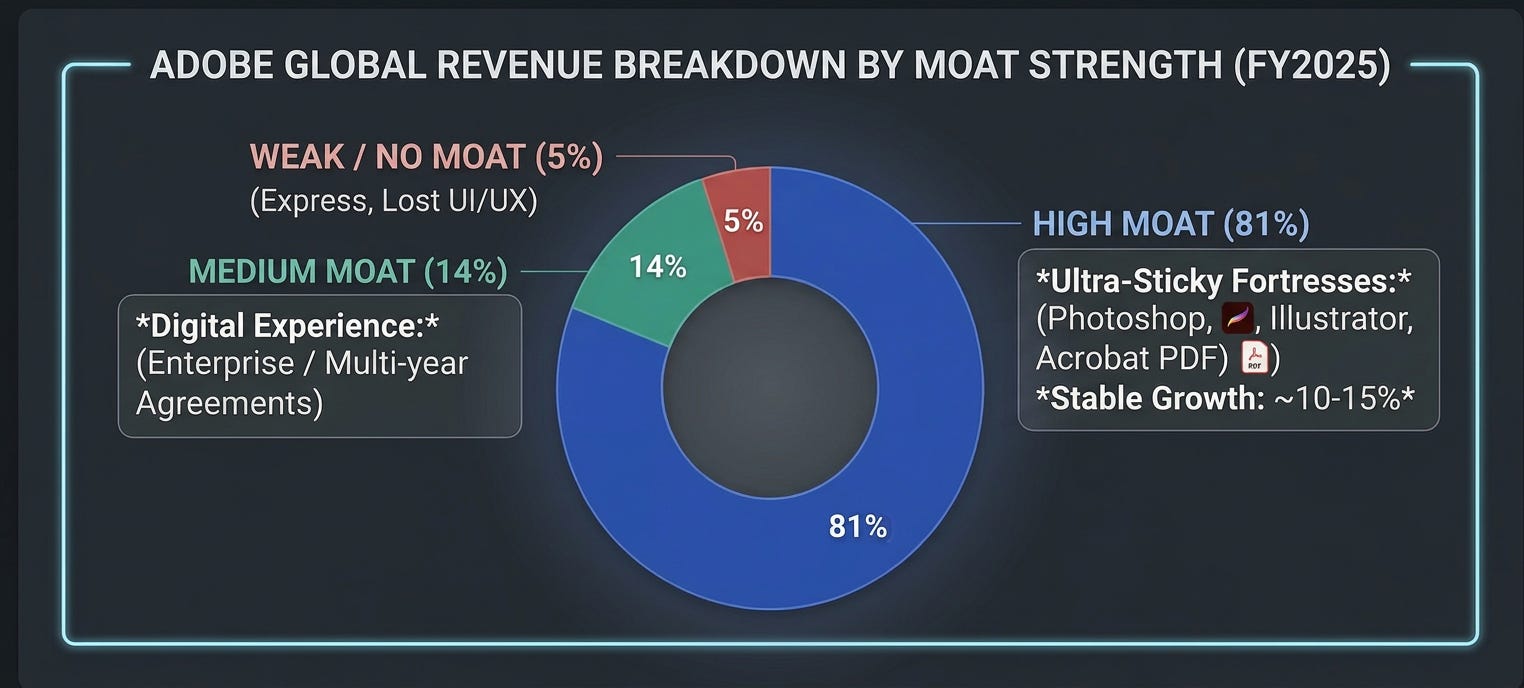
(Generated with Firefly / Nano Banana)
81% of revenues sit in segments with high moats and stable growth — Photoshop, Illustrator, Acrobat PDF. These are not segments under competitive pressure. They are segments where switching costs are prohibitive, where the labor market replicates the lock-in through every new hire, and where no competitor has made structural inroads in a decade. 14% sits in Customer Experience Orchestration — enterprise multi-year contracts, data embedded in AEP, high switching costs of a different nature. 5% is the exposed flank: Express and the abandoned UI/UX.
The bears have built a thesis on the 5% and extrapolated it to the 100%. That is the analytical error. A franchise where 81% of revenues are in intact fortresses, growing at 10-15% annually, with 89% gross margins, does not trade at 11× earnings because the business is broken. It trades at 11× earnings because the narrative is broken.
The fortresses have not moved. The sentiment has.
Two captive populations, two different locks
The investment case rests on understanding that Adobe’s customer base contains two structurally distinct captive populations — and that each is captive through a different mechanism that a single attacker cannot simultaneously break.
The first population is the creative professional. The lock is cognitive and cumulative. A senior designer who has spent ten years building muscle memory around Photoshop’s shortcuts, a photographer whose entire catalog lives in Lightroom, a motion artist whose After Effects template library represents years of production — none of these people are switching platforms because Affinity is cheaper or Midjourney is more impressive. The cost of switching is not the subscription fee. It is the temporary destruction of professional productivity, the retraining of ingrained reflexes, and the risk of failing a client during the transition. The lock is also self-replicating: design schools teach Photoshop, job postings require Adobe proficiency, and the muscle memory is transmitted through the labor market before Adobe charges a single dollar.
The second population is the large enterprise. The lock operates at two levels simultaneously.
The legal level first. Enterprise legal departments have already said no to Midjourney. Not because Midjourney produces inferior images — it often produces superior ones. Because the training data provenance is legally uncertain, the IP indemnification is absent, and a multinational running a global advertising campaign cannot accept the litigation risk. Adobe Firefly, trained on licensed content with full IP indemnification, is the only scaled answer to that legal constraint. Adobe is not selling generation quality to this customer. It is selling an insurance policy against a Getty Images lawsuit.
The operational level second. Adobe does not claim to have the best generative model. It claims to be the place where all the best models work together. Firefly integrates 30+ third-party models — Google, OpenAI, Anthropic, Runway, Flux, Ideogram — directly into the creative workflow. A designer who wants Midjourney’s aesthetic, OpenAI’s precision, and Runway’s video generation does not need to open 50 tabs, download from one platform, upload to another, reformat, re-import, and start over. They stay in Photoshop. They stay in Premiere. The models come to them.
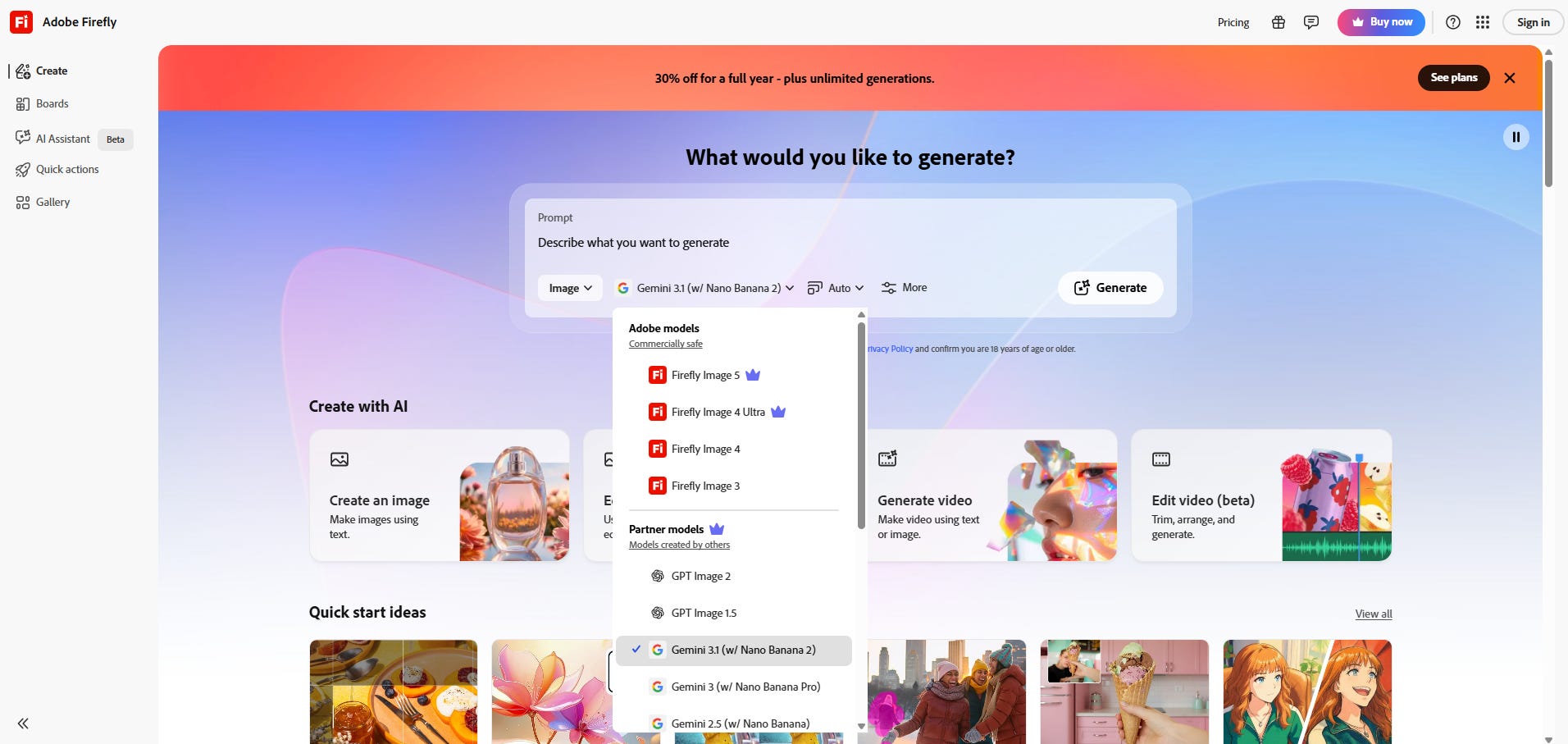
The alternative is what happens without Adobe. Generate in Midjourney, download the file, open Photoshop, import, edit, export, upload to the campaign management platform, reformat for each channel, re-upload to each ad platform separately. Then do it 10,000 times. Then ensure every asset is brand-compliant. Then ensure no asset contains training data that exposes the company to an IP lawsuit. Then govern which employees are sharing which proprietary assets into which public models. And before any of that — get each best-of-breed tool individually approved, budgeted, contracted, and security-reviewed by IT and procurement. Every new tool is a separate vendor relationship, a separate budget line, a separate compliance review, a separate renewal negotiation.
“It’s an operational and a legal nightmare. That’s the kind of thing you wish to your enemy.”
Adobe controls the last-mile activation points through GenStudio’s native integrations with every major advertising platform — Google Campaign Manager 360, Meta Ads, LinkedIn, Amazon Ads. Even an enterprise that generates content with an open-source model upstream must transit through Adobe to activate, measure, and optimize at scale. The pipes are Adobe’s.
The self-cannibalization signal
Adobe Stock — the licensed image marketplace — is seeing accelerating revenue decline as AI generation replaces stock photo purchases. Management acknowledged approximately 30 basis points of drag on total ARR in Q1 2026. The bears read this as evidence that AI is destroying Adobe from within.
The correct reading is the opposite. Adobe is deliberately cannibalizing its own stock photo business with Firefly rather than letting Midjourney do it instead. Apple made the same decision when it killed the iPod with the iPhone. The $30 iTunes download was replaced by the $1,000 iPhone. Adobe is replacing a stock photo purchase — a one-time transaction — with a generative credit subscription embedded in a recurring ARR relationship. The transition costs 30 basis points today. The question is what it builds tomorrow.
The Stock Cannibal at a distressed price
Since the market decided Adobe was worth 11 times its earnings, Adobe has been buying its own shares at a historically low price. 6.16% of shares retired in twelve months. At this pace, EPS grows at 16-17% annually through pure share count reduction — independent of revenue growth, independent of AI monetization, independent of the SaaSpocalypse narrative. Even in a scenario where revenues stagnate, the investor’s share of the earnings base grows every quarter. The Stock Cannibal does not require a bull market to work. It requires a depressed price and a cash-generative business. Both conditions are currently met.
The Ballmer scenario — why no visionary is required
The market is punishing the Narayen departure as if Adobe requires a visionary CEO to survive the AI transition. That is the wrong frame.
Microsoft under Steve Ballmer missed every major technology shift of the 2000s — smartphones, tablets, social networks. The market berated him for fourteen years. During that time, profits tripled. The infrastructure survived the strategic errors. Satya Nadella then monetized that infrastructure in ways nobody had anticipated.
A Ballmer-equivalent at Adobe — a disciplined operator who protects the fortresses, maintains the buyback program, and does not destroy capital on ill-conceived acquisitions — produces a satisfactory return from the current valuation without requiring any heroic assumptions about AI monetization. The PDF tooling franchise and the professional imaging suite do not need a visionary to keep compounding. They need competent stewardship of structural advantages that have taken thirty years to build. The bar is lower than the market is pricing.
If the successor turns out to be more than a Ballmer — a Satya Nadella profile who finds the next monetization layer in the AI transition — the upside is considerably larger. But the base case does not require it.
The cool of today is the cheap of tomorrow
The AI generation tools that feel disruptive today are following a pattern that has repeated itself in every technology cycle. The CGI effects of Jurassic Park required supercomputers and months of specialist work — today a TikTok filter replicates them in three clicks. The professional graphic design of the 2000s required years of Adobe training — Canva made that aesthetic available to anyone. The hyperrealistic AI images that impressed everyone two years ago now saturate every feed and are beginning to feel generic.
When technical execution becomes free and ubiquitous, the eye adjusts. The value migrates toward what the machine cannot replicate: judgment, narrative, cultural relevance, brand authenticity. Producing 10,000 images in a day is now trivial. Producing 10,000 images that are meaningfully different, strategically coherent, and brand-perfect is still hard. That is the problem Adobe’s professional tooling and enterprise orchestration platform are built to solve. The demand for creation does not shrink when creation gets cheaper — it explodes. That is Jevons’ paradox applied to content. Adobe is the infrastructure of that explosion.
Catalysts
Operational. Q2 2026 results on June 11th. The analyst consensus has been cut to $5.01 non-GAAP EPS against Adobe’s own guidance of $5.80-$5.85. The bar is historically low. A delivery in line with guidance produces a violent surprise effect — not because the business improved, but because the expectations had been driven below reality. The stabilization of inferencing costs relative to credit revenue growth is the second operational catalyst: when the margin pressure from AI compute visibly plateaus, the operating leverage embedded in the 89% gross margin structure will express itself fully.
Market. The bear thesis has become consensus. A significant portion of institutional holders are underweight or short Adobe on the SaaSpocalypse narrative. A reassuring publication forces those managers to cover — the buying pressure is mechanical and independent of any new fundamental development. The $25 billion buyback authorization running simultaneously creates a permanent bid below the market price.
Strategic. The CEO succession announcement is the single largest discrete catalyst available. A recognized, AI-credible successor profile eliminates the management uncertainty premium instantaneously. The Semrush closing in Q2 2026 validates the post-Figma M&A discipline — bolt-on, cash-funded, no dilution, no antitrust risk.
Macro. A Federal Reserve rate cut reduces the discount rate applied to long-duration recurring cash flows — mechanically expanding the PE multiple on a business with $22 billion in committed future revenues. A regulatory tightening on AI training datasets in the EU or US widens the Firefly compliance moat automatically: if legally clean training data becomes mandatory, Adobe’s competitive position strengthens through its competitors’ legal exposure rather than through any action Adobe takes.
Reverse-DCF — what the market implies
At approximately $260 per share and a market capitalization of approximately $102 billion, the market implies that the present value of Adobe’s growth opportunities — the PVGO — represents only 20-35% of the total price, depending on the WACC assumption. The remaining 65-80% is paid for by the earnings the business generates today, with zero incremental growth assumed.
The market is pricing Adobe as a no-growth cash machine. At 11 times forward earnings, you are not paying for the AI monetization optionality, the Firefly ARR trajectory, the Customer Experience Orchestration expansion, or the operating leverage embedded in the margin structure. You are paying for the rents that already exist — and getting everything else for free.
What would invalidate the bull thesis
Three signals to monitor every quarter:
Digital Media ARR decelerating structurally below 5% growth.
Gross margin declining durably below 87% under inferencing cost pressure.
Creative Cloud retention rates falling visibly in any disclosed metric.
None of these signals are present. When one appears, the thesis requires reassessment. Until then, the bear case is a future risk priced as a present reality.
Blind spots
The monetization velocity of generative credits into ARR is difficult to isolate from public disclosures — the aggregate figures support the narrative but do not yet prove the thesis at scale. The inferencing cost trajectory remains uncertain: nobody outside Adobe knows how fast GPU costs will rise relative to credit revenue growth over the next four quarters. The segment merger from FY2026 reduces the granularity available to track Digital Media versus Customer Experience Orchestration separately. The CEO succession timeline and profile are unknown. The transition toward consumption and outcome-based pricing introduces partial variabilization of ARR that could create quarterly volatility in reported metrics without reflecting underlying business deterioration.
Valuation
The PE story
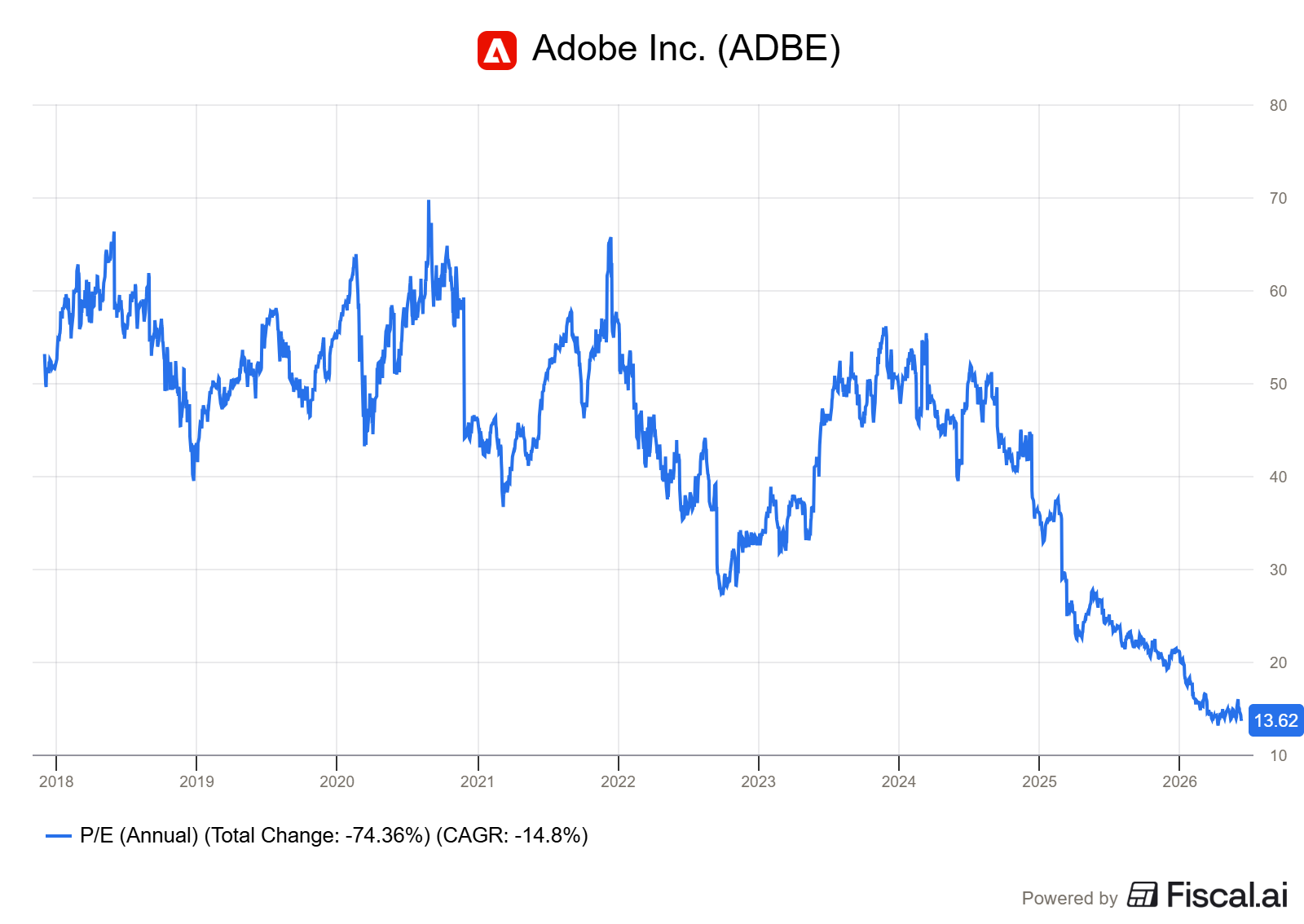
Adobe traded between 40× and 60× trailing earnings during the 2021 SaaS euphoria. The normalization began in 2022 with rising rates. The Figma blocking in late 2023 accelerated the compression. The SaaSpocalypse narrative and the Narayen departure announcement finished the job.
Today Adobe trades at approximately 14×-16× trailing earnings — its lowest level since the pre-pandemic era. The software sector trades at a forward PE median of 13×-15×. Adobe, with 89% gross margins and 97% recurring revenues, trades at or below the sector median. A franchise of this quality has never sustainably traded at these multiples outside of crisis conditions.
Two readings are possible. Either the market is right and Adobe is in structural decline — in which case the financial data should already be showing early deterioration. Or the market is wrong and is pricing a future risk as a present reality — in which case the current multiple is an anomaly that will correct when the narrative shifts.
The financial data supports the second reading. The PE Gap is the entry point.
The capitulation signal
The technical picture confirms what the fundamentals suggest. In late May 2026, Adobe touched a low of $241.44 on volume of approximately 8.8 million shares — roughly double the daily average. A volume spike of that magnitude on a multi-year low is the signature of capitulation: forced sellers and momentum traders exiting at any price, absorbed by institutional buyers with a longer time horizon.
Since that low, the stock has recovered to the $256-$263 range. The short-term moving averages — 8, 20, and 50-day — have been reclaimed. The RSI has returned to a constructive 57-58, confirming that selling pressure has exhausted itself without the business having deteriorated.
The stock is still well below its 200-day moving average of approximately $303 — the long-term trend remains technically impaired. But the combination of a capitulation low, a volume-confirmed floor, and a $25 billion buyback program running at depressed prices creates an asymmetric setup: the downside is bounded by the buyback bid, the upside is bounded only by the pace of sentiment normalization.
Capitulation is not a prediction of immediate recovery. It is a signal that the most motivated sellers have sold. What remains is a cleaner shareholder base — and a management team deploying $2.48 billion per quarter into the same stock at the same depressed prices.
Valuation scorecard
Assumptions
Entry price: $258.00 (June 5, 2026). Time horizon: 2.57 years, targeting end of 2028. Base GAAP EPS run-rate: approximately $17.35 (FY2025 net income of $7.13 billion divided by approximately 411 million diluted shares).
The EPS growth in each scenario is built from the revenue trajectory of the individual segments, combined with the buyback program. Bear case assumes a defensive freeze — share count stays flat at 410.1 million, no contribution from capital return. Central and bull cases assume 6% annual share count reduction.
Base case — segment revenue assumptions:
PDF / Acrobat: +15% — verified FY2025 trajectory, AI Assistant adoption adds a layer to the structural monetization of the Reader installed base.
Professional imaging (Photoshop, Illustrator, Lightroom): +10-11% — the cultural fortress compounds steadily.
Video and motion (Premiere, After Effects): +10% — DaVinci pressure is real but contained; the workflow lock holds.
Firefly / AI generation: strong growth on a small base — generative credit consumption accelerating, enterprise compliance contracts building; not yet material to the aggregate.
3D — Substance: moderate growth — niche market, insulated from AI disruption short term.
Digital Experience / Customer Experience Orchestration: +9% revenue, +11% subscription — in line with market, no pricing power expansion assumed.
Adobe Express: +2% — no recovery assumed against Canva.
UI/UX — ex-XD: zero.
On the EPS side, the buyback program retires approximately 6% of shares annually independently of revenue growth — 6 percentage points of EPS growth with no operational improvement required. Combined with the segment trajectory above, base case EPS growth is approximately +16% annually.
Bear case (+6% EPS/year) — this scenario implies disruption contaminating the fortresses themselves. PDF and Document Cloud decelerates to +8%, professional imaging to +5%, Digital Experience to +5%. Express stays at +2%. Firefly monetization stalls. Buybacks continue but cannot compensate for fortress erosion. This is not a scenario where Canva wins the consumer market — that has already happened and is already priced. This is a scenario where the field signals described in the bear thesis begin to materialize: design schools dropping Photoshop, enterprise procurement shifting away from Acrobat, Creative Cloud retention visibly declining. The +6% EPS is the mechanical floor when revenue growth collapses to near-zero and only buybacks remain.
Base case (+16% EPS/year) — the Ballmer scenario. No visionary CEO required. No AI monetization acceleration required. No rerating beyond historical norms required. The fortresses hold, the buyback runs, and the multiple normalizes toward the lower bound of the historical range. This is the minimum reasonable outcome if the bear thesis does not materialize on the segments that matter.
Bull case (+26% EPS/year) — the fortresses hold AND Firefly begins to print materially in the aggregate ARR AND the new CEO is credible AND Customer Experience Orchestration reaccelerates on agentic adoption. The multiple returns toward a normal SaaS quality valuation. This is not the 2021 euphoria. This is simply what Adobe is worth when the market stops pricing it as a dying business.
The scorecard
Two-year horizon. Current price ~$260. Pre-tax, pre-fees.
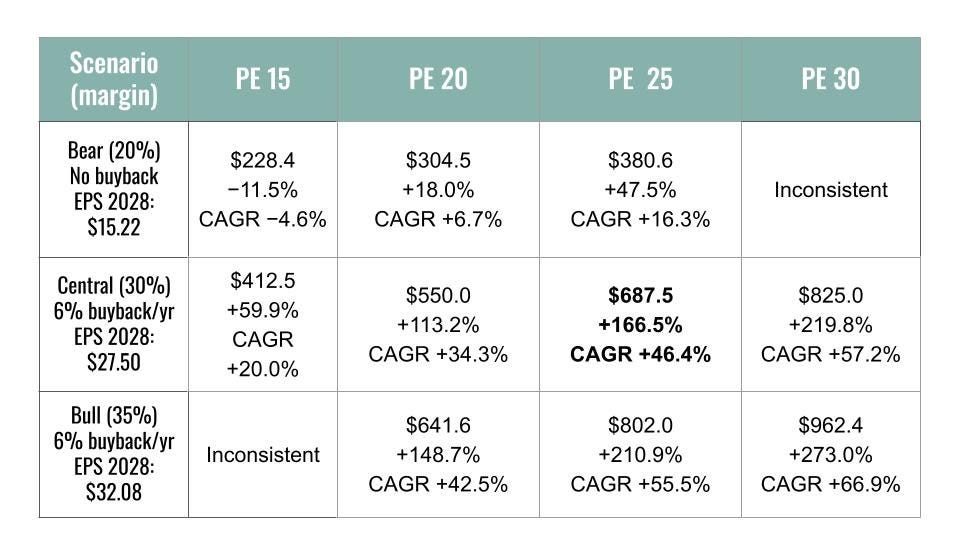
One important caveat: all figures are pre-tax and pre-fees. The actual return in your hands will depend on your tax situation, the investment vehicle you use, and any transaction costs. A gain of +62% in a taxable account is not the same as +62% in a tax-sheltered envelope. Run the numbers for your own situation before drawing conclusions.
How to read this
The bear case assumes no buyback contribution — a defensive freeze with share count flat at 410.1 million — and an operating margin of 20%, reflecting fortress erosion. EPS 2028: $15.22.
At PE 15× — $228, -11.5%, CAGR -4.6% — this is the scenario where the SaaSpocalypse narrative persists and disruption has genuinely begun to erode the core segments. A real loss, but a modest one. The earnings power of a business generating $10 billion annually in operating cash flow does not evaporate overnight. At PE 20× — $304, +18%, CAGR +6.7% — growth disappoints but the multiple partially normalizes. A positive return even in the pessimistic scenario.
The central case assumes 6% annual buyback and an operating margin of 30%. EPS 2028: $27.50. At PE 20× — $550, +113%, CAGR +34.3% — the Ballmer scenario. No visionary CEO required. No AI moonshot required. The fortresses hold, the buyback runs, the multiple normalizes toward the lower bound of its historical range. At PE 25× — $687, +166%, CAGR +46.4% — the same scenario with a multiple that reflects the quality of the business rather than the fear surrounding it.
The bull case assumes 6% annual buyback and an operating margin of 35% — returning to pre-AI-infrastructure-investment levels as inferencing costs stabilize and operating leverage expresses itself. EPS 2028: $32.08. At PE 25× — $802, +211%, CAGR +55.5% — this is my personal conviction scenario. Not the prediction. The consequence if Adobe stops being priced as a dying business. At PE 30× — $962, +273%, CAGR +66.9% — a full rerating toward historical norms. Not necessary for the thesis to work.
The S&P 500 benchmark over the same 2.57-year horizon: +27.4% total return at +10% CAGR. The central case at PE 20× already doubles the benchmark. The bear case at PE 20× still beats it.
The asymmetry
The realistic downside is contained. The realistic upside is significant. That gap — not the absolute price target — is the investment case.
You don’t need the bull scenario to make money here. You need the fortresses not to be broken.
Portfolio considerations
Sizing
The position sizing follows one principle: conviction should be proportional to the clarity of the thesis and the measurability of the downside.
On the thesis: the bear case requires the destruction of fortresses representing 81% of revenues. That destruction is not visible in the current data — not in ARR, not in gross margin, not in retention metrics, not in the field signals that precede financial deterioration. The thesis is clear.
On the downside: the bear case at PE 13× produces a -6% loss over two years. The floor is the earnings power of a business generating $10 billion in operating cash flow annually with 97% recurring revenues. That floor is measurable and concrete.
Both conditions — thesis clarity and measurable downside — justify a position above the portfolio neutral weight.
The position is currently 10% of the portfolio. The concentration is temporary by design. The target exit is a multiple normalization toward 18×-22×. When that normalization occurs — driven by a catalyst or simply by the passage of time — the position will be trimmed and the capital redeployed toward the next anomaly.
Style and correlation
Adobe is currently a Quality business priced as Deep Value. The fundamentals — 89% gross margins, 63% ROIC, 97% recurring revenues — are those of a premium software franchise. The price — 15× trailing earnings — is that of a mature industrial cyclical in a down cycle. That mismatch is the opportunity.
In a portfolio already concentrated in US large-cap technology, Adobe adds a style diversification rather than a sector diversification. The return driver here is not momentum or growth multiple expansion — it is sentiment normalization on a business whose fundamentals have not moved. That dynamic is largely decorrelated from the AI momentum trade that drives names like Nvidia or Microsoft at current valuations.
The defensive characteristic is real: Acrobat and Photoshop are operational expenses for the businesses and professionals that use them. They are not discretionary spend. In a recession, a law firm does not cancel its Acrobat Pro licenses. A design agency does not stop using Photoshop. The subscription base is structurally resilient to economic cycles in a way that advertising-dependent or transaction-dependent businesses are not.
A note on the cycle
Howard Marks’ framework on market cycles applies directly here. The SaaSpocalypse has moved sentiment from optimism to pessimism — from 50× earnings in 2021 to 15× earnings in 2026. That move has been driven by narrative, not by a proportional deterioration in fundamentals. The business that generated $7.13 billion in net income in FY2025 is not priced like a business generating $7.13 billion in net income. It is priced like a business expected to generate significantly less.
Cycles turn not when the news gets good, but when the news stops getting worse. The Q2 2026 results on June 11th are the first test. A delivery in line with guidance — against a consensus that has been cut to levels below Adobe’s own guidance — is sufficient to begin the turn. No acceleration required. No new narrative required. Just the absence of the deterioration the market has priced in.
Conclusion
Adobe is not a broken business. It is a misread one.
The market has applied a distressed multiple to a franchise generating 89% gross margins, 97% recurring revenues, and $10 billion in annual operating cash flow. The fear driving that discount — the SaaSpocalypse — is a legitimate long-term risk and an absent present reality. The ARR is growing. The gross margin is at a record. The field signals that would precede a structural deterioration are not there.
The bears are right about the edges. Express lost to Canva. UI/UX was surrendered to Figma. These are real losses. They represent less than 5% of revenues. The bears are wrong about the conclusion: that peripheral losses signal systemic collapse. The fortresses — PDF, professional imaging — represent 81% of the business and are intact.
At 15× trailing earnings, you are not paying for the AI optionality, the Firefly ARR trajectory, the Customer Experience Orchestration expansion, or the operating leverage embedded in the margin structure. You are paying for the rents that already exist. Everything else is free.
And while the market debates the SaaSpocalypse, Adobe retires 6% of its own shares every year.
Superior products and superior environments drive superior returns. With Adobe you got world-class products with fortress environments on most of the products — with the valuation on a dying business.
The SaaSpocalypse is a story. The numbers tell a different one.
Image credits
Product and marketing visuals sourced from Adobe Inc. (adobe.com). Financial charts sourced from Fiscal.ai.
Important Disclosure & Disclaimer
All content published by JB Peter on this platform is strictly for educational and informational purposes. It does not constitute investment, financial, legal, or tax advice, nor does it represent a personal recommendation or solicitation to buy or sell securities. This research is operated by ORIACON (SASU) and reflects independent corporate analysis. Every reader must conduct their own independent research (Due Diligence) or consult a licensed professional before making any financial decision, as financial markets involve a high risk of capital loss. At the time of writing, ORIACON or the author HOLD shares in the company analyzed in this article. Following this publication, ORIACON and the author reserve the right to buy, sell, or modify positions in any security mentioned at any time, without prior notice to readers or subscribers.