Peter Lynch called turnarounds one of the most rewarding categories in investing. He meant it literally.
Not rewarding in the sense of intellectually stimulating — though they are. Rewarding in the sense of returns. When a company is universally abandoned, the price embeds a probability of permanent failure that is almost always too high. Correct that probability, and the re-rating is violent.
Lynch knew something that most investors forget in the heat of a collapse: the market is not valuing the future, it is reacting to the past. It is pricing yesterday’s disaster, not tomorrow’s recovery. The investor who can separate the two — who can look at a broken company and ask not “what went wrong” but “what has actually changed” — is in a position that almost no one else occupies.
That position is lonely. It is uncomfortable. And it is, historically, exceptionally profitable.
Atos died of hubris. A technology conglomerate that confused size with strength, acquisitions with strategy, and complexity with value. The collapse was spectacular, painful, and entirely self-inflicted.
For French retail investors, Atos is something more than a failed investment. It is a wound. For years, the story dominated financial headlines — the profit warnings, the governance scandals, the revolving door of CEOs, the accounting irregularities, the restructuring that wiped out 99% of shareholder value. Every French investor with a brokerage account watched it happen in slow motion. Many owned it. Most lost money on it.
That collective trauma has a precise financial consequence: Atos has become uninvestable in the French retail imagination. Not because of what the company is today — but because of what it was. The ticker symbol alone triggers loss aversion, disgust, and the instinctive desire to look away.
That instinct is understandable. It is also, in my view, creating one of the most asymmetric opportunities currently available on the French market.
What interests me is not the collapse. It is what comes after.
Plan
This article starts with the story — five acts that explain everything about how Atos got here, and why the starting point matters for what comes next. The business section covers the go-forward entity: two operations, a simplified perimeter, the clients and products that remain. The competitive advantage section is short and honest — Atos has no moat, and the article says so directly. Financials and management follow, with particular attention to the post-May 2026 debt structure and the alignment of the man running the turnaround. The article then addresses why nobody wants to own this stock right now, presents the two competing theses in full, a nine-scenario valuation scorecard, and portfolio considerations including an explicit exit strategy.
I know you’re busy, so I always start with a summary called The short version. If that’s all you have time for, that’s fine. The rest of this article explains why.
The short version
Atos died of hubris. It is being reborn by simplification.
Every asset disposal, every contract exit, every headcount reduction makes the business more readable — and a readable business is a refinanceable business. Each simplification step unlocks better financing terms. Better financing terms reduce the distressed premium embedded in the equity. A lower distressed premium means the multiple converges toward peers. And a simple re-rating to peer multiples — without any growth assumption, without any AI optionality, without any macro tailwind — already implies a multiple of several times the current price.
Even in a scenario where the remaining debt maturities — €1,945m of intermediate and subordinated instruments due in 2029-2030 — were never refinanced, Atos enters that window with €1,736m of total liquidity, €1,086m above its covenant floor, and a business generating positive operating cash flow. The financial cushion is sufficient to execute the turnaround on its own terms. Refinancing is the upside, not the prerequisite.
The equity market has not seen this yet. The bond market has. In May 2026, Atos placed €1,250m of senior secured bonds maturing in 2031. The issuance was heavily oversubscribed by institutional credit investors — professionals who model default probability for a living and chose to lend rather than be repaid. The equity market prices distress. The bond market prices recovery. One of them is wrong.
My conviction is that Atos will recover. The base case — peer re-rating at 10% operating margin by 2028 — produces a ×6 return from current levels. The bull case, incorporating the Sovereign Agentic AI Studios and the French public sector demand recovery, produces a ×8 to ×10.
The first test is July 30, 2026. The rest of this article explains the work behind that conclusion.
The Business
History
To understand what Atos is becoming, you need to understand what it was. Not as a cautionary tale, but as a diagnostic. The pathology explains the cure.
Act One — The Ascent (1997–2014)
Atos was built methodically. A series of well-executed acquisitions — Siemens IT Solutions, Bull, Xerox ITO — created a genuine European IT services champion. The group managed the IT infrastructure for multiple Olympic Games, entered the CAC 40, and spun off its payment processing division Worldline in a €3.2 billion IPO. By 2014, Atos was what it claimed to be: the largest IT services company in Europe, with a coherent strategy and a track record of execution.
Act Two — The Hubris (2014–2019)
Then came the acquisitions that should never have happened.
The $3.4 billion purchase of Syntel in 2018 was the defining error. Atos paid a premium for an Indian IT services provider at the precise moment when the offshore IT services model was being commoditized from below and disrupted from above. The goodwill recorded on the balance sheet — maintained at an artificial level for years — became a slow-motion time bomb. Alongside Syntel, the group accumulated layers of complexity: subsidiaries, geographies, service lines, and cost structures calibrated for aggressive growth rather than sustainable profitability. As Philippe Salle would later state explicitly, the cost base was not aligned with market realities. It was built for conquest, not for margin.
Internally, the organization became political. Each division defended its territory, protected its headcount, and optimized for its own metrics. Nobody said no to low-margin contracts. Nobody asked whether the next acquisition made economic sense. The culture of winning at all costs — in revenue, in market presence, in headline numbers — overrode every discipline of capital allocation.
Act Three — The Revelation (2019–2021)
The cracks appeared sequentially, then simultaneously.
Profit warnings. Margin compression on fixed-price contracts signed before inflation. The discovery of reverse factoring arrangements used to artificially improve working capital. Goodwill impairments that should have been taken years earlier. Three CEOs in less than three years. And in September 2021, the final indignity: removal from the CAC 40, the index Atos had joined as a symbol of French technological ambition.
The auditor situation compounded the governance failure. Grant Thornton had signed the accounts for 36 consecutive years — the definition of the rubber stamp problem that Financial Shenanigans warns against explicitly. The accounting irregularities that eventually surfaced were not invisible. They were unseen because the people paid to see them had stopped looking.
Act Four — The Collapse (2021–2024)
What followed was three years of accelerating destruction.
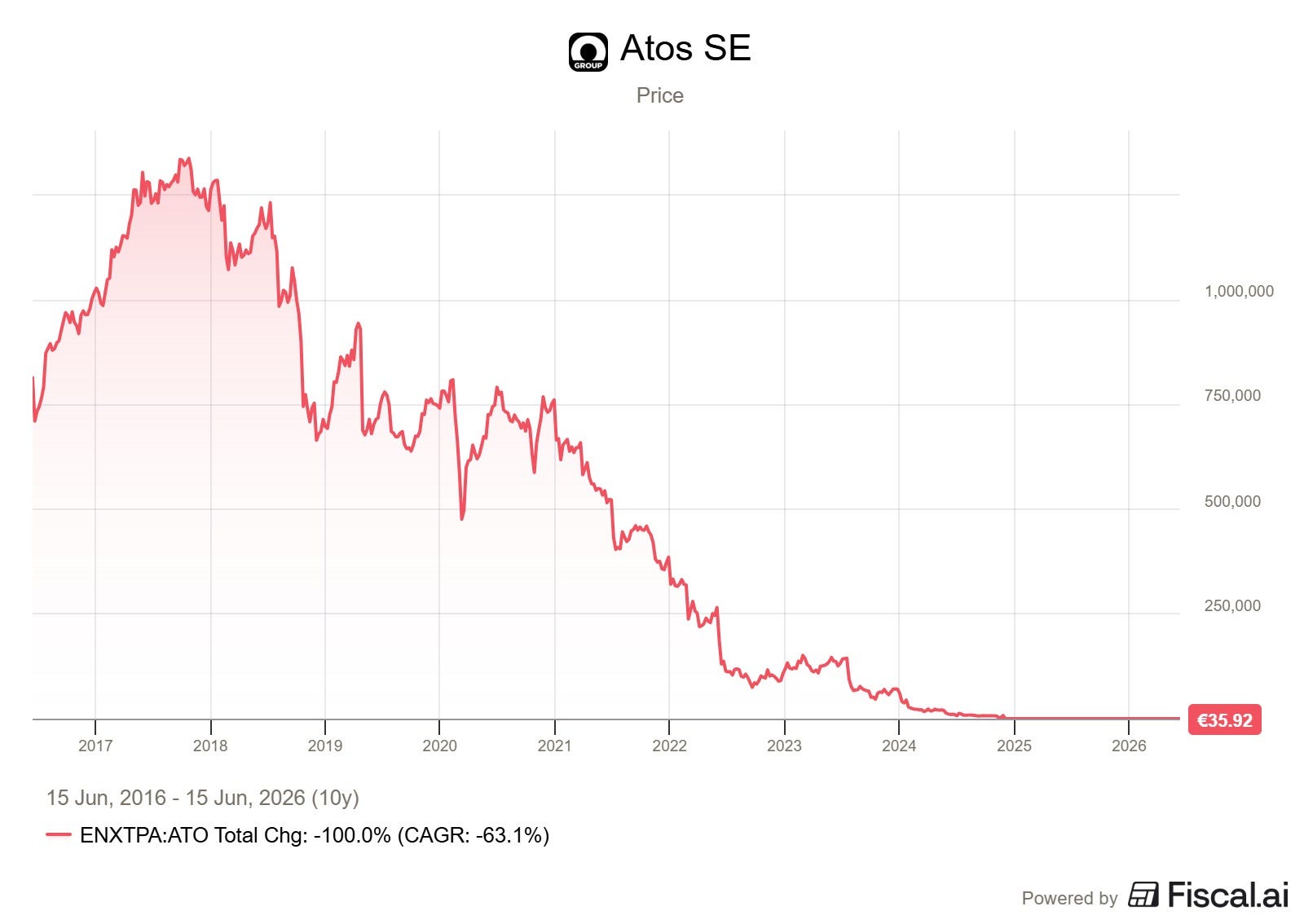
Accumulated net losses. Failed attempts to separate the group into two independent entities — Tech Foundations and Eviden — that went nowhere. A conciliation procedure, then a formal restructuring under French insolvency law. And finally, the event that burned the image of Atos into the memory of every French retail investor who held the stock: a 99,99% dilution of existing shareholders, as debt was converted into equity and the company was handed to its creditors. A share consolidation of 10,000 to 1 followed in April 2025 — a technical operation, but psychologically devastating for anyone still holding.
From a peak of €1,338,000 per share equivalent in 2018 to €15 at the restructuring low — a division by 89,000 in value for any shareholder who held through the entire journey. Not a bad investment. A generational destruction of wealth.
Act Five — The Reconstruction (2025–)
On January 16, 2026, the Commercial Court of Pontoise validated the restructuring plan. Philippe Salle, a specialist in corporate turnarounds with a documented track record, took the helm. The Genesis plan was launched — a structured program of cost reduction, contract rationalization, and portfolio simplification.
The results began to appear immediately. The Advanced Computing division, the former Bull supercomputer business, was sold for €252 million in cash, completed March 31, 2026. Ideal GRP was divested in January 2026. The South American operations are in the process of being sold. Four Sovereign Agentic AI Studios were launched across France, Germany, the UK, and the United States. The Sovereign Cloud platform is scheduled for launch in July 2026.
On May 12, 2026, Atos successfully placed €1.25 billion in senior secured bonds maturing in 2031 — heavily oversubscribed by institutional investors. The restructuring debt, carrying interest rates of up to 13%, was refinanced at approximately 8%. The wall of debt that had made the group technically insolvent was pushed back to 2031.
The reconstruction has begun. Whether it completes is the question this article addresses.
Segments of activity
Atos today operates through two distinct brands. Atos handles services. Eviden handles products and systems. The separation is not cosmetic — it reflects two genuinely different competitive realities, two different margin profiles, and two different roles in the investment thesis.
Atos Services competes in a market that commoditizes by design. Managed infrastructure, digital workplace, cloud migration, standard integration — these are services where price pressure is structural, where Indian offshore providers set the floor, and where the only sustainable response is either scale or specialization. Atos has chosen specialization. The Genesis contract rationalization — deliberately exiting low-margin agreements even at the cost of revenue — is not a concession. It is the only rational path for a European IT services provider that cannot win a price war against TCS or Infosys. Three points of the -11% organic revenue decline at Q1 2026 are voluntary exits. That number is a management decision, not a market signal.
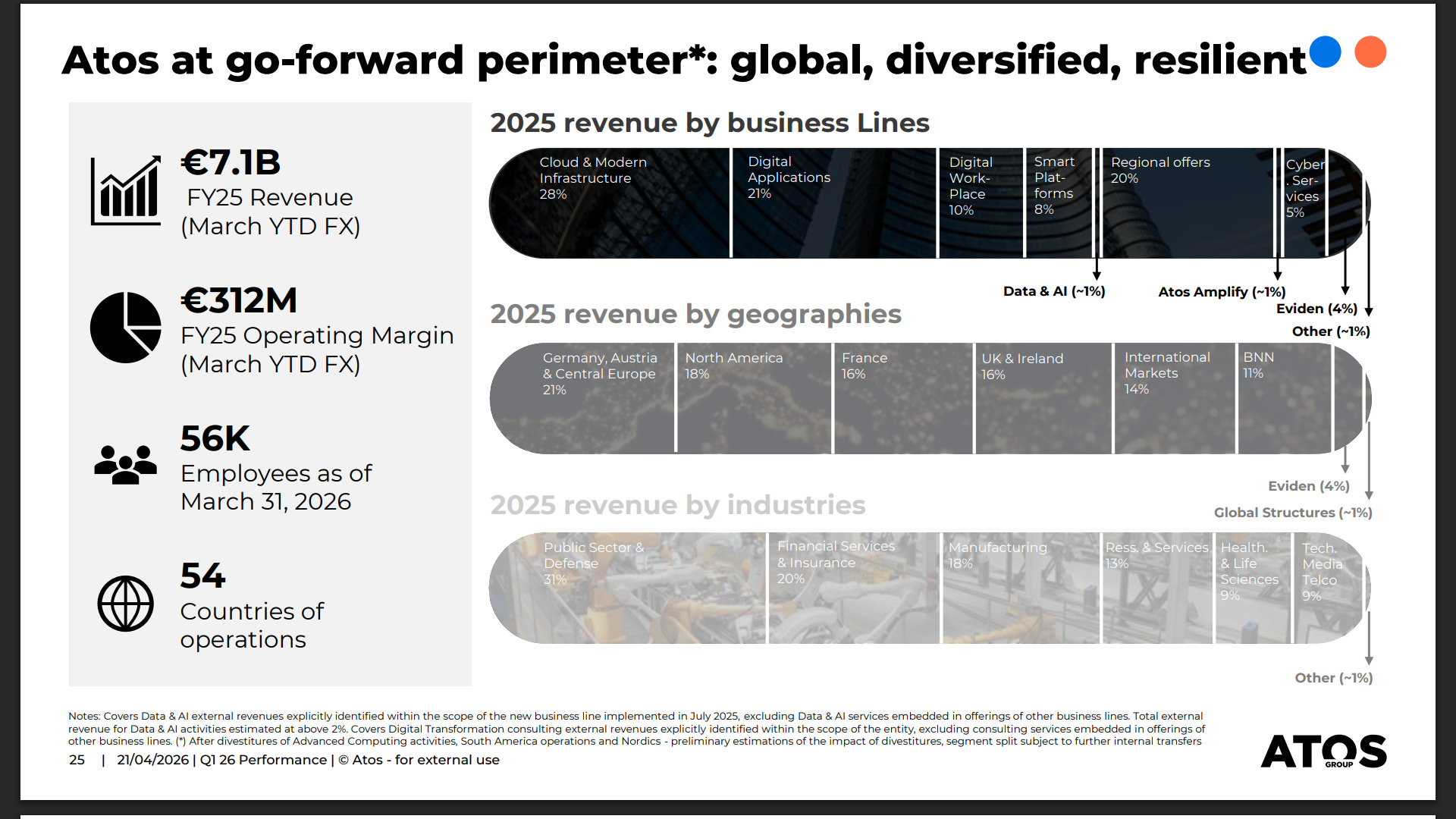
Eviden operates in a different world entirely. Cybersecurity hardware — HSM modules, key management systems, the Proteccio and Orbion product lines certified under France Cyber — cannot be produced by an offshore provider and cannot be replaced by a software subscription. The ANSSI certification, the PASSI accreditation renewed in 2026, the ISG Leader recognition in cybersecurity, and the security clearances required for defense contracts take years to obtain and cannot be purchased. Eviden’s competitive position is not commercial. It is regulatory. And it protects the 31% of group revenues coming from public sector and defense — the single largest client vertical, and the one with the highest barriers to competitive displacement.
Clients
The client base is not a collection of commercial relationships. It is a set of long-term institutional dependencies. Defense ministries across Europe. NATO. Critical infrastructure operators. Major French and German banks. Energy utilities. Large manufacturing groups. These organizations do not change IT providers lightly — the switching cost on a multi-year managed services contract runs to 15-25% of annual contract value, before counting operational risk.
The renewal rate of 94% at Q1 2026, up from 91% a year earlier, is the most direct measure of this dependency. Clients are renewing at higher rates during a period when Atos was still formally in restructuring. That number does not reflect enthusiasm for Atos. It reflects the rational calculation of organizations that cannot afford the disruption of switching.
The North America book-to-bill of 160% at Q1 2026 is the other number that matters. It is the clearest signal that the counterparty risk discount — the informal freeze on new commitments from clients who feared Atos might not survive — is lifting. Commercial decisions that were deferred for eighteen months are being made. That pipeline is converting at a rate that significantly exceeds current billings.
Products
Three forward product lines define the positioning of Atos beyond commodity IT services — and none of them appears in the current revenue mix in any material way.
The Sovereign Cloud Platform, scheduled for launch in July 2026, addresses a regulatory gap that American hyperscalers cannot fill regardless of their European data residency commitments. Jurisdiction over the operating entity is not the same as jurisdiction over the data. For any organization processing information that cannot leave French or European jurisdiction — and that category is growing with every new directive under NIS2, DORA, and defense procurement rules — this platform has no direct equivalent.
The Sovereign Agentic AI Studios, launched in Q1 2026 across France, Germany, the UK, and the United States, are four lighthouse deployments of autonomous AI agents on certified sovereign infrastructure for public sector and regulated industry clients. Revenue today is not material. Certifications, reference clients, and positioning are.
Proteccio HSM, KMS, and Orbion are certified hardware security products deployed across banking, government, and defense internationally. These are not commodity products. They are physically controlled, auditable, regulatory-grade security infrastructure that competitors cannot replicate without years of certification work — and that clients in classified environments cannot replace without equivalent years of re-certification.
Competition
On commodity IT services, Atos competes with Capgemini, Sopra Steria, CGI, T-Systems, and IBM Services in Europe, and with Indian offshore providers globally. This is where Genesis is actively reducing exposure.
On sovereign technology — classified government infrastructure, certified cybersecurity hardware, sovereign cloud, defense systems — the competitive set is radically smaller. Thales, Orange Cyberdefense, Airbus CyberSecurity on the defense side. No American hyperscaler can legally compete for data classified at defense level. No Indian offshore provider has the clearances. The competitive position on this segment is built over decades and not replicable on any reasonable timeline.
The strategic logic of Atos post-Genesis is explicit: exit the first competitive environment as quickly as profitability allows, and deepen position in the second as quickly as certifications and client relationships permit.
Competitive Advantage
Warren Buffett has never invested in IT services. The reason is simple and worth stating directly: this is not a business with a moat.
No network effects. No proprietary intangible assets that compound over time. No cost structure that structurally undercuts competitors. No switching costs high enough to constitute a genuine barrier rather than an inconvenience. An IT services company wins contracts, delivers them, and competes for the next one. The talent walks out the door every evening. The methodology can be replicated. The pricing is observable. This is, in Buffett’s framework, precisely the kind of business he avoids — one where the competitive position must be defended continuously rather than one that defends itself.
This matters for the thesis. Atos is not an investment in a great business at a distressed price. It is an investment in an ordinary business at a catastrophic price — with a specific, time-limited catalyst to close that gap. Understanding the difference shapes everything about sizing, holding period, and exit discipline.
What Atos has instead of a moat are de facto barriers — real, but different in nature and durability.
The long-term contracts in place represent the most immediate asset. A 94% renewal rate during active restructuring is not loyalty. It is the rational behavior of organizations for whom the cost and risk of switching exceeds the benefit of moving to a competitor. That friction is valuable. It is not permanent.
The regulatory certifications on the sovereign and defense segment are the closest thing to a structural barrier Atos possesses. ANSSI (France’s national cybersecurity agency, whose qualification is required for any provider handling sensitive government data) certification. PASSI (the French qualification required to conduct security audits on information systems for regulated entities and government agencies ) accreditation. Defense security clearances that take years to obtain and cannot be purchased. These create a legally enforced competitive perimeter around the 31% of revenues coming from public sector and defense. A new entrant cannot compete for a classified French defense contract next quarter regardless of how good their technology is. That barrier is real — and in a world where sovereign technology is becoming a political priority, it may be becoming more valuable rather than less.
The management team is an advantage — but a temporary one. Philippe Salle’s track record in turnarounds, his personal capital invested in Atos shares at inception, and his incentives aligned on the exact metrics that drive shareholder value create a rare alignment between the person running the company and the people who own it. That alignment is specific to this moment and this individual. It is not an institutional characteristic of Atos.
The exit conclusion follows directly from the competitive analysis. Once the turnaround is complete — once the distressed multiple has normalized toward peer levels and the Genesis restructuring has delivered its margin targets — what remains is an ordinary IT services company in a sector without durable competitive advantage. At that point, the investment thesis is exhausted. A broad market index, compounding quietly at historical rates, becomes the superior choice. Holding an IT services company past its re-rating inflection point is not patience. It is inertia.
This is why the exit is defined before the position is fully built. Not as a failure of conviction, but as a consequence of clear thinking about what kind of business this is.
Management
Philippe Salle is not a technology visionary. He is not here to articulate a grand digital transformation narrative or to position Atos as the next European AI champion. He is here to do one specific thing that he has done before, in other companies, in comparable situations: cut what needs to be cut, stabilize what can be stabilized, and return a business to a margin structure that justifies a normal valuation.
That is exactly what this situation requires. And it is why his appointment matters more than any product announcement or partnership deal that Atos could make.

Track record
Salle brings a documented history of operational turnarounds across French and European companies in very different sectors — a profile that is itself a signature. Vedior Southern Europe in staffing. Geoservices International in oil services. Altran in engineering consulting, restructured before its acquisition by Capgemini. Elior Group in contract catering. Emeria — formerly Foncia — in property management, where he led a seven-year operational repositioning of one of France’s largest real estate services groups.
The common thread across these mandates is not sector expertise. It is process. Rapid diagnosis, cost base reduction, non-core asset disposal, and a communication discipline that sets conservative targets and reports against them without revision. He does not manage expectations upward.
The early evidence at Atos is consistent with that pattern. Genesis Part One — the restructuring phase — was completed ahead of schedule and under budget. That is not a coincidence. It is a management signature.
Skin in the game
Salle invested several million euros of his own capital in Atos shares at the time of his appointment. This is not a token gesture. It is a financial commitment that places his personal wealth in exactly the same position as the minority shareholder reading this article. He gains if the share price recovers. He loses if it does not. There is no asymmetry in his favor that does not also benefit the shareholder.
The incentive structure compounds this alignment. His variable compensation is indexed to the precise metrics that define the bull thesis: operating margin, debt reduction, and free cash flow generation. There is no scenario in which Salle collects his performance bonus while the shareholder loses money. The interests are not approximately aligned. They are structurally identical.
Governance
Salle holds the combined Chairman and CEO role — a concentration of power that would draw criticism in normal circumstances and that the standard governance frameworks rightly discourage. In this context, it is the correct structure. A turnaround requires speed. Speed requires authority. A separated Chairman and CEO in a distressed situation creates the possibility of board-level friction at the precise moment when executive decisiveness is the scarcest resource.
The external discipline that replaces normal governance separation comes from the creditors. They hold contractual audit rights over the balance sheet and liquidity position on a quarterly basis. Any deviation from the Genesis plan triggers covenant mechanisms. This is more rigorous than most board oversight — and it has no political dimension. The creditors are not protecting relationships or managing reputations. They are protecting capital.
Shareholder structure
Post-restructuration, the shareholder base is dominated by the former creditors who converted debt into equity. These are specialized distressed investing funds — professionals who have seen every variant of corporate restructuring, who modeled the Atos recovery scenario before converting, and who have every incentive to monitor management performance aggressively. They are not passive shareholders. They are active monitors with information access that no minority investor possesses.
For the retail investor, this creates an unusual form of protection. The most sophisticated players in the capital structure have already done the work, reached a positive conclusion, and put their capital behind it. That does not eliminate risk. It does change the risk profile materially.
19.4 million shares outstanding post-consolidation. Float remains limited — which amplifies both the upside when institutional re-engagement begins and the volatility in the interim.
Why Nobody Wants to Own Atos
Understanding why the stock is where it is requires understanding who is — and who is not — in a position to buy it. The absence of buyers is not irrational. It is structural. And structural absences create structural opportunities.
The retail investors who lost everything
Atos was a CAC 40 constituent. For the French retail investor of the 2010s, it was not a speculative position. It was a blue chip — the kind of stock a careful saver held in a long-term account alongside Total, LVMH, and Sanofi. The kind of stock a financial advisor recommended without embarrassment.
From a peak equivalent to €1,338,000 per adjusted share in 2018 to €15 at the restructuring low — a division by 89,000 in value for any shareholder who held through the entire journey. Hundreds of thousands of French retail investors experienced some version of this destruction. Many are now party to collective legal actions against former management. The ticker ATO does not represent an investment opportunity to these investors. It represents a personal financial trauma.
These are structural sellers. Not because Atos at €35 is worth less than Atos at €35 was worth yesterday — but because their brains associate the symbol with the loss. They are not making an analytical decision about current value. They are reacting to a memory of past pain. The price at which they sell has nothing to do with the price at which the business should trade.
The institutional investors who cannot enter
The constraints that keep professional money out of Atos are not analytical. They are structural — and they operate simultaneously on three dimensions.
Market capitalization first. At approximately €680 million, Atos is a small cap. A fund managing €5 billion that wanted to allocate 2% of its portfolio would need to deploy €100 million — more than 14% of Atos’s entire market capitalization. That position cannot be built without moving the market on the way in and cannot be exited without moving it on the way out. The funds large enough to find Atos interesting are precisely the funds that cannot own it at this size.
Data availability second. Atos publishes revenue on a quarterly basis. There is no quarterly P&L, no quarterly cash flow statement, no quarterly balance sheet. The first complete financial picture at the go-forward perimeter will not exist until the H1 2026 publication on July 30. A portfolio manager who wants to recommend Atos to an investment committee today cannot answer the most basic question — what is the normalized earnings power of this business — with audited numbers. That is not a solvable problem through better analysis. It is a data gap that will close on a specific date.
Mandate constraints third. Many institutional mandates explicitly exclude companies that have emerged from insolvency proceedings, carry sub-investment grade debt ratings, or fall below minimum market capitalization thresholds. These are not judgment calls made by the portfolio manager. They are contractual restrictions written into the fund documentation. A manager who believes the Atos thesis is correct may be legally unable to act on that belief.
The result
A stock where the natural sellers are emotionally compelled to sell regardless of price, and the natural buyers are structurally prevented from buying regardless of conviction. That combination does not produce efficient pricing. It produces a discount that has nothing to do with fundamental value — and everything to do with market structure.
The discount closes when the structural constraints lift. Market capitalization above €1 billion unlocks the small cap fund universe. A full H1 2026 P&L gives investment committees the numbers they need. A credit rating upgrade toward BB removes the mandate restrictions. Each of these triggers is a direct consequence of Genesis execution — not a separate catalyst requiring a separate event.
The investor who can act before those constraints lift — who has no mandate, no minimum market cap requirement, no committee to convince, and no memory of 2018 — occupies a position that institutional capital cannot reach until the re-rating has already begun.
Financials
Numbers first, then context.
Revenue
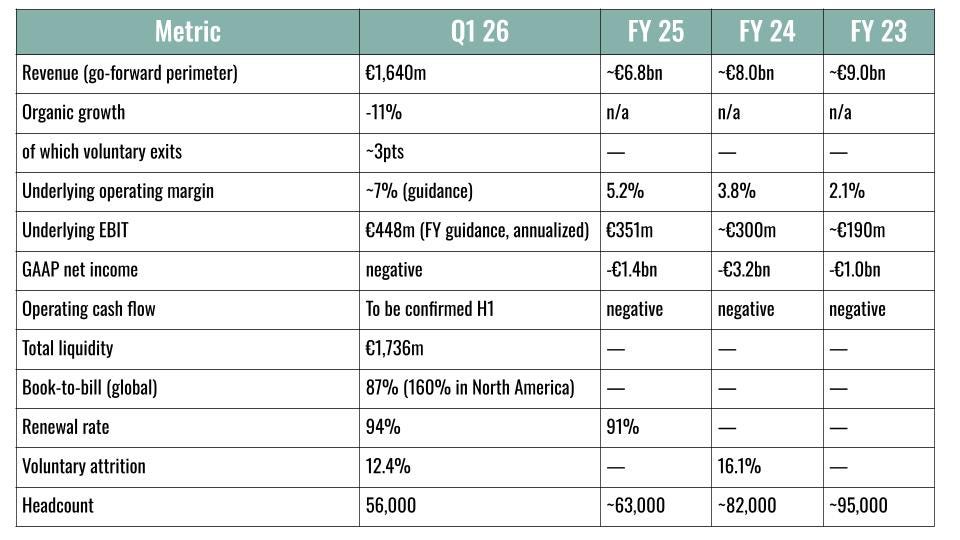
The -11% organic decline at Q1 2026 requires decomposition before it can be interpreted. Approximately three percentage points reflect deliberate contract exits — low-margin agreements terminated as part of the Genesis rationalization. The remaining eight points reflect genuine volume attrition: contracts expiring without full renewal, scope reductions, and the residual effect of the counterparty risk freeze that suppressed new signings throughout 2024 and early 2025.
The directional signals that matter are not in the revenue line. The North America book-to-bill of 160% indicates that new commercial activity is running significantly ahead of current billings in the geography that saw the sharpest attrition. The global renewal rate rising from 91% to 94% year-on-year indicates that retained clients are staying at an increasing rate. Voluntary employee attrition fell from 16.1% to 12.4% — a signal of organizational stabilization that precedes financial stabilization by two to three quarters. These are leading indicators. Revenue is a lagging one.
One additional dynamic is absent from the published numbers but material to the forward trajectory. France represents 17% of group revenue at Q1 2026. The political paralysis that followed the 2025 dissolution of the National Assembly froze public sector purchasing decisions for eighteen to twenty-four months. Defense and government represent 31% of group revenues — the single largest client vertical. A significant portion of the revenue underperformance in France is not competitive displacement. It is deferred demand, accumulating behind a political calendar that has a defined resolution point: the presidential election of May 2027 and the legislative realignment that will follow. That demand does not disappear. It waits.
Margin
The trajectory from 2.1% underlying operating margin in 2023 to 5.2% in 2025 to 7% guided for full year 2026 is the single most important data series in this analysis. It is happening while revenue declines — which is the signature of genuine structural cost reduction rather than operating leverage from volume growth.
Philippe Salle stated explicitly on the March 2026 earnings call that the legacy cost base was not aligned with market realities. This is not a diplomatic formulation. It is a precise diagnosis: the previous management built an organization sized for offensive growth — geographic expansion, acquisition integration, market share at any margin — and never recalibrated it for the profitability discipline that an IT services business at this scale actually requires. Genesis Part One, the restructuring phase, was completed ahead of schedule and under budget. The cost base that remains is the one Salle chose to keep.
The operating leverage that has not yet played out is the central mechanism of the valuation case. Headcount has fallen from approximately 95,000 in 2023 to 56,000 today — a reduction of 41% over three years. Revenue over the same period has declined from approximately €9.0bn to a guided €6.4bn — a reduction of approximately 29%. The cost reduction has exceeded the revenue reduction. When that gap stabilizes — when headcount reduction has fully absorbed the revenue base it is now serving — each incremental euro of new revenue falls almost entirely to operating income. That inflection point is what the current multiple does not reflect.
Cash flow and liquidity
The first complete cash flow statement at the go-forward perimeter will be published with the H1 2026 results on July 30. That publication is the first real test of the thesis.
In a pure services model with no inventory and minimal capital expenditure requirements, normalized operating cash flow should converge toward underlying EBIT. The two numbers should be close. Any material and unexplained divergence — operating cash flow significantly below reported EBIT on a sustained basis — would be the most important red flag this analysis could identify. It would suggest either that the underlying margin is not converting to cash, or that working capital dynamics are concealing a deterioration that the income statement does not show.
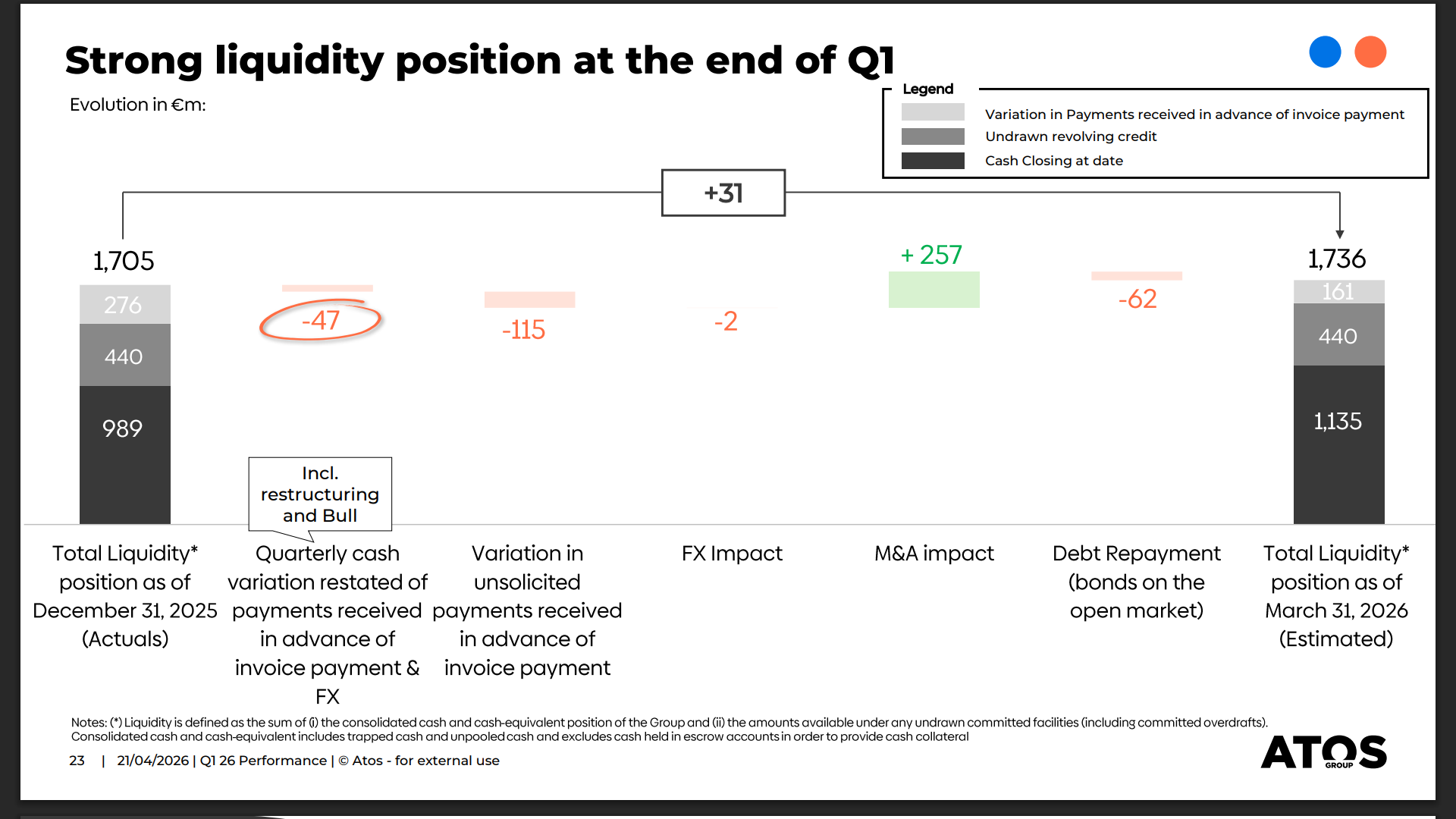
Current liquidity stands at €1,736m — comprising €1,135m cash, €440m undrawn revolving credit facility, and €161m in customer advance payments. The banking covenant floor is €650m. The group sits €1,086m above that floor. At current operational cash consumption rates, that buffer represents more than eighteen months of operational runway without any additional cash generation.
Debt structure and the May 2026 refinancing
Note: the debt structure below is approximated from the 2025 Universal Registration Document, the Q1 2026 earnings release, and the May 2026 refinancing announcement. Figures may differ from final audited H1 2026 accounts.
On May 12, 2026, Atos replaced that entire senior tranche with €1,250m of new senior secured bonds maturing in 2031, rated B+/BB- by S&P and Fitch, and heavily oversubscribed by institutional investors. The annual cash interest saving is estimated at €40-55m — flowing directly to net income without any operational effort.
Understanding the debt stack
When a company carries multiple layers of debt, not all creditors are equal. The ranking determines who gets paid first if the company cannot meet its obligations — and therefore who takes the most risk, and who demands the highest interest rate in compensation.
Think of it as a waterfall. In a liquidation or restructuring, the available cash flows down from top to bottom. Senior creditors drink first. Junior creditors get whatever is left. Equity holders — the shareholders — get nothing until every creditor above them has been paid in full.
Atos currently carries three layers.
Senior secured debt sits at the top of the waterfall. It is backed by collateral — specific assets of the group pledged as security. In a default scenario, senior secured creditors have the first claim on those assets. Because the risk is lowest, the interest rate is lowest. The new €1,250m bonds issued in May 2026 sit here, at 8.125% for the fixed tranche.
Intermediate debt (1.5L) sits in the middle. It has a claim on assets, but only after senior secured creditors have been fully repaid. Higher risk, higher interest rate. The 1.5L term loan carries EURIBOR plus 2.6% cash interest plus 2.0% PIK.
Subordinated debt (2L) sits at the bottom of the creditor stack, just above equity. It is the last to be repaid in any recovery scenario. Highest risk among creditors, and rated CCC by the rating agencies — reflecting the limited recovery prospect if the senior layers consume all available value.
Equity — the shares — sits below all of this. Shareholders are the residual claimants. They own what remains after every creditor has been paid. In a distressed scenario, that residual can be zero. In a recovery scenario, it captures all the upside once the debt is serviced.
This structure explains why the equity of a leveraged company in turnaround can move dramatically on relatively small improvements in operating performance. A business generating approximately €430-450m of underlying EBIT that carries ~€3.2bn of debt at an average blended cost of 8-9% has approximately €180-200m of pre-tax income available to equity after debt service. Small changes in EBIT translate into large percentage changes in what reaches the shareholder. That leverage is the source of both the risk and the opportunity in this thesis.
The current debt structure post-refinancing is as follows:
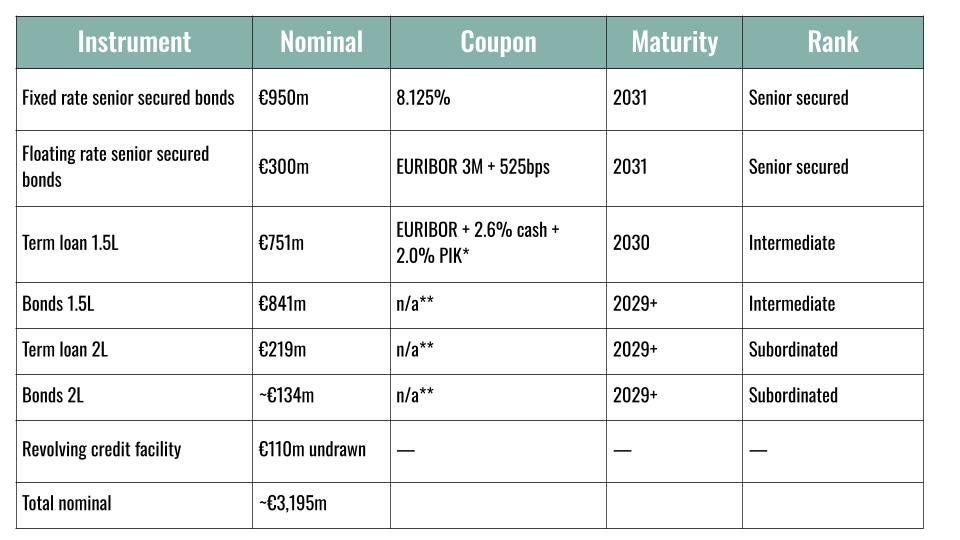
Don’t forget that they sit on €1,736m of cash, so they are cannot go bankrupt until 2030, even if the FCF remains flat.
PIK (Payment-in-Kind): interest not paid in cash but added to the principal balance, compounding the debt outstanding over time.
*Coupon details on 1.5L and 2L instruments not publicly disclosed in available documents. These instruments carry sub-investment grade ratings from S&P and Fitch, reflecting their subordinated position in the capital structure.
The 2031 maturity on the new senior bonds eliminates any refinancing pressure on the senior tranche for five years. The residual intermediate and subordinated instruments — approximately €1,945m nominal across 2029-2030 maturities — represent the execution constraint that keeps Genesis discipline in place through 2029. They are not an existential risk at current liquidity levels. They are a timeline.
The bond market signal embedded in the May 2026 issuance deserves separate attention. Institutional credit investors chose to lend €1,250m to Atos at these terms in sufficient volume to produce a heavy oversubscription. This is not sentiment. It is due diligence with capital at risk — conducted by professionals whose mandate is to price default probability precisely. It does not guarantee the equity thesis. But when the bond market validates the trajectory and the equity market prices catastrophe, that divergence is itself a signal. It rarely persists indefinitely.
Accounting considerations
Three items warrant specific attention.
The Syntel/TriZetto litigation produced a revised final judgment of $297.9 million. Atos filed an appeal in May 2026 and deposited $290 million as collateral. The amount has been provisioned in full on the balance sheet. This is a risk that has been identified, sized, and covered — not eliminated, but contained. It will not produce a surprise on the income statement.
The Genesis restructuring charges — €71m in Q1 2026 alone — are recurring by the nature of the plan. The correct analytical approach is to watch their trajectory rather than their absolute level. A declining quarterly charge over the next four to six quarters is the confirmation that the restructuring is completing rather than expanding. A flat or rising charge would signal that the cost base reduction is proving harder than guided.
The 2025 Universal Registration Document discloses total tax loss carryforwards of €7,572m as of December 31, 2025 — of which €7,276m are carried forward indefinitely, with no expiry date. The largest concentrations are in Germany (€1,686m), France (€1,481m), and the United Kingdom (€1,176m).
The practical effect of this stock is a structural reduction in the effective tax rate during the recovery period. Under French tax rules, utilization is capped at 50% of taxable income above €1m per year. The precise applicable ceiling may also be affected by the debt-for-equity exchanges that occurred during the December 2024 restructuring — a technical point that the group’s tax disclosures do not fully resolve in publicly available documents, and that investors should verify independently.
What is not in doubt is the order of magnitude. Even under conservative utilization assumptions, a stock of €7,572m of loss carryforwards — against a business guiding toward €430-450m of annual underlying EBIT — implies that Atos will pay materially below the standard 25% French corporate tax rate for an extended period. Every euro of pre-tax income retained through this mechanism rather than paid to tax authorities flows directly to net income and ultimately to the shareholder.
This benefit is structurally invisible in standard financial screens, which display either a negative net income or an incomprehensible effective tax rate for a company in the early stages of recovery. It will become visible precisely when the business reaches sustained profitability — which is the moment when the equity multiple is also re-rating toward peer levels. The two effects compound simultaneously.
The Two Theses
Every investment has two stories. The bear story explains why the current price is justified or too high. The bull story explains why it is wrong. The job of the analyst is not to pick a side before doing the work — it is to build both cases as rigorously as possible, then decide which one the evidence supports.
On Atos, the bear case is real. It deserves to be taken seriously. What follows is the strongest version of it I can construct — not a strawman designed to be knocked down, but the argument a careful skeptic would make.
The Bear Case
The central bear argument is simple: Atos is a legacy IT services company attempting to reposition as a sovereign technology player, without the financial resources, the technological differentiation, or the time required to complete that transition before the debt structure forces another crisis.
Revenue decline is not fully voluntary. Management attributes three percentage points of the Q1 2026 organic decline of -11% to deliberate contract exits. The remaining eight points reflect genuine market attrition — clients reducing scope, contracts expiring without renewal, and competitors winning business that Atos could not retain. In a European IT services market where Capgemini grew organically at approximately 4.5% and Sopra Steria at 3.2% in the same quarter, Atos is losing ground that its peers are gaining. That is not a restructuring artifact. It is a competitive signal.
The Advanced Computing sale was a strategic concession, not a strategic choice. Atos sold its Bull supercomputer division — the asset with the most direct exposure to AI infrastructure demand — for €252m in cash because it needed the liquidity. It did not sell Bull because Bull was non-core. It sold Bull because it could not afford to keep it. The timing could not be worse: the AI infrastructure market is experiencing the most significant capital deployment in the history of enterprise technology, and Atos has just exited its only credible entry point into that market.
The Sovereign Agentic AI Studios are a narrative, not a business. Four studios across four countries, launched in Q1 2026, with lighthouse clients that have not disclosed contract values. No material revenue contribution. No disclosed pipeline figures that would allow an independent assessment of conversion rates. In the absence of numbers, the Studios are a communication exercise — the kind of forward-looking positioning that distressed companies have used for decades to maintain investor interest while the underlying business stabilizes. They may become real. They are not real yet.
The margin trajectory is partially illusory. The improvement from 2.1% in 2023 to a guided 7% in 2026 is real — but it is driven in significant part by the removal of loss-making contracts rather than by genuine operational improvement in the retained business. When a company exits €500m of revenue generating negative margins, the reported margin on the remaining business improves mechanically. That is not the same as building a more efficient organization. The test will come when the contract rationalization is complete and the margin must be sustained without further portfolio pruning.
The debt structure remains constraining. The May 2026 refinancing improved the senior tranche materially. But approximately €1,945m of intermediate and subordinated debt matures in 2029-2030, at costs that include PIK components compounding on the balance sheet. The window to refinance these instruments at acceptable terms will depend on execution between now and 2028-2029. One or two quarters of disappointing results could close that window.
What if the bear is completely right?
If the bear thesis is correct in full — revenue attrition accelerates beyond the voluntary exits, the margin cannot be sustained without continuous portfolio pruning, the Studios generate no material revenue, and the 2029-2030 debt maturities arrive before the group has rebuilt sufficient creditor confidence to refinance at reasonable terms — then the outcome is a second restructuring. The intermediate and subordinated creditors, who hold approximately €1,945m of claims, convert that debt into equity in a second dilution event. The residual value for current shareholders approaches zero.
That is the scenario the current price partially reflects. Not certainty — but a non-trivial probability. Estimating that probability precisely is the work of the bull case.
The Bull Case
Fourteen arguments. Some are operational. Some are financial. Some are structural. Some are macro. They are independent of each other — which means the bull case does not require all fourteen to be correct. It requires enough of them to be correct to close the gap between the current distressed multiple and a normalized peer multiple.
One — Simplification as forced re-rating.
An IT services company with two clear businesses, a defined client base, and a stable perimeter can be valued on peer multiples. Capgemini trades at approximately 11-12x EV/EBIT. Sopra Steria at 9-10x. The current implied EV/EBIT on Atos — approximately 5.6x on guided 2026 EBIT — reflects a probability of non-survival that the balance sheet no longer justifies. The simplification of the perimeter is not a strategic achievement. It is a valuation unlocking event. The market cannot apply a peer multiple to a company it cannot read. Once it can read it, the multiple must adjust.
Two — Contract rationalization as hidden operating leverage.
In an IT services business, margin is a function of two variables: the day rate billed to the client, and the cost of the consultant sitting on the bench between assignments. When a low-margin contract exits the portfolio, two things happen simultaneously. The revenue falls. But the headcount associated with that contract — consultants deployed on engagements that generated negative or negligible margin — is either redeployed to better-priced work or exits the organization. The cost base shrinks faster than the revenue base, because the cost that was attached to that revenue was already consuming more than it generated.
This is the mechanical explanation for the margin trajectory from 2.1% in 2023 to a guided 7% in 2026, occurring in parallel with an 11% revenue decline. The portfolio is not just getting smaller. It is getting cleaner. Every contract that remains is one that management chose to keep — which means it meets a minimum margin threshold that the exited contracts did not. The operating leverage that follows is not a forecast. It is arithmetic.
Three — The judicial shield and the 2031 refinancing eliminate the existential risk.
The most powerful argument the bear had in 2023 and 2024 was the liquidity cliff. A company that might run out of cash has zero option value for equity. The Commercial Court of Pontoise removed that argument on January 16, 2026. The May 2026 refinancing extended it to 2031 on the senior tranche. With €1,736m of total liquidity and €1,086m of headroom above the covenant floor, the group has more than eighteen months of operational buffer. The probability of near-term default has moved from material to remote. The equity multiple must reflect that shift — and it has not yet done so.
Four — Counterparty risk unlocking.
Throughout 2024 and early 2025, clients who wanted to extend or expand their Atos contracts faced an informal constraint: the risk that Atos might not survive to complete the engagement. Procurement committees deferred decisions. Contract renewals were negotiated at minimum scope. New business was awarded to safer alternatives. The January 2026 court validation and the May 2026 bond issuance removed that constraint. The North America book-to-bill of 160% at Q1 2026 is the first measurable evidence that deferred commercial decisions are converting. That pipeline represents future revenue at full margin — with no incremental cost of acquisition, because the client relationships already exist.
Five — The deleveraging flywheel.
Every euro of free cash flow generated by the business has three possible destinations: debt repayment at par, open-market debt buyback at a discount, or reinvestment in growth. In all three cases, the equity holder benefits. Debt repayment reduces future interest charges, improving free cash flow mechanically. Open-market buyback at a discount — Atos repurchased €62m of debt in Q1 2026 — creates immediate value by retiring liabilities below their face value. Reinvestment in growth increases future EBIT. As the debt load decreases, interest charges decrease, net income increases, the credit rating improves, and the next refinancing occurs at lower rates — which reduces interest charges further. The flywheel is non-linear and self-reinforcing.
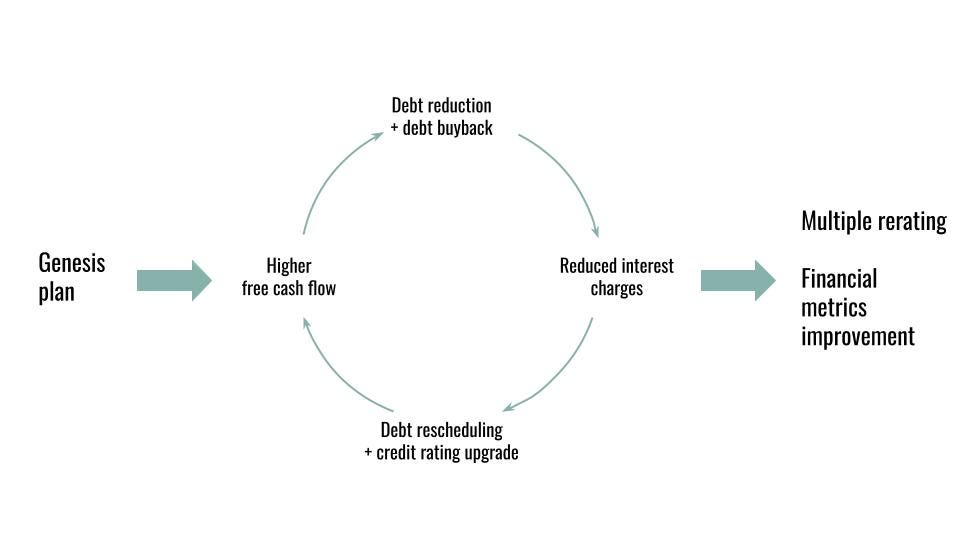
Every turn of the wheel simultaneously improves the income statement, the balance sheet, and the cash flow statement.
Six — Tax loss carryforwards as a structural net income amplifier.
The 2025 Universal Registration Document discloses total tax loss carryforwards of €7,572m as of December 31, 2025 — of which €7,276m are carried forward indefinitely with no expiry date. The largest concentrations are in Germany (€1,686m), France (€1,481m), and the United Kingdom (€1,176m).
The practical effect is a structural reduction in the effective tax rate during the recovery period. Under French tax rules, utilization is capped at 50% of taxable income above €1m per year. The precise applicable ceiling may also be affected by the debt-for-equity exchanges that occurred during the December 2024 restructuring — a technical point that the group’s tax disclosures do not fully resolve in publicly available documents, and that investors should verify independently.
What is not in doubt is the order of magnitude. A stock of €7,572m of loss carryforwards against a business guiding toward €430-450m of annual underlying EBIT implies that Atos will pay materially below the standard 25% French corporate tax rate for an extended period. Every euro of pre-tax income retained through this mechanism rather than paid to tax authorities flows directly to net income and ultimately to the shareholder. This benefit is structurally invisible in standard financial screens — it will become visible precisely when the business reaches sustained profitability, which is the same moment the equity multiple is re-rating toward peer levels. The two effects compound simultaneously.
Seven — AI does not destroy the IT services model. It transforms it.
The bear thesis on AI disruption of IT services sounds logical and fails on contact with organizational reality. The hypothesis is that AI will automate the work currently done by consultants, reducing demand for external services. Anyone who has spent meaningful time inside a large organization knows why this is incomplete.
Companies do not hire external IT service providers primarily because they lack technical capability. They hire them for three reasons that AI cannot address.
First, to access competencies that are not worth building internally — specialized skills applied to projects that occur once per decade, on technology stacks that will be obsolete before internal teams have been trained.
Second, to provide the organizational cover required to execute changes that internal teams cannot drive alone. In any large institution, transformation meets resistance. External providers carry the authority of neutrality — they can say what internal teams know but cannot say, and execute what internal management has decided but cannot implement against entrenched interests.
Third, to maintain competitive advantage in an environment that is accelerating. If AI increases the pace of technological change — and it demonstrably does — the gap between what organizations need to deploy and what they can build internally widens, not narrows. Every technology cycle creates a new wave of consulting demand. ERP created SAP consultants. Cloud created cloud migration specialists. AI is creating a new category of demand for implementation, integration, and governance expertise that no organization will build entirely in-house.
History confirms the pattern. The arrival of ERP in the 1990s was supposed to make SAP consultants redundant — it created a multi-billion euro industry. The arrival of cloud computing was supposed to eliminate managed infrastructure outsourcing — it generated a decade of migration engagements that filled the order books of every major IT services firm. Agentic AI will follow the same dynamic. The question for Atos is not whether that wave exists. It is whether Atos is positioned to capture it.
Eight — Regulated industries cannot use general-purpose AI. They need Atos.
The AI disruption thesis assumes unconstrained technology adoption. In the real world of regulated industries — which represent the majority of the Atos client base — the constraint is not the technology. It is the regulatory framework within which it must operate.
A French bank cannot send its credit risk models through an American API. A European defense ministry cannot run its operational planning on infrastructure subject to the US CLOUD Act. A critical infrastructure operator cannot automate its systems with a model whose training data, architecture, and update cycle are outside its control. These are not strategic preferences. They are legal requirements enforced by RGPD, NIS2, DORA, and classified defense procurement regulations.
These organizations will not use general-purpose AI. They cannot. What they will use is purpose-built, sovereignty-certified, contractually accountable AI — deployed by a partner with the right clearances, the right certifications, and the legal capacity to assume responsibility for system failures. That is precisely what the Sovereign Agentic AI Studios are designed to deliver. The regulatory barrier that protects Atos’s existing client base on IT services is the same barrier that positions it as a preferred partner for sovereign AI deployment.
Nine — The bond market validates the thesis independently.
Institutional credit investors — funds that model cash flows, stress-test covenants, and price default probability for a living — chose to lend €1,250m to Atos in May 2026 at terms that produced a heavy oversubscription. These professionals have access to information that equity analysts do not. They conducted due diligence with capital at risk. Their conclusion was that the risk of lending to Atos at 8.125% for five years was acceptable — in an environment where that same conclusion was far from consensus among equity investors.
The bond market does not guarantee the equity thesis. But when credit professionals validate the trajectory with their own capital, and the equity market continues to price catastrophe, that divergence is itself a signal. The two markets are analyzing the same company. One of them is wrong about the probability of recovery. The oversubscription suggests which one.
Ten — The French political cycle unlocks deferred public sector demand.
France represents 17% of group revenue at Q1 2026. Defense and government represent 31% of total revenues — the single largest client vertical. The political paralysis that followed the 2025 dissolution of the National Assembly froze public sector purchasing decisions for eighteen to twenty-four months. Large IT transformation projects, multi-year cybersecurity contracts, sovereign cloud migrations — all require budget visibility that a succession of short-lived governments could not provide.
The presidential election of May 2027 and the legislative realignment that will follow create a defined resolution point. A new executive with a stable parliamentary majority will have both the mandate and the political capital to commit to multi-year infrastructure investments. The demand that has been accumulating behind the political calendar does not disappear. It converts — into exactly the kind of long-term, high-value, sovereignty-sensitive contracts that Atos is positioned to win and that its competitors without French defense clearances cannot bid on.
Eleven — Geopolitical fragmentation as a structural tailwind.
Something fundamental is changing in the architecture of enterprise technology — not cyclically, but structurally. The combination of US-Europe trade tensions, the activation of the CLOUD Act as a geopolitical instrument, and the growing awareness among European institutions of their dependency on American technology infrastructure has produced a shift in procurement behavior that will not reverse with a change of administration in Washington.
European companies and public institutions are actively seeking to reduce their exposure to technology infrastructure they do not control. That demand for European sovereign technology — cloud, cybersecurity, AI — is growing independently of any decision Atos makes. The sovereign cloud market is estimated at $45bn today, growing at approximately 38% annually toward $224bn by 2029. Atos does not need to capture a large share of that market to generate material incremental revenue. A 2-3% share of the European sovereign AI services segment by 2030 would represent a transformational addition to a business currently valued at €680m.
Atos did not create this market. It finds itself at the intersection of regulatory certification, long-term institutional relationships, and sovereign infrastructure capability at precisely the moment when that intersection becomes strategically critical. That is not a forecast. It is a description of where the company currently stands.
Twelve — The macro refinancing window is reopening.
The geopolitical environment of the past three years has structurally tightened credit conditions for sub-investment grade European borrowers. The war in Ukraine, the energy shock that followed, and more recently the escalation of tensions around Iran have all contributed to a risk premium environment that made accessing capital markets expensive for distressed issuers. Credit spreads on European high yield widened materially across the cycle. Investor appetite for complexity contracted.
Against that backdrop, Atos placed €1,250m of senior secured bonds in May 2026 — and was heavily oversubscribed. That is the baseline from which to measure what comes next.
The Iran situation, if it moves toward de-escalation or containment in the second half of 2026, removes one of the principal sources of geopolitical uncertainty currently embedded in European credit spreads. Energy price stability, reduced safe-haven demand, and a normalization of risk appetite across fixed income markets would compress the spread applicable to any future Atos refinancing. The €1,945m of intermediate and subordinated debt maturing in 2029-2030 — currently carrying rates that reflect both Atos’s specific credit risk and a generalized geopolitical risk premium — becomes refinanceable at materially better terms in a normalized environment.
Each 100 basis points of spread compression on that tranche represents approximately €19m of annual interest saving. At 200 basis points of improvement — a conservative estimate in a genuinely de-escalated environment — the annual saving approaches €40m, flowing directly to net income without any operational contribution from Salle or his team.
This catalyst costs Atos nothing. It arrives from outside. And it compounds every other argument in this list.
Thirteen — The structural short squeeze.
Atos has been among the most heavily shorted stocks on the Paris exchange. With 19.4 million shares in circulation post-consolidation and a limited float, the technical conditions for a short squeeze are structurally present.
A short squeeze does not require the thesis to be correct to produce a violent price movement. It requires a catalyst — any publication that forces short sellers to reassess their probability of recovery — combined with insufficient liquidity to absorb simultaneous forced covering. The H1 2026 results on July 30 are that catalyst if the numbers validate the Genesis trajectory. The covering demand from short positions, layered on top of fundamental buyers re-entering after data confirmation, can produce a price move that significantly overshoots fair value in the short term.
This is not a fundamental argument. It is a market structure observation. But in a stock with this float profile and this short interest, the technical amplification of a fundamental catalyst is a real and quantifiable component of the expected return distribution.
Fourteen — Analyst coverage will return. And when it does, it brings institutional flows with it.
Five analysts currently cover Atos. Zero buy recommendations. The consensus is not bearish because the analysts have studied the post-restructuring thesis and found it wanting. It is bearish because the mandate constraints, the data gaps, and the reputational risk of recommending a stock that destroyed 99% of shareholder value make any positive recommendation professionally difficult to defend before July 30.
That changes when the numbers arrive. A single broker of the first rank upgrading from Sell to Neutral — or from Neutral to Buy — after H1 2026 data confirms the margin trajectory triggers mandatory buying from mandates that follow consensus. It is not the upgrade itself that moves the stock. It is the cascade of institutional flows that follow an upgrade from an analyst whose recommendation carries weight with the fund managers who were structurally excluded from the position.
The re-rating does not require all five analysts to change their minds simultaneously. It requires one. The probability of that happening increases with every quarter of clean execution.
Points of failure — what would invalidate the bull case
Three signals would change the conclusion of this analysis.
The H1 2026 free cash flow, to be published July 30, must converge toward the guided underlying EBIT. A material and unexplained divergence between operating cash flow and reported earnings would suggest that the margin improvement is not converting to cash — the most serious accounting red flag in a services business.
The book-to-bill ratio, net of voluntary exits, must remain above 90% on a sustained basis. A decline below that level on the retained portfolio would indicate that involuntary client attrition is accelerating beyond the voluntary rationalization — the signal that competitive displacement is outpacing the restructuring.
The Genesis restructuring charges must decline sequentially over the next four to six quarters. Flat or rising charges beyond 2026 would indicate that the cost base reduction is harder to execute than guided — and that the reported margin contains a component that is structural rather than transitional.
If any of these three signals deteriorates materially, the bear case deserves a second reading.
Valuation
The multiple story
Atos today trades at an implied EV/EBIT of approximately 5.6x on guided 2026 underlying earnings — a multiple that reflects a material probability of non-survival. That probability has changed fundamentally since the January 2026 court validation and the May 2026 refinancing. The multiple has not.
For reference, the European IT services peer group trades as follows:
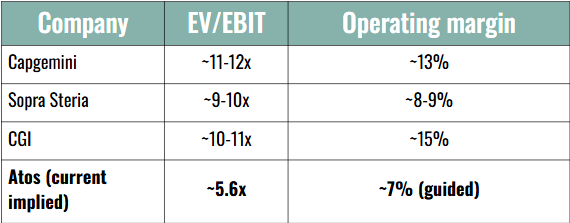
The gap between 5.6x and the lowest peer multiple of 9x is not a reflection of inferior business quality in the recovered state. It is a reflection of the distressed premium still embedded in the equity price — a premium that was justified in 2023 and 2024, and that is becoming less justified with every quarter of clean execution.
My central assumption is that Atos will, over time, trade toward a multiple consistent with a stable, profitable European IT services company. Not Capgemini. Not a premium. A multiple that reflects ordinary survival and ordinary profitability in an ordinary sector.
What happens between now and then — macro shocks, geopolitical events, a broad market selloff, an Iran escalation — I have no idea. Nobody does. The scorecard below maps possible destinations, not a schedule, and deliberately excludes crash scenarios. Price fluctuations will be driven by investor sentiment as much as by fundamentals.
Key assumptions
Before the scenarios, the inputs that drive them.
Revenue base : €6.2-6.4bn at the go-forward perimeter for 2026, declining toward stabilization. No revenue growth assumed in the base case through 2027. Modest recovery toward €6.8-7.0bn in 2028 reflecting counterparty risk unlocking and French public sector demand normalization.
Operating margin : 7% guided for 2026. 8.5% central assumption for 2027 as Genesis Part Two delivers operating leverage. 10% for 2028 consistent with management’s published ambition.
Interest charges : approximately €200-220m in 2026 post-May refinancing, declining toward €160-180m in 2027-2028 as the deleveraging flywheel reduces the debt load.
Effective tax rate : materially below the standard 25% French corporate rate during the recovery period, given €7,572m of tax loss carryforwards. Exact rate subject to the technical treatment of the December 2024 debt-for-equity exchanges. Conservative assumption of 15% effective rate applied across all scenarios.
Share count : 19.4 million shares post-consolidation. No dilution assumed.
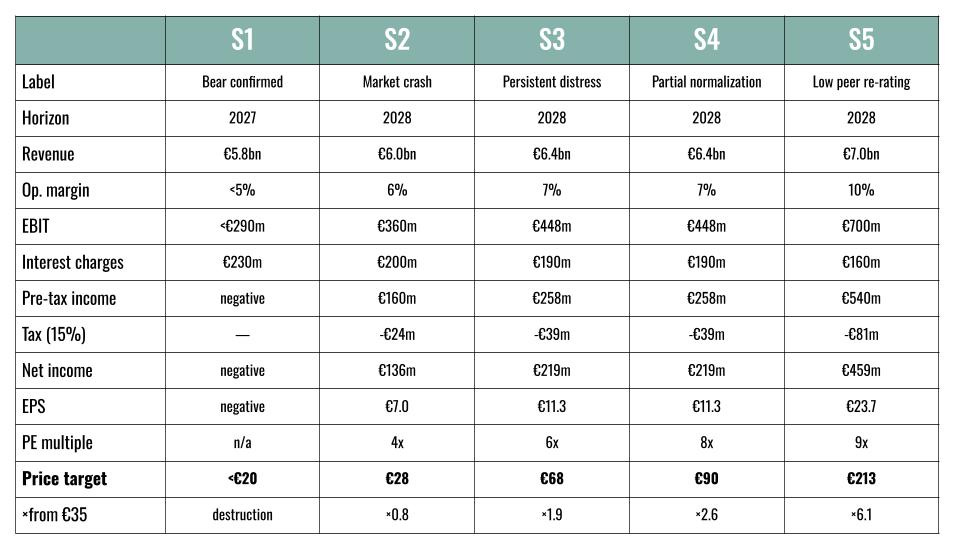
Figures as of June 2026. All scenarios projected to end-2028 horizon except S1 (bear confirmed, 2027) and S9 (sovereign AI re-classification, 2030+). Price reference: €35 as of June 13, 2026.
Scorecard map n°1
Scorecard map n°2
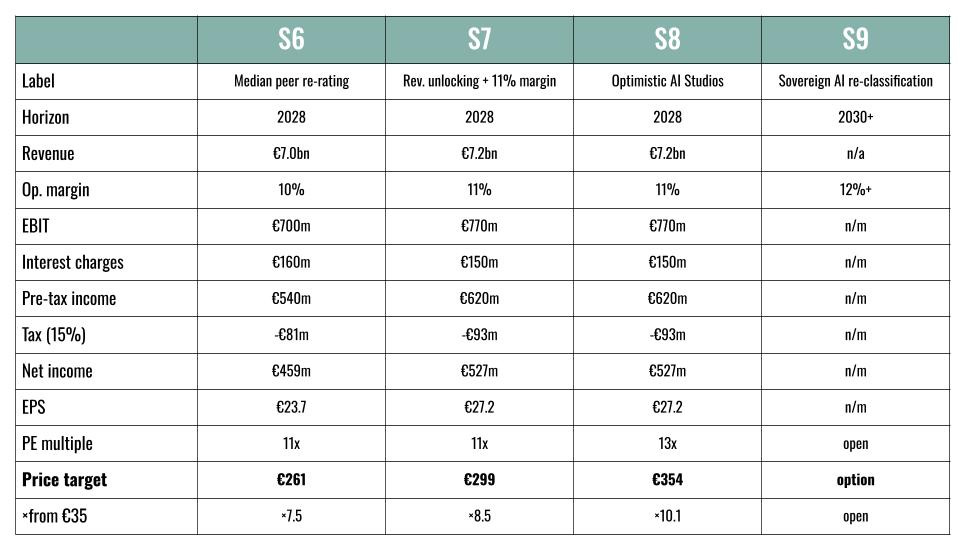
Interest charges are deducted from EBIT to arrive at pre-tax income. Interest charges decline over the horizon as the deleveraging flywheel reduces the debt load.
Reading the scorecard
My personal scenario is S7 — revenue recovery toward €7.2bn, 11% operating margin, and a 13x PE multiple reflecting the beginning of a market re-classification toward sovereign AI infrastructure rather than pure IT services. That scenario requires Genesis to deliver, the Sovereign Agentic Studios to generate visible revenue by 2028, and the French public sector demand to normalize post-2027 elections. It is not a heroic assumption. It is a sequential execution of things that are already in motion.
But the honest reading of this table is simpler than that. Even a conservative reader who dismisses the AI optionality entirely, assigns no credit to the French political catalyst, and applies a peer discount for residual restructuring risk — S4 at ×2.6 or S5 at ×6.1 — is looking at a return profile that is exceptional on a two-year horizon.
The asymmetry is in the numbers. The downside scenarios require simultaneous failure — Genesis underdelivers on margin AND the 2029-2030 debt maturities arrive before creditor confidence is rebuilt. The May 2026 refinancing, heavily oversubscribed by institutional credit professionals, has made that combination materially less probable. The upside scenarios require only sequential execution of things that are already happening.
What happens between now and then — macro shocks, geopolitical events, a broad market selloff — I have no idea. Nobody does. The scorecard maps possible destinations, not a schedule. Price fluctuations will be driven by investor sentiment as much as by fundamentals. A broad market selloff, an oil shock, a recession — any of these could push the stock temporarily below the bear case independent of Atos’s fundamentals. That risk is real and is addressed in the portfolio section.
Portfolio Consideration
Currency
Atos is listed in euros on Euronext Paris. For a euro-denominated investor, there is no currency risk. For an international reader holding dollars or pounds, the EUR/USD and EUR/GBP dynamics add a layer of exposure that is independent of the investment thesis. At current levels, the euro trades at historical averages against both currencies — neither a headwind nor a tailwind worth adjusting for in the base case.
Correlation
The Atos thesis is structurally independent of the narratives driving most equity portfolios today. It does not depend on AI semiconductor demand, US rate cycles, GLP-1 adoption curves, or cryptocurrency momentum. It depends on one thing: whether a specific management team executes a specific operational plan against a specific debt maturity schedule.
That independence is valuable. In a portfolio that already carries exposure to Nebius on GPU infrastructure, Strategy Inc. on Bitcoin, Adobe on creative software, and Booking on travel demand — Atos adds a dimension of return that is uncorrelated to any of those positions. A broad technology selloff that hurts Nebius and Adobe does not change the Genesis execution probability. A Bitcoin drawdown that hits Strategy Inc. does not affect the Atos book-to-bill ratio. The positions do not move together.
Defensive or offensive
Both. The position is defensive on the downside — the refinancing to 2031, the €1,736m liquidity position, and the creditor surveillance structure create a floor that pure equity risk does not normally provide. The position is offensive on the upside — ×6 to ×10 in the central and bull scenarios on a two-year horizon is not a defensive return profile.
This combination — bounded downside, open upside — is the defining characteristic of a well-structured turnaround position. It is also why sizing discipline matters: the position deserves meaningful weight precisely because the asymmetry is real, but concentration beyond a certain threshold introduces liquidity risk that the thesis does not compensate for.
The non-disruption theme
Atos sits alongside other positions in this portfolio that share a common analytical thread: businesses that the market has partially valued as disruption victims and that the evidence suggests are disruption beneficiaries. Adobe’s creative tools are not being replaced by AI — they are being enhanced by it and the monetization is beginning to appear in the numbers. Booking’s platform is not being disintermediated by Google — the direct booking rate is rising. Atos’s IT services model is not being automated away — it is being repositioned toward the segment of the market where AI adoption requires exactly the kind of sovereign, certified, accountable infrastructure that Atos provides.
The market prices disruption fear before disruption evidence. That gap between narrative and data is where the returns in this portfolio are generated.
Sizing
My current position: 821 shares acquired December 6, 2024 at €26.92, and 474 shares acquired March 6, 2026 at €41.69. Blended PRU of €32.32. Total position approximately 15% of the portfolio at current levels.
The sizing reflects the conviction level and the risk profile simultaneously. The bear thesis is weak — it requires simultaneous failure of multiple independent catalysts. The bull thesis is strong — fourteen independent arguments, a dated catalyst on July 30, and a management team with personal capital at risk on the same outcome. The downside is bounded by the balance sheet. The upside is asymmetric.
The one constraint that sizing must respect is liquidity. With approximately 55,000 shares traded daily on average, a position of 1,295 shares can be exited in less than one trading session without market impact. That liquidity envelope defines the practical ceiling for position size at this market capitalization — and it is why the thesis will be more interesting, not less, as the market capitalization grows toward and beyond €1bn.
Exit strategy
This is not a permanent holding. The absence of a structural competitive advantage — no network effect, no proprietary technology, no switching cost deep enough to constitute a moat — means that Atos at normalized profitability is an ordinary IT services company in an ordinary sector. Warren Buffett never invested in IT services for exactly this reason. Once the distressed premium has been eliminated and the multiple has re-rated toward peer levels, the investment thesis is exhausted.
The exit signal is not a price target. It is a condition: when the Genesis restructuring is visibly complete, the margin is sustained above 9% for two consecutive reporting periods, and the multiple has begun to reflect normalized profitability rather than distressed survival — the position rotates. Not into cash. Into a compounding vehicle that does not require active monitoring or a specific management team to perform: a broad market index, or a quality compounder with a genuine and durable competitive advantage.
The discipline of defining the exit before the position is fully built is what separates a thesis from a hope. On Atos, the exit is already defined. The only variable is the timeline.
Conclusion
Peter Lynch was right about turnarounds. They are uncomfortable by design. The discomfort is not a bug — it is the mechanism that creates the opportunity. If owning Atos felt easy, the price would already reflect the recovery.
What I have tried to do in this article is separate the discomfort from the risk. The discomfort is real — a CAC 40 blue chip that destroyed 99% of shareholder value, a ticker that carries collective trauma for hundreds of thousands of French retail investors, a balance sheet that was technically insolvent eighteen months ago. The discomfort is entirely legitimate.
The risk is a different question. Risk, properly defined, is the probability of permanent capital loss. On that definition, the Atos of June 2026 is a materially different entity from the Atos of 2023. The existential risk has been addressed by the court, the balance sheet, and the creditor structure. The operational risk is being addressed quarter by quarter by a management team with personal capital at stake. The financial risk has been pushed to 2031 on the senior tranche by a bond market that was given the opportunity to disagree — and chose instead to oversubscribe.
What remains is execution risk. Salle must deliver the margin. The Studios must convert pipeline to revenue. The French public sector must resume its purchasing cycle. The bond market must remain open for the 2029-2030 refinancing. None of these are guaranteed. All of them are measurable. The first measurement arrives on July 30.
This is not a thesis built on hope. It is a thesis built on a specific sequence of verifiable events, with a specific catalyst, against a specific valuation that has not yet adjusted to a specific change in the probability of survival. That gap — between the price that reflects yesterday’s risk and the value that reflects today’s balance sheet — is the investment.
Atos died of hubris. The reconstruction has begun. The market has not yet decided to believe it.
That is the opportunity.
Image credits
Product and marketing visuals sourced from the investor relations section of Atos Group. Financial charts sourced from Fiscal.ai. Additional visuals created by the author.
Important Disclosure & Disclaimer
All content published by JB Peter on this platform is strictly for educational and informational purposes. It does not constitute investment, financial, legal, or tax advice, nor does it represent a personal recommendation or solicitation to buy or sell securities. This research is operated by ORIACON (SASU) and reflects independent corporate analysis. Every reader must conduct their own independent research (Due Diligence) or consult a licensed professional before making any financial decision, as financial markets involve a high risk of capital loss. At the time of writing, ORIACON or the author HOLD shares in the company analyzed in this article. Following this publication, ORIACON and the author reserve the right to buy, sell, or modify positions in any security mentioned at any time, without prior notice to readers or subscribers.