
In April, I sold my oil position in OKEA, a Norwegian E&P I’d held since August 2024. +110% in nine months. With that capital freed up, I split it in two. Half went to reinforce Novo Nordisk, already in the portfolio. The other half was waiting for the right conviction.
After weeks of research, I found it. Booking Holdings.
The stock is trading at a PE of 21.6x today, its lowest valuation since 2023. Looking back further, this valuation level has only appeared twice in the last ten years: March 2020, when borders were closed and planes were grounded, and March 2016. Two aberrations in a decade. This feels like a third one in the making.
The business is posting operational records. Revenue up 13%, margins expanding, free cash flow north of $9 billion, buybacks running at full speed. And yet the market is pricing it as if the model is about to be destroyed. The fear: AI will disintermediate online travel agencies. Users will plan their holidays through ChatGPT, Claude or Gemini, and Booking will become invisible.
In May 2025, I bought Alphabet at a PE of 17x, its lowest in ten years. The question everyone was asking: “Is Google Search broken by AI?” Since then, the stock is up +100%.
Today I’m asking the same question about Booking, as it holds the same mechanics: operational records, an AI disruption fear not yet showing up in the numbers, and a PE at a multi-year floor. The question is whether Booking will be its victim or its infrastructure.
This article starts with the business itself: what Booking Holdings actually does, how it makes money, who its customers and suppliers are, and what makes it structurally difficult to displace. From there, it examines the two competing theses: why the market is afraid, and why that fear may be overstated. The valuation section translates those arguments into a scorecard with concrete scenarios. The article closes with portfolio considerations: how this position fits into a concentrated ten-stock portfolio and a conclusion.
I know you’re busy, so I always start with a summary called The short version. If that’s all you have time for, that’s fine. The rest of this article explains why.
The short version
Booking Holdings is the world’s dominant travel marketplace. 4.4 million properties. 1.2 billion room nights per year. 60% of bookings arriving directly, without touching Google.
The stock has lost 33% from its peak. The market is punishing a narrative: AI will disintermediate online travel agencies. ChatGPT, Claude and Gemini will plan your holidays, and Booking will become invisible.
My view: the market is pricing a future disruption as a present reality. The business is posting records. Room nights are growing. Direct traffic is rising. The only confirmed casualty is KAYAK, a metasearch brand representing 4% of revenues. The core is intact.
At a normalized PE of 18x (stripping out $1.3B in non-cash FX losses and a one-time impairment) you are paying below the COVID floor for a franchise that generates $8.5B in free cash flow minus stock-based compensation and has $21.8B in buyback authorization left to deploy at depressed prices.
I bought on May 12th at €149.03, a normalized PE of 18x. The position is 6% of my portfolio. I am prepared to increase to 20% if the stock continues to fall and the thesis holds.
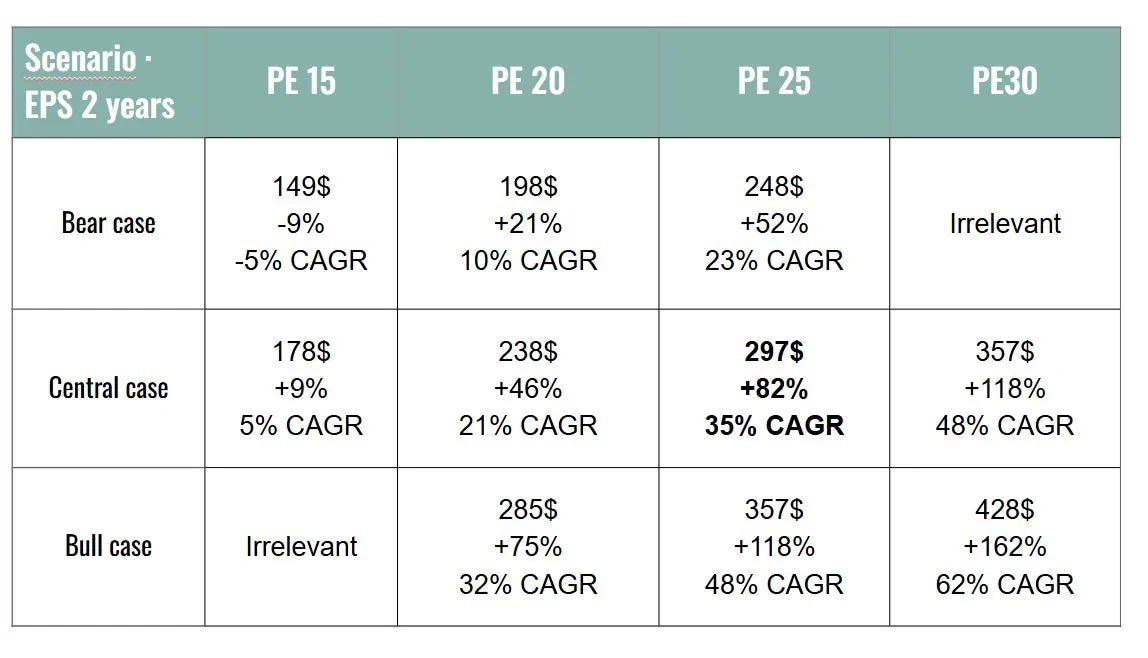
The valuation scorecard puts the central case at $297(+82% from current prices, 35% CAGR over two years) at a PE of 25x, simply normalizing toward the lower end of the historical range.
Understanding Booking’s business, supply chain and environment
History
Booking Holdings didn’t start as a travel company. It started as an experiment in consumer psychology.
Priceline was founded in 1997 with a single idea: let consumers name their own price for airline tickets, hotels and rental cars. The model was radical for its time, and famously promoted by William Shatner in ads that became part of American pop culture. The concept worked well enough to survive the dot-com crash, but the real transformation came quietly, from the other side of the Atlantic.
In 2005, Priceline acquired Booking.com, a small Dutch startup that had been building something far less glamorous but far more durable: a straightforward commission-based marketplace for European hotel reservations. No auctions, no gimmicks. Just inventory, search, and a clean booking experience. The acquisition cost a fraction of what the business would become. It was one of the greatest capital allocation decisions in internet history.
Over the following decade, Booking.com became the dominant force in global online travel, while the Priceline brand receded to its North American discount niche. The parent company eventually formalized what had been obvious for years: in 2018, it renamed itself Booking Holdings. The Dutch acquisition had consumed the American parent.
The group has since added Agoda for Asia-Pacific, KAYAK for metasearch, and OpenTable for restaurant reservations. A 25-for-1 stock split took effect in April 2026, bringing the share price from over $4,000 to approximately $160, making the stock accessible to retail investors for the first time in years.
The marketplace model
What Booking Holdings sells matters less than what it actually is. Booking calls itself a travel company. What it runs is a two-sided marketplace, a platform whose entire purpose is connecting two audiences that need each other but can’t find each other efficiently without an intermediary.
On one side, 4.4 million properties looking for guests. On the other, hundreds of millions of travelers looking for somewhere to stay. Booking organizes that meeting, takes a commission on the transaction, and scales without owning a single bed.
But the marketplace model goes beyond the transaction itself. Booking also handles what happens when things go wrong: customer service, cancellations, disputes, overbookings, or fraud. That after-sales layer is a core part of the value proposition, and it’s one of the reasons the platform commands 15 to 25% commissions without facing mass defection from either side. A traveler who knows Booking will fix a problem at 2am in a foreign city pays the slight premium without thinking twice. A hotel accepts the commission for the same reason: it’s the cost of outsourcing headaches nobody on the property wants to deal with.
That structure, asset-light, transaction-based, network-driven, with service embedded, is the foundation of everything that follows.
Booking.com: the engine
Booking.com is four businesses running on a single platform, each at a different stage of maturity.
Accommodation is the core: 4.4 million properties across 220 countries in over 40 languages. Hotels, apartments, villas, hostels, boats. This segment is the foundation everything else is built on.
Flights are the growth story. Available in 55 markets, the segment grew 28.5% in Q1 2026. Booking isn’t trying to become an airline booking specialist. It’s trying to own the full travel itinerary.
Attractions (tours, experiences, activities) grew 80% in 2025, albeit from a small base. The logic is to capture more of the trip: a traveler who books a Louvre skip-the-line ticket through Booking.com has one more reason to start there next time.
Payments are the least visible and potentially the most significant. Booking is expanding its payments infrastructure across millions of bookings. The 10-K is explicit on the intent: payments remove friction and deliver additional value for both travelers and partners. It’s an extension of the Connected Trip vision.
Taken together, these four products represent what management calls the Connected Trip: the idea that Booking owns every meaningful touchpoint of a journey, from inspiration to checkout. It’s an ambitious vision, still early in execution, but the direction is clear.
The other brands
Priceline serves the North American discount market: hotels, flights and rental cars at negotiated rates, with a loyalty program layered on top. It remains profitable but isn’t the growth driver.
Agoda covers Asia-Pacific, a region where Booking.com has historically underperformed relative to its global dominance. With outbound Chinese tourism recovering and Southeast Asian middle classes expanding, Agoda is the optionality play on the fastest-growing travel market in the world.
KAYAK is the metasearch comparator, the one that aggregates prices from Booking.com, Expedia, and direct hotel sites, then sends traffic to whoever wins the auction. Nobody says “I booked it on KAYAK.” It exists in the background of travel planning, which is precisely why it’s vulnerable. When an AI agent does the comparison for you, KAYAK loses its reason to exist. Management acknowledged this in 2025 with a $457 million impairment. The problem is real, the write-down is honest, and the exposure is limited: KAYAK represents roughly 4% of group revenues.
OpenTable handles restaurant reservations, primarily in the US. It’s a useful adjacency to the Connected Trip thesis.
Suppliers
Booking’s supplier base goes beyond the properties listed on its platform. Several critical dependencies are worth naming clearly.
Google is simultaneously Booking’s largest traffic supplier and a potential competitor, probably the most structurally ambivalent relationship in the business. Performance marketing on Google Search and Google Hotel Ads drives a significant portion of inbound traffic. Booking pays billions annually for that visibility. The fact that 60-65% of bookings now arrive through direct channels is partly a deliberate effort to reduce that dependency.
Apple and Google control the distribution of Booking’s mobile app through their respective stores, a structural dependency shared with every consumer app company. The mobile channel now accounts for a mid-fifties percentage of room nights booked, up from low-fifties in 2024, and the vast majority of that mobile traffic is direct.
Cloud infrastructure providers host the technical backbone of the platform. Payment processors, Adyen and equivalents, handle the transaction layer of the merchant model. Global Distribution Systems such as Amadeus and Sabre provide aggregated flight content for the flights vertical.
None of these supplier relationships are unique to Booking. But they are real dependencies, and an investor who treats Booking as purely asset-light is missing the operational infrastructure it relies on daily.
Agency vs merchant
For most of its history, Booking operated on an agency model: traveler pays hotel at check-in, hotel pays Booking a commission afterward. Simple and low-risk, but cash comes in late and Booking holds no funds in transit.
The merchant model inverts this: Booking collects payment from the traveler at the time of booking, holds the funds, and settles with the hotel later. This generates a meaningful float, cash that technically belongs to suppliers but temporarily sits on Booking’s balance sheet.
The transition is accelerating. Merchant bookings represented 70% of gross bookings in 2025, up from 63% in 2024. The 10-K is transparent about the cost: the merchant model generates additional expenses (payment processing, fraud chargebacks, personnel). But it’s also explicit on the outcome: in 2025, incremental revenues from facilitating payments exceeded the associated incremental costs. The transition is already profitable on its marginal economics.
Geographic revenue
Booking doesn’t publish a geographic revenue breakdown. The 10-K consolidates everything into a single reportable segment with no regional split, a deliberate choice that masks the European concentration.
Using a market share proxy, Europe accounts for roughly 55 to 60% of revenues, North America for 17 to 20%, Asia-Pacific for 12 to 15%, and the rest of the world for the remainder.
The European concentration deserves a more precise reading. Europe is the world’s number one travel destination. Demand flows in from the US, Asia, the Middle East, and Latin America. The revenue is recognized where the hotel is, not where the traveler comes from. Booking isn’t just the leader in Europe. It’s the global gateway to Europe. A weak dollar, rising Asian outbound tourism, or recovering transatlantic demand all flow through Booking’s European inventory. The concentration in the accounts understates the geographic diversity of the underlying demand.
Ethics issue
No analysis of Booking Holdings is intellectually complete without naming the friction points in its model.
On the consumer side, Booking has systematically deployed nudge marketing: “Only 1 room left,” “34 people looking at this right now,” countdown timers on prices. These techniques manufacture urgency that may not reflect reality. Consumer protection authorities across Europe have taken notice, and the regulatory risk is explicitly acknowledged in the 10-K.
The relationship with hoteliers is structurally asymmetric. An independent hotel that delists from Booking.com loses roughly half its online visibility overnight. That dependency gives Booking the leverage to maintain 15 to 25% commission rates without facing meaningful defection. Hotels participate because the alternative is worse, not always because the terms feel fair.
None of this is existential. But a company that generates this much value from network effects and supplier dependency will always attract regulatory attention. That’s the price of dominance.
Competitive advantage
Porter, Mauboussin, and most frameworks for analyzing competitive moats converge on the same question: why can’t a well-funded competitor simply replicate what this business does? For Booking Holdings, there are four distinct answers.
Network effects
Booking operates a classic two-sided network effect: more properties attract more travelers, more travelers attract more properties. At 4.4 million listings, the network has reached a scale that is self-reinforcing and practically impossible to replicate from scratch, not because of the technology, but because of the trust infrastructure built around it. Verified reviews accumulated over decades, cancellation guarantees, multilingual customer service, fraud protection. These take years and billions to build. They cannot be downloaded.
The network effect also operates within the traveler base itself. Every completed booking generates a review. Every review makes the next traveler’s decision easier. Every easier decision brings another traveler. The data flywheel compounds quietly in the background.
Brand
Booking.com is one of the most recognized travel brands in the world. But brand here means something more precise than awareness. It means habit. Travelers who have used Booking.com once, resolved a problem through its customer service, or benefited from a Genius discount don’t actively choose it again. They default to it. That behavioral anchoring, the reflex of opening the app rather than running a search, is what transforms a brand into a distribution moat. Consumer habits of this kind build slowly and erode slowly. They are among the most durable competitive advantages in consumer-facing businesses.
The contrast with KAYAK is instructive. KAYAK is a useful tool, technically competent, widely used, but it has generated no behavioral habit whatsoever. Users pass through it without remembering it. Booking.com users return to it without thinking. That difference is the difference between a commodity aggregator and a franchise.
Pricing power and economies of scale
Booking maintains commission rates of 15 to 25% across its property base without facing meaningful defection. For an independent hotel, the alternative to paying Booking’s commission is losing roughly half of its online distribution. That asymmetry is pricing power in its purest form: not the ability to raise prices arbitrarily, but the ability to maintain them without justification.
At scale, Booking also buys Google traffic more efficiently than any competitor. The same search auction that costs a smaller OTA $X per click costs Booking less per converted booking, because Booking’s conversion rate, average booking value, and repeat customer rate are all higher. Scale begets efficiency begets scale.
The Transformation Program, $550 million in annual cost savings achieved by end of 2025, is the operational manifestation of this dynamic. Fixed costs have been compressed and mutualized across brands while revenue continues to grow. The operating leverage is now structurally embedded.
Competition
Airbnb is the most culturally visible competitor but the least directly comparable. Airbnb’s inventory is almost entirely alternative accommodation: private homes, apartments, unique stays. Booking.com’s inventory spans both traditional hotels and 3.9 million alternative properties. The overlap is real but partial. The brand is really strong, especially in Europe, the biggest market of Booking.
Expedia is the most structurally comparable, a global Online Travel Agency (OTA) with a similar portfolio of brands (Hotels.com, Vrbo, Trivago) and a similar marketplace model. But where Booking has built a globally recognized brand with deep behavioral habits, Expedia’s brand recognition is significantly weaker outside North America. The profitability gap reflects this: Booking’s margins run structurally higher than Expedia’s despite operating in the same market. Booking simply runs the same model better, with a stronger brand behind it.
Google Hotels aggregates hotel prices directly in search results, allowing travelers to compare and sometimes book without visiting an OTA. This is a genuine threat, but it has been a genuine threat for a decade, and Booking’s direct traffic has risen rather than fallen during that period. The 60-65% direct booking rate is the empirical answer to the Google Hotels question. Travelers who know what they want go to Booking directly. Google captures the undecided.
Trip.com is the dominant OTA in China and increasingly relevant in Asia-Pacific outbound travel. As Chinese tourism recovers and expands globally, Trip.com represents genuine competition for international bookings, particularly in Europe, where Chinese tourists are a growing segment of inbound demand. Agoda is Booking’s answer to this dynamic, but the competitive intensity in Asia is real and shouldn’t be understated.
Financials
Key financial metrics
Commentary
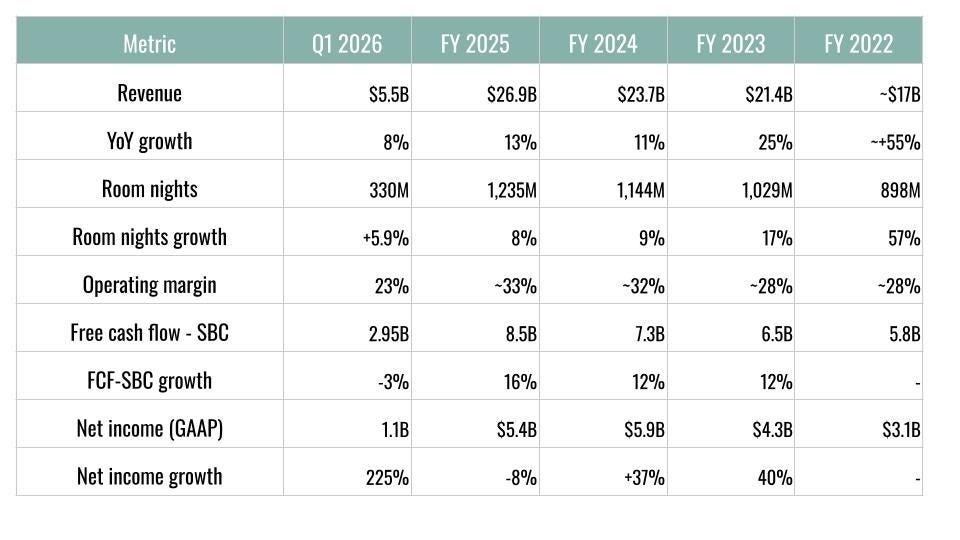
Operating margin: Q1 is structurally Booking’s weakest quarter every year. European summer travel, the core revenue driver, peaks in Q3. The annual operating margin of 32.8% is the right baseline. The 23% Q1 figure is seasonal. Q3 2026 will be the real test of the thesis.
FCF decline in Q1 2026 (-2%): not a concern. Q1 FCF benefited from $1.9B in working capital movements driven by the seasonal increase in deferred merchant bookings. This number shouldn’t be annualized. Trailing twelve-month FCF stands at $9.0B, up 6% year-over-year, the relevant figure.
Net income drop in FY 2025 (-8%): the business didn’t deteriorate. Net income was depressed by $1.3B in non-cash FX losses on euro-denominated debt and a $457M one-time KAYAK impairment. Strip those out and normalized earnings were approximately $6.8B, a record. This is covered in detail in the accounting risks section below.
Net income surge in Q1 2026 (+225%): don’t over-read this figure. The Q1 2025 base was artificially low for the same FX reasons. Adjusted EPS growth of +14% is the more meaningful number for underlying operational performance.
A note on ROIC and ROE: both metrics are difficult to use meaningfully for Booking Holdings. The company carries negative book equity (-$5.6B) as a result of its aggressive buyback program, a sign of capital returns discipline. This makes ROE mathematically distorted and ROIC highly sensitive to how invested capital is defined, with published figures ranging from 30% to 79% depending on the methodology. What matters is the direction: returns on capital have expanded dramatically since 2021 and are well above the company’s cost of capital. The precise figure is less important than the trend.
The natural hedge and why the FX losses don’t matter economically
Booking is a US-listed company that reports in dollars. The majority of its revenues are generated in euros, hotels in Europe, priced in euros, booked by travelers worldwide. Its long-term debt is also partially denominated in euros, issued on European capital markets at historically favorable rates.
The mechanism is straightforward. When the euro strengthens, European revenues converted into dollars increase, a direct benefit to the income statement. When the euro weakens, those same revenues decrease, but the euro-denominated debt, converted into dollars on the balance sheet, also shrinks, generating an accounting gain that partially offsets the revenue impact. A stronger euro hurts the debt side and helps the revenue side; a weaker euro does the reverse. The liability structure hedges the operating exposure naturally, without derivatives, without cost.
The $1.297B FX loss in 2025 is the accounting manifestation of a stronger euro inflating the dollar value of the debt on the balance sheet, not a business loss so much as a translation artifact. The CFO comes from institutional finance. The euro debt is not an accident.
The merchant float: a hidden asset
As Booking shifts from agency to merchant model, it collects payment from travelers at the time of booking and remits to hotels only after the stay. At any given moment, Booking holds billions in cash that technically belongs to its hotel partners.
This float is not Booking’s money — it appears as a liability on the balance sheet. But it is interest-free funding provided involuntarily by the supply side of the marketplace. As merchant bookings grow — 70% of gross bookings in 2025, up from 63% in 2024 — the float grows with them.
Two practical implications for the investor. First, the gross cash figure overstates available liquidity — the $16.8B on the balance sheet as of Q1 2026 includes deferred merchant bookings that will be remitted to hotels. It is not all Booking’s money to deploy freely. Second, quarterly FCF figures can be flattered by seasonal float movements. Q1 is peak booking season — travelers pay upfront for summer stays that haven’t happened yet. The float swells, boosting reported cash generation. Q1 2026 FCF of $3.1B included $1.9B from this seasonal effect. The relevant figure is trailing twelve-month FCF — $9.0B.
The float is such a stron asset. It is a structural feature of the merchant model — one that grows as the business grows, and that represents a form of supplier financing that most businesses would pay dearly for. Booking gets it for free.
Management
Glenn Fogel: CEO since 2017
Fogel didn’t found Booking. He inherited a dominant business and made it more dominant, and that tells you something about the culture he runs. No grand vision speeches, no moonshot announcements. Quarterly calls are sober, measured, and consistently conservative in tone.
The track record on guidance is one of the cleanest in large-cap internet. Fogel systematically under-promises and over-delivers, room nights guided conservatively, delivered above the high end of the range, quarter after quarter. The Q1 2026 beat, room nights up 6% against guidance that signaled caution on Middle East headwinds, is the latest in a long series. Markets tend to penalize conservative guidance with lower multiples.
The KAYAK impairment in 2025 is the most revealing data point on Fogel’s character as a capital allocator. Writing down $457 million on an asset representing 4% of revenues, doing so explicitly and clearly, with a direct explanation of why (rising AI-driven customer acquisition costs in metasearch) isn’t what insecure management teams do. They obscure it, or restructure around it, or blame the macro. Fogel named the problem, sized it, and moved on. That’s the behavior of someone who cares more about the accuracy of the picture than the comfort of the audience.
Skin in the game
Fogel holds approximately 643,000 shares post-split, worth around $102M, split between direct holdings and a grantor retained annuity trust. His compensation is structured around base salary, annual bonus, PSUs and RSUs tied to ROIC and relative TSR targets. The regular share sales under a pre-established 10b5-1 plan are mechanical: they reflect vesting schedules and portfolio diversification, not a discretionary view on the stock. We don’t know his total net worth, but for a CEO whose career has been built entirely at Booking Holdings, it’s reasonable to assume Booking represents a substantial portion of his personal wealth. Zero insider purchases over five years is a neutral signal for someone whose entire professional net worth is already concentrated in a single name.
The more relevant skin-in-the-game signal is the buyback program itself. Management has returned over 100% of free cash flow to shareholders since restarting the program in 2022, and reduced the share count by 22% net of dilution in that period. At current prices, which management presumably believes are depressed, the $3.6B in Q1 2026 buybacks represent an unusually large deployment of capital into their own stock.
The two thesis
Bear
Why the stock has fallen
The decline isn’t explained by a deterioration in fundamentals. Revenue grew 13% in 2025, free cash flow minus SBC reached $8.5B, and room nights hit a record 1.235 billion. The stock fell because the market repriced the risk of a future that hasn’t yet arrived.
Three factors combined: cautious Q1 2026 guidance that flagged a Middle East conflict impact on room night growth (roughly two percentage points of headwind, according to management), macro uncertainty around US consumer spending and transatlantic tourism flows under tariff pressure, and, most significantly, the AI disruption narrative. The market has decided that online travel agencies are structurally vulnerable to agents that can plan and book travel autonomously, bypassing intermediaries entirely.
The KAYAK impairment of $457M gave the bears a concrete data point. It’s the only one they have.
The bear arguments
AI disintermediation: It is the central fear. The scenario: travelers ask Claude, ChatGPT or Gemini to plan a trip, the agent searches inventory, compares prices, and completes the booking without the traveler ever visiting Booking.com. In this world, Booking becomes either invisible or a backend supplier with no pricing power. The fear is legitimate. The timeline, unknown. The evidence in the current numbers, absent.
Three sub-scenarios deserve distinction. In the light scenario, AI agents become powerful travel planners but still route transactions through Online Travel Agencies; Booking pays a new “AI tax” on top of the existing Google tax, margins compress but the business survives. In the intermediate scenario, agents bypass OTAs for search but still need Booking’s inventory and trust infrastructure to complete the transaction, so Booking’s role shifts from discovery to fulfillment. In the extreme scenario, agents connect directly to hotel APIs, Booking’s 4.4 million properties become accessible without intermediation, and the platform loses its reason to exist.
DMA and price parity: under the EU Digital Markets Act, Booking can no longer contractually require hotels to offer their lowest rates on its platform. A rational traveler who finds a property on Booking and books directly with the hotel pays less. Booking becomes a free discovery engine. The bear case: this structurally erodes conversion and take rates over time.
Mix dilution: flights and attractions are growing fast, 37% and 80% respectively in 2025. But both carry lower margins than accommodation. As they grow as a share of revenue, blended margins face structural pressure regardless of operational efficiency.
What if the bear thesis is really true?
If AI disintermediation is genuinely underway, the first measurable signals would be declining room nights in absolute terms on Booking.com’s core, rising customer acquisition costs on the accommodation segment specifically, and erosion of direct booking rates. None of these signals are present in Q4 2025 or Q1 2026 data. The bear thesis is being priced as present reality. It remains a future risk.
And even in the extreme scenario: 4.4 million verified properties, decades of reviews, cancellation guarantees, multilingual customer service and fraud protection cannot be replicated by an API connection. The inventory and trust infrastructure Booking has built isn’t downloadable. Booking in the extreme scenario becomes the infrastructure layer AI agents plug into, less glamorous, but not zero.
Bull
The business the market is ignoring
While the market prices a disruption that hasn’t arrived, the underlying business keeps compounding. FCF minus SBC grew 16% in FY 2025 to $8.5B. Operating margins expanded to 32.8%, more than 1,100 basis points above 2021 levels. The Transformation Program delivered $550M in annual savings, already in the run-rate. Every dollar of that flows directly to the bottom line in 2026.
60% direct: the empirical answer to the AI fear
Over 60% of room nights are now booked through direct channels: users who open the Booking app or type the URL without passing through Google or any other intermediary. That figure has been rising consistently year over year. It’s the single most important data point in this analysis.
When I type “Booking” into Google to navigate to Booking.com, I’m one data point in that 60%. Google is serving as my address bar. Booking pays no commission on that reservation. The same logic applies to AI agents: a traveler who opens the Booking app directly because that’s their habit bypasses every intermediary, AI or otherwise.
The DMA argument has the same answer. Hotels that offer lower prices on their own websites risk being downgraded in Booking’s search rankings, losing visibility on a platform that drives the majority of their bookings. The contractual lever is gone. The algorithmic lever remains. Most hotels play along.
Genius as a disintermediation defense
The Genius program is a structural moat against disintermediation. A traveler at Genius Level 2 or 3 (now representing a high-50% share of room nights) compares prices with a Genius discount already embedded in their mental model. A competing platform offering the same base price appears more expensive. An AI agent that recommends a cheaper alternative on a direct hotel website is fighting against a behavioral anchor Booking spent years building.
The stock cannibal at work
Since restarting buybacks in 2022, Booking has reduced its share count by 22% net of dilution. $3.6B was deployed in Q1 2026 alone, at prices management presumably considers depressed. $18.2B in buyback authorization remains. At current prices, every buyback dollar buys more earnings per share than it would at historical multiples. The mechanism compounds more powerfully precisely because the stock is cheap.
Catalysts
Four categories of catalysts could trigger a re-rating.
Earnings: Q3 2026 is the key quarter, peak European summer season, first full year of Transformation Program savings in the cost base, and the first quarter where Middle East headwinds from Q1-Q2 anniversary out. A beat and raise on that print would address the macro fear, the margin fear, and the AI fear all at once.
Structure: short interest has built on the AI narrative. A strong quarter could force covering, and a short squeeze on a stock with $18B in buyback authorization behind it is a powerful combination.
Strategic: Booking has $16.8B in cash and investments. An acquisition in AI travel technology, or an announced partnership making Booking the backend of a major LLM travel agent, would invert the narrative entirely.
Macro: dollar weakness benefits both revenue conversion and the FX line in the income statement. A Fed rate cut cycle expands multiples on profitable growth companies mechanically. Clarification of DMA obligations removes a regulatory uncertainty that’s been overhanging the stock.
What would invalidate the bull thesis
Four signals worth monitoring every quarter:
room nights declining in absolute terms on the core Booking.com accommodation segment;
the direct booking rate falling below 60% and trending down;
customer acquisition cost rising on accommodation specifically;
an AI agent demonstrably completing hotel bookings at scale without routing through an OTA.
None of these have appeared. When one does, the thesis deserves reassessment.
Test it yourself
Ask Claude, ChatGPT or Gemini to plan your next holiday. Note where you end up. Then compare the same search on Booking.com and Airbnb: pricing, cancellation terms, customer service guarantees. The bear thesis assumes AI makes Booking irrelevant. The bull thesis says AI makes Booking more necessary, because travelers need someone to trust when things go wrong, and that trust takes decades to build.
Blind spots
Four blind spots worth acknowledging honestly.
Geographic revenue isn’t published. The proxy method used in this analysis rests on market share estimates that could be wrong. If Booking’s European concentration is higher than estimated, FX sensitivity is higher than modeled.
The quality and adoption rate of the AI Trip Planner isn’t measurable from public data. Management reports positive signals on conversion, but the counterfactual (what conversion would be without it) is unknowable.
The long-term impact of DMA on take rates isn’t yet visible in the numbers. It may take several years to materialize, or it may never matter if the algorithmic lever proves as effective as the contractual one was.
Glenn Fogel’s tenure: he’s run the business well for eight years. There’s no succession plan visible in public filings. Key man risk exists, even if it isn’t the central concern today.
Price scorecard
This section is the output of everything above. The numbers only make sense if you’ve read the two thesis section. As Damodaran said, “a valuation without a thesis is just a spreadsheet”.
The metric
We use the normalized PE, instead of the forward PE, which is built on analyst estimates rather than published facts. Starting from the 10-K, we strip out the non-cash, non-recurring items that distort the GAAP net income:
Net income GAAP: $5.404B
+ Non-cash FX losses: +$1.297B
+ KAYAK impairment: +$457M
- Associated tax benefit (~20%): -$351M
Normalized earnings: ~$6.8B
At the current price of $163, market cap ~$128B, the normalized PE is approximately 18x, against a historical range of 25-30x in normal conditions, and a COVID floor of 16.8x in March 2020. The only times Booking traded below 20x in the last ten years were March 2020 and March 2016. This is the third occurrence.
You’re paying less than 22x the structural earnings power of one of the most profitable marketplaces in the world.
The scorecard map
The core thesis
My central assumption is that Booking Holdings will, over time, trade back toward its long-term average earnings and its long-term average multiple.
What happens between now and then, macro shocks, AI developments, rate cycles, geopolitical events, a crash, I have no idea. Nobody does. The scorecard below maps possible destinations and deliberately excludes crash scenarios. Price fluctuations will be driven by investor sentiment as much as by fundamentals.
A broad market selloff, an oil shock, a recession: any of these could push the stock well below the bear case temporarily, independent of Booking’s fundamentals. That risk is real and is addressed in the portfolio section.
What I believe is that paying 21.5x normalized earnings for a business of this quality, at a valuation that’s appeared only twice in ten years, offers a margin of safety that makes the uncertainty manageable.
The scorecard
The table uses EPS TTM of $7.61, a central growth assumption of +25% per year over two years, and three scenarios for growth and multiple expansion. Bear case assumes growth 20% below base. Bull case assumes growth 20% above base. Combinations that are internally contradictory, a bear earnings trajectory with a bull multiple, or vice versa, are marked irrelevant.
One important caveat: all figures in the scorecard are pre-tax and pre-fees. The actual return in your hands will depend on your tax situation, the investment vehicle you use, and any transaction costs. A gain of +82% in a taxable account is not the same as +82% in a tax-sheltered envelope. Run the numbers for your own situation before drawing conclusions.
How to read this
The bear case at PE 20x ($198, +21% from current price) is the realistic downside if the AI disruption narrative persists and growth slows. Even here, the return is positive over two years. The only scenario that produces a loss is PE 15x in the bear case, a multiple last seen at the absolute trough of COVID, applied to a business posting records. That’s not a base case. That’s a panic scenario.
The central case at PE 25x ($297, +82%, 35% CAGR) requires no heroic assumptions. It simply prices the business at the lower end of its historical multiple range, with earnings growing at the central rate. That’s what a re-rating looks like when a sentiment-driven discount unwinds.
The bull case at PE 30x ($428, +162%) requires both strong earnings growth and multiple expansion back to peak levels. It isn’t necessary for the thesis to work.
The asymmetry
The realistic downside is contained. The realistic upside is significant. That gap is the investment case.
You don’t need the bull scenario to make money here. You need the business not to be broken. Everything in this article suggests it isn’t.
Portfolio considerations
Sizing
I initiated a position on May 12th at €149.03 per share, a normalized PE of approximately 18x at the time of purchase. The position currently represents approximately 6% of the portfolio.
I’m prepared to increase that allocation to up to 20% if the stock continues to fall, not because I expect it to, but because the quality of the business at depressed valuations justifies a larger conviction bet. It’s a thesis: if room nights decline in absolute terms on the core Booking.com accommodation segment, or if the direct booking rate falls consistently below 60%, the investment case deserves reassessment. As long as the thesis holds, lower prices are an opportunity.
Cyclicality
Booking carries meaningful exposure to travel demand, consumer confidence, and oil prices. A cheaper barrel makes flying cheaper, drives volume, and lifts the whole travel ecosystem. Conversely, an oil shock or a consumer spending contraction hits travel before most other discretionary categories.
That cyclicality is precisely what creates the entry point. The market prices in the downturn before it arrives, compresses the multiple, and offers the business at a discount to intrinsic value. The exit comes when optimism returns and the multiple normalizes. Buy the sentiment trough, hold through the recovery, sell the enthusiasm. The cycle does the work.
This is also deliberate tactical allocation. I sold OKEA, a Norwegian oil producer, a direct play on the oil cycle, to partially fund this position. Rotating from a commodity cyclical at peak geopolitical risk premium into a quality consumer cyclical at a sentiment trough isn’t a coincidence. It’s the same logic applied twice, on opposite sides of the oil price.
Currency
Booking is listed in dollars. I hold it in euros. The currency exposure is real but partially self-correcting: as covered in the accounting section, Booking’s euro revenue base and euro-denominated debt create a natural hedge within the business itself. A weaker dollar benefits both the converted revenue line and the FX accounting line simultaneously. I don’t hedge the currency exposure at the portfolio level. The business structure already does part of that work.
Conclusion
Booking Holdings is a misread business.
The market has applied a COVID-level valuation to a company posting record revenue, record free cash flow, and expanding margins. The fear driving that discount, AI disintermediation, is legitimate as a long-term risk and absent as a present reality. Room nights are growing. Direct traffic is rising. The Transformation Program has delivered. The stock cannibal is buying back shares at the cheapest multiple in a decade.
I bought on May 12th at a normalized PE of 18x. That’s the third time in ten years this valuation has appeared. The previous two were March 2016 and March 2020. Both were followed by significant re-ratings.
I don’t know when the re-rating happens this time. I don’t know what the path looks like. What I know is that I’m paying a fair price for an exceptional business, and that the cycle, eventually, always completes.
The bear thesis is true as a risk. It isn’t true as a present reality. The market is confusing the two.
That gap is the trade.