
1. Quarter Verdict
EverQuote delivered on revenue, growing 25% year-over-year. Operating margin expanded from 9% to 12%, and operating income grew 65%. EPS growth was muted by a tax headwind, but the underlying results are solid.
Nothing here shows any sign of disruption to the business today.
EverQuote delivered another quarter of growth and profitability.
The investment thesis has always rested on a simple observation: a platform like EverQuote already exists and works in Europe — MoneySuperMarket and GoCompare in the UK, CHECK24 in Germany, LesFurets in France — and the US is simply following the same path with a lag. This is a genuinely good business that the market has beaten down.
With a PE of 11.4 and a PFCF-SBC of 12.5 on a price of $24 (premarket), EverQuote is a quality small-cap that should re-rate toward double its current price
Verdict: Another quarter, another fear of disruption that is still not showing up. Re-rating will come.
My Reaction
Management is talking extensively about its EBITDA Adjusted.
To focus on this point, I dislike the usage of EBITDA, as it doesn’t reflect the true health of the company.
But Adjusted EBITDA? It is something I strongly dislike:
The term isn’t standardized and its definition can be adjusted to whatever management wants to show you.
If the GAAP term were good, they would present it.
It gives me a seductive vision from management, showing you the parts of the truth they are willing to and not the actual situation. I cannot feel trust in such conditions.
In this kind of situation, I usually check for financial shenanigans, to see if the partial vision provided by management is also distorted in the financials.
Management defines it as: “net income (loss), excluding the impact of stock-based compensation expense; depreciation and amortization expense; restructuring and other charges; acquisition-related costs; legal settlement expense; interest income; and income taxes. “
Luckily, the numbers for EverQuote are still strong and the net cash position tells you the company generates enough cash to fund itself and still return some of it to shareholders
But still, I won’t comment on any Adjusted EBITDA metrics.
I have held EverQuote since April 30, 2026 and I’m up 60% at the time of writing, a pretty solid result.
The company is heavily profitable, and priced like it’s dying. I still don’t see any disruption. Management is able to take advantage of the undervaluation to buy back as many shares as possible, a good point for the long term. I can clearly see the company trading around $100 within a few quarters
When? The main question is when the market will consider that EverQuote is a winner, and won’t be disrupted anytime soon.
2. The Numbers
2.1 At a Glance
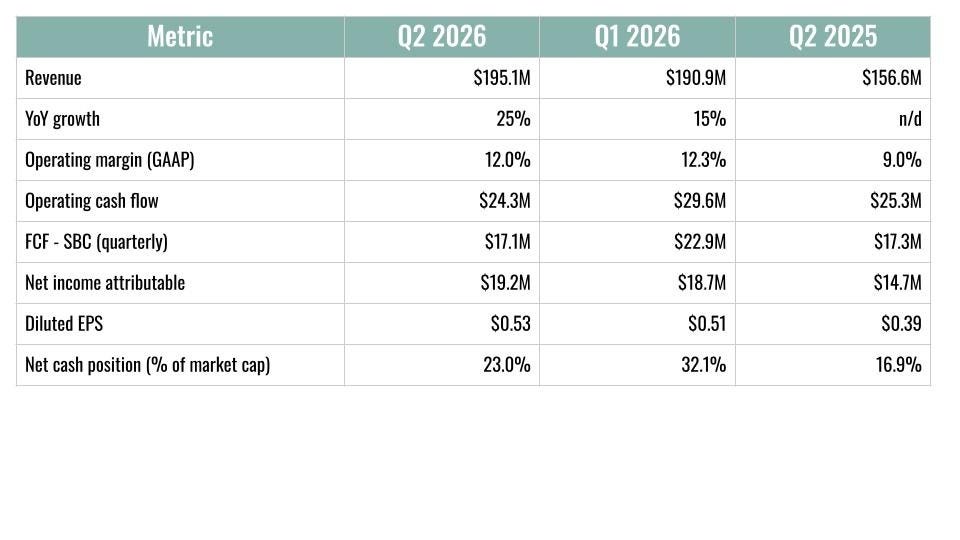
This table summarizes the key metrics from EverQuote’s Q2 FY2026 earnings release: https://investors.everquote.com/news/news-details/2026/EverQuote-Announces-Second-Quarter-2026-Financial-Results/default.aspx
2.2 Commentary
Revenue: 15% year-over-year in Q1, 25% in Q2. Those are good numbers, as they usually increase the operating leverage. But it cannot be found yet in the increase of earnings. This is the reason, in my opinion, why management is talking about EBITDA Adjusted.
The main activity is in the Auto segment (+23.3%, $172.1M), but the Home & Renters segment is gaining more traction +35.2% ($23.0M). A good signal, as it isn’t their core activity and they take market share from their competitors - online: MediaAlpha and offline: TV, display advertising, physical agents (i.e., in-person/traditional insurance agents).
Operating Margin : 12% in Q2 vs 12.3% in Q1, vs 9% in Q2 ‘25. The operating income grew 65% YoY for just 25% growth of revenue. The leverage is the key to the rerating and earning growth I am looking for. It went from a small basis, though.
Net income and Free cash flow: Free cash flow - Stock-based compensation dipped sequentially, $22.8 million versus $28.1 million in Q1. The dip reflects a working-capital timing effect.
Income before income taxes is up from $15.1M to $24.5M (+62% YoY), but the tax rate went from 2% to 21%, due to a one-time tax credit last year. It was a one-time event that won’t occur next quarter.
Cash position : $192.3 million in cash, zero debt, $50 million bought back since last August. Net cash as a share of market cap fell from 32.1% in Q1 to 23.0% in Q2. This number is pretty satisfying, as this “lowers” the effective PE ratio by 23%, and management will be able to buy shares back and push the share price higher.
3. Key Takeaways from the Earnings Call
Management spent a lot of the call on AI — a new bidding tool called Smart Campaigns, internal AI agents, early work on capturing traffic from AI search and what they called “agentic commerce.” It’s a real shift in framing: AI used to come up as a threat to comparison platforms like this one, and now it’s being pitched as EverQuote’s own weapon.
Management follows a metric, the Variable Marketing Dollars (VMD), which is Revenue minus the expense for traffic acquisition from Meta, Google, etc. It tracks the true value the company adds. The ratio of this metric is the Variable Marketing Margin (VMM).
The most-asked question on the call, more than once, was whether the margin would compress as the company invests in AI. CFO Joseph Sanborn kept steering it back to dollars, saying the company does “not solve for VMM margin, we solve for VMD,” and reiterated a target in the high 20s. That’s a defensible way to run the business, and keeps a focus on operational leverage.
The AI story moved from a defensive talking point to an offensive one. For the moment, only the story changed: it is still to be found in the VMM.
Combined ratios stayed healthy — “in the 80s,” per management — which is the clearest evidence available that the 2023 collapse was cyclical, not structural.
On capital allocation, management laid out three priorities in order: organic growth, buybacks ($50 million cumulative), and M&A as a lever toward the $1 billion target. No sign of a deal happening soon.
4. Where the Investment Thesis Stands
I had no time to formalize a deep dive yet, although I meticulously checked the company on a checklist I have.
4.1 Bear Thesis Signals — Triggered or Not
- AI disintermediation (Google/Meta build native insurance comparison tools) → not triggered. Management is positioning EverQuote as an AI infrastructure partner instead, though that’s a claim only and not a measured outcome yet.
- Traffic dependency (rising Google/Meta click costs compress margin) → not triggered. VMM held at 29.2%, in line with last year.
- Rising carrier combined ratios cutting marketing budgets → not triggered. Combined ratios described as healthy, in the 80s.
- Stock-based compensation dilution → partially active. SBC is real ($10.8 million year-to-date) but partly offset by $29 million in buybacks over the same period.
- Product concentration in Auto insurance → still structurally true (88% of Q2 revenue), though Home is growing faster and slowly diluting it.
4.2 Bull Case Prerequisites — Status
- Recovery of the auto insurance cycle → confirmed. Healthy combined ratios, accelerating Auto growth.
- Operating leverage from AI and scale → confirmed and strengthening. Operating income growth nearly tripled revenue growth.
- Disciplined capital return → confirmed. $50 million bought back, consistent pace.
- Diversification into Home insurance → in progress. Home grew 35.2% against Auto’s 23.3%.
- Path to $1 billion in revenue → reaffirmed by management this quarter.
- VMM expansion above 35% → not observed. Still at 29.2%.
Disclaimer
All content published by JB Peter on this platform is strictly for educational and informational purposes. It does not constitute investment, financial, legal, or tax advice, nor does it represent a personal recommendation or solicitation to buy or sell securities. This research is operated by ORIACON (SASU) and reflects independent corporate analysis. Every reader must conduct their own independent research (Due Diligence) or consult a licensed professional before making any financial decision, as financial markets involve a high risk of capital loss. At the time of writing, ORIACON or the author HOLD shares in the company analyzed in this article. Following this publication, ORIACON and the author reserve the right to buy, sell, or modify positions in any security mentioned at any time, without prior notice to readers or subscribers.