
Introduction
We have three bank cards in our European household and we will keep only one, because we won’t need more.
It all began in April 2024 when I started taking up positions on Visa and Mastercard. I was up 30% one year later, but I decided to exit both, rotating into Nvidia and Alphabet.
The main trigger was an event that I saw coming for them in the European Union; and that I still haven’t seen written about anywhere, not even on Substack.
I am convinced that in a few years, the developments described in this article will come to pass (at least in the EU) with major implications for Visa, Mastercard, and PayPal.
I. The flywheel
The spectacular growth and competitive advantage of Visa and Mastercard are based on the following flywheel: more issuers attract more merchants, more merchants attract more cardholders, more cardholders generate more transactions, more transactions produce more data, more data enables better value-added services, and better services attract more issuers.
And so on.
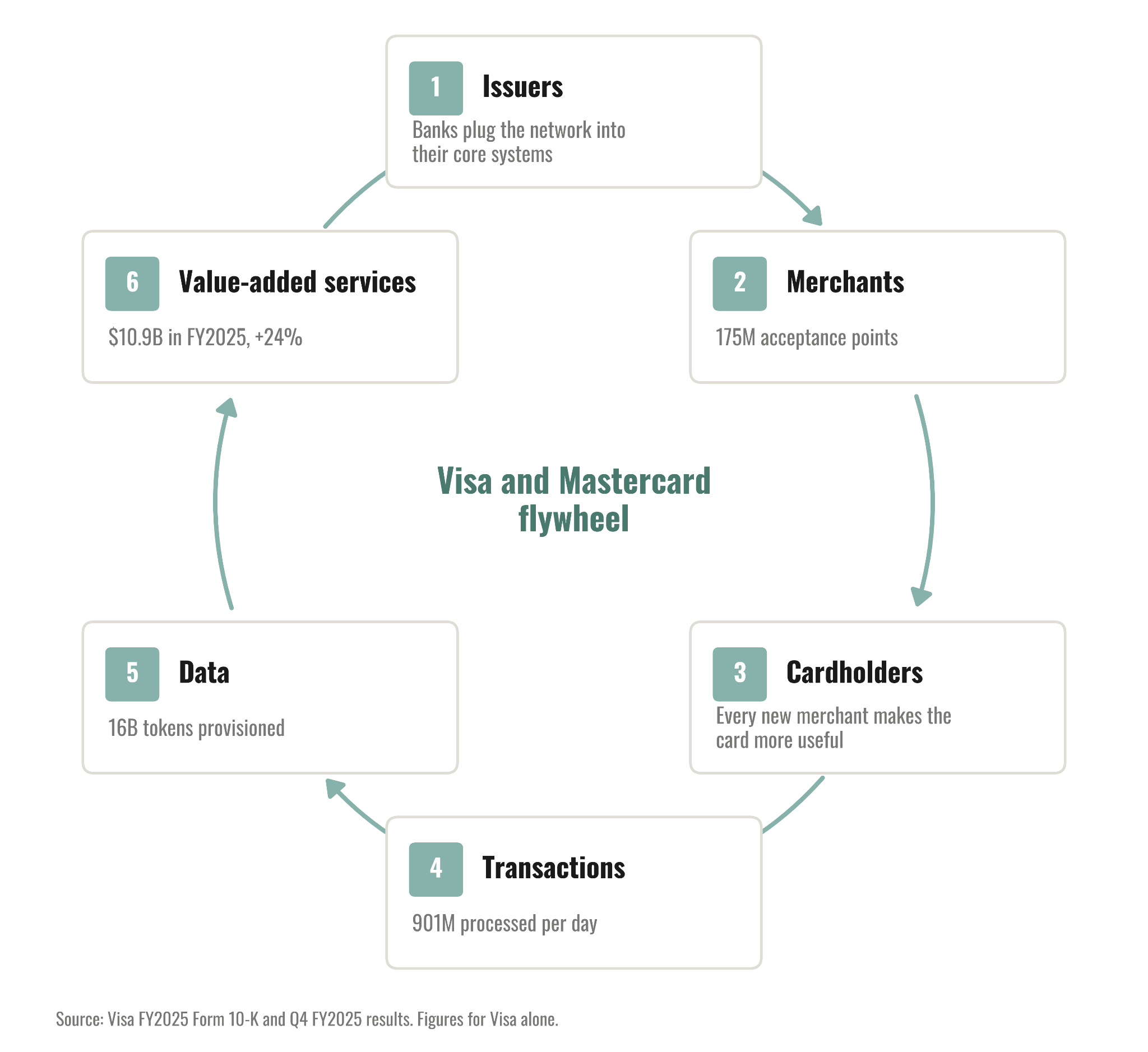
Once the scale effect is reached, you’ll have a network of 150 million acceptance points across 200+ countries, with switching costs, that are based on decades of embedded infrastructure in every bank’s core systems.
Visa’s FY2025 results look solid, especially in the United States, where you get rewards: miles, cashback, airport lounges.
II. the vectors of the broken flywheel
1. In EU, fees is all you get
In the US, Visa and Mastercard can afford incentives. In the EU, it’s just a commodity to pay, as the regulator capped interchange (0.20-0.30%), and rewards barely exist.
So when an alternative shows up, nobody has a reason to stay and the cheapest option wins.
Germany is ahead on most tech topics, but not on payments: cash is still widely used and a lot of transfers go through the banks. Paypal commands approximately 30% of German e-commerce transactions, the dominant payment method online. That position was built on a single use case: I want to pay online without giving my card number, with buyer protection.
There is, of course, Wero, but the system launched in 2024 and backed by European banks offers exactly the same features as Paypal. The only benefit is simply that it is a European public service. An “economic patriotism” in short, without much interest beyond the love of the flag.
2. A2A: the disruption already underway
Disruption has already begun in two countries with national initiatives. Credit cards aren’t the only losers; cash is also a collateral victim of the operation. But that doesn’t translate into investment losses for anyone for the latter.
PIX, Brazil, launched November 2020
The initiative was mandated by the Banco Central do Brasil. It is free for individuals; merchants pay 0.33%, compared to 2.3% for cards. Participation is mandatory for any institution with more than 500,000 accounts.
Five years later, in 2024, there were 64 billion transactions (exceeding the combined volume of Visa and Mastercard) and 93% of Brazilian adults were using PIX. A resounding success.
Meanwhile, the use of cash fell from 43% to 6% of all payments. Visa and Mastercard incured combined losses of R$12B between 2021 and 2024, or nearly $2.3B.
It was such a success that in September 2025, the U.S. Trade Representative launched a formal investigation into PIX, calling it an “unfair competitive disadvantage” for U.S. card networks, a claim echoed in a White House report in April 2026. President Lula responded: “No one will make us change PIX.”
UPI, India, launched in 2016
Nine years after its launch, UPI had processed 644 million transactions in a single day in June 2025. In May 2025, the value of UPI transactions was 12 times greater than the cumulative total of all card transactions in India. UPI is growing at an annual rate of 30–40 percent, compared with 10 percent for Visa. Another resounding success.
3. The Digital Euro: Once Bit, Twice Bit, Three Times Bit
The digital euro is a central bank digital currency (CBDC). It is a form of public currency issued directly by the European Central Bank, with the same legal status as cash.
It is a sovereign currency, backed by the ECB, and accessible to all citizens and businesses in the eurozone.
Currently, when you pay by card, you are using bank money (i.e. private money) processed through a private infrastructure owned by U.S. companies. The digital euro would be the first form of public digital currency directly accessible to EU citizens. It would be the equivalent of a banknote, but in digital form. So it is not a stablecoin, but an official version of a currency.
The ECB has made it clear that its goal is to reduce dependence on foreign payment infrastructures.
In practice, you store your digital euros in a wallet provided by your bank, a post office, or any authorized payment service provider. You can make payments in stores, online, or between individuals, whether online or offline. No internet connection is required for offline transactions. There are no transaction fees for users.
Here are the main design features confirmed by the ECB. These may change between now and the go-live date.
Acceptance is mandatory for all merchants in the eurozone from day one. Transactions are off-line, and only the payer and the payee know the details; the Eurosystem cannot directly link transactions to individuals. In principle, holding limits would be capped at €3,000 per individual. Cash and existing payment methods would still be available.
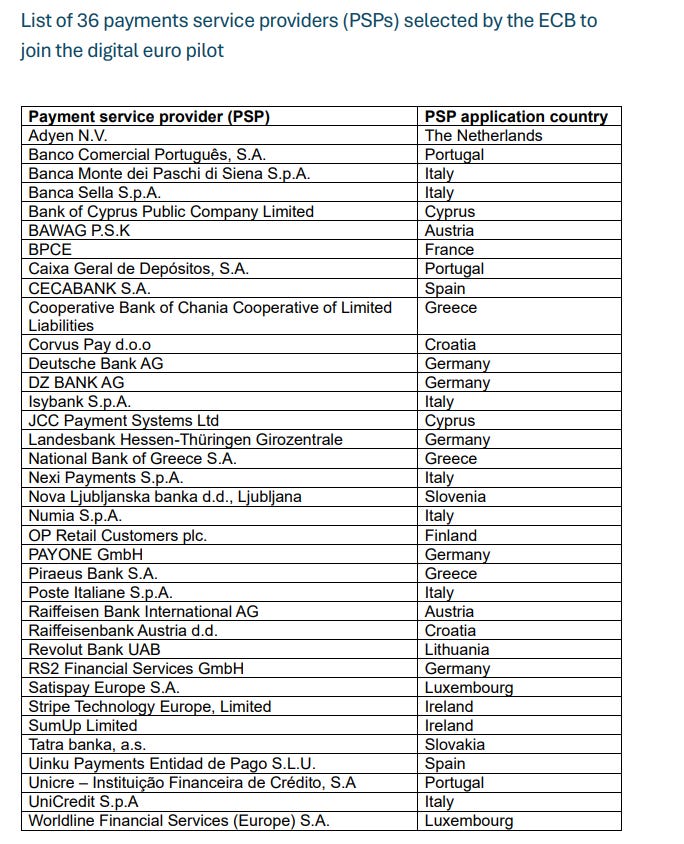
As for the timeline, following a study phase in 2021 and preparatory phases, on July 9, 2026, Parliament approved its negotiating mandate in plenary session by a vote of 416 to 169, with 22 abstentions. Next, a political agreement is expected by the end of 2026, then a 12-month pilot from the second half of 2027, and first issuance as early as 2029 if nothing slips. Some delay is likely. Below is the list of PSPs selected for the pilot.
4. What about me ?
We have three credit cards at home, at about €9 each per month. We’ll keep one for trips abroad, for the insurance and the best international transaction fees.
The other two will go. The digital euro will cover the same things at no cost, and every merchant in the eurozone will have to accept it.
The €9 includes my bank’s fees. What Visa and Mastercard take is about 0.1% of each transaction. The impact could be to 150 million households in the same situation.
As an independent analyst, I may end up with no business card at all. If the digital euro covers everyday payments and domestic B2B transactions, a corporate card isn’t needed anymore, out of business travel abroad. One more brake on the flywheel.
5. The Guillou Case
On August 20, 2025, the U.S. Treasury put Nicolas Guillou, a French judge at the International Criminal Court, on its sanctions list, next to drug traffickers and Al-Qaeda members, for issuing arrest warrants against Prime Minister Netanyahu and former Defense Minister Gallant.
Visa and Mastercard had to comply, and so did PayPal. In France, paying in euros, a French judge couldn’t buy groceries or withdraw cash with his card anymore.
His own words, spoken at the Union of Judges’ convention in October 2025:
I realized that Europe no longer has any sovereignty when it comes to payment systems, since we rely almost exclusively on American payment cards: Visa, Mastercard, and American Express. Even if your bank doesn’t close your account, you no longer have any means of payment.
Nicolas Guillou (French judge at the International Criminal Court)
As reported by Le Monde on November 19, 2025 (in French): the U.S. executive can cut off any European citizen from the banking system and digital life of their own country.
Everyone at the ECB and in Brussels saw it. For the EU, this is a matter of survival, and they know it.
6. Risks perceived by intermediaries
Visa’s 10-K for fiscal 2025 does mention this risk:
The European Central Bank has launched a multi-year project to study the introduction of a digital euro, which would serve as an alternative to foreign digital currencies and payment service providers. If their rollout proves successful, these national payment platforms and digital currencies could have a significant impact on Visa’s domestic and cross-border payments, particularly in terms of potential disintermediation.
Mastercard’s 10-K barely mentions the topic, and PayPal’s report doesn’t mention it at all.
III. The Impact on Visa, Mastercard, and PayPal
1. Expansion Scenario
At first, the digital euro will be open only to eurozone residents, and to non-residents with an account at a eurozone payment provider. Non-residents will still pay with their Visa card. But it could also expand to neighbouring countries, over the coming years.
Central banks could also connect their systems directly and skip the intermediaries. Then, moving money would become a utility run by public institutions, a bit like water or electricity.
With the emergence of nationalism and national pride, paying with the national network could become a way to show your ideological views.
3. Financial impacts
61% of Visa’s revenue comes from outside the United States, and the Eurozone is a big part of it. Since Visa is asset-light, any downturn in revenue would severely affect the operational leverage, and the flywheel would start turning backwards, as shown in the picture below.
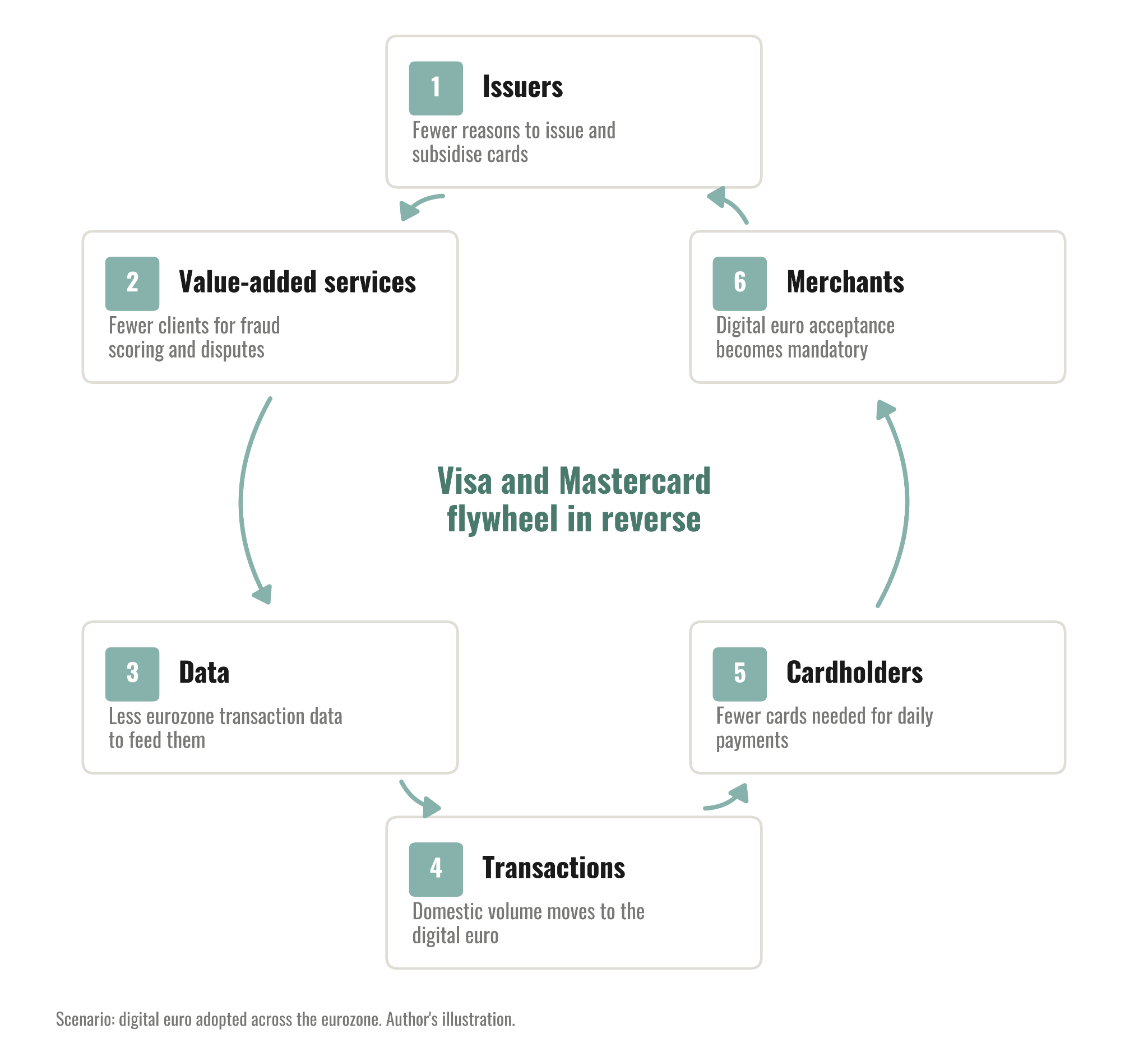
Data processing and service revenue follow the decline in revenue proportionally. International transactions and value-added services should hold better.
A drop in revenue hits ROIC immediately, and the premium on the multiple (because of the stability of the business) would shrink. For me, today’s price does not justify the risk premium of Visa or Mastercard.
PayPal has the same exposure as Visa and Mastercard in Europe, but nothing like their international transactions as a last line of defense. So it’s even worse for them.
Conclusion
Given the successful examples of Pix in Brazil and UPI in India, I see no reason why the model wouldn’t be a success in the Eurozone. And since the Guillou affair, this approach has become a necessity, there’s no turning back.
Meanwhile, fintech companies continue to emerge, and the account-to-account payments are growing. I find it hard to look ahead to the future of payment methods with confidence. I think there will be a name for what is happening to Visa, Mastercard and PayPal in Europe.
We’ll call it the “Finpocalypse.”
Disclaimer