
This is the first article in a series on getting started with stock market investing. The goal here is to cover the basics you need to know before you start investing. The next articles will cover “choosing my first ETF,” then “choosing my first individual stocks,” followed by sections on creating a watchlist and putting together a checklist.
1. Why Invest?
One might already ask: Why take the time to invest? Because of inflation.
The 20th-century British economist John Maynard Keynes witnessed the shift toward an inflationary regime following World War I, which gave rise to two types of actors:
The losers: Holders of currency and bonds, whose capital is eroded by inflation.
The winners: Entrepreneurs and investors who have invested in real assets and inventories of goods, because the nominal value of their holdings automatically keeps pace with—or exceeds—rising prices, while the real cost of their past debts decreases with inflation.
2. Types of Investments
What exactly are these asset classes?
-Real estate: You buy a property for yourself or one that generates a return (rental income) known in advance and expected to rise in line with inflation.
-Credit: This refers to a loan with a defined term and terms and conditions established in advance. The gains and losses are known to all parties. This category generally includes bonds, fixed-income securities, savings accounts, and private debt.
-Equity: We are investing in a business whose profits are uncertain and more or less difficult to predict. This category typically includes companies, whether publicly traded or not. Due to the uncertainty of the business, the investor will demand a risk premium to justify the investment, which can be understood in terms of the following question: “Why invest in a company and take the risk of a loss when I can make a risk-free investment yielding 4%?” The maximum loss is 100%, and the maximum gain is potentially “unlimited”.
-Commodities: Prices depend on supply and demand within a production process and, therefore, on the global economic climate, as well as on the level of speculation in this area.
-Store of value: Gold, Bitcoin, etc.: Their value depends on the market’s assessment of their worth and is therefore also subject to significant fluctuations. Gold has generated a long-term return of approximately 8% per year since the 1970s.
3. Within the “Equity” category
Investing in one or more companies can take various forms:
Public markets: A company goes public to raise capital and provide liquidity. This gives investors the undeniable advantage of being able to sell their shares at virtually any time.
Private Equity: investment in unlisted companies—illiquid and with limited information available. The average return is generally higher than that of the public market, with capital typically locked up for 10 years.
ETFs: Exchange-Traded Funds (ETFs) are portfolios of stocks grouped according to a common theme: the S&P 500, MSCI World, STOXX 600, Nasdaq 100, or a more specific theme (semiconductors, water, green energy, automotive, ethically-driven indices, etc.).
Investment funds: A fund manager collects money from investors and invests it according to a defined strategy in listed or unlisted markets. The manager is compensated through management fees (often 1–2% per year).
Moving forward, we will focus on ETFs and the market for individual stocks. Due to liquidity concerns and a lack of transparency regarding positions, private equity is not an asset class in which I wish to invest. As for managed funds, the high management fees and lack of transparency also deter me from investing in them.
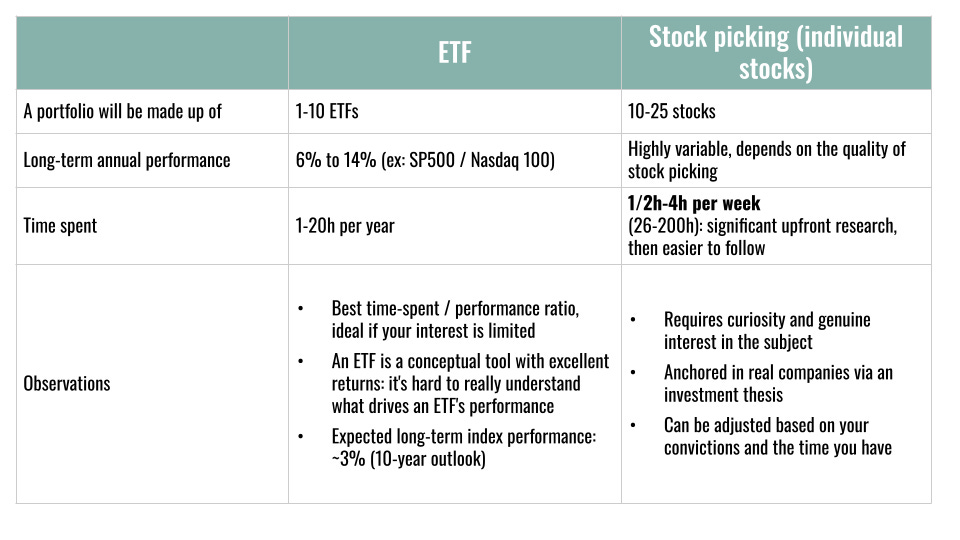
A portfolio made up of ETFs can contain anywhere from one to about ten holdings. Some investors will be comfortable holding just a single MSCI World or S&P 500 ETF. Some will want to focus on specific bets, requiring a portfolio with more lines. If you track an index, you naturally achieve its return, which generally ranges from 6% to 14% per year on the long-term. Monitoring ETFs is very time-efficient and will take you only a few hours a year. In my opinion, this offers the best time-to-return ratio and is even ideal if you have only a limited interest in investing. On the other hand, since ETFs operate at a fairly high level, calculating the impact of various risks is a much more difficult exercise than it is for individual stocks: for example, answering the following question is, in my opinion, beyond the reach of an individual investor: “In the event of an oil shock or a rate hike, what would be the impact on the S&P 500 index?”
A portfolio composed of individual stocks will generally contain between 10 and 25 holdings, and its performance will vary greatly depending on the investor’s luck and skill. It requires significantly more time—at least one hour per week, if not several hours each week. The most complex part occurs before the purchase, when selecting the portfolio’s holdings; once that’s done, monitoring the portfolio is much simpler. Stock picking requires curiosity and a keen interest in the subject; those who engage in it are often enthusiasts. Whereas ETFs operate at a high level of abstraction, stock picking is grounded in reality through the selection of companies based on an investment thesis. In my view, it’s easier to tailor your portfolio to your available time, investment style, and convictions.
The table below summarizes the differences between ETFs and individual stocks:
4. Building Your Target Asset Allocation
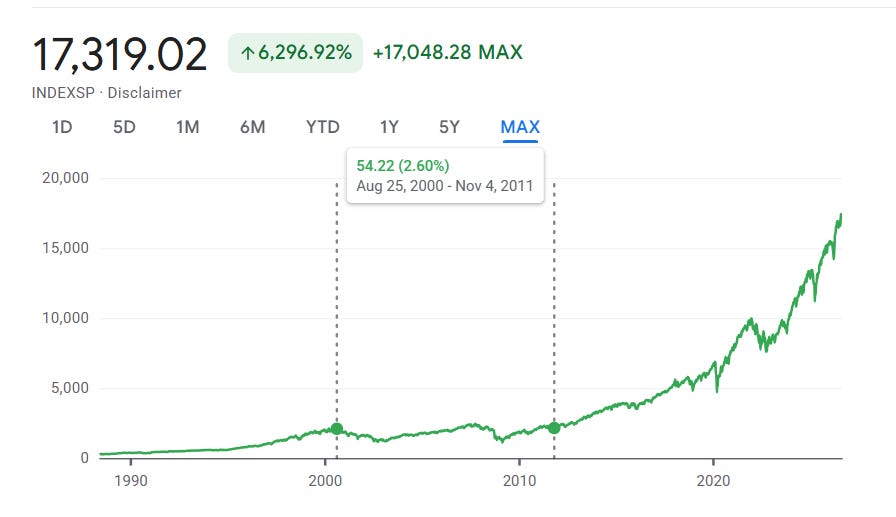
In the stock market, expected returns are not linear. Those who invested in the S&P 500 at the top of the Internet Bublle took 11 years to break even. Yes, you went in positive territory from 2006 to 2008, only to experience the Great Financial Crisis.
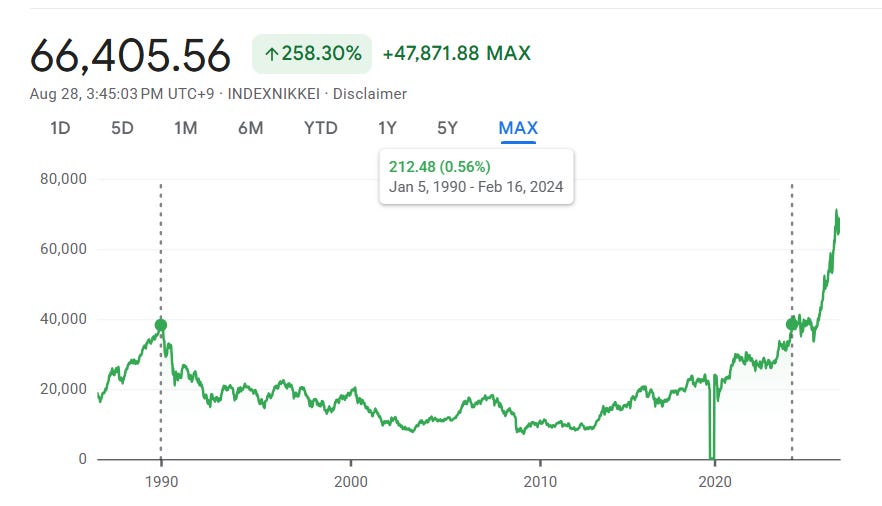
Similarly, those who invested in Japan in 1990 took 34 years to recover their losses.
Money invested in the stock market is tied up for the long term, generally for at least 5 or 10 years. That is why it is recommended to have funds available to meet short- and medium-term needs. This step, in particular, should be adapted to your specific needs.
The first step is to set aside 3–6 months’ worth of expenses for unexpected events, usually in a savings account.
Next, you should calculate your needs for various projects over a time horizon of less than 5–10 years:
A real estate reserve (for a loan, a reserve for renovations, etc.)
Special events (leisure, work, life milestones such as wedding or moving expenses)
If you are 45 or older and have children, estate planning is an issue that deserves careful consideration and should be integrated into your investment strategy.
With the remaining part, define long-term capital allocation from among the following:
Fixed income (calculated based on your needs as indicated above)
Real Estate
Equities (ETF, Individual stocks)
Other Asset Classes
The longer the investment horizon, the more the portfolio can be invested in stocks.
If you are 20 years old, your time horizon is potentially 50–70 years. If you are 60 years old, your time horizon is potentially 10–30 years, and you may want greater capital protection in light of your estate planning or future needs.
This question is difficult to answer at this stage and may need to be refined over time. The idea here is to get started and explore this question in greater depth later on.
5. Choosing Your Investment Wrappers
Unless you’re an individual living in Switzerland or Luxembourg—or some other lucky person in a similar situation with a 0% tax rate—your investment decisions will need to be weighed against your tax situation. In financial theory, optimizing your tax rate is just one of many ways to maximize your return (despite all the implications this may have for our societies).
There are many online resources for finding investment wrappers in your country. Start by searching online, and also ask your banker what options he can offer you.
To give you an example and to illustrate my point, I have three investment wrappers available for a French individual:
-A Plan d’Epargne en Action (PEA = Stock Savings Plan) that allows you to hold French and European Union stocks, with a tax rate of 18.6%.You need to wait for 5 years before unlocking the capital, but it is possible to switch investments within the account (e.g., sell Novo Nordisk to buy Interparfums) without incurring taxes, paying only the applicable buy and sell fees.
-A French “assurance-vie” (life insurance account) that allows me to hold approximately 1,000 individual stocks and which I use to hold shares in companies such as Microsoft, Booking, etc. The management fee is 0.5% per year, and when I want to sell shares to take profits, the insurer processes the transaction within 2 to 3 business days and takes a fee of 0.1%. Withdrawals from the wrapper are taxed at 24.7% after 8 years, 31.4% before.
A Compte Titres Ordinaire (standard securities account) with Interactive Brokers that lets you hold everything, with no custody fees and a 31.4% capital gains tax rate when you sell. Less useful for compounding, but it gives you access to some excellent investments.
Having multiple investment accounts sometimes creates a problem when I want to switch from one account to another, because withdrawing funds from my PEA or life insurance policy results in tax implications that I’d rather avoid.
6. Calculate Your Net Return
Let’s look at an example of how to calculate net return based on my three investment vehicles and their applicable fees and taxes, using the purchase and resale of a stock. Suppose that in two years, I’ve doubled my investment, for a return of 100%.
I can invest in this stock using all three of my investment wrappers, but the results will vary depending on my choice.
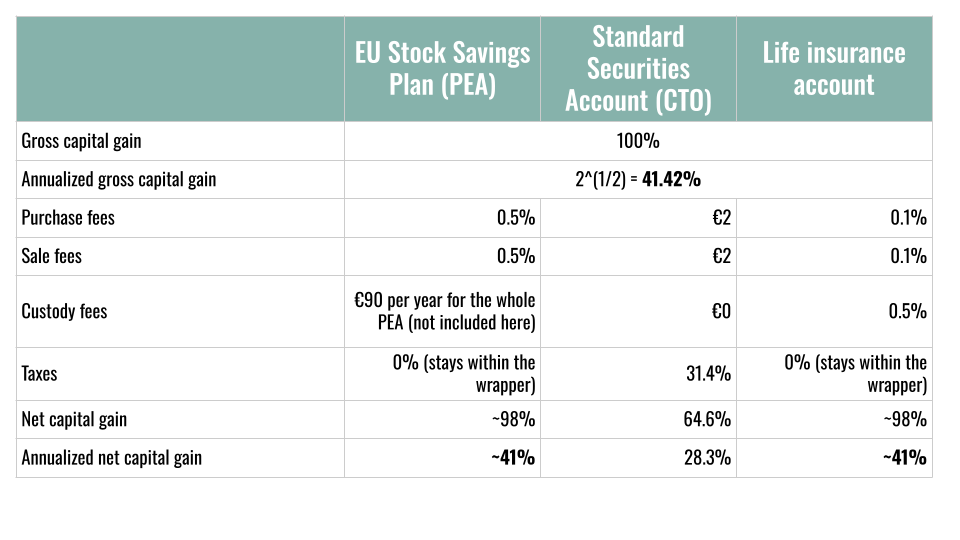
There is a significant difference between the CTO and the other investment wrappers due to the capital gains tax on the CTO upon resale.
Here is a general rule: Performance is shown net of fees and net of taxes.
On my Substack, all the calculations provided are shown before fees and taxes so that you can adjust them to fit your specific situation.
7. Conduct a pilot test
Investing is a major time and emotional commitment. I started investing in 2023 by transferring a six-figure sum directly. Even though it ultimately turned out well, mentally, it was a nightmare, and I wouldn’t wish it on anyone. Looking back, I think it’s a practice that needs to be tested, and for which I suggest three phases:
Learning Phase and First Practice Session
Transition phase toward a target portfolio
Maturity phase for its target portfolio
1. Learning Phase and First Practice Session
When you first start investing, that’s when you’re most likely to make mistakes that can cost you a lot of money and take a long time to recover from. There’s no “rookie discount” if you lose 50% on a stock just because it’s your first investment.
The goal of this phase is to reduce the risk of capital loss and to understand how markets and companies operate. It is primarily a training exercise.
This will also help you determine whether the subject interests you enough to move toward stock picking and whether you have the stomach to handle the volatility inherent in the stock market. At any moment, you might open your portfolio and see a 30% or 50% loss on one or more positions. Furthermore, watching a stock’s slow decline from its highs to its lows is a real emotional challenge.
The idea is to spend the first year with a portion of your investment capital in the stock market—in an ETF and a few stocks—say, three, if I had to give a number. Some people use “paper trading” (that is, they pretend to invest in a mock portfolio), but in my opinion, nothing beats the emotional involvement that comes from seeing gains and losses in your own money.
This year, you’ll have plenty of reading and studying to do to better understand the world you’re entering.
2. Transition phase toward a target portfolio
Naturally, you’ll want to keep going and try out several investment strategies to see which ones you feel comfortable with. You’ll do a lot of research and evaluate different companies and investment styles, and inevitably, along with your successes, you’ll make a few mistakes.
This is also where you’ll start allocating a portion of your invested capital toward your target amount. This phase is quite time-consuming because it lays the foundation for your life as an investor.
We move away from the purely theoretical approach of the first stage and toward a more practical focus.
3. Maturity phase for its target portfolio
The portfolio is built up to its allocated amount and involves periodic monitoring of the portfolio. The investor now has sufficient autonomy to navigate the stock market.
So what’s next ?
Following this article, the goal is to start investing in an ETF and a few individual stocks. The next articles will focus on choosing this ETF and then selecting individual stocks.
Here is the link for the next article:
Investing 101 Part 2 — Choosing Your First ETF

We mentioned in the previous article that buying a large ETF offers the best balance between returns and time spent, especially for a beginner investor. Whether you’re just starting out or building a portfolio, it’s often a very good choice and the benchmark for any investment in individual stocks. We’ll explore a few questions about how they work, whic…
Disclaimer: This content is for educational purposes only and does not constitute investment advice — see our full disclaimer.