
The objective of this Investing 101 series is to give you the basics on how to invest.
We mentioned in the previous article that buying a large ETF offers the best balance between returns and time spent, especially for a beginner investor. Whether you’re just starting out or building a portfolio, it’s often a very good choice and the benchmark for any investment in individual stocks. We’ll explore a few questions about how they work, which indexes they track, how to distinguish between different ETFs, their alignment with ethical criteria, the difference between broad-market and thematic ETFs, and finally, a practical example of how I would select an S&P 500 ETF if I had to choose one from the list available in one of my investment wrappers.
Here is the previous article in case you missed it:
Investing 101 - Getting started before you buy anything

This is the first article in a series on getting started with stock market investing. The goal here is to cover the basics you need to know before you start investing. The next articles will cover “choosing my first ETF,” then “choosing my first individual stocks,” followed by sections on creating a watchlist and putting together a checklist.
1. How does an ETF actually work?
An ETF, which stands for Exchange-Traded Fund, is a basket of securities weighted according to a defined formula. It trades continuously on the stock exchange, just like a stock. It can be bought and sold through a brokerage account.
If a stock rises within the index, the ETF automatically purchases shares to maintain the new weighting. Similarly, if a stock falls, its weighting decreases. Purchases and sales are executed automatically via an algorithm.
Indexes are also periodically rebalanced and reconstituted—quarterly or annually, depending on the index. Companies that no longer meet the criteria (size, liquidity, sector) are excluded; new ones are added automatically. This allows the portfolio to be automatically updated for the best indexes and to stay current with trends.
There are generally two types of ETFs tracking the same index:
Market-cap-weighted ETFs: winners automatically gain a larger weight simply because their price rises — no buying required — which drives concentration toward top performers over time.
Equal-weight ETFs: By definition, they avoid concentration by selling when prices rise and buying when they fall.
They are created by issuers such as Amundi, Vanguard, or Blackrock (via iShares).
But what happens if the issuer goes bankrupt?
An ETF is a fund and is generally structured as a separate legal entity. Its underlying assets are not on the asset manager’s balance sheet.
Thus, the issuer’s bankruptcy does not result in a loss of value for the securities held by the fund.
In practice, the real risk scenario is the liquidation or closure of the fund (see the “assets under management” criterion below).
2. Two Categories of ETFs
ETFs can be divided into two categories, each with different objectives:
Broad-market ETFs that track major indexes, such as the S&P 500, MSCI World, STOXX 600, and Nasdaq 100. We’ll discuss them in more detail in the next section.
Thematic ETFs are tactical bets on a specific sector or technology: semiconductors, artificial intelligence, blockchain/cryptocurrencies, water, green energy, etc.
The arguments in favor of broad-market ETFs: built-in diversification, a track record of performance, and they also benefit from the rebalancing mechanism discussed in Section 1: new stocks are added, while underperforming ones are removed.
The limitation of thematic ETFs: they generally appear only after the trend is already well established. Issuers launch the product after observing growing enthusiasm, which structurally puts them behind the curve. An ETF focused on semiconductors or blockchain launched after the underlying asset has already experienced a sharp rise is a good example: the product arrives just as the news has already been priced in.
Broad-market ETFs are excellent for the core of a portfolio. It’s best to view thematic ETFs as a deliberate tactical play on the sidelines of a portfolio (and therefore with a smaller allocation), and focus on a broad-market ETF to start with.
3. The major indexes
Most ETFs track major stock market indexes. Buying them amounts to making a bet—often an implicit one—that we’ll try to explain here.
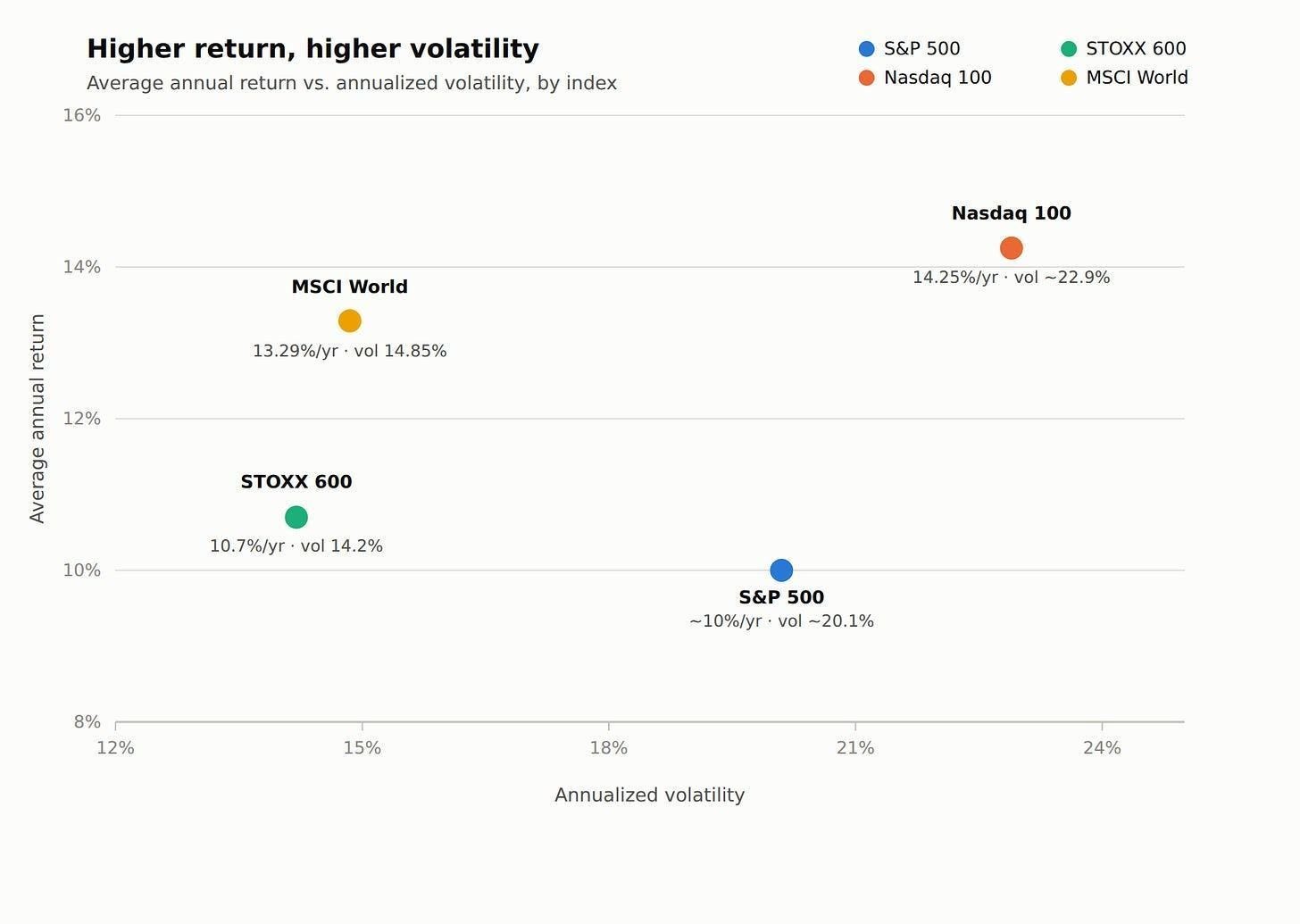
S&P 500: 500 large U.S. companies, weighted by free-float market capitalization. This means there are approximately 500 companies, but the ~10 largest account for a disproportionate share of the total weight. Average return: ~10% per year since 1957 (S&P Dow Jones Indices, via Fidelity). Annualized volatility: ~20.1% over 2007–2025 (Nasdaq, Nasdaq-100 vs. S&P 500 comparison, Q4 2025).
Nasdaq 100: The 100 largest non-financial companies listed on the Nasdaq. Heavily weighted toward tech and growth—not a general “U.S. large-cap” index. Average return: 14.25% per year since its launch in 1985 (Nasdaq, 40th-anniversary press release, January 31, 2025). Annualized volatility: ~22.9% over 2007–2025 (same source). Higher returns come with higher volatility—there’s no such thing as a free ride.
Investing in these indexes implicitly means placing the U.S. at the center of the global economic system and keeping it in first place. In other words, it means the continuation of the current Pax Americana. After all, this is not just about U.S. profits, but about the profits of American companies around the world. If U.S. companies lose global market share, the profits of S&P 500 / Nasdaq 100 companies decline, and this affects the index.
STOXX 600: 600 European companies of all sizes—large-, mid-, and small-cap. Offers intra-European geographic diversification, with sectors that are more cyclical and industrial than in the United States. Average return: 10.7% per year over 5 years. Annualized volatility: 14.2% over 5 years (official STOXX fact sheet, data as of July 31, 2026).
Investing in the European Union offers a means of sectoral and geographic diversification relative to the United States. The expected return depends on the role the Union will play in the coming years.
MSCI World: approximately 1,500 stocks in developed markets (~23 countries). In practice, the index is weighted at ~70% toward the United States, so it is less “global” than its name suggests. Average return: 13.29% per year over 10 years. Annualized volatility: 14.85% over 10 years (official MSCI fact sheet, data as of July 31, 2026).
This index, based on its name, seems like a consensus choice, but its 70% weighting in U.S. stocks makes it a bet that hinges primarily on the health of the U.S. economy.
A note on “world” indexes: The MSCI World excludes emerging markets—China, India, Brazil, among others. The MSCI ACWI (All Country World Index) includes them. The term “world index” therefore does not have a single meaning—check the composition before buying into the name.
Where to start with your first ETF: The S&P 500 is a good place to begin for educational purposes. It is the most widely discussed and best-documented index available—with a long history of data, consistent coverage by the financial press, and comparisons that are easy to find. Its composition is also relatively easy to understand: 500 major U.S. companies that most people are already familiar with.
4. Criteria for comparing ETFs based on the same index
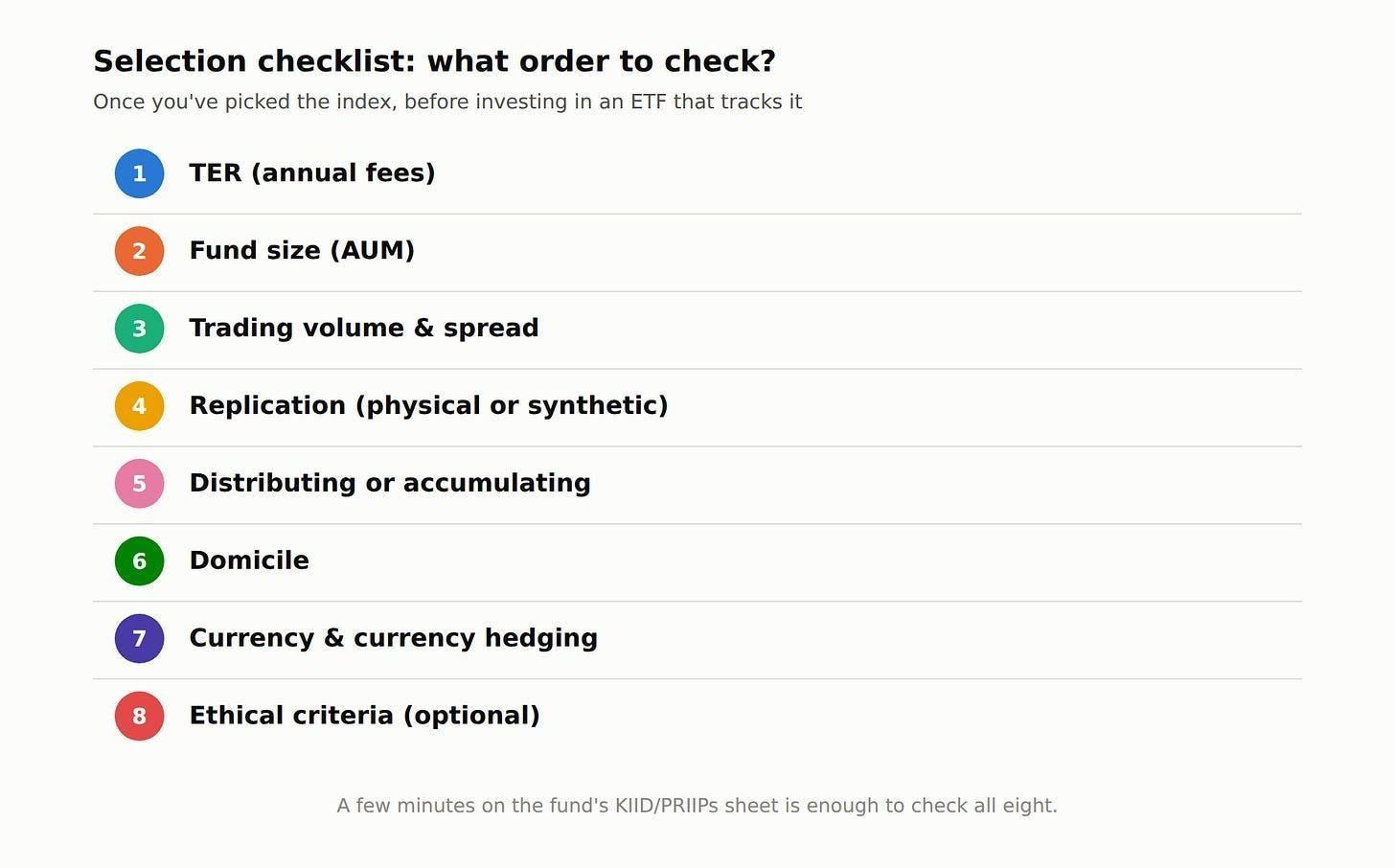
Once an index has been selected, several competing ETFs track it—the factors that make a difference over the long term:
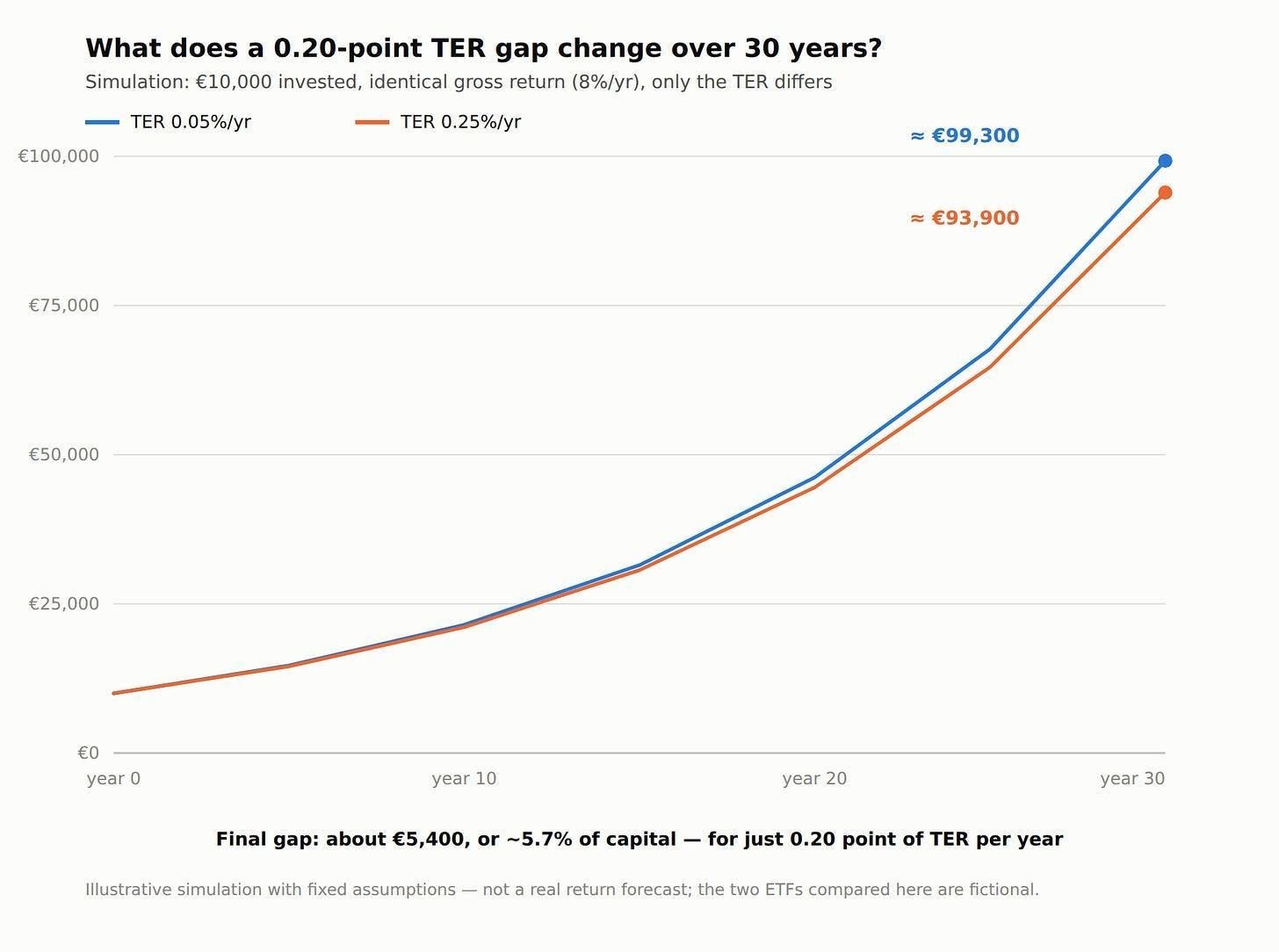
TER (Total Expense Ratio): annual fees deducted from the portfolio’s value; even a difference of 0.1% to 0.2% per year, when compounded over the long term, will make a difference. Beginner investors tend to focus on fees. Don’t forget the rule: performance is shown net of fees and taxes. Fees are a minor issue. Spend two hours researching ETF and fund fees, but don’t make them your main concern.
Assets Under Management (AUM): An ETF with low assets under management (<50–100 million euros) faces a risk of fund closure or liquidation (forced arbitrage, exit fees, tax mismatch)—assets under management are also a proxy for market confidence.
Trading volume and bid-ask spread: market liquidity (different from outstanding shares) → an ETF with low trading volume can be expensive to buy or sell, even with a low expense ratio
Replication:
Physical (actual purchase of the underlying securities) : the ETF owns real parts of businesses.
Synthetic: the ETF enters into a swap with a bank counterparty. The mechanics are technical, but the actual risk is generally limited.
Impact on tracking error (the difference between the ETF’s performance and that of the actual index)
Distributing vs. accumulating: A distributing ETF pays dividends in cash (which you must reinvest yourself and which are taxed upon receipt, depending on the jurisdiction); an accumulating ETF automatically reinvests them in the fund (no dividend cash flow to manage, and taxation deferred until sale, depending on tax laws). Generally, an accumulating ETF is more advantageous from a tax management perspective. You can always sell a portion of your accumulating ETF’s shares yourself to recreate a dividend-like cash flow if you need one.
Domicile: the country where the fund itself is registered (not the investor’s country of residence, nor the exchange where the ETF is listed)—an ETF domiciled in Ireland and an ETF domiciled in Luxembourg can both track the S&P 500, be listed on Euronext Paris, and be accessible to the same French or foreign investor; Why this still matters: Before receiving a dividend from a U.S. company, the fund is subject to a withholding tax levied by the U.S. tax authorities, and the rate of this withholding depends on the tax treaty between the United States and the fund’s country of domicile—not between the United States and the investor’s country; For example, the U.S.-Ireland tax treaty has historically been more favorable than others, which explains why the vast majority of U.S. equity ETFs available in Europe are domiciled in Ireland.
Listing currency vs. underlying currency: An ETF listed in euros that tracks a U.S. index does not eliminate currency risk—you are still exposed to currency fluctuations, and a 10% decline in the dollar results in a 10% decline in the ETF.
Currency hedging: a criterion distinct from the previous one—an “EUR Hedged” ETF actively offsets (using derivatives) the impact of EUR/USD fluctuations on performance, unlike an unhedged ETF, which is fully exposed to this currency risk in addition to the index’s performance; Hedging comes at a cost (included in the expense ratio or charged separately, depending on the fund) and is neither good nor bad in and of itself—it depends on whether the investor wants to isolate the index’s pure performance or accept exposure to the dollar as an additional form of diversification. For example, hedging an S&P 500 investment against your home currency amounts to choosing protection against a decline in the dollar as well as protection against an appreciation of your home currency.
Ethics: This aspect is specific to each investor and involves selection or exclusion criteria that should be examined. You’ll often find ESG (Environment, Social, Governance) criteria and for France, ISR (Socially Responsible Investing)—which frequently exclude weapons, tobacco, and fossil fuels. Funds may also select the “best-in-class” investments in their category, which has led me to question the appropriateness of those choices. The best approach is to look up the ethical definition within the index the fund tracks to fully understand what you’re buying and to review the fund’s top holdings. It should be noted that, on the one hand, “ethical” ETFs often underperform their conventional counterparts, and, on the other hand, “ethics washing” is a fairly common occurrence in this category.
5. An example, please!
OK, so I asked you to find a first ETF, but now you are stuck in a list of ETFs in your investment wrapper with a headache. “Which one am I supposed to choose between the 10 suggestions I got?” Let me give you an example of how I would search.
I typed “SP500” into the search bar on my life insurance website and found the following 7 results, compiled in a table:
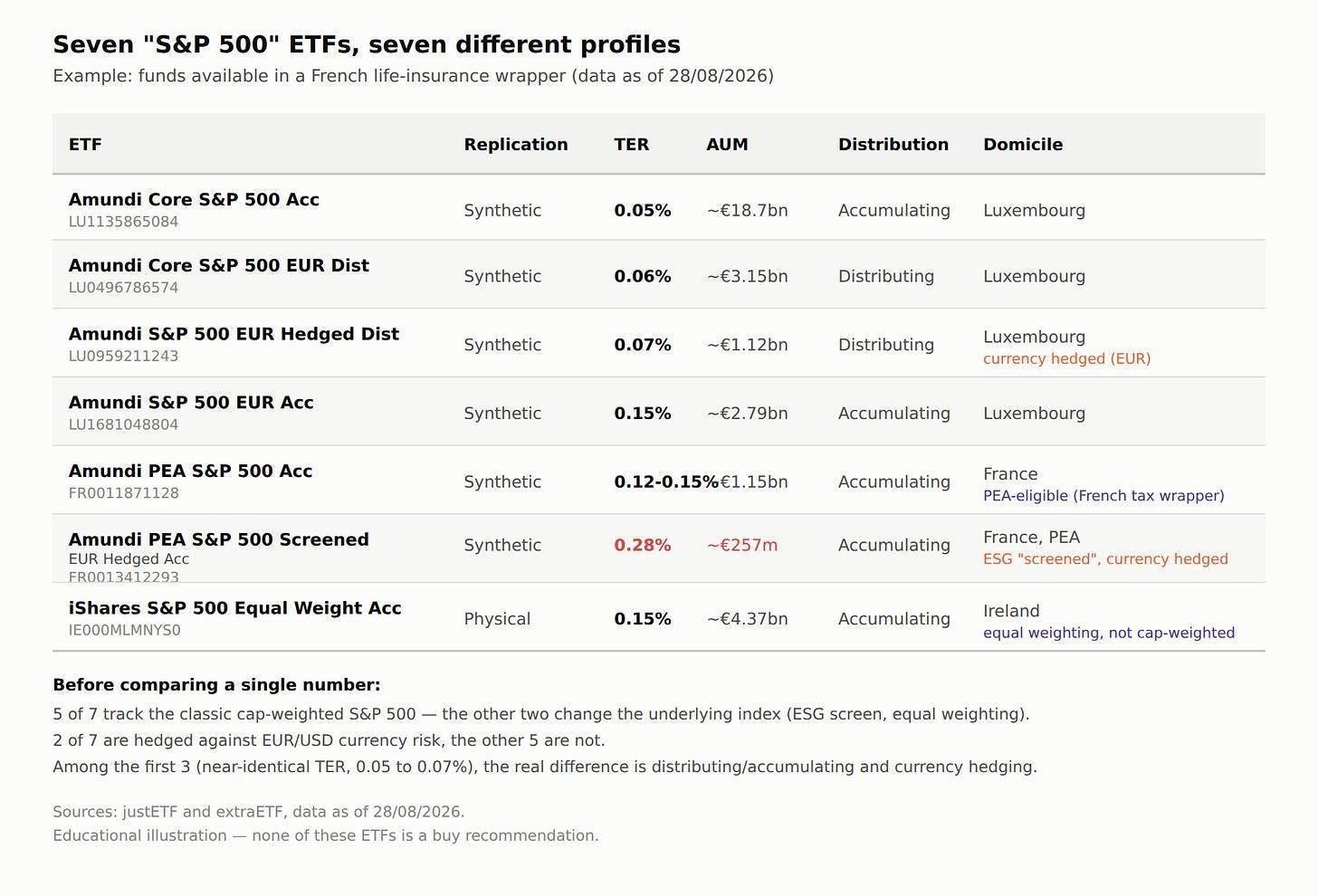
It’s worth noting right away that six of the seven are market-cap-weighted ETFs, as opposed to the seventh, which is an equal-weight ETF—representing a different investment strategy.
The first two on the list, from Amundi, are virtually identical in terms of fees but differ in terms of assets under management and dividend policy. I think that, given assets of this size—over a billion—I don’t see a problem, so both pass the test. Personally, I have a long-term investment horizon, so I’d prefer the Acc. However, French life insurance policies automatically reinvest dividends, so they’re practically equal. Between the two, I’d therefore choose the cheaper one in theory, even though the result after several years will be virtually the same.
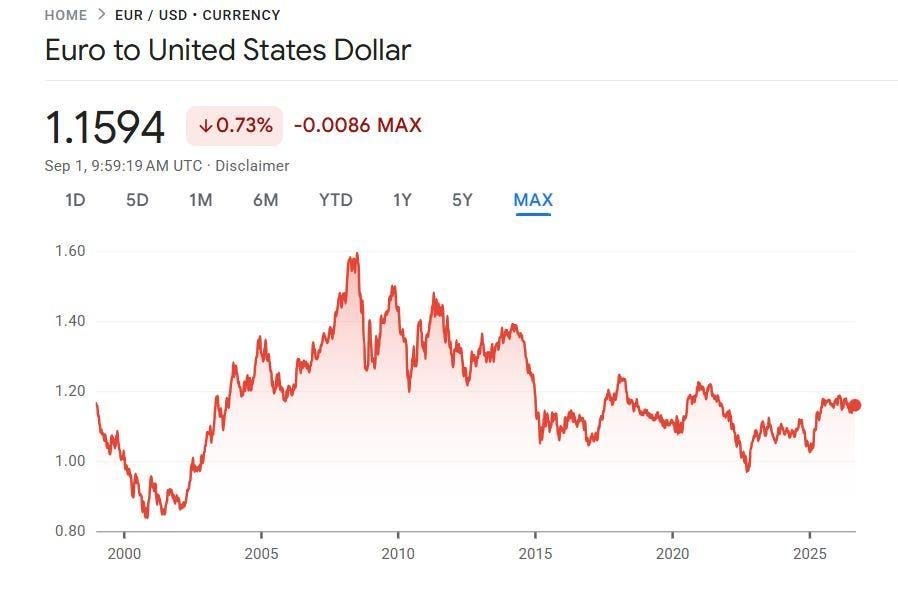
The third is a distribution-oriented, hedged fund, which is potentially a positive if you want to reduce your exposure to the dollar. I don’t have a strong opinion on this at the moment, and logic would suggest hedging at the top of the market. The EUR/USD chart below shows that the right time was from 2002 to 2008, and that the timing was poor between 2008 and 2015. This is very clear to see on a long-term retrospective chart, but it’s very difficult to answer this question for the years ahead. Especially since in 2008, conditions were not favorable for the stock market…
The fourth fund, “Amundi S&P 500 EUR Acc,” is identical to the first one, but has higher fees. It is therefore less attractive. This is an older version; Amundi has lowered its fees over time, and the first fund appears to be the new product line. We can therefore expect further fee reductions in the coming years for smaller ETFs.
The 5th option is eligible for a France-specific investment wrapper (a tax-deferred account with lower taxes). This is not relevant here, and it is less attractive in terms of fees than the first option.
The 6th Amundi PEA S&P 500 Screened is hedged, PEA-eligible, and has higher fees. So, aside from the ESG component, it’s a less competitive product than the first one. The assets under management are a bit low, but that’s often the case with ESG ETFs. It’s more of a risk than a red flag. To find out what the ESG component consists of, visit the issuer’s website and open the KID, which indicates that it tracks the “S&P 500 ESG+ Index.” The rest of the research takes place on the Standard & Poor’s website, as they are responsible for the index.
The starting point is the traditional S&P 500 universe, but limited to companies for which S&P has greenhouse gas emissions data (via Trucost) from within the last five years.
The following are also excluded: companies that derive a significant portion of their revenue from coal (≥1%), oil (≥10%), natural gas (≥50%), or fossil fuel-based electricity generation (≥50%); controversial weapons, small arms, military equipment in the broad sense, tobacco, alcohol, and gambling; as well as companies deemed non-compliant with the United Nations Global Compact or embroiled in serious ESG controversies.
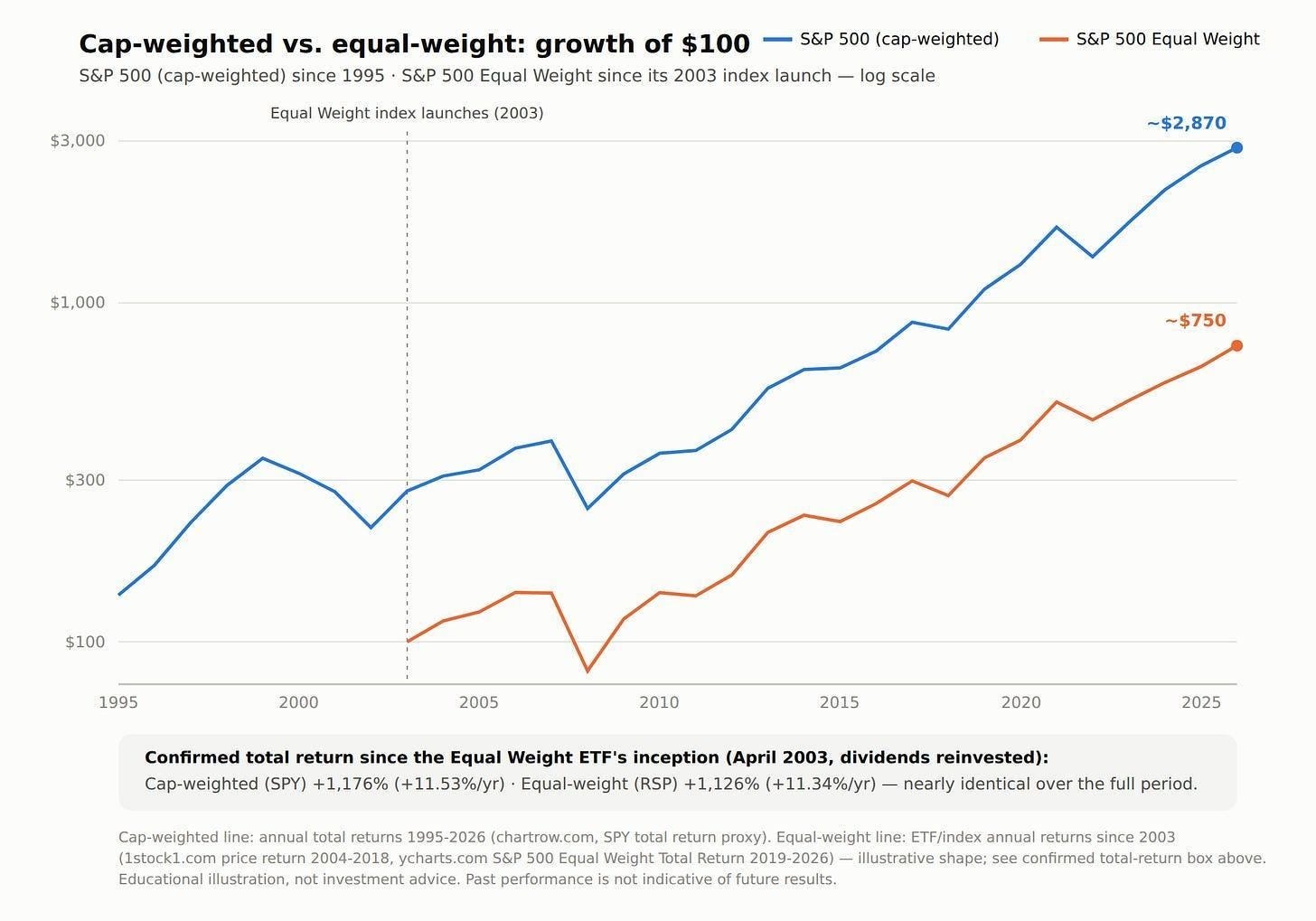
The last one on the list is an equally weighted ETF: This is more the exception than the rule. It overweights small-cap stocks and undervalued stocks, and underweights growth stocks. It underperformed during the dot-com bubble (the pro-tech and growth phase), and has underperformed since 2015. It outperformed by nearly 1.5% per year from 2003 to 2022.
A cap-weighted portfolio is an implicit bet on the continued leadership of the largest growth stocks, while an equal-weight portfolio is a bet on diversification and a return to the mean.
It helps avoid sharp declines resulting from significant market concentration, while still benefiting from rising markets. Currently, ten stocks account for nearly 40% of the S&P 500, which means that this index is, in part, a bet on AI.
In conclusion, based on my preferences, I would choose either:
Amundi Core S&P 500 Acc: The Most Cost-Efficient Option, and a Bet on Continued Market Gains
Amundi S&P 500 EUR Hedged Dist: a bet on continued market gains and a weaker dollar / a stronger euro
Amundi PEA S&P 500 Screened: Striving for a Balance Between Performance and Ethics
iShares S&P 500 Equal Weight Acc: a bet on continued market gains with partial protection against downside risk (whereas in the first fund, the top ten stocks account for 40% of the index, here they account for only 10/500 = 2%).
However, these considerations apply to an established portfolio, with variations that reflect market conditions. In the hypothetical scenario of holding an ETF for one year to get used to market volatility—using about 1% of your target capital—the first choice, Amundi Core S&P 500 Acc, is the most appropriate solution; or, if you have specific ethical preferences, ETF No. 6 (Amundi PEA S&P 500 Screened).
Now that you’ve placed your purchase order, let’s consider some possible scenarios for the next year:
The market will rise by 10% or more,
The market will move sideways, with a range between -10% and 10%.
The market will fall by 10% or more.
All of this is accompanied by significant volatility, driven by investor sentiment, macroeconomic news (inflation, war, or the risk of war), or expectations regarding AI, in particular.
If the market is rising: great—you’ll have made a small profit, having learned to navigate volatility.
If the market remains flat: you will have learned to familiarize yourself with the world of the stock market.
If the market declines: since you have a long-term perspective, you benefit from having already invested a portion of your capital, having lived a market downturn, and securing a better purchase price for the rest of your allocation that you have yet to invest.
So what’s next?
We will see the basics of the other school of investment in publicly traded markets, namely the selection of individual stocks. This one is my favorite and where you will get the most content from my Substack.
Note on AI use: There isn’t 41% AI in my text—it’s more like 25%, written on a content which I find satisfactory. The difference between our two figures is due to the DeepL translation combined with errors in Pangram, from an original text in French. Pangram penalizes authors for whom English is not their native language.
Disclaimer: This content is for educational purposes only and does not constitute investment advice — see our full disclaimer.