
The objective of this Investing 101 series is to give you the basics on how to invest. This is the first of three articles on how to analyze a stock.
This article was originally a single piece, but given its length, I decided to split it into three parts to make it easier to read and more educational.
The three articles will follow the format I use in my deep dives. This first one will consider a business review covering the products and services sold by the company, followed by an examination of the market structure and competitive advantage. This article will conclude with an assessment of the company’s life cycle and a review of market segments (such as quality, value, etc.).
The following articles will cover:
-In the second part: financial aspects, management analysis, and capital allocation
-Followed in the third part by an outlook based on bullish and bearish arguments and the company’s valuation.
Here are the two first articles in case you missed it:
Investing 101 - Getting started before you buy anything

This is the first article in a series on getting started with stock market investing. The goal here is to cover the basics you need to know before you start investing. The next articles will cover “choosing my first ETF,” then “choosing my first individual stocks,” followed by sections on creating a watchlist and putting together a checklist.
Investing 101 Part 2 — Choosing Your First ETF

We mentioned in the previous article that buying a large ETF offers the best balance between returns and time spent, especially for a beginner investor. Whether you’re just starting out or building a portfolio, it’s often a very good choice and the benchmark for any investment in individual stocks. We’ll explore a few questions about how they work, whic…
1. Introduction
The first question to ask is: “What does the company sell? What products and services does the company offer?”
This is the core of the study, around which all other responses will revolve. It is therefore necessary for you to review the various products and services and the markets in which they are sold. This requires you to know what market shares they hold.
Obviously, a company does not operate in a vacuum; it is necessary to identify its environment—that is, its customers, suppliers, and competitors.
What are the company’s customers looking for in this product? How many are there? Do they purchase the product directly from the company or through a distributor? Does the company have a major customer that poses a risk?
As for suppliers, who are they? Is there a critical dependency on any of them, or does any of them have pricing power?
For competitors, we will seek to determine their market shares and their products.
Finally, at this stage, we can ask ourselves what ethical issues or risks the company faces. This is something I consider early enough in my research to rule out candidates who wouldn’t be a good fit for me.
Once you’ve taken this initial look at the big picture, the question to ask yourself comes back to the products: “Am I able to determine whether the company’s products or services are superior to those of the competition?”
That’s Peter Lynch’s famous “Invest in what you know.” If you can answer that question, great—you’re probably onto something. For example, in my own circle, I’ve noticed that the people I meet place a higher value on iPhones. That my kids, like everyone else, always prefer Coca-Cola to any other drink on earth. That if people had to keep just one streaming service, the majority would choose Netflix.
There are many excellent investment opportunities available to us as individual investors, and they do not require any special skills.
Conversely, if you are unable to determine whether the company outperforms its competitors based on anything other than the numbers, you will always have a hard time keeping your cool during a market downturn and forming a clear opinion about your investment.
A 2018 study by Hendrik Bessembinder titled “Do Stocks Outperform Treasury Bills?” indicates that, among stocks listed in the United States between 1926 and 2016 (approximately 25,300 securities), only about 4% of the securities accounted for all of the stock market’s net wealth creation over that period. The remaining 96% did no better than one-month Treasury bills (i.e., short-term U.S. bonds).
A follow-up study, expanded to include 62 countries over the period 1990–2020, found an even more concentrated result: 2.4% of the world’s publicly traded companies accounted for all $75.7 trillion in net stock market wealth creation during that period.
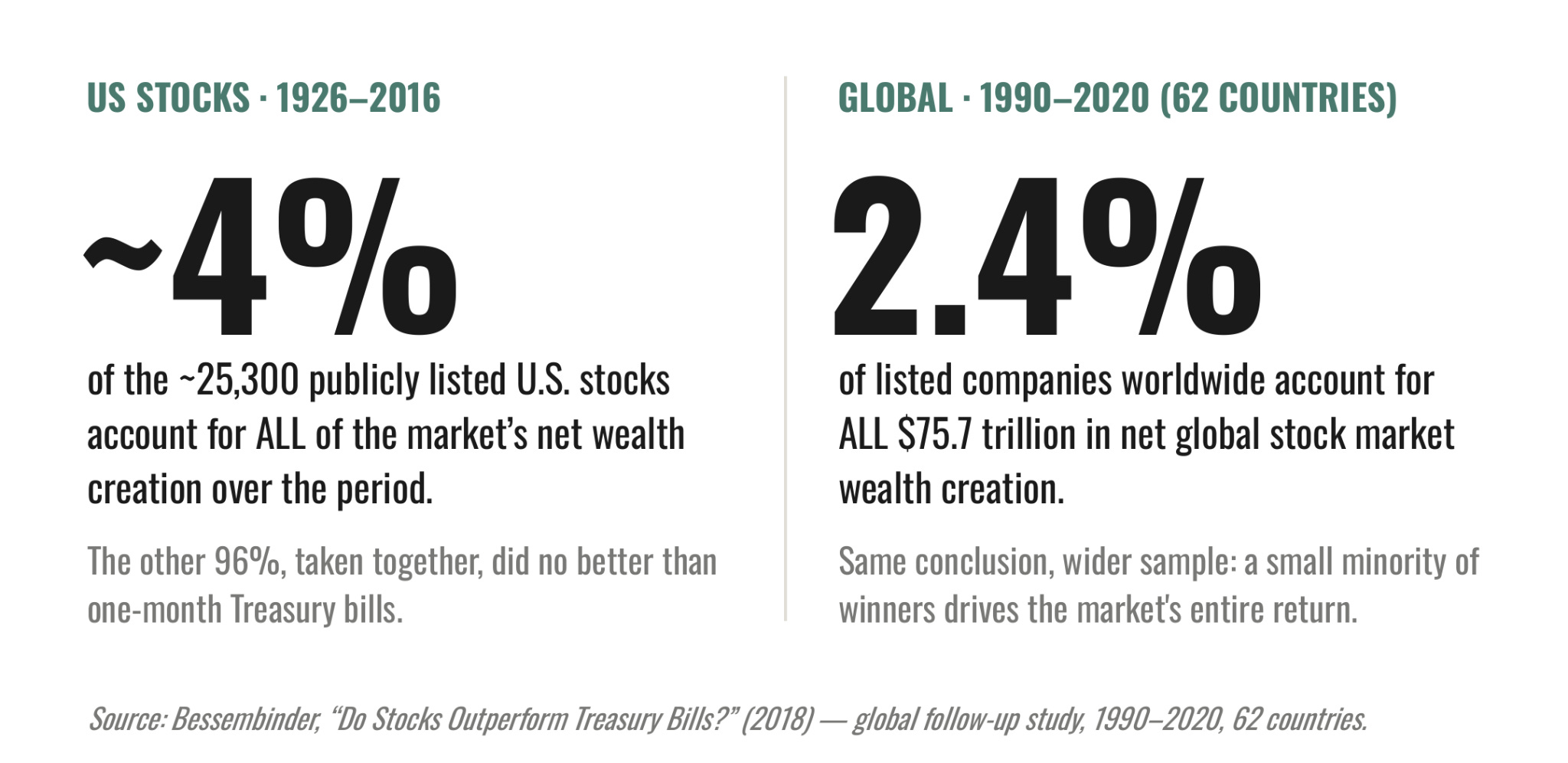
The takeaway from this point is that the stock market’s performance is driven by a very small number of winners and a myriad of losers. And it is these few companies that will be the gems of your portfolio.
These are companies that I refer to as “category definers,” because they have helped create a product category in which they dominate the competition—or better yet, have no competition at all.
This superiority stems in particular from the market structure and the differentiation these companies have succeeded in achieving in their market.
2. Market Structure
2.1 The Model of Pure and Perfect Competition
One of the first topics I studied as an undergraduate economics major was the model of pure and perfect competition, because it provides the framework within which many companies operate.
We’ll see why this model is the bane of shareholders. It has several characteristics:
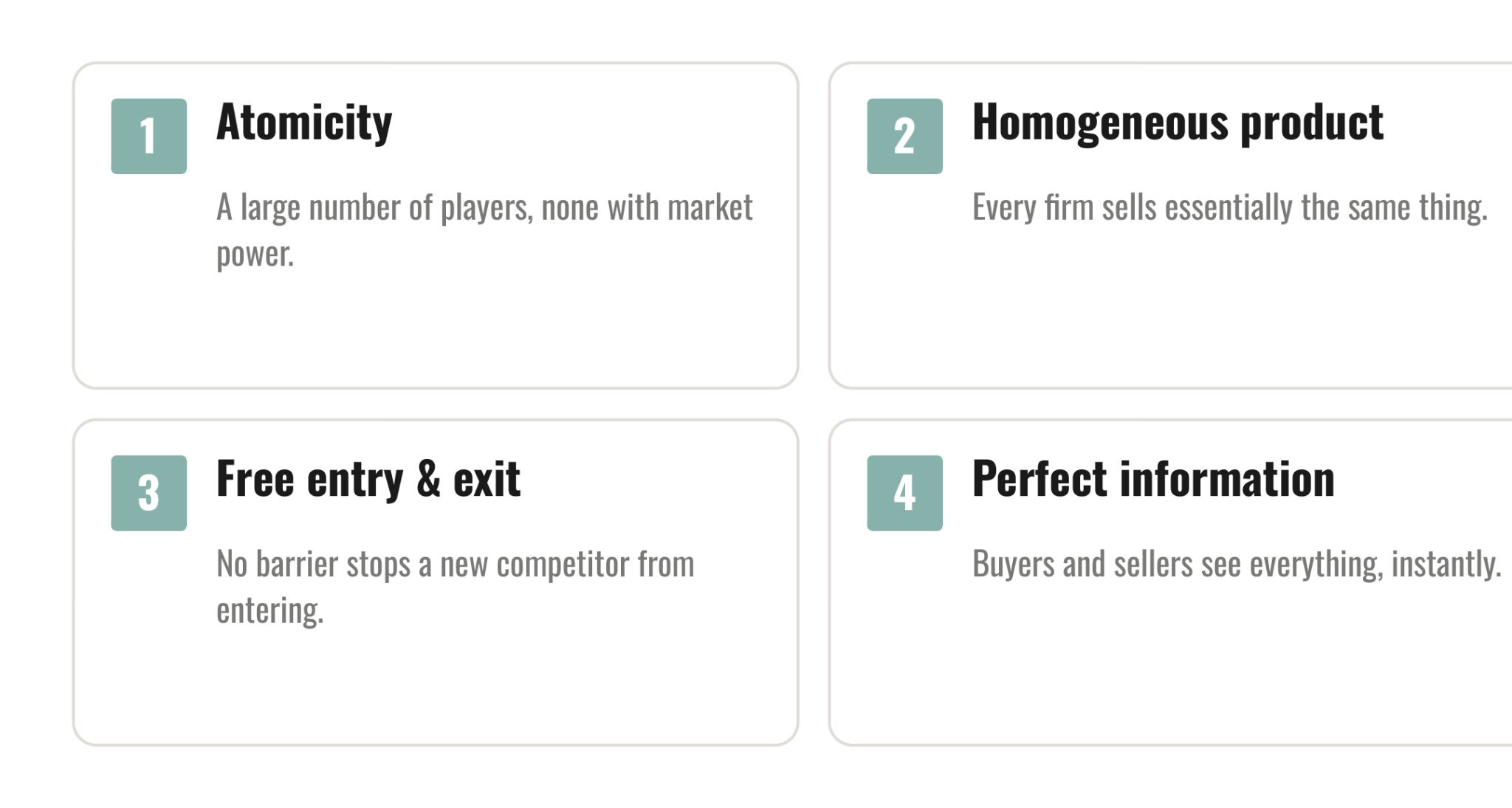
The implication of these four points is that, in this model, firms’ long-run profits tend toward zero, because any profit will attract competitors. Increased competition will drive prices down until producers go out of business, thereby restoring the equilibrium price. The price is therefore equal to the marginal cost (the cost of producing one additional unit), and the return on invested capital (ROIC) is equal to the WACC (the cost of capital).
Agricultural commodities such as bulk coffee, corn, wheat, and soybeans come close to this model: there are thousands of producers selling the same product in a market where anyone in the right climate can start growing that crop, and where price information is available on international markets. The foreign exchange (forex) market is also similar.
Every company will obviously seek to break free from this model, with varying degrees of success depending on the “imperfections” present in its market—which are referred to by the academic term “competitive advantage.” The most famous investor of all, Warren Buffett, coined the term moat to describe this concept, and it is now commonly used in the financial world. It is precisely because it is possible to break away from this model that individual investing makes sense.
Before examining the specific mechanism that enables this escape (the “moat,” discussed in more detail below), it is helpful to first determine where the company falls on the spectrum of market structures.
2.2 Market Structure: From Monopoly to Niche
On one end of the spectrum is the model of pure and perfect competition, and on the other end is the monopoly, which poses societal challenges. In between, there are several gradients worth exploring:
Monopoly : A single firm serves the market. Since users cannot find alternatives to the firm’s products and services, the firm’s bargaining power is disproportionate. The regulator typically seeks to regulate or break up this monopoly, or to turn it into a public utility. Monopolies often exist in the form of public utilities (Con Edison in New York, PG&E in California, and airports when there is only one at the local level, such as in Zurich or Florence). Often, this type of market is maintained when there is no practical reason to allow competition to enter.
Duopoly : Two dominant players share most of the market—for example, Visa and Mastercard in payment networks, or Airbus and Boeing in long-haul aircraft. They manage to coexist because neither has any interest in triggering a price war that would hurt both of them equally. This type of market is often very profitable for shareholders, and it is easy to track the market by following the two leading companies.
Oligopoly: A handful of players (usually 3 to 5) share a market with high barriers to entry—competition may be divided into market segments allocated to each player. The goal is always to avoid a price war, which would be costly for all players. It is also possible for all players to agree on a market price; this is known as a cartel. Such an agreement tends to draw the ire of regulators.
Niche market: a market that is too small, too specialized, or not glamorous enough to attract serious competitors—there’s no need for a legal monopoly or a patent; the market’s size or specialization itself acts as a barrier (no one bothers to enter a market whose potential is considered too limited)
Pure and perfect competition: no firm makes a profit.
The general rule to remember is that the best competition is no competition at all, or as little as possible.
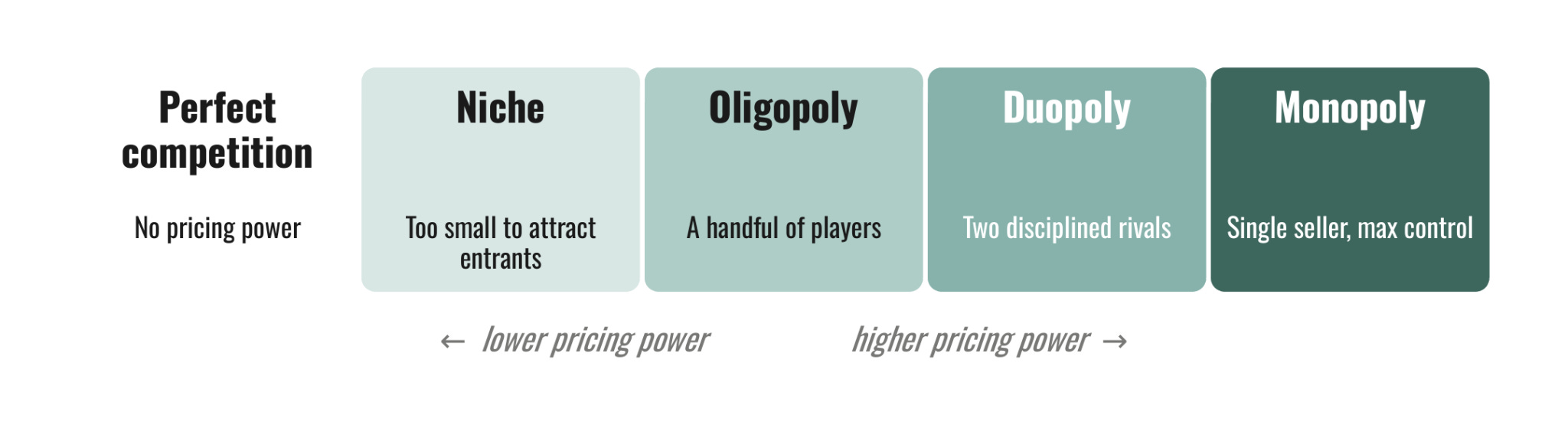
This classification provides a useful overview of the market and its existing players. We must now examine the reasons why new players cannot enter this market—that is, the company’s competitive advantage.
2.3 Competitive Advantage (Moat)
This article is not intended to be exhaustive on every point, so I will outline the main moats you should know about:
Switching costs: switching costs — it’s expensive or a hassle to leave,
Network effects: The product becomes more useful as more people use it
Brand: Customers pay more for the same product because of the name
Economies of scale: The largest product is structurally less expensive than the others because fixed costs are spread out
The difficulty of replicating a product
Regulatory or intangible assets: licenses, patents, rare permits.
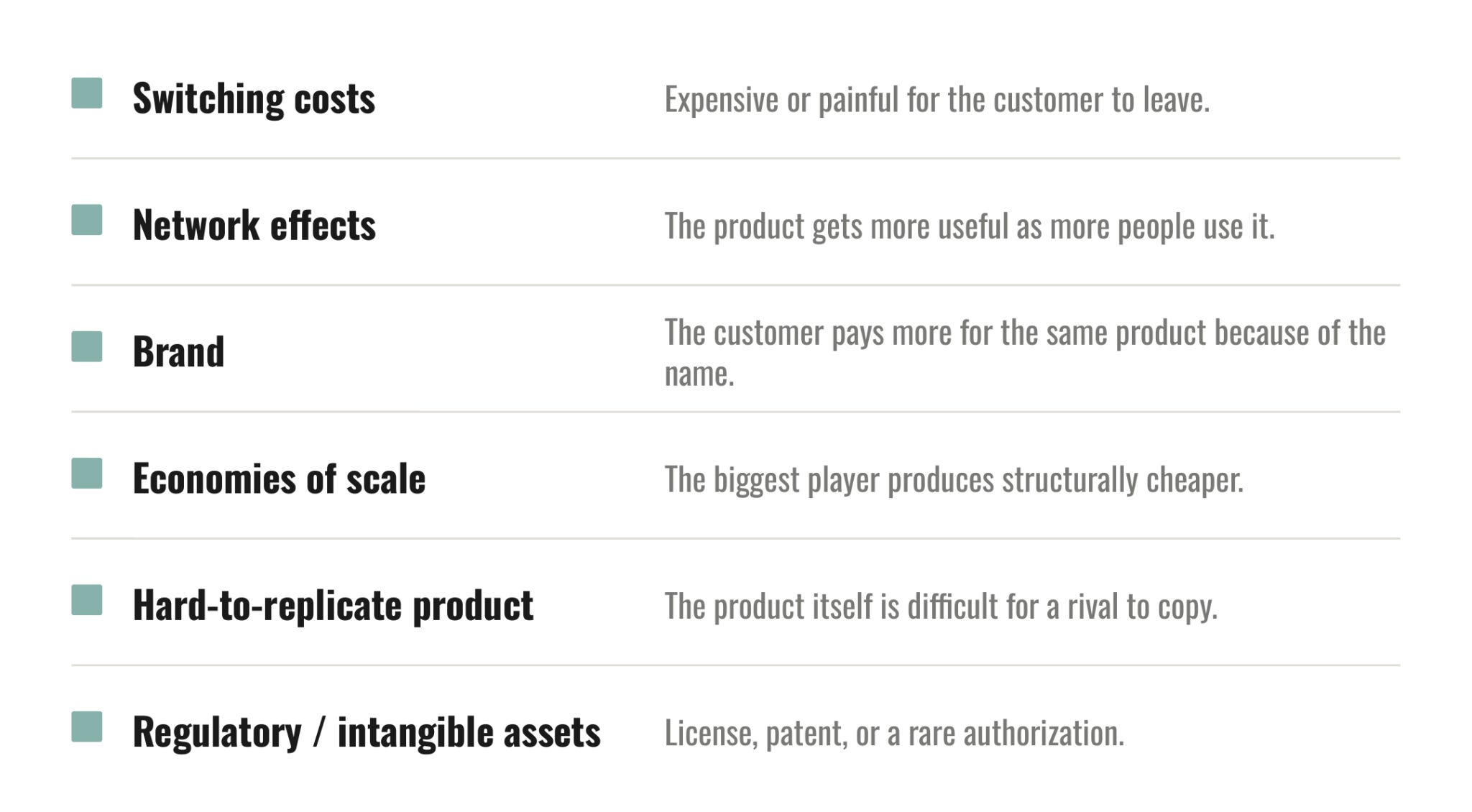
Often, the best companies have multiple competitive advantages that grow stronger over time
On the other hand, keep in mind that what can reshuffle the deck within the market is technological change, which is a double-edged sword: it can help established companies solidify their position—or work against them.
Let’s take Coca-Cola as an example. Consumers place a higher value on Coca-Cola by choosing it over a cheaper alternative. Decades of advertising and history have linked it, in the minds of consumers, to sporting events, sharing, and a polar bear. Behind this beverage lies the entire world of American soft power.
Yes, the product can be replicated by any chemist, but the name and visual identity remain protected by a trademark.
In terms of the costs of change, Coca-Cola has locked out the competition with distribution contracts that are unbeatable due to the volumes sold. At the local takeout restaurant, there’s often a Coca-Cola fridge. Doing without it would mean replacing the fridge (which is certainly sold at a competitive price), and doing without Coca-Cola products would mean cutting back on one of its easy sources of high-margin revenue. If you leave Western countries, your choices for non-alcoholic beverages will often be limited to water, local sodas, or products from the Coca-Cola lineup. The latter are therefore, by nature, much more competitive.
Competitors’ products can threaten the company through e-commerce, reaching consumers directly without going through a century-old distribution network. However, Coca-Cola can still try to acquire the most promising startups early in their development, before regulators block the merger to maintain competition in the market.
Warren Buffet a eu la phrase célèbre: “If you gave me $100 billion and said take away the soft drink leadership of Coca-Cola in the world, I’d give it back to you and say it can’t be done.”
It is important to note that a moat is built over time and that, by its very nature, a new company will not have one. Everything rests on the pillars of superior products and services and high-quality management.
3. Life Cycle and Framework for Analyzing the Initiative
3.1 The Life Cycle of a Business
A company can be viewed in an organic way, as having a life cycle: it starts small with a product or service, then grows and develops a business model that becomes increasingly efficient, enabling sustained growth over time. The business, which initially operates at a loss, eventually manages to turn a profit and sustain that profit over the long term. Growth is strong at first because the company is starting from a small base, then slows over time until it stabilizes. Finally, the decline phase begins, which can occur more or less rapidly depending on the nature of the business.
Aswath Damodaran, professor of corporate finance and valuation at New York University’s Stern School of Business, offers excellent resources, particularly on the corporate life cycle. The images below are taken from one of his articles:
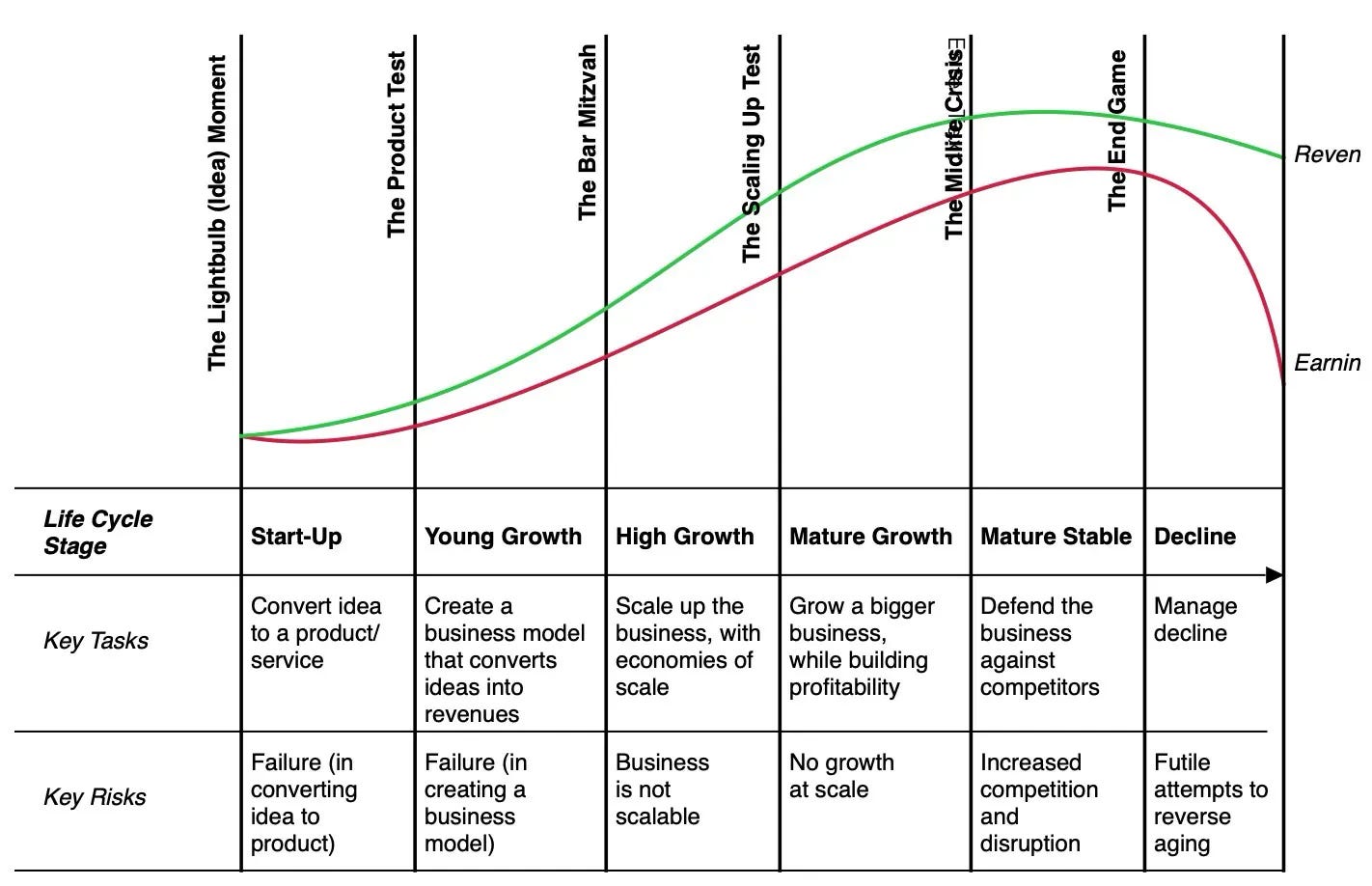
Depending on your experience and investor profile, you will likely develop preferences for certain investment life cycles, styles, or factors.
3.2 Investment Styles
We often hear about Quality, Value, and Growth stocks, and we can explain what these terms mean based on the framework outlined above.
Growth: targets the Young Growth and High Growth stages—the investment is based on the company’s future trajectory, expected revenue, and profits.
Quality: Targets companies in the High Growth or Mature Growth stages. The company is well-established, as are its competitors; it has one or more moats and is poised for significant future growth.
Dividend: This strategy targets the Mature, Stable, and Decline stages, where the company generates cash but lacks opportunities for reinvestment. It chooses to return this cash to shareholders in the form of dividends or share buybacks. This category notably includes so-called “cannibal” companies, as their stock price is driven upward primarily by share buybacks.
Value: Does not target a specific stage but rather a discrepancy between price and value, regardless of the stage. A company can be classified as a “value” stock at any stage of its life cycle. Generally, there is an underlying issue, or the market perceives it that way.
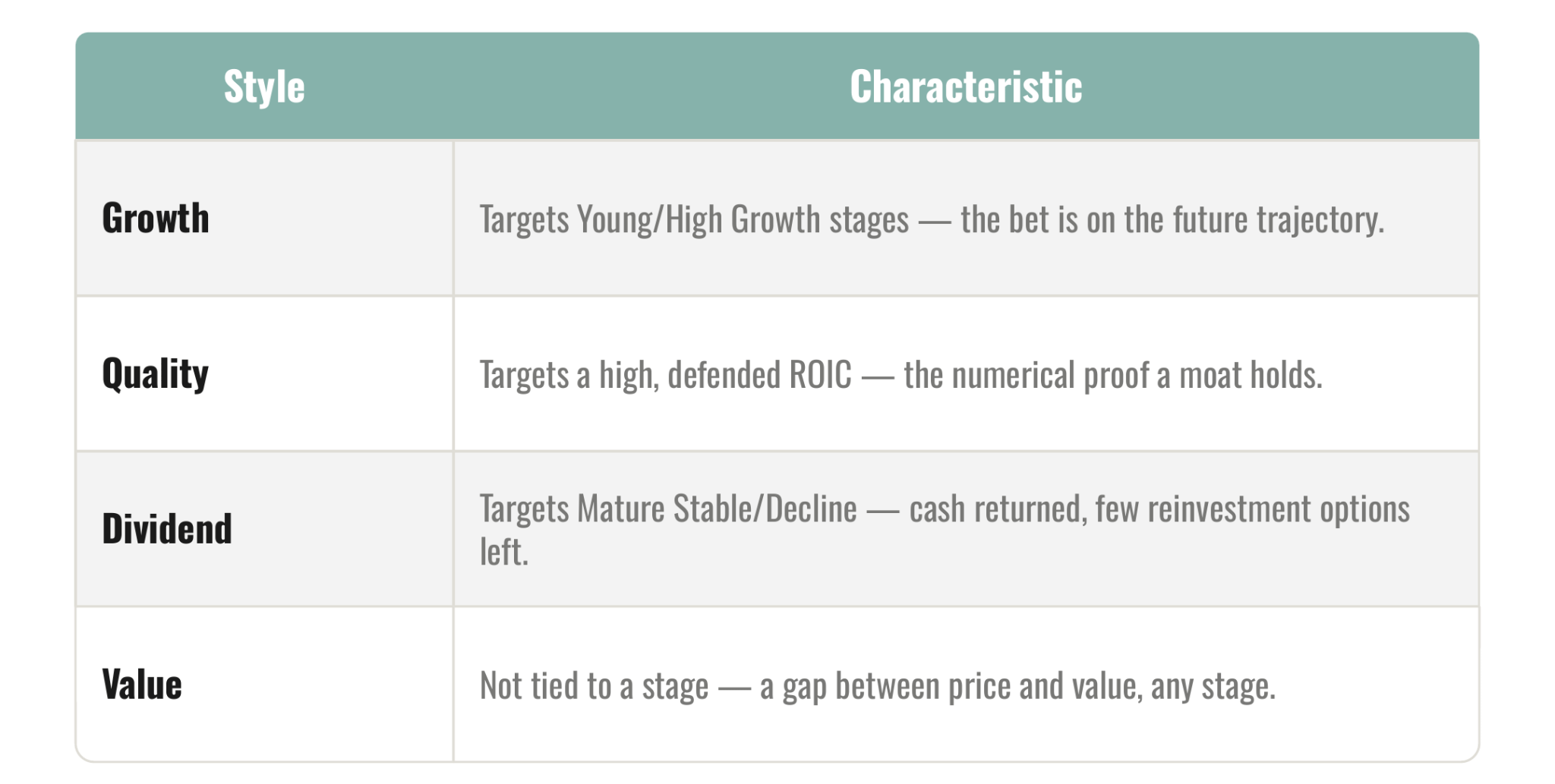
This is a simplified explanation: when you look at the details, a company may share characteristics of several different investment styles. Similarly, there are several investment styles, and they can coexist within the same market.
Beginner investors tend to turn to dividend-paying stocks for their safety and the almost magical appeal of receiving regular dividends. However, the lack of business growth and opportunities for reinvestment often leads to low returns that underperform the benchmark index.
They will also tend to gravitate toward value stocks, thinking they’re getting a good deal (“Company X has a P/E ratio of 5, while its competitors have a P/E ratio of 15—I’m getting a great deal”). In most cases, the reason is valid and stems primarily from issues related to the company’s business or future prospects.
Growth stocks are also very popular because, even though most of them will underperform the index and carry risk, a handful of winners offer the prospect of multiplying your investment in just a few years.
Ultimately, quality stocks will offer the best risk-return ratio due to their competitive moat and long-term growth prospects. As a result, they often command higher prices than other stocks. As with value stocks, the right time to invest is when the company appears (the word “appears” is important) to be facing temporary difficulties.
For educational purposes, I believe the best choice of three stocks to start with is “quality” stocks, given their long-term potential, financial stability, and competitive advantage.
Due to data quality limitations, I can provide a performance breakdown covering the past 15 years, but not beyond that. We have been in a nearly continuous bull market since then, with the exception of dips in 2018, 2020, and 2022.

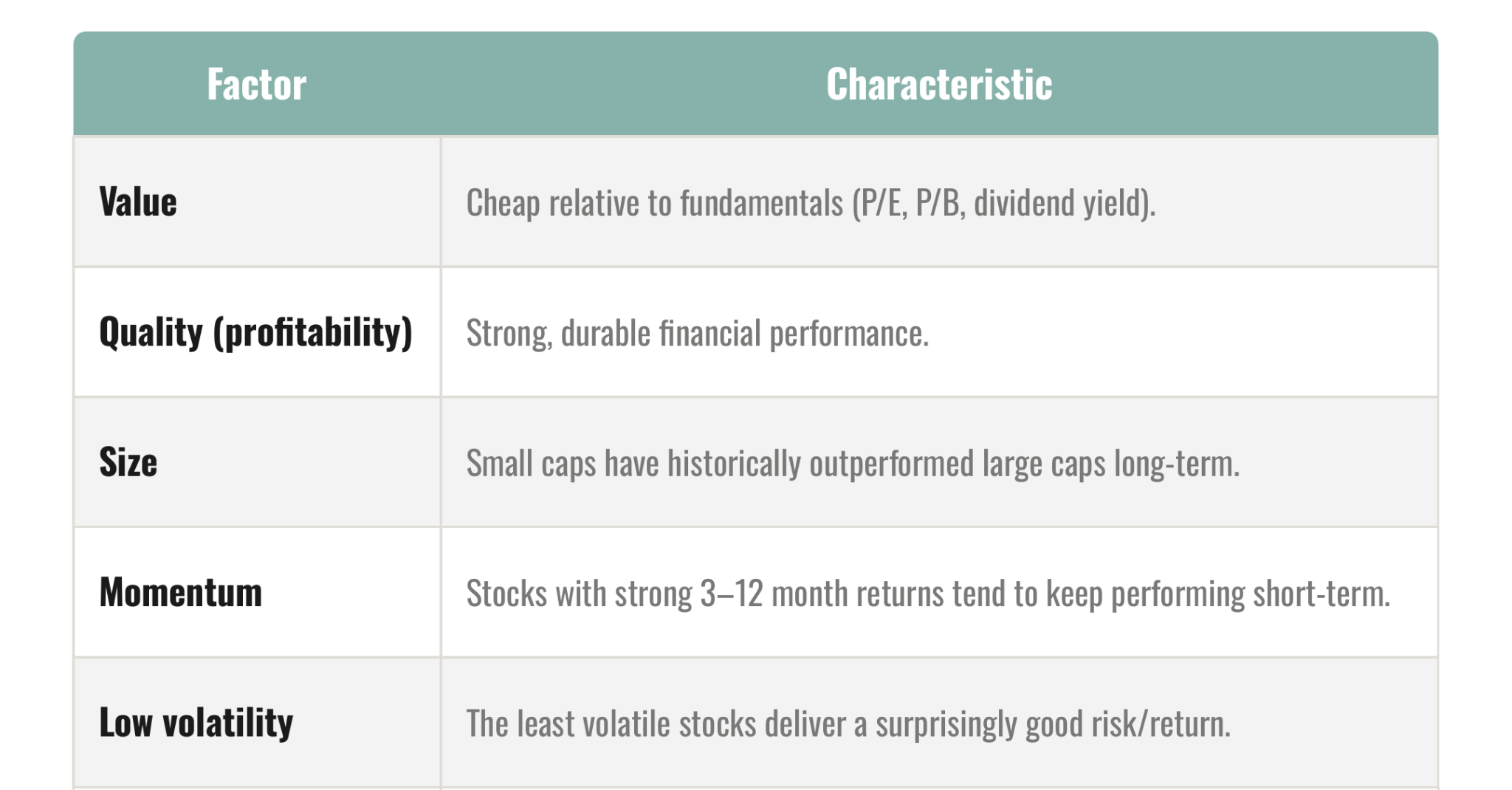
3.3 Investment Factors
Investment styles can be cross-referenced with factors, which incorporate this classification and add several points:
Size (small-cap stocks have historically outperformed large-cap stocks over the long term). Stocks are classified as small-cap when their market capitalization is between $300 million and $2 billion, mid-cap between 2 and 10 billion, and large-cap above that.
Momentum (stocks that have performed well over the past 3 to 12 months tend to continue doing so in the short term). This reflects a well-known investor bias: investors tend to buy what’s rising and sell what’s falling.
Low volatility (the least volatile stocks offer a surprisingly good risk-return profile, contrary to intuition),
Final thoughts
We have seen the forces at work that underpin a company’s growth and profits: products and services, market structure, competitive advantage, life cycle, and investment styles and factors. As you have learned, the best competition is to have no competition—or as little as possible.
Aswath Damodaran wrote, “A good valuation is a bridge between stories and numbers.” We will therefore move back and forth between the qualitative aspect—part of which we have already presented—and the quantitative aspect.
The following article will cover the company’s financials and management. By cross-referencing the data from the first and second articles, we will provide an overview of the company’s current situation, before exploring its future in a third article.
Disclaimer: This content is for educational purposes only and does not constitute investment advice — see our full disclaimer.