
1. Performance
Over the trailing twelve months, the portfolio is up +18% against 20% for the S&P 500 (total return).
Year-to-date, +13.2% against roughly +12.4% for the index. At the end of May I was at 18,9%, and with an ATH of 24% in June
Since inception (2nd of October 2023): +21.2% vs S&P 500 +22.3%
All figures are pretax, net of fees, and exclude the effect of any cash contributions or withdrawals — only return on capital already at work.
I don’t use options and I’m currently unlevered, I plan to write about this later.
My job here is to follow around 15 stocks closely enough that you don’t have to — so you can track your portfolio in 1-2 hours a week, and still get access to the great buys when they show up.
2. Sentiment
Patience is the key for investors: mistakes are made by entering the market too hastily, exiting too quickly, or trying to time the market—efforts that are unsuccessful most of the time.
Out of an abundance of caution, I’ve been tracking the S&P 500’s performance for several quarters now, and because my portfolio is divided into three parts:
Stocks that are on the rise, such as Nebius, the star performer in my portfolio,
New theses that need to be rolled out (Booking, HDS, THK, Microsoft)
Theses that are taking longer than expected, or that are facing negative momentum (Atos, Novo Nordisk, Adobe).
I don’t see any issues in my portfolio right now that require me to make any decisions.
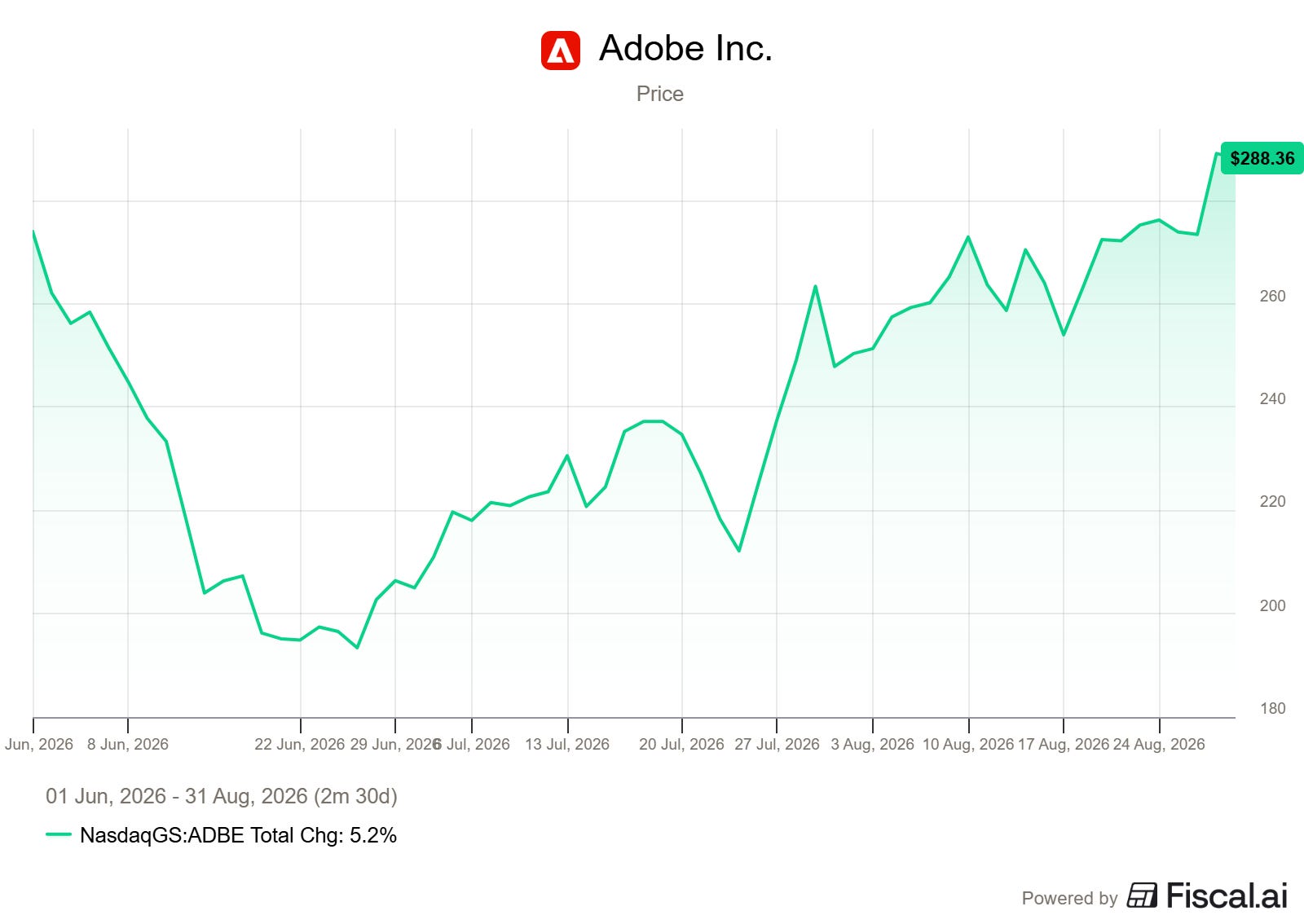
Valuations for AI stocks remain high and uncertain, and investor sentiment is splitting the market into two camps: the so-called AI winners and the AI losers. Getting into AI-related sectors like memory or photonics seems risky to me, and it’s important to track the momentum of stocks considered “losers” to improve your entry point. The discussion of Adobe’s stock price further on is a very good illustration of this.
Overall, the market is a bit expensive, but there are still plenty of opportunities available. In particular, I see stocks like Costco trading at a price that makes it highly likely they’ll be wiped out in the next market downturn—namely, a P/E ratio of 47, compared to annual growth of 15%...
3. Positions
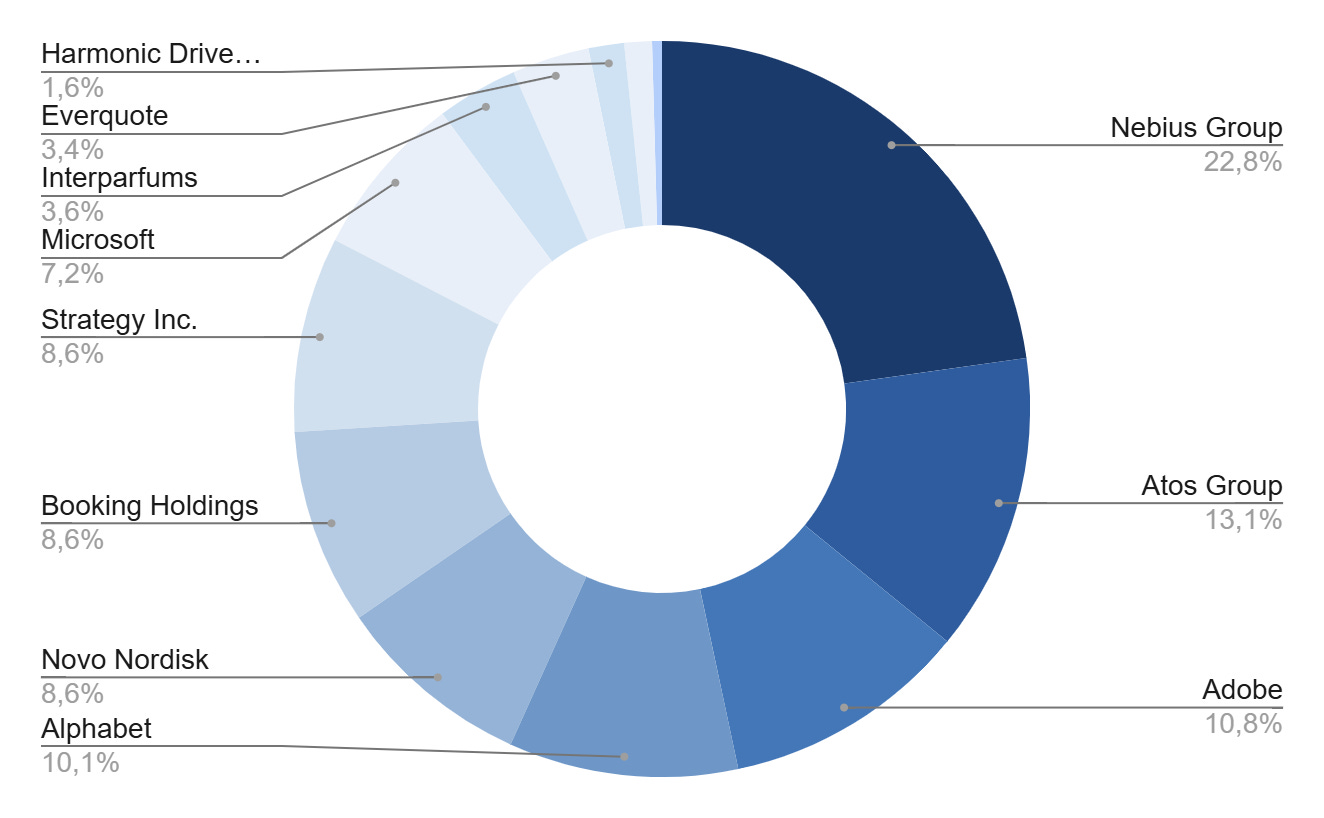
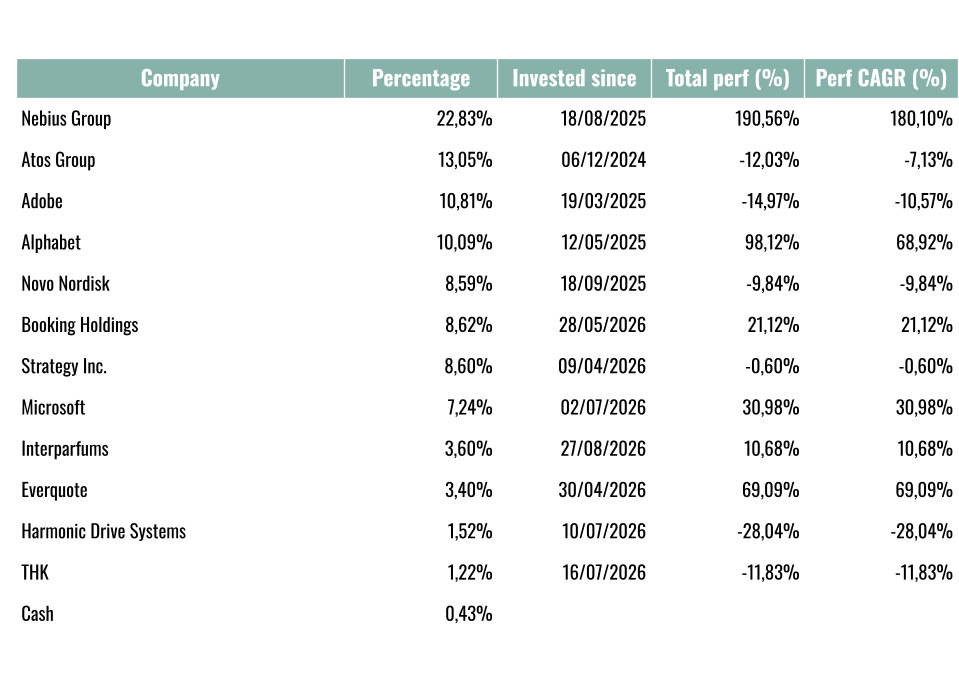
Nebius Group - 22.83% of the portfolio
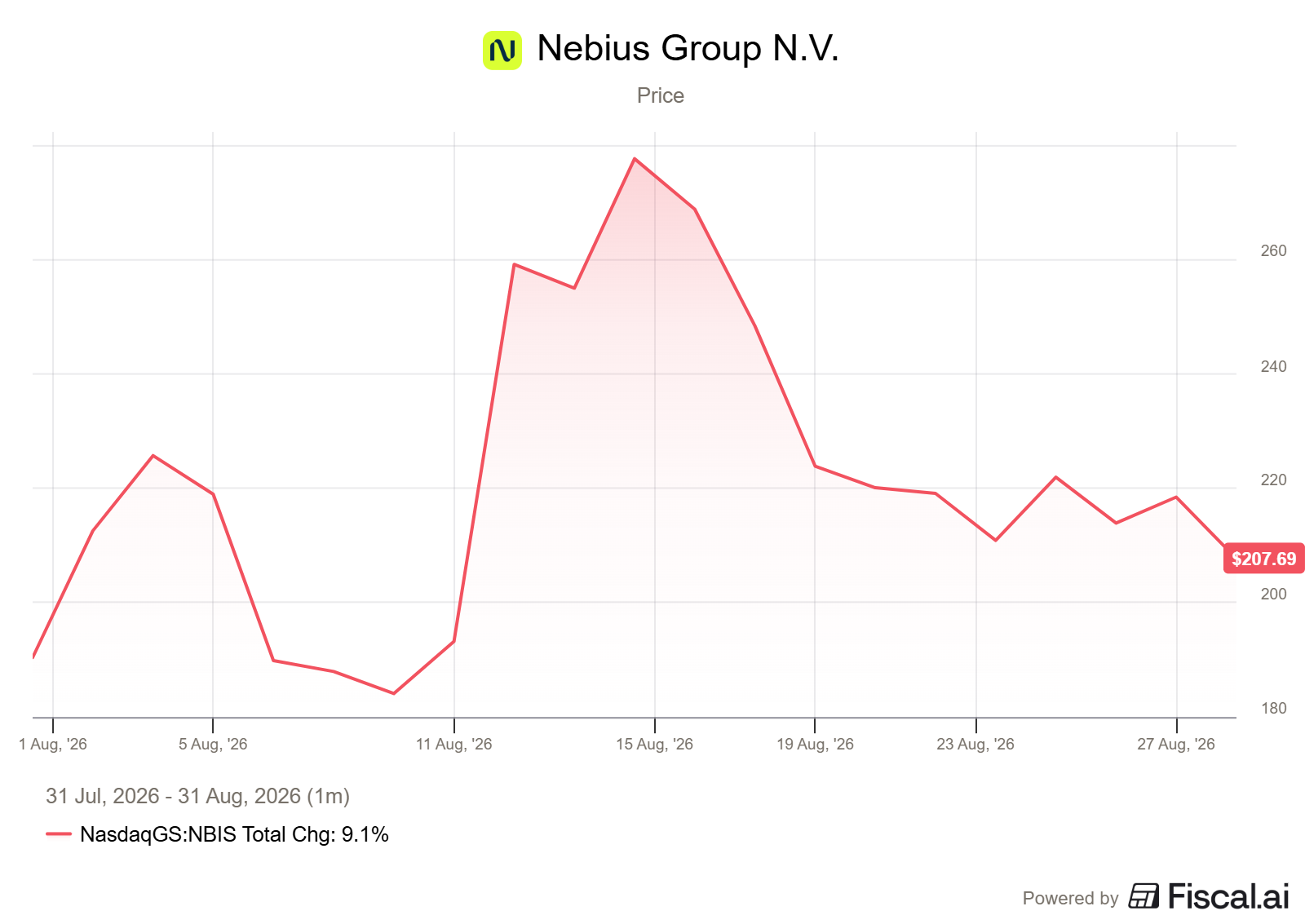
Status: On the quarterly results of August, 12 EPS beat estimates by a wide margin (-$0.12 vs -$0.69 expected), while revenue landed essentially in line ($582.3M vs $584.2M consensus). The stock rose more than 30% on the day the earnings were announced and quickly gave up those gains after a few days. The stock is up 9% over the past month.
Nebius is the largest holding in my portfolio, but I do not intend to reduce its weighting given its excellent results and outlook. I had mentioned that I might increase my position around $150, a price the stock briefly surpassed during the July 29 crisis related to Situational Awareness.
On August 24, Nebius completed a $5.75 billion convertible bond offering, including nearly $3.5 billion at 0.5% maturing in 2030, with the remainder at 4.5% maturing in 2034. In addition, $800 million in bonds were exchanged for nearly 16 million shares. This represents a potential dilution of 6%, which is minimal given the need to finance growth—especially growth at such a rapid pace.
Management always finds an opportune moment to announce bad news for shareholders—usually after a sharp rise in the stock price, a major contract, or an excellent quarterly report.
Atos Group - 13.05% of the portfolio
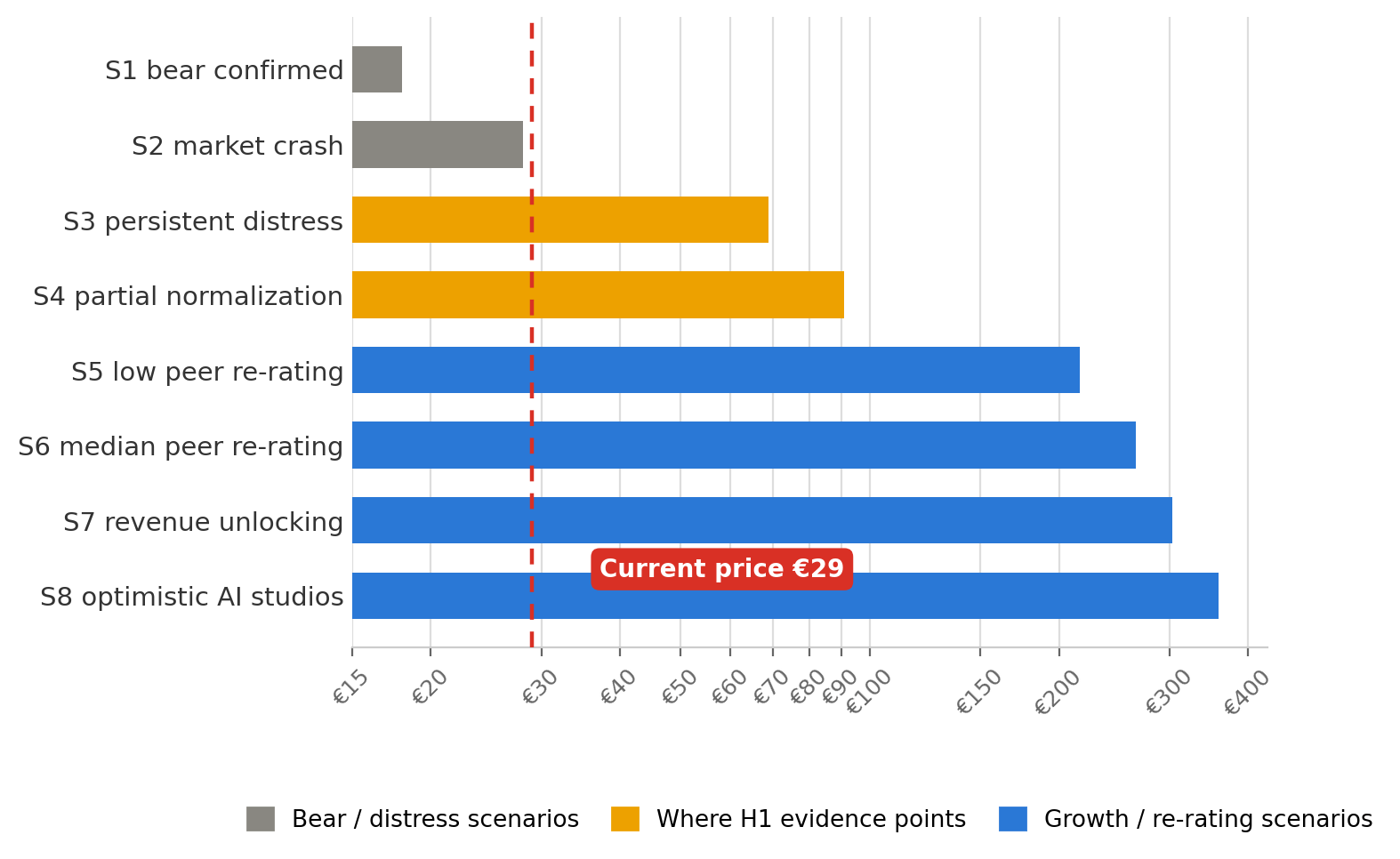
Status: No significant news since the H1 followup. Again, Management is delivering improvements, that the price didn’t catch up. According to my scenarios, Atos Group could be priced around €60-70. My portfolio stays in line with the SP500 performance since Atos price isn’t moving yet. Once it does, I should outperform the index.
Adobe - 10.8% of the portfolio
Status: Although there have been no major changes in the fundamentals, the stock has rebounded by 50% from its lows at the end of June. Its performance fluctuates based on investors’ projections for the software sector, which one day seems to have no future at all, only to become, the next day, an indispensable part of a company once again. The software sector is the perfect example of Mr. Market’s bipolar behavior in our time. The company is set to report on September 10, and this could lead to a re-rating given the lack of disruption anticipated in the deep dive, especially following the recent positive momentum. Keep in mind that the market is a bit slow to catch up, and may decide that the sell-off is over and that an uptrend lies ahead, attracting massive capital inflows to this sector, which is more predictable than the semiconductor sector.
Alphabet - 10.1% of the portfolio
Status: On August 6, Alphabet issued $31.5 billion in bonds, a record high for the company. Google’s parent company is no longer relying solely on its cash flows to finance its AI investments but is also turning to debt. In my view, a prudent use of debt is beneficial, assuming that the company, like its competitors, has visibility into the profitability of its investments. To support this, Google Cloud’s margins have been steadily increasing for several quarters. In addition, Berkshire Hathaway is increasing its stake in Alphabet at Warren Buffett’s express request—a sign that the Oracle of Omaha believes in the company’s competitive moat and its future over the coming decades.
Novo Nordisk - 8.6% of the portfolio
Status: The central point of this quarter is the guidance raise for 2026, with adjusted sales now expected to grow from flat to -6% at CER, vs. -4% to -12% previously. Management gave us two reasons to adjust sales: one good, a provision reversal, and one semi-good, with impairment of terminated drugs.
The main growth is made by the obesity segment, and inside it, by the Wegovy pill (almost none by the injectable Wegovy). I expect the worldwide launch of Wegovy HD to provide additional revenue and operating profit.
Verdict: The volume effect, which is positive, is now outweighing the price effect. In front of us, I see the upside; behind us is the downside.
Booking Holdings - 8,6% of the portfolio
Status: Thesis on track. Despite fears of AI disruption, tourists are still booking with Booking. Room nights grew 5% YoY, the operating margin improved from 33.1 to 34%. Free cash flow minus SBC is up 17%. A pretty solid quarter with beating on expectations on all metrics.
The price is up 24% since my deep dive on June, 5.
Strategy Inc. - 8.6% of the portfolio
Status: Bitcoin was sitting around its floor near the 200-week moving average, slightly below it and suddenly the market decided that the price was too low. As the market is more concerned than obsessed with AI, appetite for crypto came back, but I’m confident it comes back into focus eventually. Momentum is rising again.
An 8-K filed August 24 shows that 18.26M Class A shares were sold for $2.006B net. $136.4M went to buy back STRC preferred shares, $300M to the USD Reserve, and $1.59B seeded a new “USD Cash” pool earmarked for dividends, buybacks, or convertible redemptions. Michael Saylor’s strategy were to “never sell”; it changes to opportunistic buys and sells depending on market conditions, which I find quite sound. The price of Bitcoin appears to be stabilizing around 80k USD, up from 60-65k.
Microsoft - 7.2% of the portfolio
Status: I started a position on the 2nd of July. All the information is in the deep dive and I don’t see major updates to the deep dive from then.
Since my article, the stock is up 31%.
Interparfums - 3,6% of the portfolio
Status: I made a recent buy from Novo Nordisk and Adobe. No issues with both, but I wanted to show you skin in the game. The repricing is underway, with analysts raising price targets.
Everquote - 3,4% of the portfolio
Status: Thesis on track. A deep dive is coming, but the short version is the following: this is an asymmetric position which combines the strengths of a quality company with the discount inherent in small-cap stocks. The bet is that the profitability collapse of 2022 doesn’t repeat, while the market is still pricing in a level of uncertainty that no longer matches the business. I will certainly sell this one to add to AppLovin once the momentum is better.
Harmonic Drive Systems - 1,6% of the portfolio and THK - 1,2% of the portfolio
Status: I wrote an update on both on August 10: both companies raised their guidance and saw their stock prices fall amid concerns over intervention in the yen and the sell-off in semiconductors, but they did not exceed analysts’ expectations.
That’s a pity, because THK’s 364% increase in profits seemed very impressive. HDS will increase production capacity by 33% at its Beverly, Massachusetts, facility and is continuing to invest in Japan, allocating approximately 10 billion yen to the production of gearboxes for humanoid robots at its Ariake plant. THK will once again expand its ball screw factory in Dalian, with completion scheduled for December 2027. Neither Europe nor China is benefiting from capacity investments by either of these companies—which supports the “trusted supplier to the bloc” argument put forward in July.
4. Outlook
I have the following companies on the radar:
Micron and SanDisk: both are good buys at these prices. I am looking for a continuation of the selloff considering the risk of cyclicity.
Netflix: a good buy at current price.
Super Micro Computer: a very attractive PE of 15, with risk of commoditization vs opportunity of bottleneck.
Dino Polska: A genuinely beautiful Polish compounder, sitting on my watchlist. I’m waiting for signals that the Polish grocery price war is ending before entering. I need to watch it more closely, as the price war could be at the end. The momentum is good on this one.
AppLovin: the PE ratio tends to compress over time. The growth stays amazing. I made a deep dive about this wonderful company, and expect to buy whenever the momentum gets better.
DLocal: a good buy at current price. Very good long-term outlook
I write “good buy” meaning that the long-term outlooks are very good, but the stock could go in any direction within a year.
I follow companies on an “anti-radar”:
Nvidia: The PE has been compressing quarter after quarter, which on the surface looks like the same setup as Adobe or Novo — a quality business getting cheaper. It isn’t. I suppose that as the AI supercycle progresses, the P/E ratio declines due to investors’ fears of the end of the cycle. In the absence of strong conviction, I prefer to sit on the sidelines and wait.
Eli Lilly: I found no financial shenanigans despite investigation on this subject.
Final thoughts
To continue expanding the content available on my website and help new investors become self-sufficient, I’ve decided to write a series of articles on how to invest, with a particular focus on the basics. Part of what I hope to contribute is providing the information I wish I’d had as a new investor. As a priority, whenever I come across companies that seem like great buys with promising prospects, I’ll publish a deep dive. Otherwise, the focus will be on educational articles.
Disclaimer: This content is for educational purposes only and does not constitute investment advice — see our full disclaimer.