
1. Performance
Over the trailing twelve months, the portfolio is up +26% against 18% for the S&P 500 (total return).
Year-to-date, +8.3% against roughly +9.5% for the index. At the end of May I was at 18,9%, and with an ATH of 24% in June
Since inception (2nd of October 2023): +19.5% vs S&P 500 +21.7%
All figures are pretax, net of fees, and exclude the effect of any cash contributions or withdrawals — this is a pure return on capital already at work.
I don’t use options and I’m currently unlevered, I plan to write about this later.
My job here is to follow around 15 stocks closely enough that you don’t have to — so you can track your portfolio in 1-2 hours a week, and still get access to the great buys when they show up.
2. Sentiment
I moved up with the market, and now I’m moving down with it. How do I feel about that? Genuinely, I don’t care. I’m confident in every single company I own, and I let their thesis play out.
I had a bit of FOMO with memory stocks going up so much in June, so I initiated a position in Sivers Semiconductors (0.5% of the portfolio), and sold it a couple of days after. I usually never invest without doing due diligence first, but I made an exception this time.
It was a bit of a bad surprise to see Atos Group didn’t reprice yet, because I strongly believe the company will recover and rerate significantly.
I feel like the semiconductor selloff will continue, and that I’ll get a chance to build positions in memory stocks — the prospects look very good for Micron and SanDisk.
What am I worried about? Losing my existing capital, with losses based on fundamentals. The market’s sentiment is now fluctuating because the investors don’t know how to position on AI stocks or how much to value them, since so much depends on the assumptions you start with.
3. Pedagogical module : Compounder vs Multibagger: The Ratchet Effect
The concept: The portfolio runs on two buckets with different mandates.
Compounders
Do you remember the first rule of investing? Don’t lose.
The goal of this category is to secure your capital and let it appreciate over a long-term horizon. It’s the Quality phase of Warren Buffett (after his cigar-butt phase).
The objective is to maximize risk-adjusted return by holding exceptional companies you buy at a good price. Peter Lynch called it Growth at a Reasonable Price (GARP).
The rationale behind this is simple: roughly 4% of stocks generate 100% of long-term market returns.
The longer you hold them, the more important the growth of free cash flow becomes, and the less important the entry PE ratio becomes.
You can invest actively, holding individual stocks, or in a passive way with ETFs.
You may ask: which ones?
Since the best long-term risk-adjusted returns are in quality stocks and large ETFs, you would rather hold the Mag-7 or the MSCI World / Nasdaq-100 than no-growth dividend stocks. You could expect 15-25% per year of growth just on the FCF, plus a rerating of the PE.
Investors who got beaten down on a quality stock may say ‘I’m here for the long-term’. It is a good sentence because in this category, time is your friend, and you’d probably recover if you are patient enough.
Multibaggers
The goal of this category is to get massive gains in a short period of time. Why wouldn’t everybody do that ? Because it’s damn difficult ! You may find:
Growth stock: finding it before everyone else
Turnaround stocks: distinguish which company will recover
Cyclical stocks: correctly anticipate the direction before the actual move
Cryptoassets or commodities: correctly anticipate the direction before the actual move
You can also invest here in an active way, with the holding of individual stocks, or in a passive way with ETFs.
The way you deal with it is with the intrinsic asymmetry of the stock market: what you can lose is limited (max 100%), and what you can win is potentially unlimited. When you are leveraged, you break this asymmetry (generally, don’t be leveraged, especially in multibaggers). The ideal setup is a stock where ‘either I gain a significant amount, or I don’t lose much’. Don’t forget these are riskier stocks.
Some market spots are ideal for this category: small-caps, as they are under-covered, and inaccessible to big money because of illiquidity — meaning they can rapidly become a major shareholder.
Most 10-baggers come from small-caps, and some of them have the advantages of compounder as they have quality stocks, and of a multibagger with the re-rating.
I said you could expect 15-25% per year for the compounders, plus the rerating. For the multibaggers, almost everything is possible here, plus the rerating. It is a reason why I don’t like small-caps indexes. Moreover, the best ones will leave the intermediate indexes to be in the top indexes (nasdaq100, SP500, etc.)
Some stocks compound for so long that you end with a 10-bagger just by sitting on them: if you hold a stock for 10 years with a 25% CAGR, you have a 10-bagger. They are multibaggers in disguise - I still categorize them as compounders.
In this bucket, time may bless you or punish you. And the volatility is quite high (30-70% in a year is normal), you need a stronger stomach than in compounders. And if you’re leveraged, volatility is your enemy.
How to deal with both
In a bull market, multibaggers may capture a significant part of the upside. When a multibagger pays off, it usually compensates for all the losers left along the way. As the portfolio grows, part of the gain stays safe in compounders, and part gets reallocated into other multibaggers. I call this a ratchet effect. It matters because a portfolio has a natural tendency to concentrate, especially toward its multibaggers, giving them a disproportionate size.
In a bear market, capital can be reallocated from compounders to multibaggers to regain exposure to the upside and get strong entry points on beaten-down multibaggers.
Tax matters from the moment you enter a position, not just at exit — always think in after-tax terms.
As the portfolio grows, the natural tendency is to shrink the multibagger percentage and grow the compounder percentage. Above $1M, being 100% in multibaggers feels like madness: why risk losing everything you have for money you don’t need?
My personal portfolio of six figures is designed to run 50% compounders, and 50% multibaggers, though I frequently need to reallocate toward compounders (the ratchet effect).
Questions
This probably raises a few questions worth asking yourself:
Categorize your own positions: which bucket does each one actually belong to?
Are you satisfied with your current allocation between the two?
Is there redundancy in your portfolio — multiple positions doing the same job?
Is there real diversification, or does it just look diversified on paper? Are the underlying theses and key factors correlated?
Do you understand what you hold and why you hold it?
Is each stock you hold actually better than its category ETF?
4. Positions
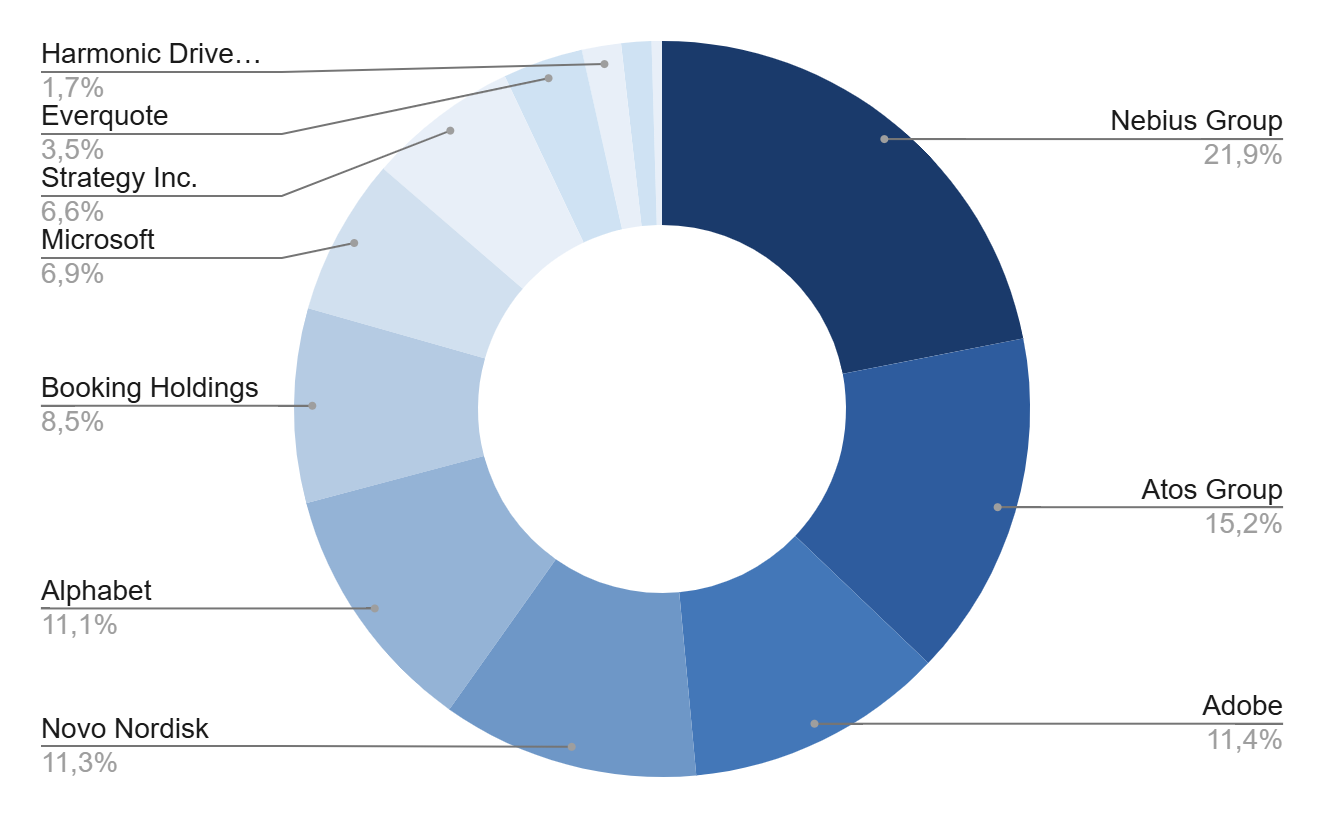
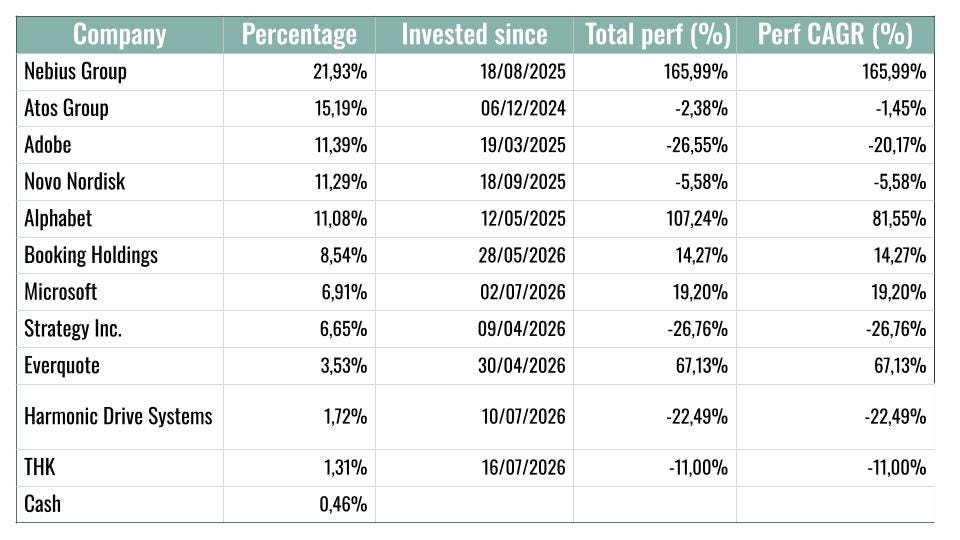
Nebius Group - 21,93% of the portfolio
Status: Thesis on track. Exceptional business. The valuation went down from the June ATH, and I would increase my position with a price under $150. Generally speaking, when I tell myself such a price, the stock has a floor a bit higher. It just bottomed to this price on the 29th of July with the Situation Awareness selloff.
Atos Group - 15,19% of the portfolio
Status: I just published yesterday an article about the followup of the thesis. H1 followup
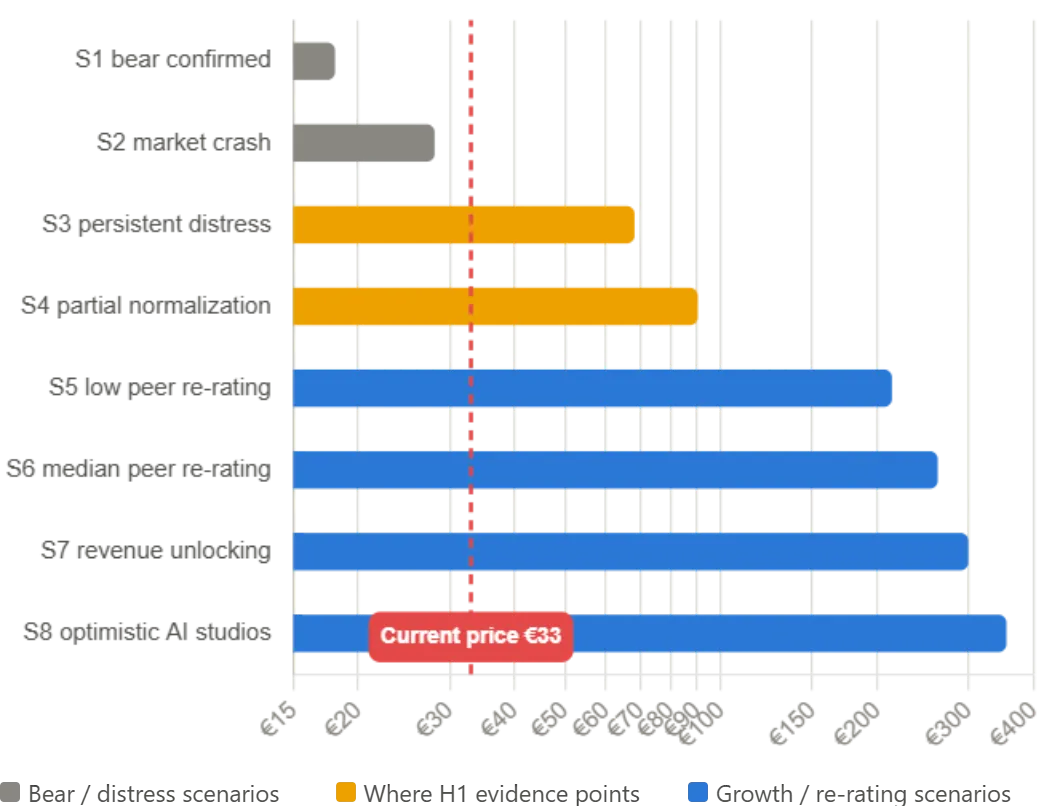
Management is delivering improvements, that the price didn’t catch up. According to my scenarios, Atos Group could be priced around €60-70. My portfolio stays in line with the SP500 performance since Atos price isn’t moving yet. Once it does, I should outperform the index.
Adobe - 11,39% of the portfolio
Status: Thesis on track, no change to the moat read laid out in the deep dive. Q2 FY2026 results, published June 11, confirmed the core of the thesis: record revenue of $6.62B (+13% reported), ending ARR of $27.1B (+12.5%), record gross margin, and EPS beating consensus ($5.96 non-GAAP vs. ~$5.82 expected). Adobe also repurchased 8.5M shares, continuing the buyback that’s been quietly compounding EPS regardless of sentiment.
The June 18 product announcement reinforced the moat thesis directly: Adobe is distributing Creative Agent through third-party LLMs (ChatGPT, Claude, Copilot, Gemini) instead of being disintermediated by them — confirming that the moat is orchestration and distribution, not raw model quality. The six largest global agencies (Dentsu, Havas, Omnicom, Publicis, Stagwell, WPP) are now standardizing on Adobe, which speaks directly to the enterprise lock-in argument from the deep dive.
The honest nuance: Adobe has still lost UI/UX to Figma and the consumer segment to Canva. The thesis rests on the 81% of revenue that sits in the fortresses — and nothing in this quarter’s numbers (ARR growth, gross margin above 87%, stable Creative Cloud retention) signals that those fortresses are cracking. The stock trades near a 7-year low, around 11x earnings, on sentiment and management transition noise (CFO departure to Marvell, CEO/CFO transition uncertainty) rather than on any fundamental deterioration.
The stock is up 30% from its lowest. I don’t see anybody left selling Adobe: those already did. As there are no more sellers, the stock is due to go up.
Novo Nordisk - 11,29% of the portfolio
Status: Thesis on track, no breach versus the original deep dive — but it still needs to materialize in the numbers.
Novo Nordisk added a new U.S. distribution rail on July 23: a Crux collaboration giving employers transparent, no-markup Wegowy pricing through the NovoCare Network Pharmacy, funded via HRA contributions applied at point of sale.
As the efficacy of Wegowy HD vs Eli Lilly’s drug and prices are similar, and as Novo’s volumes are ahead, I do not see any reasons for the valuation gap to not close.
The stock is up 34% from its lowest: the momentum is quite in favor of the company for the coming quarters.
Next results: 5th of August, the earning call will be very interesting, with a potential guidance modification since Novo sandbagged its forecast for 2026.
Alphabet - 11,08% of the portfolio
Status: Thesis on track. Exceptional business — the kind I’d consider holding forever if I were a buy-and-hold investor.
Alphabet is still an incredible cash-machine with world class products. The 82% improvement in the Cloud business is impressive at such revenue. The margin is expanding, so are Microsoft’s and Amazon’s. I see it as a confirmation of the profitability of AI’s investments.
For now, the PE is compressed by the exceptional results in the P&L of Anthropic and SpaceX.
Booking Holdings - 8,54% of the portfolio
Status: Thesis on track, sleep-well-at-night territory. I funded this position by selling OKEA ASA, a Norwegian oil play I’d held since August 2025, for +110% in nine months. The rotation wasn’t incidental — my view was that the geopolitical conflict would stay on a plateau rather than escalate, which made rotating out of an oil-cycle bet and into a quality consumer cyclical at a sentiment trough the same logic applied twice, on opposite sides of the oil price. If the situation actually deteriorates into something closer to a real crash, that’s a different scenario entirely — I have a dedicated crash plan for that, and Booking’s sizing doesn’t need to account for it on its own.
Initiated on May 12 at a normalized PE of ~18x — the third time in ten years Booking has traded this cheap, after March 2016 and March 2020. The thesis is simple: a quality compounder priced as if it’s broken, when the numbers say otherwise. A great buy, and one I can hold without checking the price every day.
Move: No change this month. Prepared to add up to 20% of the portfolio if the stock falls further and the thesis holds — the original deep dive has the full scorecard.
Microsoft - 6,91% of the portfolio
Status: I started a position on the 2nd of July. All the information is in the deep dive.
Since my article, the stock is up 24%. The PE ratio of 22 seemed to be the floor for the stock. I am lucky to get such results this quickly.
Strategy Inc. - 6,65% of the portfolio
Status: Thesis on track, no breach — patience is what’s required here. Bitcoin is sitting around its floor near the 200-week moving average, slightly below it right now. The market is currently obsessed with AI and has little appetite for crypto, but I’m confident it comes back into focus eventually. No bankruptcy risk for MSTR — the balance sheet holds — but sentiment stays negative for now.
Everquote - 3,53% of the portfolio
Status: Thesis on track. A deep dive is coming, but the short version: this is an asymmetric position that combines the upside of quality with the structural discount of a small cap. The core bet is that the profitability collapse of 2022 doesn’t repeat, while the market is still pricing in a level of uncertainty that no longer matches the business. Patience is the main input here — I expect it to be rewarded over the next few quarters.
Move: I trimmed to add to multibaggers stocks in robotics.
Harmonic Drive Systems - 1,72% of the portfolio
Status: FY March 2026 closed out with revenue of ¥59.6bn (+7% YoY), but net income dropped -53.7% to ¥1.6bn, with net margin compressing to 2.7% vs 6.2% the prior year — so top-line growth is real, but profitability has weakened. The bright spot: FY March 2027 guidance is aggressive — revenue targeted at ¥68bn (+14.2%), operating income +141.5%, net income +179.7%, driven by demand in industrial robots, semiconductor equipment, and medical applications. TTM gross margin is around 28.3%.
The market is pricing in a sharp profitability rebound next year — but with a TTM P/E already north of 280x, this is a bet on guidance execution. The stock is in a pullback along with all the semis since June.
The company will publish next results on the 7th of August.
THK - 1,31% of the portfolio
Status: The fundamental momentum here is cleaner and more immediate: management has raised FY2026 guidance twice, on stronger-than-expected industrial machinery orders both in Japan and internationally. Latest guidance: H1 revenue of ¥138bn (+8.7%), H1 operating income of ¥15.4bn (+51%), and full-year revenue of ¥276bn with operating income of ¥31bn — a solid rebound after a 2025 marked by a large net loss. THK reports earnings on August 5, 2026 (in 4 days), worth watching closely to confirm the trajectory. The stock is also in a pullback along with all the semis since June.
5. Outlook
I have the following companies on the radar:
Micron and SanDisk: both are good buys at these prices. I am looking for a continuation of the selloff considering the risk of cyclicity.
Netflix: a good buy at current price.
Super Micro Computer: a very attractive PE of 15, with risk of commoditization vs opportunity of bottleneck.
Dino Polska: A genuinely beautiful Polish compounder, sitting on my watchlist. I’m waiting for signals that the Polish grocery price war is ending before entering.
AppLovin: the PE ratio tends to compress over time. The growth stays amazing.
DLocal: a good buy at current price.
I write “good buy” meaning that the long-term outlooks are very good, but the stock could go in any direction within a year.
I follow companies on an “anti-radar”:
Nvidia: The PE has been compressing quarter after quarter, which on the surface looks like the same setup as Adobe or Novo — a quality business getting cheaper. It isn’t. On a cyclical name approaching the back end of its cycle, a falling PE is often a misleading signal: the market is pricing in earnings that haven’t shown up yet to fall, and the multiple compresses precisely because the cycle, not the sentiment, is turning. This is the trap the good buy / great buy / scream buy framework is supposed to help you avoid — the multiple alone doesn’t tell you which kind of “cheap” you’re looking at.
Eli Lilly: I will track financial shenanigans because of the trial for misleading information about drug efficacy vs Wegowy. It is generally the consequence of the little arrangements with the truth that the company is accused of.
Conclusion
Performance of the portfolio is in line with the SP500, as Atos Group’s price doesn’t reflect the positive changes from the H1. The outperformance of the portfolio could happen fast after the rerating. I entered new positions where the theses are playing out, such as Booking, Strategy, Microsoft and robotic stocks.
My objective is also to reach 15 positions, so my dear readers can have a variety of stocks to read, but I’m in no rush to get there. The primary point is to identify great buys. I am pretty confident I’ll achieve 30% at the end of the year if the market continues in this direction. Otherwise, I would be happy to buy great companies at better prices. We are here to take advantage of the inefficiencies and madness of the stock market: that is where alpha lies.
Important Disclosure & Disclaimer
All content published by JB Peter on this platform is strictly for educational and informational purposes. It does not constitute investment, financial, legal, or tax advice, nor does it represent a personal recommendation or solicitation to buy or sell securities. This research is operated by ORIACON (SASU) and reflects independent corporate analysis. Every reader must conduct their own independent research (Due Diligence) or consult a licensed professional before making any financial decision, as financial markets involve a high risk of capital loss. At the time of writing, ORIACON or the author HOLD shares in the company analyzed in this article. Following this publication, ORIACON and the author reserve the right to buy, sell, or modify positions in any security mentioned at any time, without prior notice to readers or subscribers.