1. Performance
Over the trailing twelve months, the portfolio is up +31% against +25-26% for the S&P 500 (total return). Year-to-date, +12% against roughly +10% for the index.
Track record:
Current year YTD: +12% vs S&P 500 +8%, last end of may I was at 18,9%, and with an ATH of 24% in June
Since inception (2nd of October 2023): +22% vs S&P 500 +22%
All figures are pretax, net of fees, and exclude the effect of any cash contributions or withdrawals — this is a pure return on capital already at work, not a reflection of savings added or removed.
I don’t use options, short positions. I’m currently unlevered, I plan to write about this later.
My job here is to follow around 15 stocks closely enough that you don’t have to — so you can track your portfolio in 1-2 hours a week, and still get access to the great buys when they show up.
2. Sentiment
I’ve had strong movements on my portfolio this month, with amplitudes of more than 10% on some positions. I went from 10 positions in April to 8 today.
I made some changes to the portfolio in April and May. I now have more time to extend my research horizon, and plan to cover 15 companies, with skin in the game on the companies I cover. It’s my full-time job now.
I also closed one position, GigaCloud Technology (12% of my portfolio), at the end of May, as I suspected it to be a fraud. As I am currently buying a house, I divested the amount to pay down a mortgage. The goal here is financial freedom, and this newsletter is also built toward that goal.
I’m aware I’m too concentrated, with close to 50% of the portfolio on two stocks, following strong positive moves on those and YTD pullbacks on others. This doesn’t shake my conviction on the names that are down, and it doesn’t unsettle me on the names that are up. I’m waiting for each thesis to play out. I planted these, and I’m now waiting for their fruit.
I’m rather satisfied with my YoY performance, and my cumulative performance, after almost three years in the markets. I think the best is yet to come. My long term plan is to provide annual returns of 30-50%. Warren Buffett said it’s doable with small amounts of capital (a few million dollars…) —and I’m taking him at his word.
3. Pedagogical module : Good buy, great buy, screaming buy
I have good news and bad news. The bad news: I made several mistakes and will do more. The good news: you can learn from mine.
I bought Adobe on March 19, 2025, at a PE of 25.6. A good buy — a strong business, a reasonable price, nothing more. I was satisfied with that. By the end of the year, the multiple had compressed into great buy territory. Today, at roughly 11x, it’s sitting in a zone that could turn out to be a screaming buy.
I got the business right. I got the momentum wrong. I was happy with the good buy result instead of waiting for the market to tell me where it was actually going. I had to come back and add to the position later to make up for entering too early. The thesis never wavered — I’m still fully convinced of it today. The timing did.
This is the lesson behind three categories of stock you’ll experience as a buyer.
Good buy. Often called “a no brainer” by people who haven’t thought about the downside. You pay a reasonable price for a good business. That’s exactly what Adobe and Novo were last year. The business case looks obvious — and it is, on the merits. But the multiple, and investor sentiment, can still go lower. A good buy gives you no real margin of safety. If the narrative keeps deteriorating, you bleed before you win. After a few years, if you are patient enough, you can get easily 20% per year on those.
Great buy. The ratio between potential loss and potential upside turns clearly in your favor. You’re paying an attractive price for an excellent business at a moment when sentiment is depressed — not euphoric, not capitulating, just unloved. This is the zone where discipline is enough. You don’t need to be a hero. You don’t need perfect timing. You need to recognize the mispricing and act on it. It’s Alphabet on April 25, at 17x earnings in the middle of the AI-disruption scare on Search.
Screaming buy. A market anomaly. Meta and Netflix in 2022 — both crushed in the same bear market, both recovering into some of the best returns of the decade (Netflix is almost a 7-bagger in 3 years). This is the dream every investor chases — and it’s rare, and brutally hard to catch, because it shows up in the middle of panic, exactly when most people have no cash left and no stomach to act.
Example with Netflix in 2022
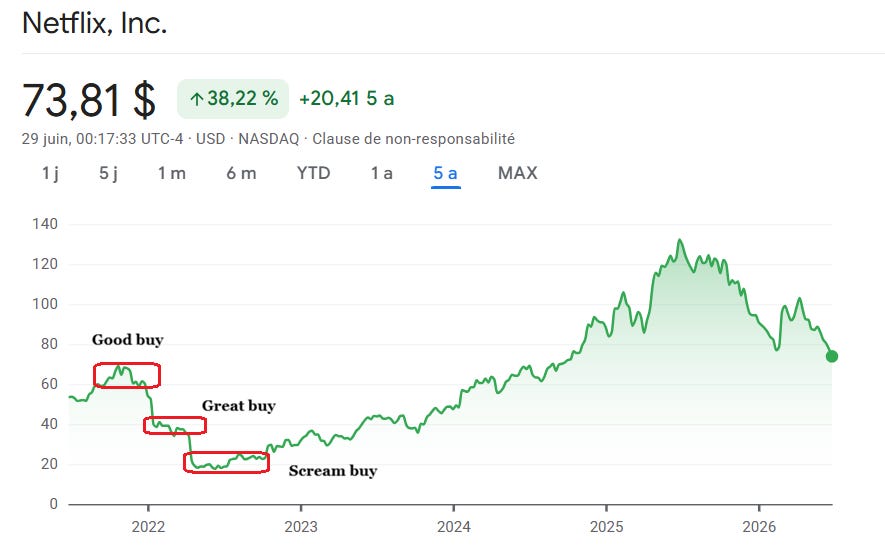
With a buy in the good buy zone (60$), and a sell in may 2025 (120$), you made 25% CAGR. With a great buy (40$), you made 43% CAGR, and with the screaming buy zone (20$), you made 80% CAGR.
If you just buy and hold, your performance tends to the long term rentability of the stock, with probably no more than 25% (which is already excellent on the long term).
The general guide — not a formula. For an exceptional business with its fundamentals intact, a PE in the 15-19x range is a reasonable marker for great buy territory; below that, you’re approaching screaming buy. But this is a guide, not an automatic trigger. It only applies if the moat is genuinely intact. If fundamentals are deteriorating, a falling multiple isn’t a discount — it’s the market correctly repricing a weaker business, and that’s not a buy at any price.
Where this puts Adobe and Novo today. Both currently trade in the 11-12x PE range, well below what the 15-19x marker would suggest for a great buy on an exceptional business. Whether that makes them screaming buys isn’t something I’m willing to claim. A screaming buy is a market anomaly — rare, and confirmed only after the fact. My conviction is that both are great buys.
What I take from this. I’ve raised my own bar. I used to settle for good buys. Not anymore. The Adobe experience — being satisfied too early, then having to come back and add to the position to correct for it — taught me that patience has a cost when you skip it, even when the thesis holds. My new standard for any new position: great buy, minimum. As long as the opportunity of a great buy, I will stay with my portfolio and continue to investigate. I won’t add positions for the sake of diversification.
4. Positions
It’s a first edition, I will improve the status over time.
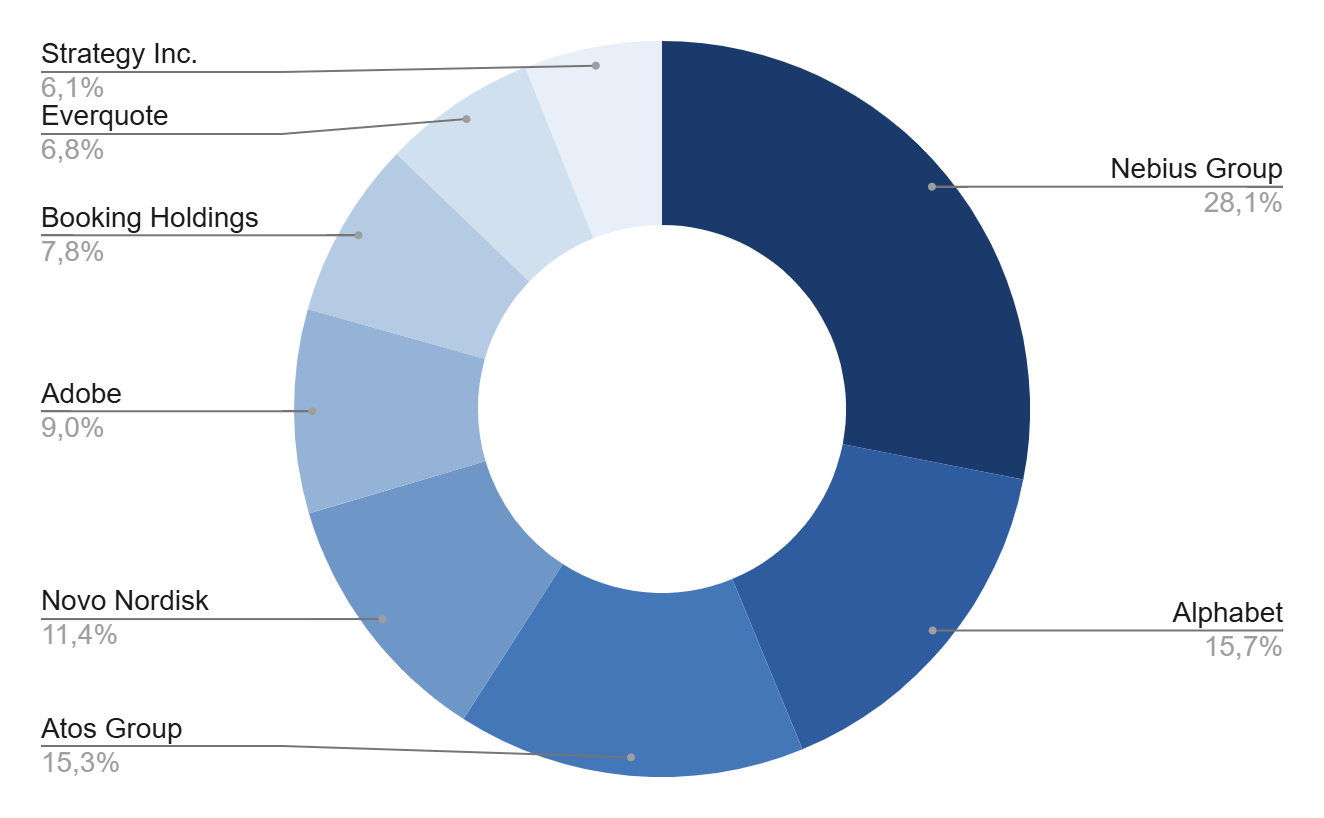
Nebius Group — 28.1% of the portfolio
Status: Thesis on track. Exceptional business, and I find the valuation rich at current levels. But selling a position that keeps performing, just because it looks expensive, is exactly the kind of market-timing call I’m bad at. I’d rather follow the stock than try to outguess it. Volatility on this one isn’t a concern; conviction on the business is what matters here, not the swings.
Move: No change this month. Position held as is.
Alphabet — 15.7% of the portfolio
Status: Thesis on track. Exceptional business — the kind I’d consider holding forever if I were a buy-and-hold investor. Fundamentals keep growing fast, and the capex raise doesn’t worry me. I’m planning a deep dive on the name. Up close to 100% since May 2025, and I’m perfectly satisfied with the position as it stands.
Move: I plan to trim this position to fund a new one — not a change of view on Alphabet, but an arbitrage to put skin in the game on a name I’m about to start covering.
Novo Nordisk — 11.4% of the portfolio
Status: Thesis on track, no breach versus the original deep dive — but it still needs to materialize in the numbers. Since the end of May, Wegovy has been reimbursed at 65% by the French national health insurance (Sécurité sociale) — the European leg of the thesis is moving forward.
Move: Divested Fortinet in April to add to this position. A direct expression of relative conviction between the two. Novo is also a great example of the good/great buy described above
Adobe — 9.0% of the portfolio
Status: Thesis on track, no change to the moat read laid out in the deep dive. Q2 FY2026 results, published June 11, confirmed the core of the thesis: record revenue of $6.62B (+13% reported), ending ARR of $27.1B (+12.5%), record gross margin, and EPS beating consensus ($5.96 non-GAAP vs. ~$5.82 expected). Adobe also repurchased 8.5M shares, continuing the buyback that’s been quietly compounding EPS regardless of sentiment.
The June 18 product announcement reinforced the moat thesis directly: Adobe is distributing Creative Agent through third-party LLMs (ChatGPT, Claude, Copilot, Gemini) instead of being disintermediated by them — confirming that the moat is orchestration and distribution, not raw model quality. The six largest global agencies (Dentsu, Havas, Omnicom, Publicis, Stagwell, WPP) are now standardizing on Adobe, which speaks directly to the enterprise lock-in argument from the deep dive.
The honest nuance: Adobe has still lost UI/UX to Figma and the consumer segment to Canva. The thesis rests on the 81% of revenue that sits in the fortresses — and nothing in this quarter’s numbers (ARR growth, gross margin above 87%, stable Creative Cloud retention) signals that those fortresses are cracking. The stock trades near a 7-year low, around 11x earnings, on sentiment and management transition noise (CFO departure to Marvell, CEO/CFO transition uncertainty) rather than on any fundamental deterioration.
The good buy → great buy progression is detailed in the pedagogical module above — same story, reinforced by the print.
Move: No change this month. Q2 follow-up
Booking Holdings — 7.8% of the portfolio
Status: Thesis on track, sleep-well-at-night territory. I funded this position by selling OKEA ASA, a Norwegian oil play I’d held since August 2025, for +110% in nine months. The rotation wasn’t incidental — my view was that the geopolitical conflict would stay on a plateau rather than escalate, which made rotating out of an oil-cycle bet and into a quality consumer cyclical at a sentiment trough the same logic applied twice, on opposite sides of the oil price. If the situation actually deteriorates into something closer to a real crash, that’s a different scenario entirely — I have a dedicated crash plan for that, and Booking’s sizing doesn’t need to account for it on its own.
Initiated on May 12 at a normalized PE of ~18x — the third time in ten years Booking has traded this cheap, after March 2016 and March 2020. The thesis is simple: a quality compounder priced as if it’s broken, when the numbers say otherwise. A great buy, and one I can hold without checking the price every day.
Move: No change this month. Prepared to add up to 20% of the portfolio if the stock falls further and the thesis holds — the original deep dive has the full scorecard.
Everquote — 6.8% of the portfolio
Status: Thesis on track. A deep dive is coming, but the short version: this is an asymmetric position that combines the upside of quality with the structural discount of a small cap. The core bet is that the profitability collapse of 2022 doesn’t repeat, while the market is still pricing in a level of uncertainty that no longer matches the business. Patience is the main input here — I expect it to be rewarded over the next few semesters, not the next few weeks.
Move: No change this month.
Strategy Inc. — 6.1% of the portfolio
Status: Thesis on track, no breach — patience is what’s required here. Bitcoin is sitting around its floor near the 200-week moving average, slightly below it right now. The market is currently obsessed with AI and has little appetite for crypto, but I’m confident it comes back into focus eventually. No bankruptcy risk for MSTR — the balance sheet holds — but sentiment stays negative for now.
5. Outlook
I want to improve my knowledge of a lot of companies I want to follow, so most of my time is spent on this and on writing deep dives on the companies I own.
On the radar — Microsoft. I’m finalizing my due diligence on MSFT. If it checks out, I’ll write up the deep dive and very likely initiate a position shortly after. The stock seems to stabilize around its 200 day moving average.
On the radar — Dino Polska. A genuinely beautiful Polish compounder, sitting on my watchlist. I’m waiting for signals that the Polish grocery price war is ending before entering. (Not currently held.)
On the radar — Netflix and dLocal. Both are good buys at current prices. They could enter the portfolio if the price comes down further — not urgent, but on the list. (Not currently held.)
A broader observation: software names look unusually interesting right now across the board — more candidates than I can act on at once.
Anti-radar — Nvidia. The PE has been compressing quarter after quarter, which on the surface looks like the same setup as Adobe or Novo — a quality business getting cheaper. It isn’t. On a cyclical name approaching the back end of its cycle, a falling PE is often a misleading signal: the market is pricing in earnings that haven’t shown up yet to fall, and the multiple compresses precisely because the cycle, not the sentiment, is turning. This is the trap the good buy / great buy / screaming buy framework is supposed to help you avoid — the multiple alone doesn’t tell you which kind of “cheap” you’re looking at.
Conclusion
This month was less about any single trade and more about discipline catching up with conviction. Eight positions instead of ten, a research horizon stretching toward fifteen, and a standard for new money that’s gone from “good enough” to “great buy, minimum.” Adobe and Novo are the proof that the lesson came from real mistakes, not from theory — and Microsoft, if the due diligence holds, will be the first position built under the new bar from day one.
The portfolio is concentrated, the conviction is high, and I’m not in a hurry. Plant the thesis, do the work, let the price come to you.
Important Disclosure & Disclaimer
All content published by JB Peter on this platform is strictly for educational and informational purposes. It does not constitute investment, financial, legal, or tax advice, nor does it represent a personal recommendation or solicitation to buy or sell securities. This research is operated by ORIACON (SASU) and reflects independent corporate analysis. Every reader must conduct their own independent research (Due Diligence) or consult a licensed professional before making any financial decision, as financial markets involve a high risk of capital loss. At the time of writing, ORIACON or the author HOLD shares in the company analyzed in this article. Following this publication, ORIACON and the author reserve the right to buy, sell, or modify positions in any security mentioned at any time, without prior notice to readers or subscribers.
Your publication aligns with a lot of what I enjoy reading. I've subscribed!