
Introduction
Most investors spend their entire lives searching for the stocks that actually matter. Here’s what the data tells us: only 4% of all listed stocks account for 100% of the net wealth created in equity markets since 1926.
That single statistic is the foundation of my approach. I don’t try to own everything. I try to identify the few companies that have the potential to be part of that 4% — and hold them until my thesis is done.
A quick word on track record
I started stock picking in October 2023. Since then, my portfolio has compounded at a 24% CAGR, versus approximately 18% for the S&P 500 in euros over the same period (I’m an European investor, so it doesn’t make sense for me to compare in dollars, as the USD/EUR is a major component of performance).
My approach splits roughly 50/50 between quality compounders and higher-conviction opportunities/multibaggers — small caps, turnarounds, and growth stories. A few positions that shaped that return : Nebius Group (+197%), OKEA ASA (+110%), Medpace (+55%), Wise (+50%), Alphabet (+118%).
I’ll publish a monthly portfolio review to track performance transparently. But for now, let’s get into what matters.
Which brings me to Novo Nordisk
I already own it. And I’m currently sitting on a -20% loss on that position.
I’m writing this deep dive anyway — not to justify a bad trade, but because I believe the market is making a mistake. That’s the only reason to hold a losing position: not hope, not denial, but a clearly articulated thesis that the current price doesn’t reflect the underlying reality.
That’s what this article is about.
The healthcare sector is notoriously difficult to analyze and even harder to predict. I rarely touch it. But what is happening with Novo Nordisk is, in my view, a historically rare setup — the kind that only emerges a handful of times per decade.
The Short Version
Novo Nordisk makes Wegovy and Ozempic — the drugs reshaping how the world treats obesity and diabetes. The stock has lost 60% from its peak. The market is punishing a difficult 2026 guidance and Eli Lilly’s market share gains.
My view: the market is pricing permanent decline in a temporary situation. Prices fell before volumes followed. The factories are being built. The oral pill just launched in the US. Wegovy HD just matched — and slightly exceeded — Zepbound on efficacy.
At PE 10x, the downside is ~9% CAGR from current prices. The central scenario gives ~33% CAGR to December 2028. I have high conviction on the bull scenario at ~36% CAGR: the duopoly holds, the production moat is real, and the volume response to lower prices hasn’t shown up in the numbers yet and it will.
I own 9% of my portfolio in Novo Nordisk at an average cost of €48.39 — currently down 20%. I haven’t sold. At this price, I think it’s still a deal.
The rest of this article explains why.
The Market — Three Segments, One That Matters
Diabetes & Rare Disease — Steady and Predictable
Diabetes care is a mature, commoditized market — predictable, but increasingly competitive. 42 million patients treated in 2025, growing at +4% in constant currency. For modeling purposes, we assume growth stays on its current trajectory — low single digits, nothing more.
The market runs on two distinct tiers:
The oligopoly — Novo Nordisk, Eli Lilly, and Sanofi collectively control around 90% of global insulin value, with Novo leading at over 45% market share. These three capture the economics.
The volume players — biosimilar manufacturers like Biocon and Wockhardt compete on price in emerging markets, with razor-thin margins. High volume, low value.
Rare diseases add a modest +9% growth cushion — hemophilia, growth disorders — useful as a margin stabilizer, nothing more.
This is a segment for dividend investors — predictable, low-growth, and frankly not why I’m here.
Obesity — A Billion-Person Market, 98% Untouched
Almost 1 billion people worldwide live with obesity. More than 100 million in the US alone, roughly 30% of UK adults, and around 15% of EU adults. Only 2% of the global obesity population is currently receiving treatment.
Let me flip that: 98% of the market is untouched. We are not talking about a product cycle. We are talking about a demographic wave that has barely started.
The alternatives? Bariatric surgery is invasive by definition — you’re cutting into someone. From conversations with physicians, a daily pill or injection is not only more practical, it’s fully reversible. The other option — doing nothing — means letting a public health crisis compound silently, with severe consequences at both the individual and systemic level. Obesity drives diabetes, cardiovascular disease, cancer. Ignoring it isn’t a neutral choice.
This market belongs to whoever wins the GLP-1 race.
The Business — The Duel That Defines The Following Years
Presentation and History
Novo Nordisk is the result of a historic merger in 1989 between two bitter Danish rivals: Nordisk, founded in 1923 by Nobel Laureate August Krogh and physician Hans Christian Hagedorn, which operated initially in the extraction and purification of bovine insulin after securing the manufacturing rights from Canada. Novo, founded in 1925 by the Pedersen brothers (a chemist and an engineer previously employed by Krogh), which operated initially in the production of its own competing insulin and later diversified into industrial enzymes.
For 64 years, this intense rivalry forced both laboratories to constantly innovate, pushing Denmark to the forefront of global diabetes care. Today, shielded from hostile takeovers by the unique governance of the Novo Nordisk Foundation, the unified group has transitioned its century-long mastery of peptide chemistry into the current GLP-1 revolution.
How We Got Here
Novo Nordisk and Eli Lilly are running the most consequential race in modern pharma. To understand where we are today, we need to understand how we got here — and what the current state of the duel looks like across every dimension that matters: molecules, production, and pricing.
Novo Nordisk had a head start. Years before obesity became the hottest market in pharma, the company was already sitting on semaglutide — a molecule originally developed for diabetes that turned out to do something remarkable: it made people lose weight. A lot of weight. Ozempic became a cultural phenomenon before Wegovy, its obesity-approved sibling, even launched. Novo Nordisk was, for a brief moment, the most valuable company in Europe.
Then Eli Lilly showed up.
Tirzepatide — Mounjaro for diabetes, Zepbound for obesity — hit two receptors instead of one. In head-to-head trials it produced slightly superior weight loss. Physicians noticed. Patients noticed. Prescriptions shifted. By mid-2025, Lilly held 57% of the GLP-1 market, having overtaken Novo in the segment Novo had pioneered. The gap has continued to widen on revenue trajectory. Lilly is projected to reach $113 billion in prescription drug sales by 2030, versus $84 billion for Novo. Both are growing fast — but Lilly is growing faster, from a higher base.
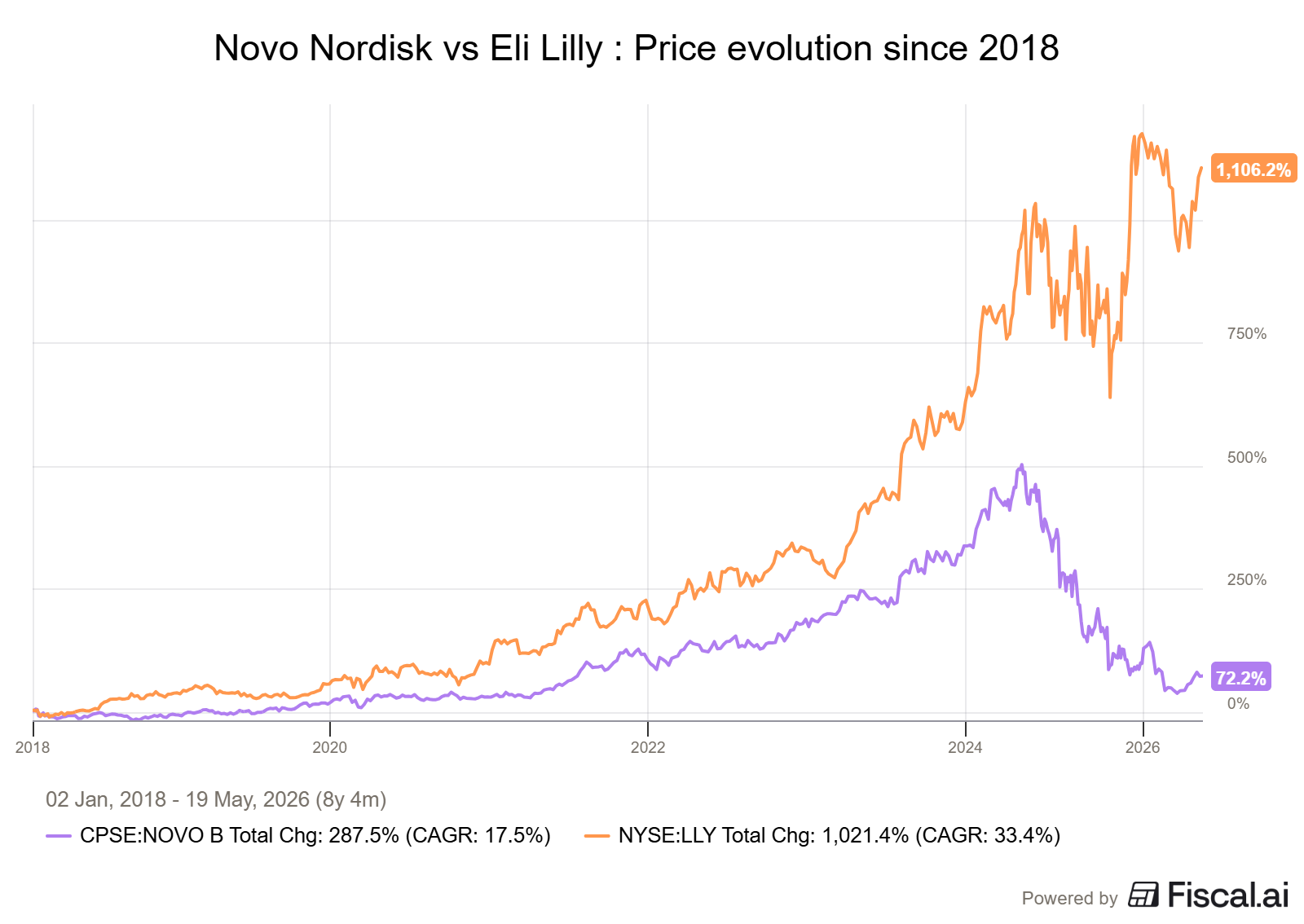
Novo Nordisk returns ~50% of earnings as dividends versus ~22% for Eli Lilly. Less cash retained means less fuel for buybacks and reinvestment — which mechanically dampens share price appreciation. The total return picture is closer than the chart suggests.
That’s the past dynamic. Let’s see where we are today.
Molecules
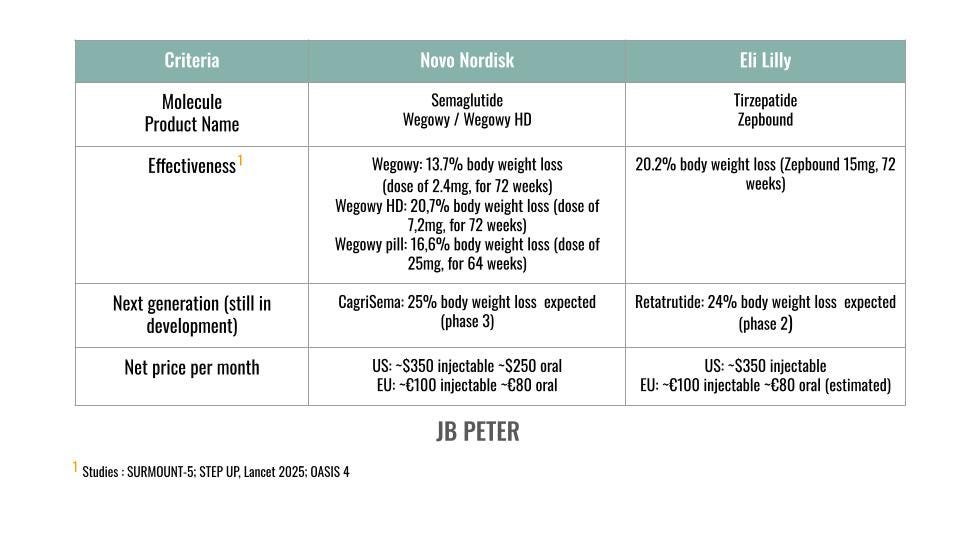
Semaglutide remains the most clinically documented GLP-1 molecule in existence. The SELECT trial demonstrated a 20% reduction in major cardiovascular events. Early data shows signals across sleep apnea, kidney disease, and addiction. Novo now has three approved obesity products: Wegovy (2.4mg, 13.7% weight loss), Wegovy HD (7.2mg, 20.7% weight loss — approved March 2026), and the world’s first oral GLP-1 pill (25mg, 16.6% weight loss).
Tirzepatide hits two receptors simultaneously — GLP-1 and GIP. In SURMOUNT-5, the first published head-to-head trial, Zepbound patients lost 20.2% of body weight versus 13.7% for Wegovy at standard doses over 72 weeks. That gap is real on current approved doses, and it explains the prescribing shift toward Lilly. Note: the trial was open-label and funded by Eli Lilly — results are robust but the methodology deserves mention.
The arrival of Wegovy HD changes the equation. At 20.7% weight loss, it exceeds Zepbound’s 20.2% in SURMOUNT-5 — though no direct head-to-head exists yet at these doses.
The next generation could widen Novo’s lead further. CagriSema — semaglutide combined with cagrilintide — shows up to 22% weight loss in Phase 2, with Phase 3 ongoing. Lilly’s retatrutide shows up to 24% in Phase 2. Both companies are converging on the same destination: more efficacy, oral delivery, broader indications.
Production
This is where the story gets interesting — and where the moat lives. Both companies are spending at a scale that is almost impossible to overstate. Novo committed $4.1 billion to a new facility in North Carolina. Lilly is spending $9 billion on its Indiana complex. These are not capacity additions. These are decade-long bets on a market that has barely started.
Building a biologics manufacturing facility takes 5 to 7 years from groundbreaking to full production. No molecule in a Phase 2 trial today will be manufactured at scale before 2030. That timeline protects both incumbents from any challenger — regardless of how good their science is.
Pricing
Pricing is the most contested battleground — and it just changed dramatically.
Before November 2025, Wegovy’s US list price sat around $1,300 per month. Real-world net prices after rebates were significantly lower, but coverage remained inconsistent and access was largely limited to patients with private insurance willing to fight for reimbursement.
Then Trump signed the Most Favored Nation executive order.
The MFN agreement caps Wegovy and Ozempic at $350/month for TrumpRx self-pay patients and $245/month for Medicare and Medicaid beneficiaries — effective 2026. For context, that’s a 73-82% cut from list price on the government channel. The market reacted badly to the announcement, pricing in margin destruction.
But here’s the counterintuitive read: lower prices mean more patients. Novo has been explicit about this — volume at $245 beats no volume at $1,300. The company that accepts price compression today to lock in 50 million patients builds a franchise that no competitor can dislodge tomorrow.
Eli Lilly is navigating the same environment. Both companies face the same pricing pressure, the same Medicare dynamics, the same employer plan inertia. This is not a Novo-specific risk — it’s a sector-wide reset that actually benefits the incumbents with manufacturing scale over any challenger trying to enter at premium pricing.
The pricing war is real. But it’s a war both duopoly players can survive — and smaller challengers cannot.
Pipeline
The current products are only the beginning. Both companies are racing to build the next generation of GLP-1 therapies — and the pipeline tells you who is investing in the future versus managing the present.
Novo’s most advanced candidate is CagriSema — semaglutide combined with cagrilintide, a long-acting amylin analogue — showing up to 22% weight loss in Phase 3 trials. Behind it, zenagamtide, a triple receptor agonist licensed from The United Laboratories, is entering Phase 3 in 2026. The oral Wegovy pill, already FDA-approved, opens an entirely new patient population. And CagriSema’s potential approval for MASH — metabolic liver disease — broadens the indication beyond obesity into a multi-billion dollar adjacent market.
Lilly is developing retatrutide, a triple agonist targeting GLP-1, GIP, and glucagon simultaneously, showing up to 24% weight loss in Phase 2. If Phase 3 data holds, it would be the most efficacious GLP-1 molecule on the market.
The pattern is clear: both companies are converging toward triple agonists, oral formulations, and broader indications. The molecule war is accelerating. What neither can shortcut is the time it takes to manufacture at scale — which is the real moat.
Financials - A Quality Compounder
Novo Nordisk has built one of the most profitable franchises in global pharma — and is now absorbing the cost of its next chapter.
Net sales reached DKK 309 billion in 2025, up 6.4% year on year, with a compound annual growth rate of 17% since 2021. Operating profit stands at DKK 128 billion. Gross margin at 81%. These are not the numbers of a company in distress.
The balance sheet is a fortress. Net cash position of DKK 95.4 billion. No leverage risk. Free cash flow recovered to DKK 28.3 billion in 2025 after a distorted 2024 impacted by the Catalent acquisition. CAPEX guidance of approximately DKK 55 billion for 2026 — the company is spending aggressively on production capacity, from a position of financial strength.
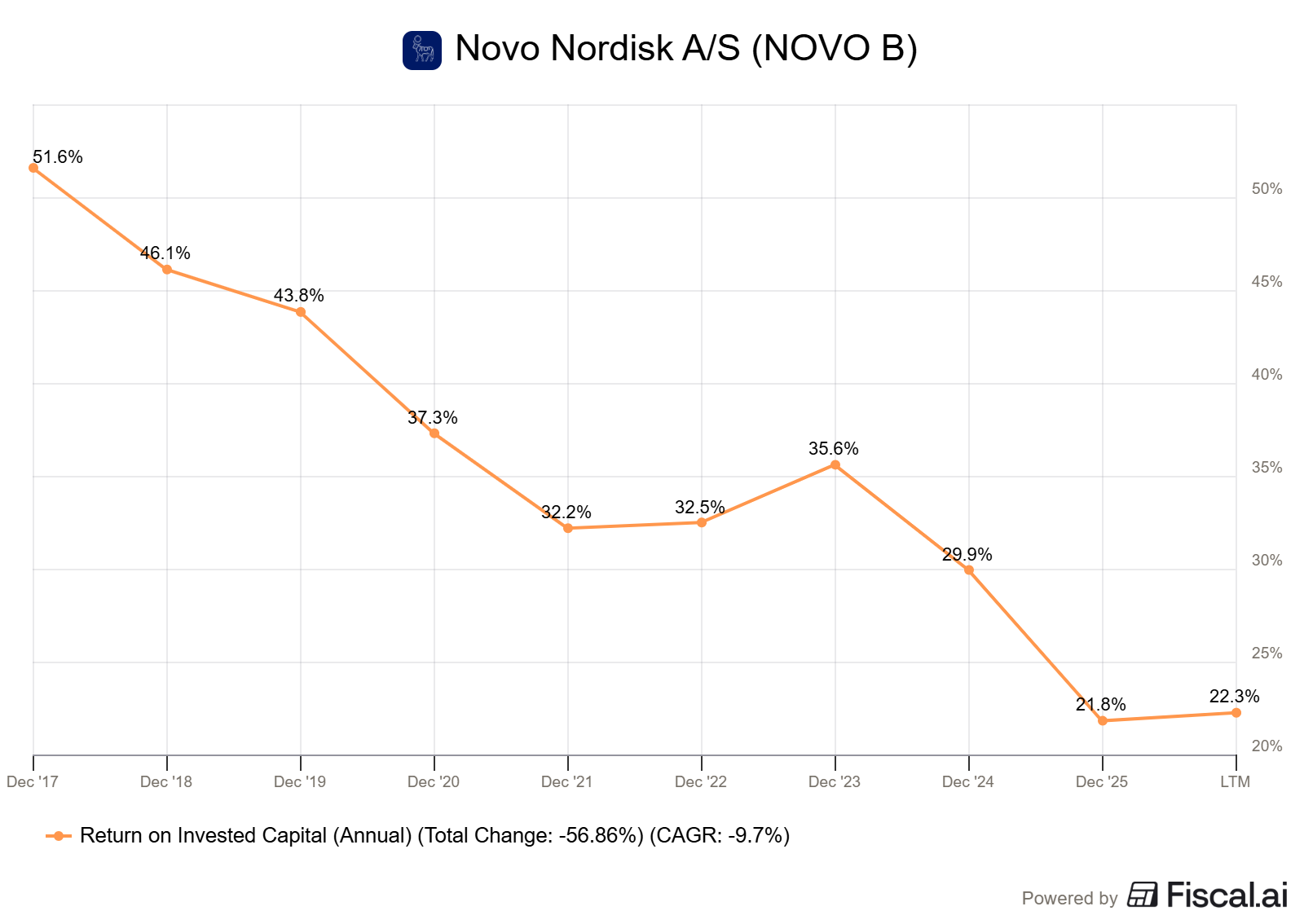
Novo Nordisk’s ROIC has declined from 51.6% in 2017 to 22.3% today — a steady compression over eight years, accelerated by the manufacturing buildout of 2024-2025.
A ROIC of 22.3% remains exceptional by any industry standard. For context, Eli Lilly’s ROIC on the same definition currently stands at 12.2% — nearly half of Novo’s, despite Lilly’s current market leadership. Both companies are in heavy investment mode. On this metric, Novo’s financial machine remains structurally superior.
The direction is down — and the market is punishing that direction. But a declining ROIC in the context of record CAPEX deployment is not a broken business. It’s a company trading current returns for future capacity. The question is whether that capacity pays off. That’s exactly what the next section Bear vs Bull is about. Before that, a last checkup on management.
Management — Aligned with Shareholders
The governance structure starts at the top. The Novo Nordisk Foundation controls 28.1% of the share capital and 77.3% of the voting rights. This is not a management team that can be pressured by activist shareholders into short-term thinking. That alignment with long-term value creation is structural, not optional.
On executive compensation, the Long-Term Incentive Programme ties executive pay to share performance over a three-year vesting period, with metrics covering financials, innovation, commercial execution, and sustainability. Short-term bonuses exist but are capped. For the detailed breakdown, Novo Nordisk publishes a separate Remuneration Report available in the annual report.
Two elements are worth flagging as potential warnings — not deal-breakers, but worth monitoring. First, Lars Fruergaard Jørgensen, who had led Novo Nordisk since 2017, was shown the door in May 2025. The announcement on the same day as a profit warning tells you everything about the real reason. Second, Doustdar is new to the CEO role. Thirty-three years inside the company is reassuring on culture and institutional knowledge, but he has never run an organization of this scale as its chief executive. Execution risk is real.
Which brings us to the central question: what happens next and what’s actually in the price today ?
Bull vs Bear : A World-Changing Drug At A Distressed Price
I own Novo Nordisk. I’m down 20% on the position. And I haven’t sold — because at this price, I think it’s still a deal. This section is my attempt to show you why.
The Bear Case — What The Market Is Seeing
At PE 10x, the market is implying a perpetual growth rate of roughly 6% per year. A company in the middle of the GLP-1 revolution, with 98% of its addressable market untouched, priced like a mature utility. That’s the bet the bears are making.
Here is what drives that pessimism:
No guidance beyond 2026. Novo guides for a mid-single digit sales decline and a low-to-mid single digit operating profit decline in 2026 — the first revenue contraction in years. Beyond that? Nothing. The market hates uncertainty more than bad news. Right now it has both.
The CEO was shown the door. Lars Fruergaard Jørgensen didn’t resign — he was replaced on the same day as the profit warning, with the quiet dignity that senior executive departures always command. That’s not a neutral signal.
Lilly is winning the market. Eli Lilly holds 57% of the GLP-1 market and is growing faster. The efficacy gap in the only published head-to-head trial was real — Zepbound 20.2% vs Wegovy 13.7%. Prescriptions followed the data.
Margin compression is structural. The MFN agreement capped Wegovy at $245-350/month — a 73-82% cut from list price on the government channel. ROIC has declined from 51.6% in 2017 to 22.3% today. The direction is down.
The patent cliff is coming. Semaglutide’s core patent expires in the US and EU in 2031. From that date, licensed Western generics manufacturers can legally copy and commercialize. Not today — but a reason not to hold forever.
And above all — the framework the market applies: The winner-takes-all logic. Zepbound delivered 20.2% weight loss vs Wegovy’s 13.7% in the only published head-to-head trial — a 47% relative difference. Google crushed Yahoo. Facebook crushed MySpace. Lilly is at 57% — so Novo becomes irrelevant. At PE 10x, the market has already written the ending.
The Bull Case — My Conviction
Here is what I believe the market is missing:
The winner-takes-all framework is wrong. And even if it were right — it no longer applies. Wegovy HD, approved March 2026, delivers 20.7% weight loss. Zepbound delivers 20.2%. The efficacy gap that justified the bear narrative has reversed. The molecule war is over.
Think Visa and Mastercard — two players, one massive structural market, both winning simultaneously. The market has had its fears about their future too and they’re still here. That’s the right mental model for Novo and Lilly through 2028.
The valuation gap makes no sense for a duopoly. Eli Lilly trades at PE 36x. Novo Nordisk trades at PE 10x. In a winner-takes-all market, that gap is justified — one player survives, the other dies. But in a duopoly where both players have manufacturing scale, approved products, and access to the same 98% untouched market, a 3.6x valuation gap is an anomaly, not an equilibrium.
The rational duopoly pricing looks more like: market leader at PE 30x, solid second at PE 22x. That’s our central and bull scenario. The current 10x is the market applying the wrong mental model to the wrong type of business.
And there’s an upside scenario the model doesn’t fully capture: if Wegovy HD takes real-world market share from Zepbound, if the oral pill unlocks a new patient population at scale, and if CagriSema delivers in Phase 3 — Novo doesn’t stay second. It challenges for pole position. At that point, the PE gap between the two companies doesn’t just close. It reverses.
Prices fell. Volumes haven’t followed. Yet. The MFN price cuts landed in late 2025. Medicare obesity coverage just opened. Employer plans are still catching up. Lower prices plus broader coverage equals more patients — but the volume response takes time. The numbers don’t show it yet. The factories do. You don’t commit DKK 60 billion in CAPEX for a market you think is dying.
Lilly’s lead is temporary. Eli Lilly is growing faster today — but partly because Novo has been supply-constrained. That’s a production bottleneck, not a demand problem. As Novo’s 14 fill-finish sites reach full capacity through 2026-2027, the volume gap narrows mechanically.
The guidance was sandbagged. A new CEO inheriting a difficult transition has every incentive to set the bar low and surprise positively. No guidance beyond 2026 isn’t a vacuum — it’s a blank page. The market hates blank pages.
The production moat is the real barrier. 14 fill-finish sites. 5 to 7 years to build and validate a new biologics facility. No challenger with a Phase 2 molecule today reaches scale before 2030. The factory war is won before it starts.
The market stays a duopoly through 2028. No credible third entrant before 2029-2030 — they need both a validated molecule AND industrial capacity. The double lock holds.That’s why the investment horizon stops at 2028: capture the duopoly premium before Big Pharma joins the dance and compresses the multiples.
The numbers. 3.6 million obesity patients treated by Novo in 2025. 12 million in 2028 — our conservative central scenario, anchored in production capacity. That’s a 3x increase in three years, for one company, in one drug category.
And remember what’s behind those numbers: societies that can no longer afford the cost of obesity. Cardiovascular disease, diabetes, cancer, lost productivity — the systemic burden is in the trillions. Governments, insurers, and employers have every incentive to accelerate coverage and access. The tailwind isn’t just commercial. It’s structural, political, and public health driven.
Valuation
I won’t give you a fair value for Novo Nordisk. The concept implies that companies eventually converge to a precise intrinsic number — I don’t believe that. What I believe is that a stock price gravitates around a range of values, constantly pulled between optimism and pessimism, risk perception and opportunity. The PE ratio is the market’s mood ring — not a calculator.
So here is my framework. I build the Bull scenario from the fundamentals — production capacity, pricing, margins, patients treated — as developed in the Bear vs Bull section above. That calculation gives me an EPS anchor for 2028. Bear and Central are discounts to that anchor, reflecting two types of risk: production execution risk and demand disappointment risk. The PE then reflects what story the market tells itself about the company at that moment.
Building The Bull — The Earnings Calculation
12 million obesity patients treated by Novo in 2028 — up from 3.6 million today. 14 fill-finish sites running at full capacity. Wegovy HD is competitive with Zepbound. Oral pill scaling. Total group revenues ~$58 billion. Net margin 33%. EPS ~31 DKK.
This is the scenario where the factories deliver, the volumes follow the price cuts, and the duopoly holds.
Bear and Central — The Discounts
Central reflects normal execution friction — a ramp-up that takes longer than expected, or some pricing pressure beyond MFN, or Lilly maintaining its lead. 15% of the earnings are discounted as risk provision in this scenario. EPS ~26 DKK.
Bear reflects a more serious risk control scenario— either a production problem (sites underperforming, FDA validation delays) or a demand disappointment (coverage expansion slower than expected, patient dropout rates higher than modeled). 30% of the earnings are discounted as risk provision in this scenario. EPS ~22 DKK. The thesis is intact but the timeline extends.
The Sentiment — What Story Does The Market Tell?
PE 15x — The market sees a mature pharma under pressure, losing market share to Lilly, facing patent cliff in 2031. A dividend stock, nothing more.
PE 22x — The market recognizes a quality compounder, solid second in a structural duopoly, with a manufacturing moat. GARP territory.
PE 30x — The market prices leadership potential. Wegovy HD closes the efficacy gap, the oral pill scales, CagriSema delivers. Novo challenges for pole position.
The Table
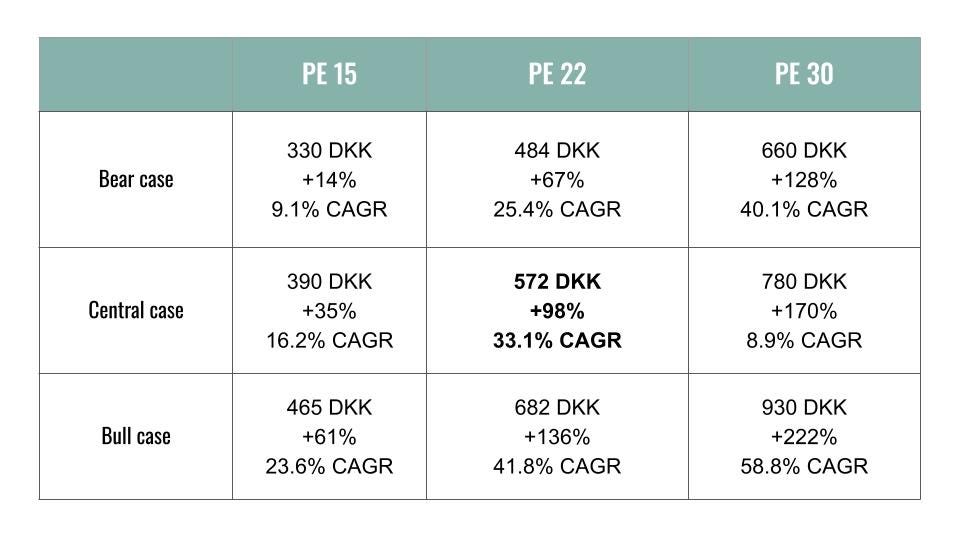
CAGR calculated from 289 DKK to December 31, 2028 (2.6 years), dividends included.
How to read this table: in the central scenario at PE 22x, the price target reaches 572 DKK by December 31, 2028 — a total return of +98% from current price, or a CAGR of 33.1% including dividends. That is my base case.
The full model with all assumptions is available here: https://docs.google.com/spreadsheets/d/12qmrNwYuS3IBPM5ji8JGd4g6ODyW7VDfmSSdcAp3pSc/edit?usp=sharing
The most likely scenario — Central, PE 22x — gives a CAGR of ~33% to December 31, 2028. The bear floor at PE 15x gives ~10% — you underperform the bull case, you don’t lose money. The upside at Bull PE 30x gives ~59% CAGR.
One observation worth noting: Eli Lilly currently trades at PE 36x. The rational duopoly equilibrium — market leader at 30x, solid second at 22x — implies significant re-rating potential for Novo without assuming anything extraordinary.
Portfolio Considerations
Currency Risk
Novo Nordisk is Danish — its stock trades in DKK, which is quasi-fixed to the euro via ERM II. For a European investor, the DKK is a non-issue.
The dollar is a different story. ~60% of Novo’s revenues are in USD. A 10% dollar decline reduces those earnings when converted to DKK. The net impact on EPS depends on the offsetting USD-denominated costs — US manufacturing, R&D, commercial operations — which partially absorb the shock. The exact figure requires a detailed cost structure breakdown, but the order of magnitude is a few percentage points on EPS. Real, but not thesis-altering.
Two channels to monitor: earnings translation (direct) and market sentiment on dollar-exposed European companies (indirect).
Sizing
I entered Novo Nordisk on September 18, 2025, and consolidated to 9% of my portfolio — my maximum position size. That’s a deliberate signal: this is a high-conviction bet, not a toe in the water.
My portfolio runs approximately 10 positions. Sizing Novo at the maximum reflects the asymmetry I see in the risk/reward at current prices — limited downside, meaningful upside, and a thesis I can articulate clearly.
On exit: I’ll let the thesis guide me. The 2028 horizon is a checkpoint, not a hard deadline. When Novo reports in 2027-2028, I’ll reassess based on the volume data, the production ramp, and the competitive landscape. Parallel opportunities in the portfolio will also influence the decision. No mechanical formula — just disciplined reassessment as the facts evolve.
A Defensive Play for European Investors
Beyond the thesis, Novo Nordisk has a structural characteristic worth noting for European investors specifically: it eliminates currency risk. Buying a Danish company in DKK, with the krone pegged to the euro, means your equity exposure is in euros by another name. In a world where the dollar is structurally weakening against the euro, that matters.
It also offers a ~4% dividend yield at current prices — rare for a growth company in this market. And as a quality compounder in healthcare, it behaves defensively during tech corrections. When markets rotate out of high-multiple technology names, capital tends to find its way into exactly this type of asset — a predictable, cash-generative business with a structural growth tailwind.
For a European investor looking to reduce tech concentration while maintaining exposure to a secular growth theme, Novo Nordisk at current prices offers an unusual combination: growth potential, income, and currency neutrality.
Conclusion
Novo Nordisk is not a complicated story. It’s a century-old Danish company that stumbled onto the most important drug class of our generation, built the industrial infrastructure to dominate it, and is now being priced as if the story is over.
It isn’t.
The market is looking at 2026 — a year of declining revenues, a new CEO, and no visibility beyond the guidance. I’m looking at 2028 — 12 million obesity patients, 14 fill-finish sites running at capacity, a weekly oral pill with no needle, and a molecule that now matches its competitor on efficacy.
The bear case is real. The risks are documented. The patent cliff comes in 2031. Lilly is ahead on market share. The pricing environment has changed permanently. None of that is trivial.
But at PE 10x — a valuation that implies 6% perpetual growth for a company in the middle of the largest untreated health crisis on the planet — I think the market is making a mistake.
I’m positioned accordingly. 9% of my portfolio, maximum conviction, eyes open.
The central scenario gives ~33% CAGR to 2028. The downside gives ~10%. That asymmetry is why I’m here — and why I haven’t sold.
Important Disclosure & Disclaimer:
All content published by JB Peter on this platform is strictly for educational and informational purposes. It does not constitute investment, financial, legal, or tax advice, nor does it represent a personal recommendation or solicitation to buy or sell securities. This research is operated by ORIACON (SASU) and reflects independent corporate analysis. Every reader must conduct their own independent research (Due Diligence) or consult a licensed professional before making any financial decision, as financial markets involve a high risk of capital loss. At the time of writing, ORIACON or the author HOLD shares in the company analyzed in this article. Following this publication, ORIACON and the author reserve the right to buy, sell, or modify positions in any security mentioned at any time, without prior notice to readers or subscribers.