1. Quarter verdict
The central point of this quarter is the guidance raise for 2026, with adjusted sales now expected to grow from flat to -6% at CER, vs. -4% to -12% previously. Management gave us two reasons to adjust sales: one good, a provision reversal, and one semi-good, with impairment of terminated drugs.
The main growth is made by the obesity segment, and inside it, by the Wegovy pill (almost none by the injectable Wegovy). I expect the worldwide launch of Wegovy HD to provide additional revenue and operating profit.
Verdict: The volume effect, which is positive, is now outweighing the price effect. In front of us, I see the upside; behind us is the downside.
My reaction
I published a note yesterday about how much I dislike the word adjusted. Here I don’t see any partial presentation of the truth. The ‘adjusted’ framing asks readers to do extra work to assess the current situation. That’s part of what I do here, and it’s normal for me to provide it to you. Management is right to give us this presentation, as it delivers the most precise picture of the business health.
With Novo Nordisk, being contrarian feels like a long path of patience, and any bottom-sell could cost you a lot, just as being too early could. It was a market darling, and then a fallen angel.
The only things that could resolve its situation are time and work (from the company). They are on track: the downside is certainly behind us, and the upside is coming.
The numbers, the bear thesis status, and the bull thesis are here to validate these points.
As a personal view, somebody from my family is taking a GLP-1 drug. It turns out she was prescribed Zepbound, presented to her as ‘more effective.’ I have to admit I didn’t take that news particularly well, as a Novo shareholder. I’m fairly convinced that going forward, Novo’s prescriptions will pick up again with Wegovy HD.
2. The Numbers
2.1 At a glance
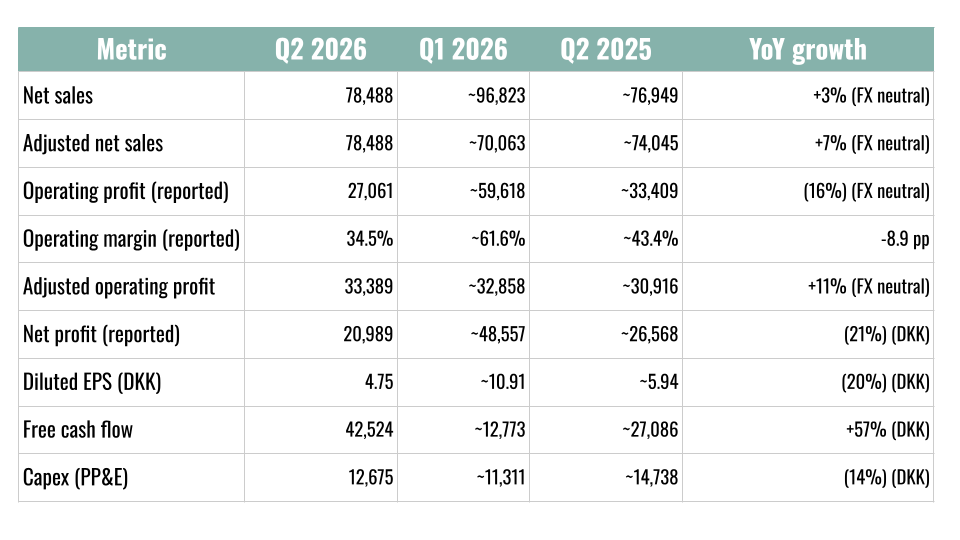
This table summarizes the key metrics from Novo Nordisk’s Q2 FY2026 earnings release: https://www.novonordisk.com/content/nncorp/global/en/news-and-media/news-and-ir-materials/news-details.html?id=916590.
2.2 Commentary
Adjustments
Management provided adjusted numbers relative to 2 one-time events.
Impairment of DKK 6B, with DKK 4B to the sole monlunabant drug. Even though it is a non-cash expense, it carries a real cost. Additional impairment could occur in the coming quarters, depending on the results (and terminations) of the pipeline. I see it as something you should be prepared for as a pharmaceutical company shareholder.
Rebate provision reversal: Under the U.S. 340B Drug Pricing Program, manufacturers must give discounts on drugs sold to hospitals and clinics serving low-income patients. Novo booked a provision in ‘25, which turned out, this quarter, to have been too conservative. The release of this provision gives a one-time boost to reported sales and profit. The underlying performance of the company is best read without this adjustment.
In my opinion, the best number for profit analysis is without rebate provision reversal and with impairment, as it is a “recurring” expense in the life of such a pharmaceutical company.
Revenue
Q2 2026 reported sales increased by 3% at CER (Constant Exchange Rate), and adjusted sales increased by 7% at CER. The volume effect, which is positive, is now outweighing the price effect, which had been reduced due to U.S. government decisions.
As expected, Obesity care accelerated, with +16% CER YoY, vs 3% for the diabetes segment. I wrote in the deep dive that this second segment is mature and commoditized, so there is no surprise here.
Inside Obesity:
The injectable Wegovy is only growing 1% CER.
The heavy lifting is done by the Wegovy pill.
With the worldwide launch of Wegovy HD, I expect clear traction to return for the injectable (for Q3 in the EU). As said previously, the drug efficacy gap with Zepbound resolved with Wegovy HD.
International Operations (unadjusted) sales grew 10% CER, whereas US Operations (unadjusted) sales shrank 2% CER.
Margins
The adjusted gross margin is shrinking from 82.7% in Q2 2025 to 78.2% in Q2 2026, due to “lower realised prices, one-time costs of around DKK 3 billion related to right-sizing of manufacturing capacity agreements, as well as a negative currency impact. This was partly countered by productivity gains and a positive product mix.“ (information from Novo Nordisk).
The adjusted operating margin is improving from 41.8% to 42.5% YoY, as Novo reduced its workforce and made efforts on cost to maintain its profitability.
Any additional price drop could lower the margin. As shareholders, we hope that the US government will move to another topic.
Without any change on this subject, we can expect the margin to be near its bottom with volume increase, price stability and additional variable cost reductions.
Net income and free cash-flow
Financial charges increased from DKK 1.95bn to DKK 2,76bn, with a higher interest rate on the debt. Worth mentioning, but nothing alarming here.
Net income fell 21% due to the adjustments, and free cash-flow increased by 57% YoY since the capex fell 14% CER YoY due to a higher base effect in 25. Investments are still strong as the future needs way more GLP1 drugs.
3. Key Takeaways from the Earnings Call
Novo’s management stays conservative in its assertions, as Novo Holdings Foundation controls 77% of the voting rights, so management has no structural incentive to overpromise to put the stock price higher. It is reinforced by a danish corporate culture of humility and trust. That’s my opinion and I’m not Danish, but I come from Central Europe and people tend to behave like that.What is a good point for trust is a bad point for rerating.
As the thesis is focused on obesity, I won’t elaborate on the pipeline.
Guidance. Framed as “a better than expected start to the year.” Management confirmed the outlook stays conservative on the Medicare Bridge program, even after a direct push from an analyst noting a competitor has been more bullish on volume inflection. This is consistent with the “guidance was sandbagged” read.
Access. “From an access perspective, quality of access for obesity GLP-1s remains poor and is a key focus area. While we see uptake for the pill in the reimbursed commercial channel, the majority of total prescriptions are self-pay.”
Manufacturing capacity. On the new API facilities: “validated the first product in the first facility... very low utilization from these facilities... bullish in terms of being able to supply significant volumes in the years to come.” Early innings on the capacity ramp. The moat is intact. It’s not yet monetized.
Cost savings, ahead of plan. The Q3 2025 restructuring is tracking ahead of its DKK 8 billion savings target. Headcount down to 66,700. That’s a cut of roughly 12,000 people, 15%, over the past year. Harder than the 9,000 figure originally announced.
Wegovy pill, international. UK: 300,000 patients in the first three weeks, versus 48,000 in the US over a comparable window. UAE: Novo’s obesity market share jumped from 30% to 45% after the pill launch. The pill already holds roughly 50% of the oral segment there, despite a competitor’s oral drug launching about a month earlier (surely Eli Lilly…). Germany launches in September. Around 80% of pill patients are GLP-1-treatment-naive. Limited cannibalization of injectable Wegovy.
What’s next. Capital Markets Day, September 2026. Formal 2027 guidance waits until February. The CFO already flagged two swing factors: the CagriSema US regulatory decision, expected by year-end, and the “mim8” decision, in H2 2026.
4. Theses Update
Anchored to the deep dive published 26/05/2026 (”Novo Nordisk: A GLP-1 Banger”).
4.1 Bear Thesis Signals
No guidance beyond 2026. Nothing in this report addresses 2027 and beyond. The raise only narrows the 2026 range, from -4% to -12% CER down to 0% to -6% CER.
Lilly winning the GLP-1 market (57% share). Lilly reports Q2 2026 the same day as Novo. One data point does stand out: Wegovy remains the U.S. market leader by new patient starts among branded obesity drugs, even as Zepbound leads on total prescriptions. I will provide content about Lilly vs Novo later.
Structural margin compression (MFN). Confirmed, but smaller than the headline number suggests. Adjusted gross margin fell, indeed, but Novo discloses that roughly DKK 3 billion of that hit is a one-time cost tied to right-sizing manufacturing capacity agreements, layered on top of lower realised prices and a negative FX effect. Strip out the one-off and the clean MFN-driven compression is well under the headline -4.5pp.
New this quarter: pipeline disappointment. Monlunabant’s development was terminated, “due to portfolio considerations,” triggering a DKK 4.0 billion impairment. ZEUS (ziltivekimab, cardiovascular) missed its primary endpoint. Neither touches the core obesity thesis directly. Both are new data points on non-GLP-1 pipeline execution that didn’t exist in May.
New this quarter: quality of growth. Trade receivables grew 25.5% since year-end, DKK 70.9 billion to 88.9 billion, roughly twice the pace of H1 revenue growth. Plausibly just the ~60-country Wegovy rollout. Still, a working-capital line to watch next quarter.
4.2 Bull Case Prerequisites
Efficacy gap with Zepbound closes, via Wegovy HD. In progress. Launched in the US in April, in the UK in June alongside the single-dose pen. No comparative prescription data yet.
Valuation gap vs. Lilly (PE 10x vs. 36x) is an anomaly. Still wide open. At ~308.7 DKK, the stock prices closer to the Bear and low-Central scenarios than the Bull case. See the updated scorecard in section 5. The market is rewarding today’s execution without re-rating the multiple.
Prices fell, volume hasn’t followed. Yet. This is the prerequisite that finally shows up in the numbers. Obesity care accelerated to +16% CER. Wegovy pill scripts kept climbing past 265,000 weekly by mid-July. Volume is now outweighing price at the net-sales level: +7% adjusted CER, despite ongoing MFN cuts.
Guidance was sandbagged. Confirmed again. It is the second consecutive raise under Doustdar.
Production moat: 14 fill-finish sites, 5 to 7 years to replicate. Reinforced by the same capex and net-debt evidence above. The moat is largely built and starting to convert into cash rather than absorbing it.
Market stays a duopoly through 2028. No new information either way this quarter.
CagriSema delivers in Phase 3. Mixed. REDEFINE 9, the lower-dose trial, showed statistically superior weight loss vs. placebo. It also lands in the same quarter as the monlunabant termination and the ZEUS failure.
5. Valuation
I’m sticking with the original deep dive assumptions. The only update is the current price. The end date stays fixed, which mechanically inflates the annualized figures, since the same target price is now spread over a shorter time horizon.
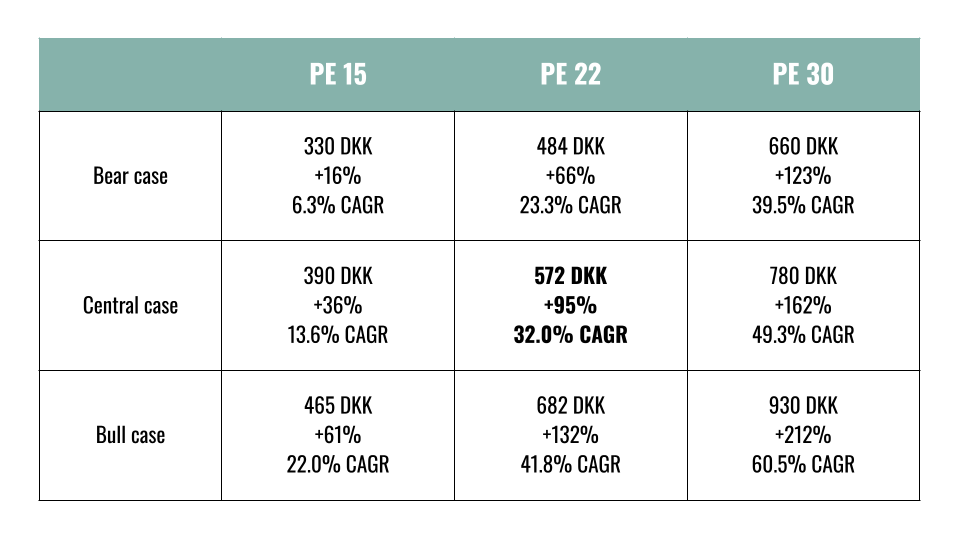
CAGR calculated from 308.7 DKK to December 31, 2028 (2.4 years), dividends included.
How to read this table: in the central scenario at PE 22x, the price target reaches 572 DKK by December 31, 2028, a total return of +95% from current price, or a CAGR of 32.0% including dividends. It is the floor of my conviction.
The assumptions depending on the PE:
PE 15x — The market sees a mature pharma under pressure, losing market share to Lilly, facing patent cliff in 2031. Just a dividend stock.
PE 22x — The market recognizes a quality compounder, solid second in a structural duopoly, with a manufacturing moat. GARP territory.
PE 30x — The market prices leadership potential. Wegovy HD closes the efficacy gap, the oral pill scales, CagriSema delivers. Novo challenges for pole position.
Disclaimer
All content published by JB Peter on this platform is strictly for educational and informational purposes. It does not constitute investment, financial, legal, or tax advice, nor does it represent a personal recommendation or solicitation to buy or sell securities. This research is operated by ORIACON (SASU) and reflects independent corporate analysis. Every reader must conduct their own independent research (Due Diligence) or consult a licensed professional before making any financial decision, as financial markets involve a high risk of capital loss. At the time of writing, ORIACON or the author HOLD shares in the company analyzed in this article. Following this publication, ORIACON and the author reserve the right to buy, sell, or modify positions in any security mentioned at any time, without prior notice to readers or subscribers.