
After proposing 48 quality small-caps with high long-term potential, I myself looked at my list with interest. I admit there are limits to my understanding of certain sectors, notably with Plejd AB (electricity), which looks very interesting, or Grupa Pracuj (Poland).
Everyone has their own edge in certain sectors; your profession or your personal experience will certainly steer you toward one of them.
You can also stay on generalist subjects where logical analysis and some market research can bring you to a sufficient level of understanding.
Remember nonetheless the following quote from Warren Buffett:
Investors should remember that their scorecard is not computed using Olympic-diving methods: Degree-of-difficulty doesn’t count. If you are right about a business whose value is largely dependent on a single key factor that is both easy to understand and enduring, the payoff is the same as if you had correctly analyzed an investment alternative characterized by many constantly shifting and complex variables.
He is also credited with:
I don’t look to jump over 7-foot bars: I look around for 1-foot bars that I can step over.
One could give the company that I am going to present to you the advantage of simplicity.
The structure of my deep dive is standard. Learn the process in the dedicated articles in the learning section. The whole article is long because it covers a lot of ground, and short because I try to give you a synthesis of the points. So I start with a “short version” for those of you in a hurry.
Today, we’ll talk about Storytel, a company based in Sweden and running a leading audiobook and e-book subscription service, with a stake in book publishing.

The Short Version
Storytel is a Swedish audiobook and e-book company with 2.75 million paying subscribers. It operates mainly in the Nordics and Europe, but also owns Audiobooks.com in the US.
Its business model allows it to acquire publishers and then distribute their content internationally through audiobooks, while gaining insights into what its consumers want. The model is profitable, enabling the company to acquire additional publishing houses.
Since 2023, the company has gone from heavy losses to profitability, improved its margins and now has almost no net debt. Returns on invested capital are rising, and Storytel can finance further acquisitions with its own cash.
But the stock has already increased fivefold since its 2023 low. A large part of that increase comes from investors being willing to pay a higher multiple.
The main question is competition. Spotify has entered the Nordic audiobook market, where Storytel makes most of its money. Subscriber growth is slowing there, and we still don’t know how much pressure Spotify and potentially YouTube could put on Storytel in the coming years.
I’m not investing in the stock for now, and I’m keeping an eye on how the share price and competition evolve. A great company with long-term prospects, and one to add to my watchlist.
1. What Storytel does
History
In 2005, Jonas Tellander and Jon Hauksson founded Bokilur, an audiobook service in Sweden with a unique product. The launch of the iPhone in 2007 made listening on the move practical, and in 2011 the first audiobook produced by Storytel came out on the Swedish market.

Jonas Tellander, CEO from 2005 to 2022
The company then grows by buying what it lacks. In 2013, it acquires the audiobook publisher Storyside and then embarks on buying publishing houses and an audiobook subscription service in the Nordic countries. The company has been listed on the Nasdaq First North Growth Market since December 2018 and passes one million paying subscribers in 2019.
In 2022, it buys the American service Audiobooks.com, reaches two million paying subscribers and its catalogue exceeds one million titles. The same year, Jonas Tellander hands over the reins of the company, remaining on the board and as a shareholder. Johannes Larcher then took over until 2024, when he was replaced by the current CEO, Bodil Eriksson Torp.
On 8 June 2026, the company transferred its shares to Nasdaq Stockholm.
What Storytel sells
The company sells stories, in two forms: access to a catalogue of audiobooks and e-books by subscription, and books that the group publishes itself (paper, audio, digital).
The group describes itself as an “ecosystem” that combines technology, distribution and content creation, through its two complementary businesses: Streaming and Publishing.
At the end of 2025, the subscription business had more than 2.67M paying subscribers, in more than 25 markets, with a catalogue of more than 1.8M titles in more than 55 languages. The market is essentially local: about 85% of listening relating to local authors and languages. A catalogue is therefore not sold in the same way in every country: publishers and authors on the ground are needed.
The company lives mainly off its subscriptions, which are billed in advance. A very appreciable part, as this revenue is recurring and predictable. The main costs are content (copyright fees, third-party publishers, printing) and marketing.
Streaming: the platform
Streaming is the consumer-facing platform, under three brands: Storytel, Mofibo and Audiobooks.com. The customer pays for a monthly subscription to listen or read with several offers that we will review in the competition section.
Added to this are distribution partnerships such as Klarna (Premium members in 14 markets access the catalogue), Vodafone Turkey, Onet Premium in Poland, and RDF Media in Chile. In addition, the company launched single-title sales in 2025 for best-sellers in English, to complement the subscription.
Publishing: the content factory
Publishing is the creative base of the group: it secures rights and works with authors on print and digital titles. It groups together publishing houses, mostly in the Nordics.
Publishing also has a licensing agreement with Spotify in the Nordic countries, so Spotify is both a competitor of Storytel’s Streaming business and a customer of Publishing.
Customers
Storytel mostly sells to individuals.
At the end of June 2026, the service counted 2.67M paying subscribers. Usage is a strong habit: 37% of paying subscribers listen every day.
The company divides its revenue by operating segments, i.e. Nordics, Europe, Americas and APAC.
Unfortunately, this segmentation does not clearly show the dynamics in the US, as the US is grouped with all of Latin America. This suggests that the figures are not exceptional in the US; otherwise, the company would show them separately.
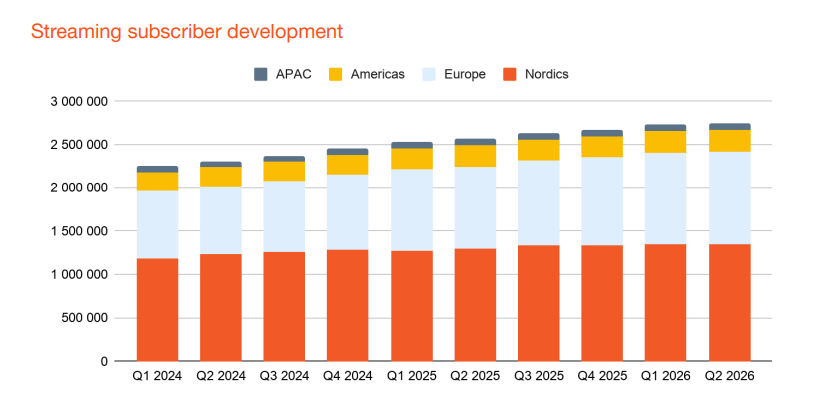
The streaming segment represents 82.3% of 2025 consolidated revenue. No customer accounts for 10% or more of revenue.
Suppliers
Storytel mostly buys stories. In 2025, the cost of goods sold is 2,190.1 MSEK, and its main item, 1,858.1 MSEK, or 46% of consolidated revenue, consists of payments to the rights holders of digital and printed books. To this are added the fees of payment providers and the cost of printed books. The other suppliers account for much less. The catalogue contains more than 1.8M titles, with more than 600,000 authors.
Some of them publish through publishing houses belonging to Storytel.
In the company’s documents, no content supplier is named as dominant: the group publishes neither the list nor the weight of its main publishers.
For the other supplier items, there is paper and printing, as well as technical infrastructure (such as Google Cloud), and payment providers.
Competitors
85% of Storytel’s listening relates to local authors and languages. Indeed, people still often prefer to listen to a book in their native language. Storytel faces four types of players: a local leader (itself), challengers backed by publishers, global platforms that serve each language with translated titles, and a few small local players. Here is an overview of direct competition:
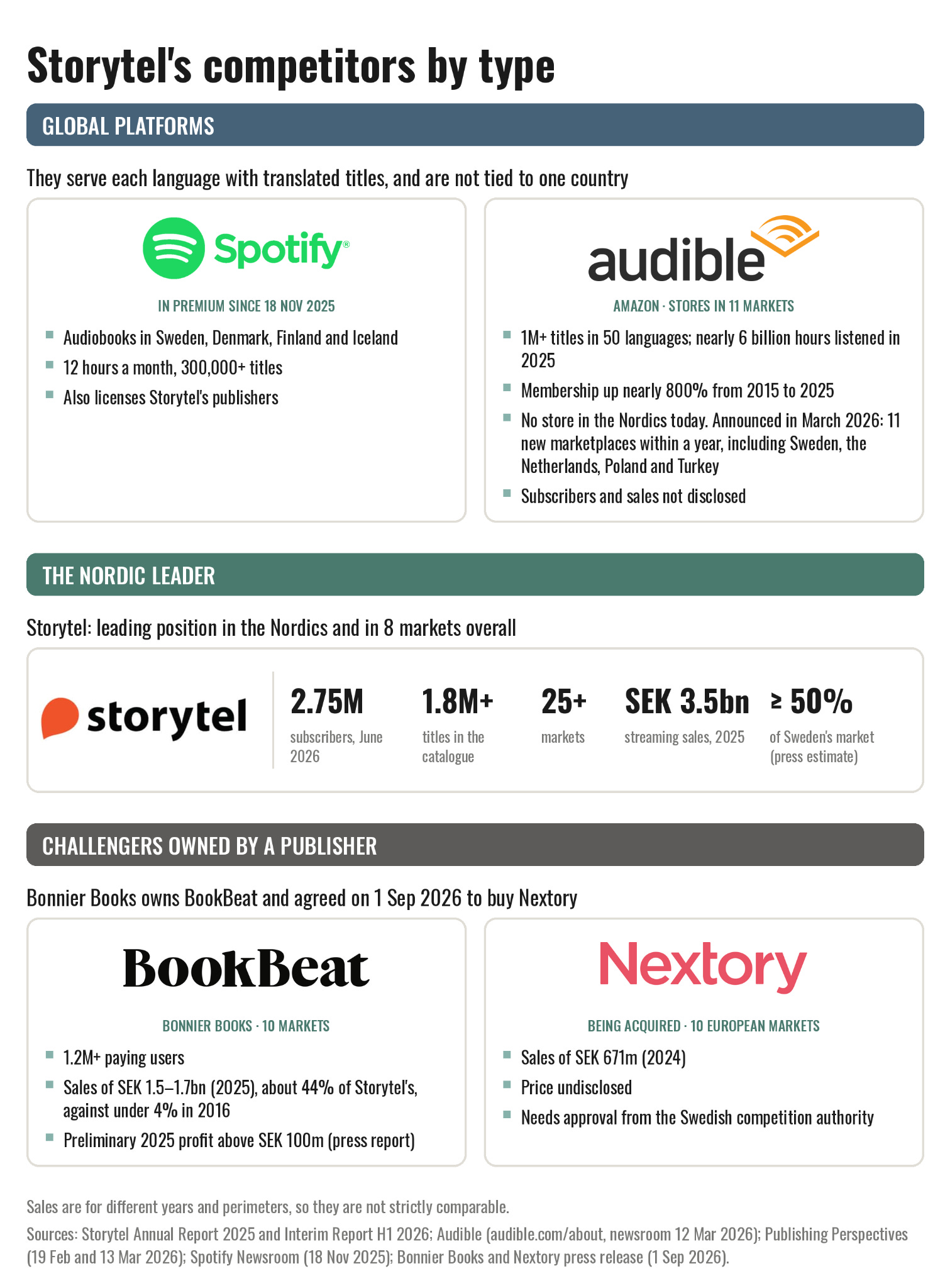
Storytel is linked to Spotify because its publishers have signed a licensing agreement with it in the Nordic countries. Spotify is therefore both a customer of Publishing and a competitor of Streaming.
We can also add indirect competition: every day the user will choose how to be entertained. This can be through listening to a book, watching a series, watching a video or listening to a podcast, browsing a social network, or any other distraction. Storytel says it fights for subscribers and content, but also for consumers’ time in general, and expects this competition to increase. I had already talked about it in the Netflix deep dive on the notion of “moment of truth”.
Here is a breakdown of usage in Sweden, compiled by Nordicom in 2025 based on nearly 6,000 people aged 9 to 85.
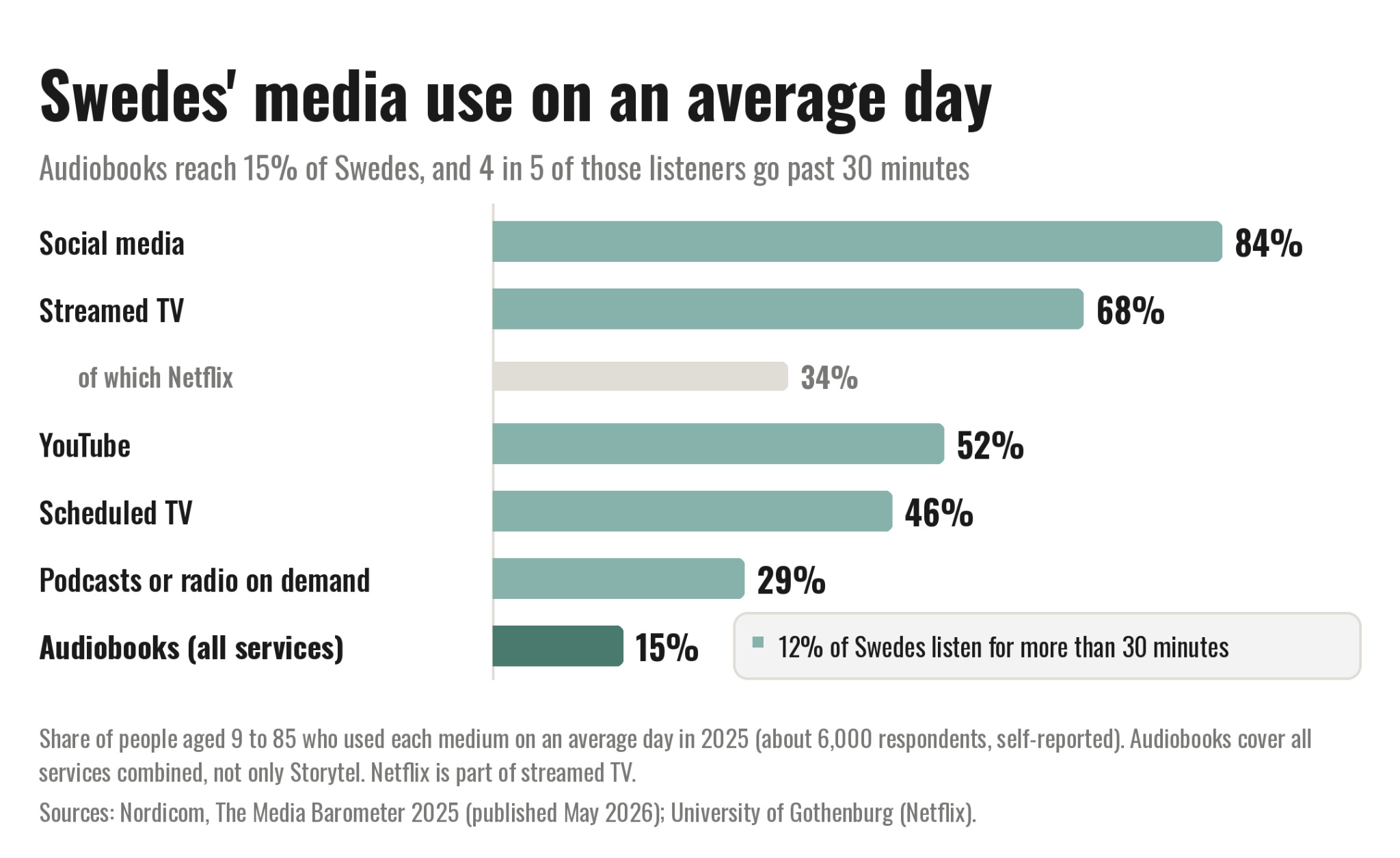
This image shows that audiobook listening remains a minority activity: 15% of Swedes on an average day, all services combined (Storytel, BookBeat, Spotify, libraries), far behind social networks, streaming video and YouTube. However, it is a lasting habit: of these 15%, 12 percentage points listen for more than 30 minutes, i.e. four listeners out of five.
Competitive advantage
Let’s take the different types of advantages:
Switching costs: low
The subscription is monthly (3, 6 or 12 months in certain markets), with no long-term commitment or loyalty program. People tend to stay out of habit, but they can leave very quickly when they see another offer.
Brand: medium
This point is difficult to evaluate quantitatively, but I suggest drawing a parallel with luxury: products belong to brands, grouped within “houses” (Vuitton, Tiffany, Gucci, etc.), and those houses are grouped within a company.
Each author is like a “house” in luxury whose books are unique products, and each publishing house is like a portfolio (or a collection) of authors to whom the public becomes attached.
Storytel owns publishing houses and therefore the distribution rights of the catalogue.
But if the author leaves, the public leaves, which puts the strength of the “Storytel brand” into perspective. The public’s attachment goes to the author before going to the service.
Its brand advantage currently exists mostly in the Nordics, where Storytel says it has been the leader of Nordic audiobooks for some twenty years, ranking first by number of subscribers in Sweden, Denmark, Norway and Iceland, with 65% of Streaming sales.
Norstedts, founded in 1823, saw one of its authors, László Krasznahorkai, receive the 2025 Nobel Prize in Literature.
Product (what Storytel does) hard to copy: low
The service itself (app, recommendations, synchronized listening between audio and text) is not rare: Spotify added it to its subscription in four Nordic countries in November 2025, and Bonnier operates BookBeat in 10 markets.
Product (audiobooks): protected by intellectual property law
Publishing also produces its own content through its publishing houses and Storyside, including Storytel Originals reserved for the service. The rest of the catalogue (more than 1.8M titles) is licensed. Backlist titles, released more than a year ago, make up 62% of consumption, and according to Storytel about 85% of listening is tied to local authors and languages: an entrant must redo this licensing work market by market, and it cannot be improvised.
This advantage protects the country-specific share of the catalogue, not the translated international titles, which any service can license in each language.
And we do not know if these licenses are exclusive: if not, a rival can license the same titles, and Spotify already does so with local publishers, including Bonnier.
AI changes the game particularly in distribution, making it easier to translate an existing book.
Network effects: the company has, in my view, a very interesting flywheel, described below.
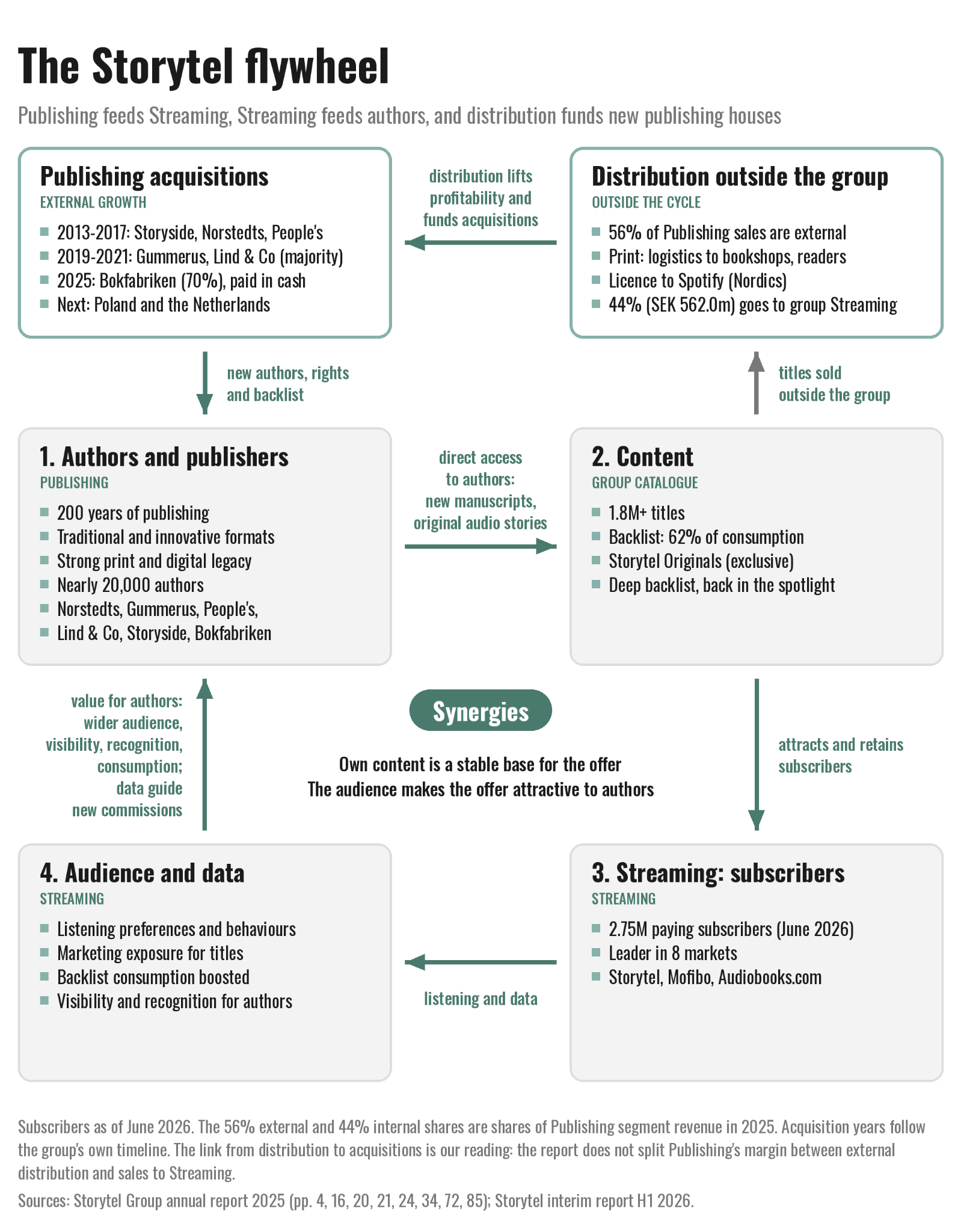
This flywheel means the moat strengthens over time, through external acquisitions, provided that they are made at a good price.
2. Financials
Key financial metrics
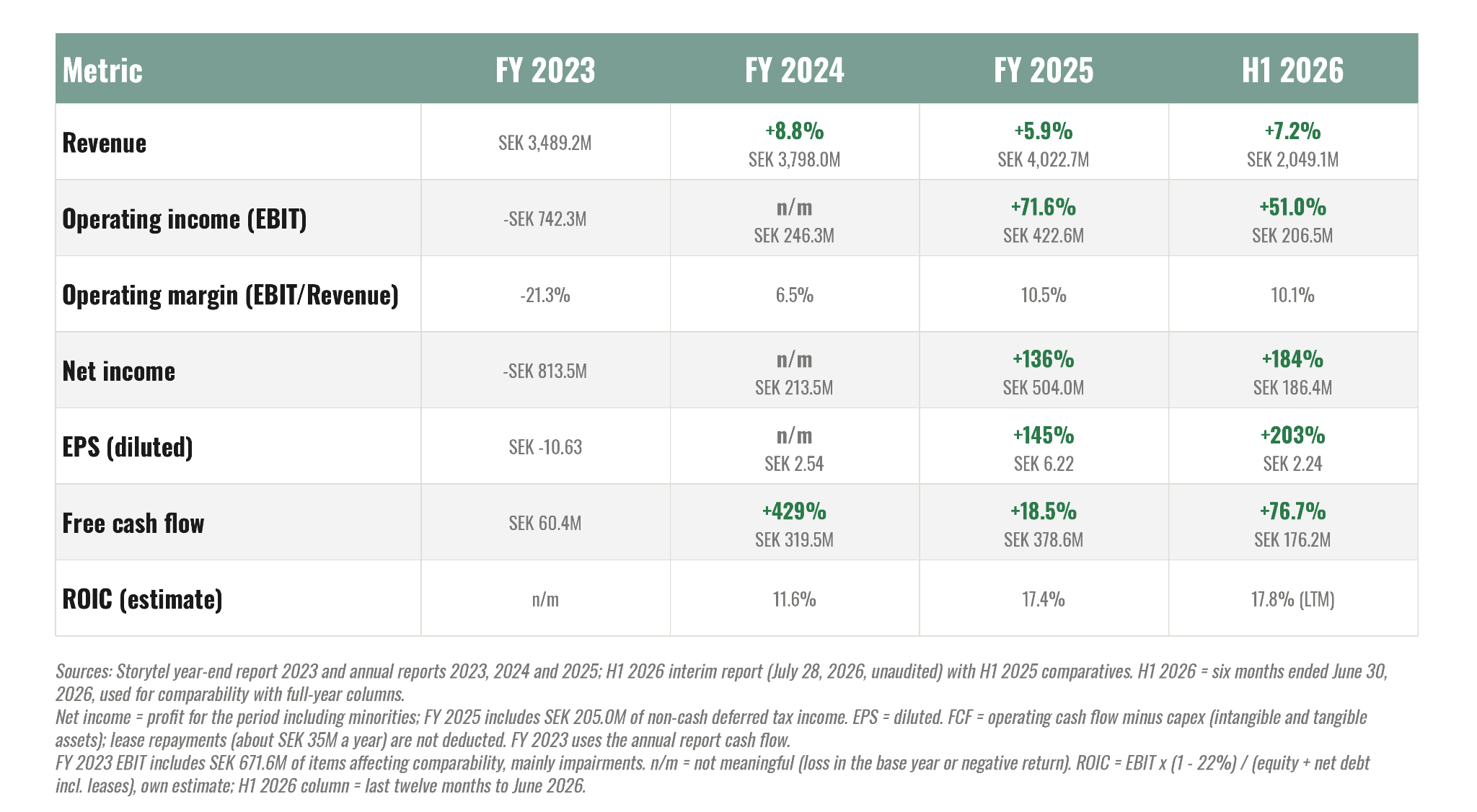
Commentary
Revenue
Growth is slowing: from 22.1% in 2022 to 8.8% in 2024 and 5.9% in 2025. The majority of the decline comes from the exchange rate, with the appreciation of the Swedish krona: growth at constant exchange rates is 9.2%.
This growth comes mainly from volumes, because the number of paying subscribers increases by 7.2% over one year (2.75M at the end of June 2026), whereas ARPU is stable at 116.4 SEK per month (116.5 a year earlier).
A word on the publishing business, which is a bit complicated from an accounting perspective.
Say Norstedts publishes a novel. It sells the book to bookstores (external sale), and it also gives the audio and e-book rights to the Storytel service, which puts them in its catalogue (internal sale).
In the group’s accounts, both are recorded as revenue in the Publishing segment. But when the accounts are consolidated, the internal sale disappears from revenue, and the corresponding purchase disappears from Streaming’s content costs. Only the real costs remain (copyright fees, printing, etc.).
Operating Margin
The 2023 loss includes 671.6 MSEK of exceptional items, including 465.4 MSEK of goodwill impairment of Audiobooks.com and 167.6 MSEK of content impairments, mostly in expansion markets.
The improvement since then comes from operations with the increase in operating leverage: in 2025, each additional krona of revenue generated about 0.78 krona of operating profit. In the first half of 2026, it was about 0.51, depending on the evolution of costs and revenue.
Net Income and Free Cash Flow
The 2025 net income is inflated by tax. Storytel accumulated losses in the past, and these losses are deductible from its future profits. Until now, it had not recorded them on its balance sheet. In 2025, it judged that it would have enough profits to use them. It therefore recorded them as an asset, which creates an accounting tax gain of 205.0 MSEK. Without this gain, net income would be 299.0 MSEK, about 40% more than in 2024.
This is the main cause of the gap between net income and FCF in 2025. For H1 2026, they are within about 5% of each other, because depreciation and amortization exceed investments, alongside changes in working capital.
Balance sheet
As of 31 December 2025, goodwill and intangible assets make up 51% of the balance sheet total (3,570.4 MSEK). Equity is 1,899.3 MSEK: once goodwill and intangibles are deducted, 68.4 MSEK remains.
Necessarily, for a company that grows through acquisitions, the amount of goodwill is bound to be large. The risk, in the event of a downturn in activity, is that an impairment will be recorded as a net loss. With the next acquisitions, this ratio of goodwill to balance sheet total could increase, which would weaken the balance sheet.
At the end of June 2026, net debt is 13.7 MSEK, or 6.6% of EBIT, which leaves room for acquisitions, or returns to shareholders via dividends or share buybacks. All covenants, including the one on net debt relative to EBITDA, were met in 2025.
3. Management
The new CEO
Bodil Eriksson Torp has led Storytel since 1 October 2024, taking over as head of the group after the founder, who stepped back from his duties in 2022, and after Johannes Larcher (who came from HBO Max) who served until 2024.
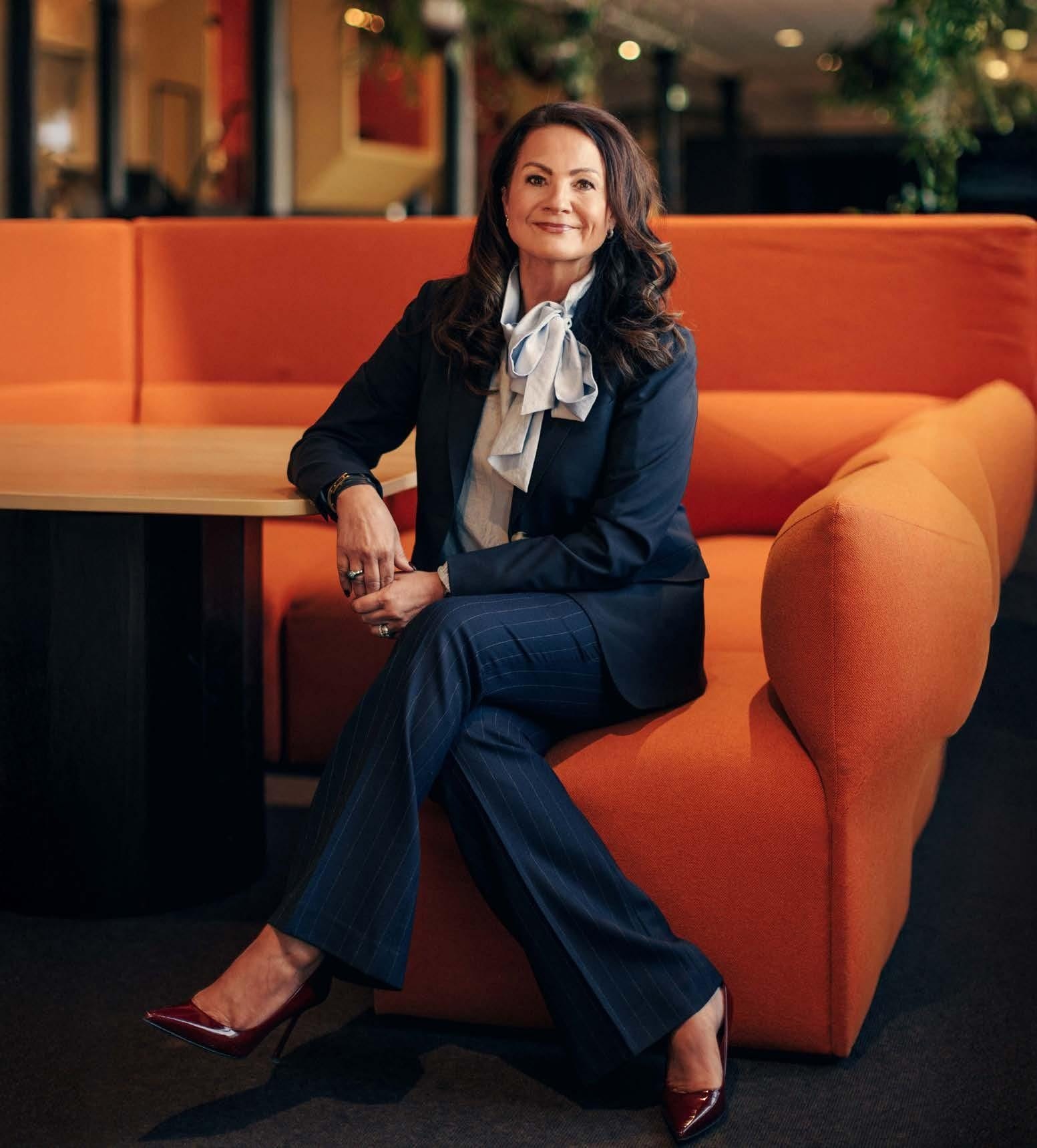
Born in 1968, she spent fifteen years at Bonnier, eight of them in general management positions, then eight years at the head of the press group Aller Media, and she most recently led the investment company VO2 Cap. Her profile is that of an executive from subscription media and major consumer brands. She comes from Bonnier, owner of BookBeat, Storytel’s direct competitor.
Under her leadership, the company reaps the fruits of the turnaround carried out by her predecessor. Almost all the executives have held their current roles since 2025.
The CEO received about 9.7 MSEK in 2025. Her personal exposure mainly goes through the share plan, as she only holds 12,634 B shares, or about 1.5 MSEK at the current price (about $150,000). That is a small amount and does not, on its own, ensure alignment with shareholders.
She also holds 108,010 share rights (about 12.7 MSEK if all are vested), linked 60% to the performance of the share and 40% to sustainability criteria, exercisable in the summer of 2028.
The other executives hold few shares (50,000 for the chief financial officer, a few thousand or tens of thousands for the others, i.e. about 0.13% of the capital for the whole team, general manager included), and 430,098 share rights.
The shareholders
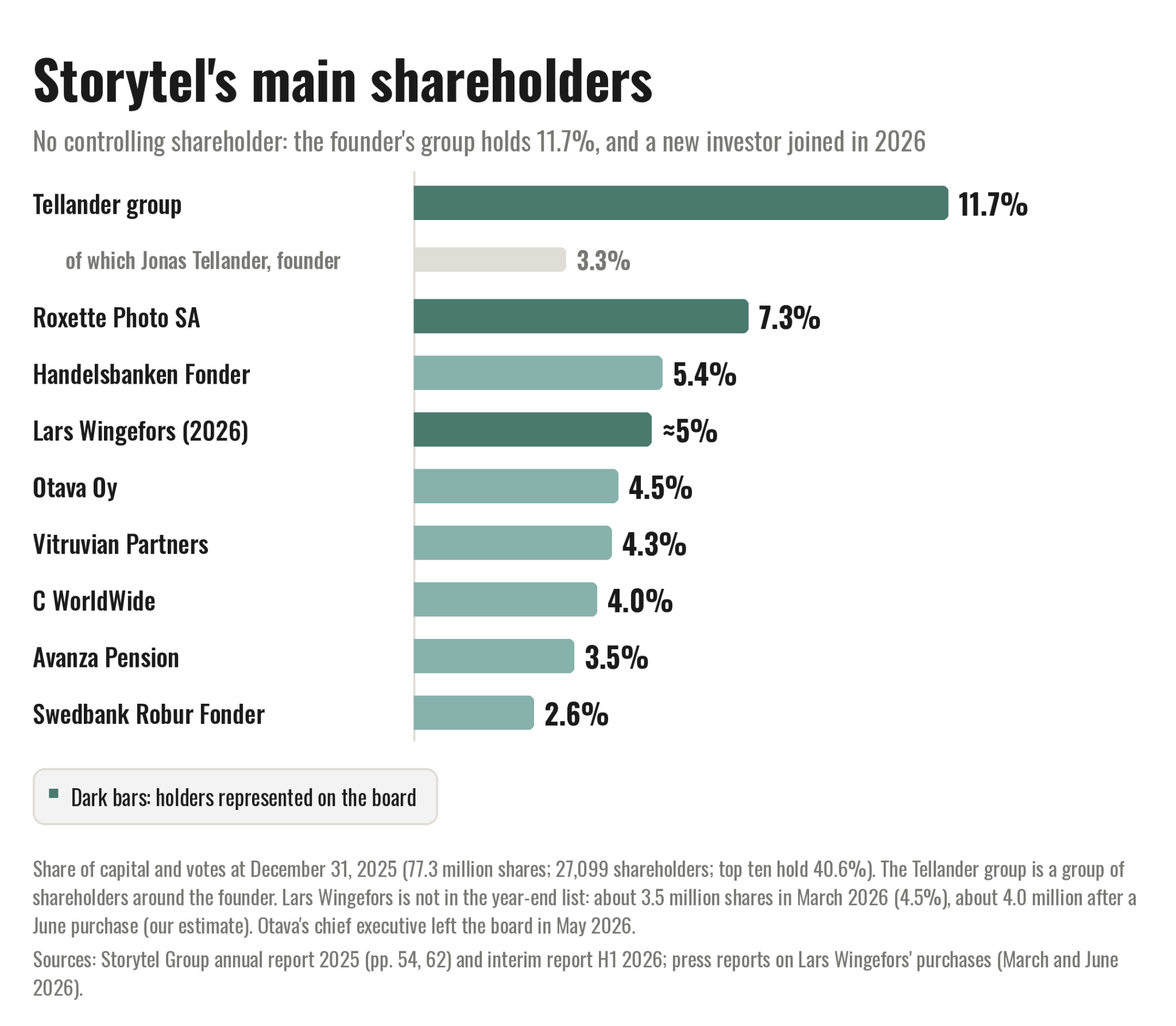
Storytel has no controlling shareholder. The capital is dispersed (27,099 shareholders at the end of 2025), the top ten hold 40.55%, and each B share gives one vote (the 635 A shares give ten, which is negligible). The company has been listed since June 2026 on the main market of Nasdaq Stockholm, after nearly eight years on First North.
Roxette Photo SA is a holding company located in Luxembourg, with Jonas Sjögren as co-owner. It owned 20% of the capital in 2019; its stake fell to 7.31% at the end of 2025, then, in 2026, it bought 110,000 shares at 83.21 SEK (9.2 MSEK) and now holds 5.75 million shares, or 7.44%.
Capital allocation
The company has capacity for profitable reinvestment with a ROIC clearly above the cost of capital.
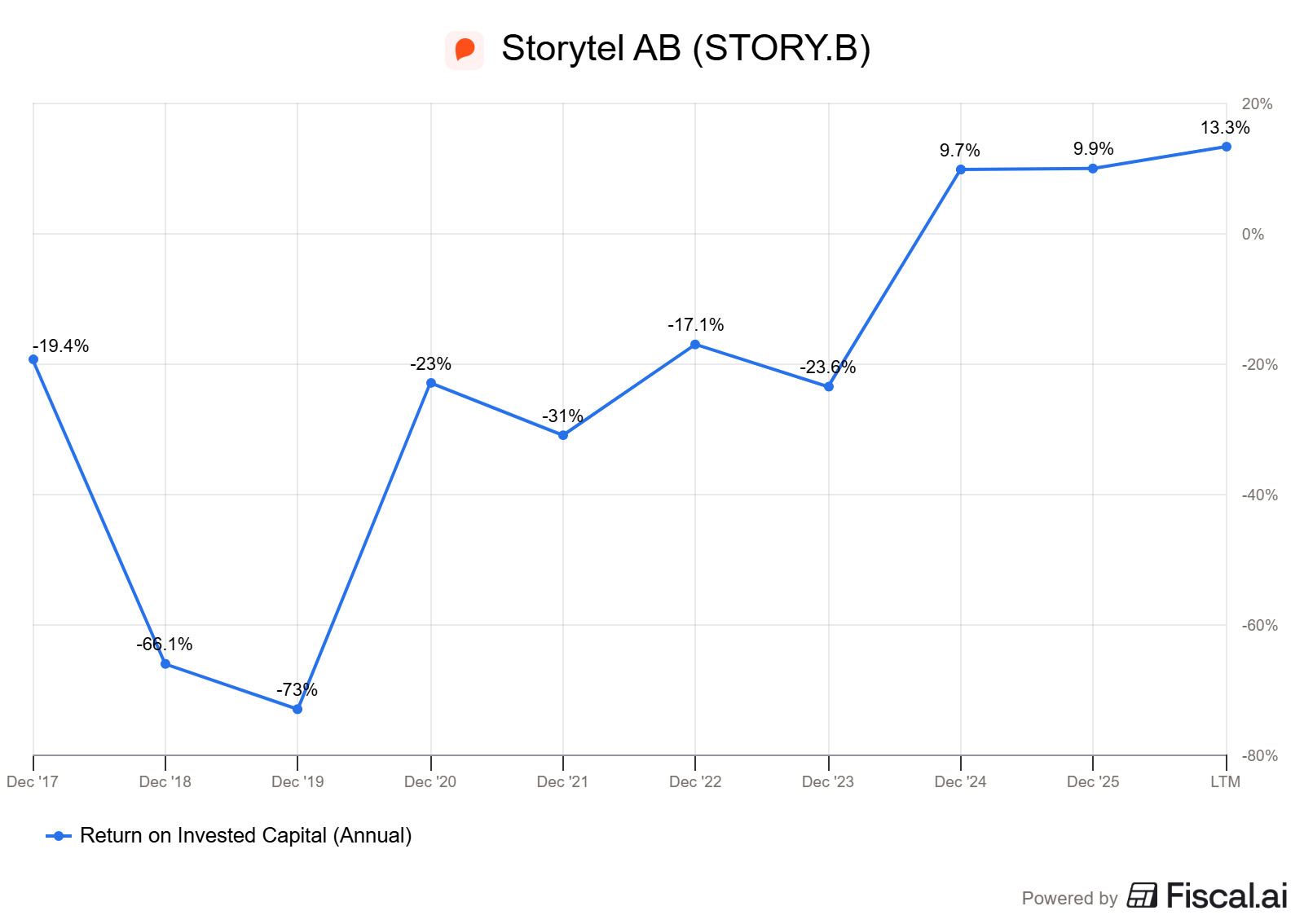
Capital finances what it should finance: first internal growth, then acquisitions, then returns to shareholders.
In 2025, the group invested 193.9 MSEK, or a third of its operating cash flow, and spent 883.6 MSEK on sales and marketing (22.0% of revenue). It also devoted 154.9 MSEK to development, of which 25% were capitalized.
In M&A, Storytel acquired two publishers between January 2025 and May 2026, paying in cash: Bokfabriken in Sweden, at 7x its EBIT, which is a good price, and Overamstel in the Netherlands and Belgium, at about 11.9 times its 2025 EBITDA, allowing it to enter these markets.
The company has a habit of paying a dividend, which represented 24% of 2025 net income attributable to shareholders. Storytel also buys back shares, in amounts corresponding to the incentive plans. This part therefore aims only to counter dilution.
4. The two theses
Why did the stock go up?
The stock trades at about five times its 2023 low, while profit went from -813M SEK for FY 2023 to 504M SEK at the end of FY 2025.
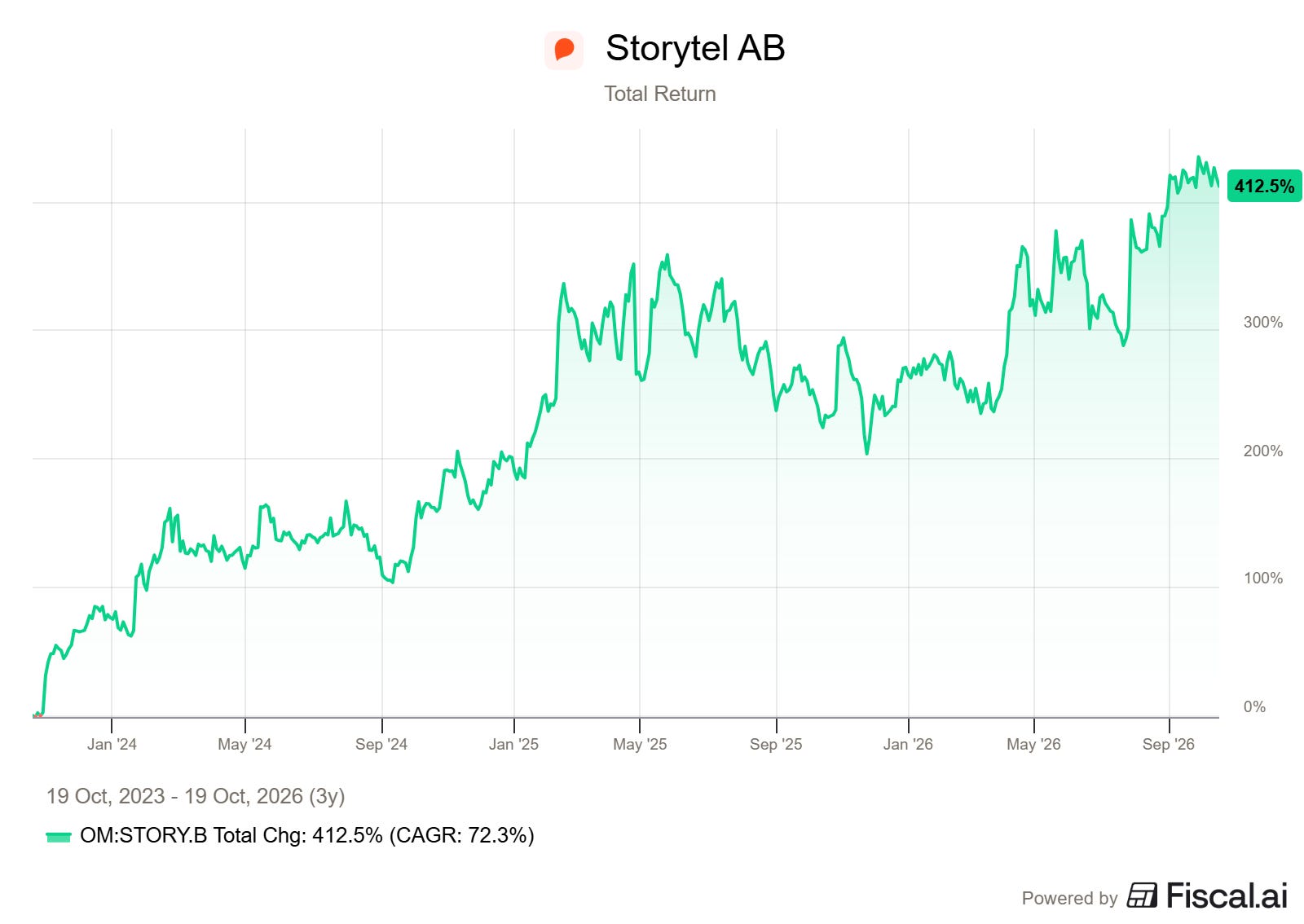
In logarithmic terms, about a quarter of the rise comes from earnings and three quarters from valuation. The market therefore pays more for the same company, or judges it less risky. I see several reasons:
Storytel returned to profitability after its 2023 losses, linked to the purchase and impairment of the goodwill of Audiobooks.com, while improving its operating leverage.
Meanwhile in 2024, the group exceeded its guidance, at the same time as it progressively improved its balance sheet, and as subscribers increased by 25% since 2023.
The fear of competition from Spotify, a potential competitor in 2025, has diminished, and it is now seen more as a distribution partner.
Bear thesis
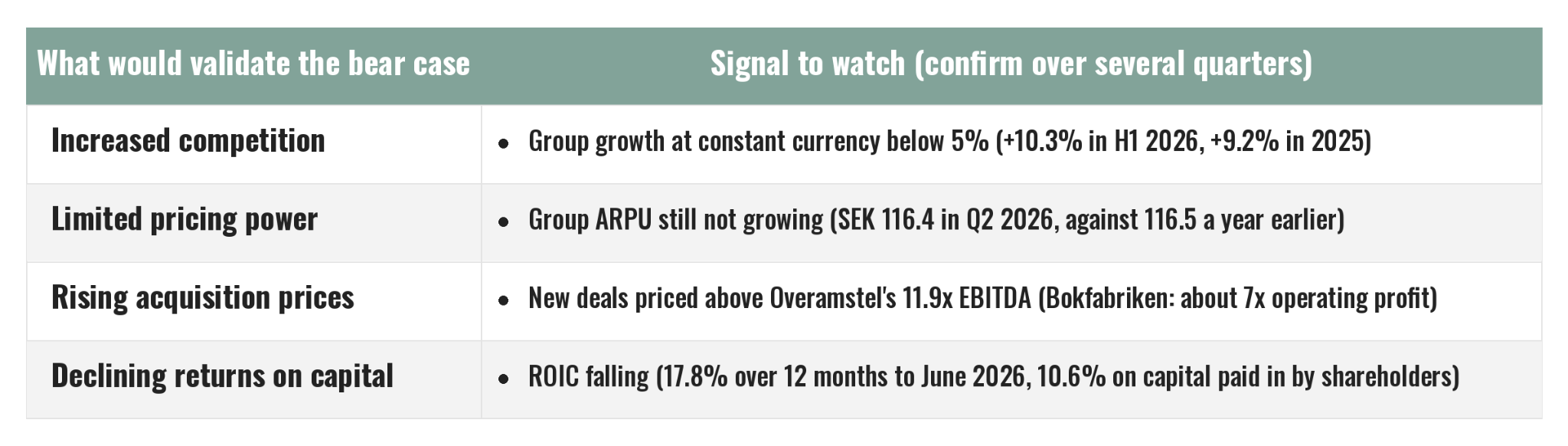
The increase in competition
For me this is the major point of the bear thesis, which is why I am not entering the stock for the moment.
The arrival of Spotify on the audiobook market could weigh. The Nordics, Storytel’s main market, account for about 59% of the group’s revenue, with growth of only 2.4% in 2025 and subscriber growth of 3.6% over one year at the end of June 2026. Spotify integrated audiobooks into its Premium subscription in the Nordic countries starting in November 2025, and announced on 7 October 2026 that it is extending its offer from 22 to more than 180 markets by the end of the year.
Net subscriber additions are already slowing: 83,000 in the first half of 2026 versus 110,000 a year earlier, and 12,000 in the second quarter versus 32,000 (my calculation from the tables by segment). Management expects net growth in 2026 at least equal to that of 2025: about 129,000 net subscribers would therefore be needed in the second half, versus 102,000 in the second half of 2025.
YouTube is reportedly considering officially integrating an audiobook offer, potentially attached to its YouTube Premium subscription, as competitors such as Spotify do.
Growth through pricing is limited
The group’s ARPU is stable: price increases in local currency are absorbed by exchange rates and by the subscriber mix, with more subscribers in Europe, where ARPU is 72 SEK (about $7), versus 154 SEK in the Nordic countries (about $14). In America, ARPU falls by 6.5%. Europe’s gross margin declines (40.7% versus 42.1%). Growth therefore comes from markets where the subscriber brings in less, and Storytel cannot raise its prices indefinitely.
The price of acquisitions grows over time
Bokfabriken cost about seven times its operating profit, Overamstel about 11.9 times its 2025 EBITDA (14 MSEK), and when entering the US with Audiobooks.com, Storytel clearly overpaid for an acquisition that is not developing for the moment.
Bull thesis
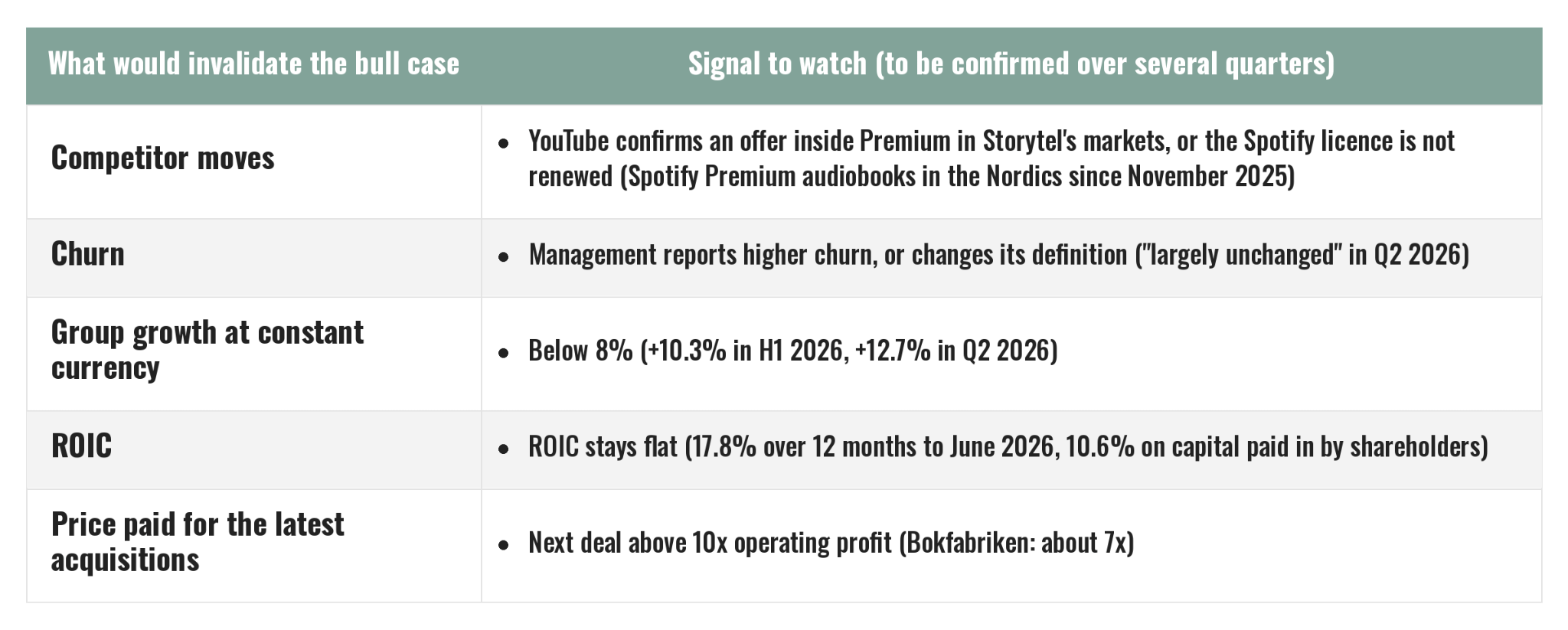
We are talking about a company without debt whose margin is rising, which finances its acquisitions and its returns to shareholders with its own cash.
The company has a flywheel
Storytel’s cycle links a publishing activity (authors, rights, backlist) to a streaming platform (audience, data). See the section “The flywheel” for details. Its size is an advantage here. YouTube and Spotify are much bigger than Storytel. For groups of that size, buying a small publishing house changes nothing, and buying a publisher large enough to matter is difficult: the larger the publisher, the greater the risk of paying a high multiple. Storytel, on the contrary, can buy houses whose size matters to it, without endangering its balance sheet.
Furthermore, the company is profitable enough to finance its growth through acquisitions. After several purchases, the company manages to reinvest and to pay a dividend, with almost no debt, while increasing its operating leverage quarter after quarter.
The market is growing and Storytel still has a lot to conquer before reaching saturation
According to the group, the number of monthly active audiobook users in its core markets (Europe and North America) almost doubled between 2020 and 2025, and industry projections point to continued growth. Storytel has 2.75 million paying subscribers for an addressable audience that the group estimates at about 400 million people (130 million excluding the United States) in its ten core markets, i.e. less than 1%. It therefore still has a lot to conquer before saturation.
And the growth figures in Europe are good, with Europe’s revenue growing by 18.2% at constant exchange rates in the second quarter, including 12.8% more subscribers (1.07 million). Europe contributed 121,000 of the 185,000 net subscribers of the last twelve months.
Competitors have not stopped the trajectory for the moment
Spotify has offered audiobooks in its Premium subscription in the Nordic countries since November 2025, and yet the group’s growth at constant exchange rates is accelerating: 9.2% in 2025, 10.3% in the first half of 2026, 12.7% in the second quarter.
The giants of the sector have, moreover, made other choices: Spotify announced in November 2021 the purchase of Findaway, an audiobook distributor, and licenses catalogues, including that of Storytel in the Nordic countries, rather than buying publishers.
If competitors want to oust Storytel, they will not be able to remove its catalogue without harming themselves.
They would therefore have an interest in making a distribution agreement with Storytel, and that is what can be seen in the figures, with external Publishing sales outside the group growing by 31.6% at constant exchange rates in the second quarter of 2026. This is also the path Storytel is taking with its agreements with Klarna in the United States (for audiobooks.com), Vodafone in Turkey, or RDF Media in Chile.
Blind spots
Neither the licensing terms nor the contracts with Spotify are published, so it is unclear whether Spotify will be more of a competitor or a distributor in the future.
The agreements with Klarna, Vodafone Turkey and RDF Media
The group is not very clear on the churn rate, and the share of family subscriptions and the conversion of end-of-quarter trials are not documented.
5. Price scorecard
The numbers only make sense if you’ve read the section on the two theses.
As Aswath Damodaran puts it, “numbers without stories to back them up are exercises in financial modeling.”
The scorecard below requires an important assumption, namely, the continuity of a normal economic environment, i.e. without a recession, a major credit event, or a market crash. I will someday write an article about how to deal with these conditions.
Any of these could push the stock below the bear case shown here, temporarily, independently of the company’s underlying performance.
All figures in the scorecard are pre-tax and pre-fees. Run the numbers for your own situation before drawing conclusions.
The horizon is three years, in October 2029.
The assumptions are the following:
Revenue growth goes from 0% per year in the bear case, to 7.5% per year in the central case, and 10% per year in the bull case.
The margins go from 8.3% in 2026 (net margin) to 7% in the bear case, 10% in the central case, and 12% in the bull case.
Payout ratio of 34% in the bull case, with none in the bear case; dividends are reinvested with no tax and no fees.
The selected range of P/E ratios displays the different estimated scenarios. We cannot display a 10-year history, the company having been loss-making over most of the last 10 years.
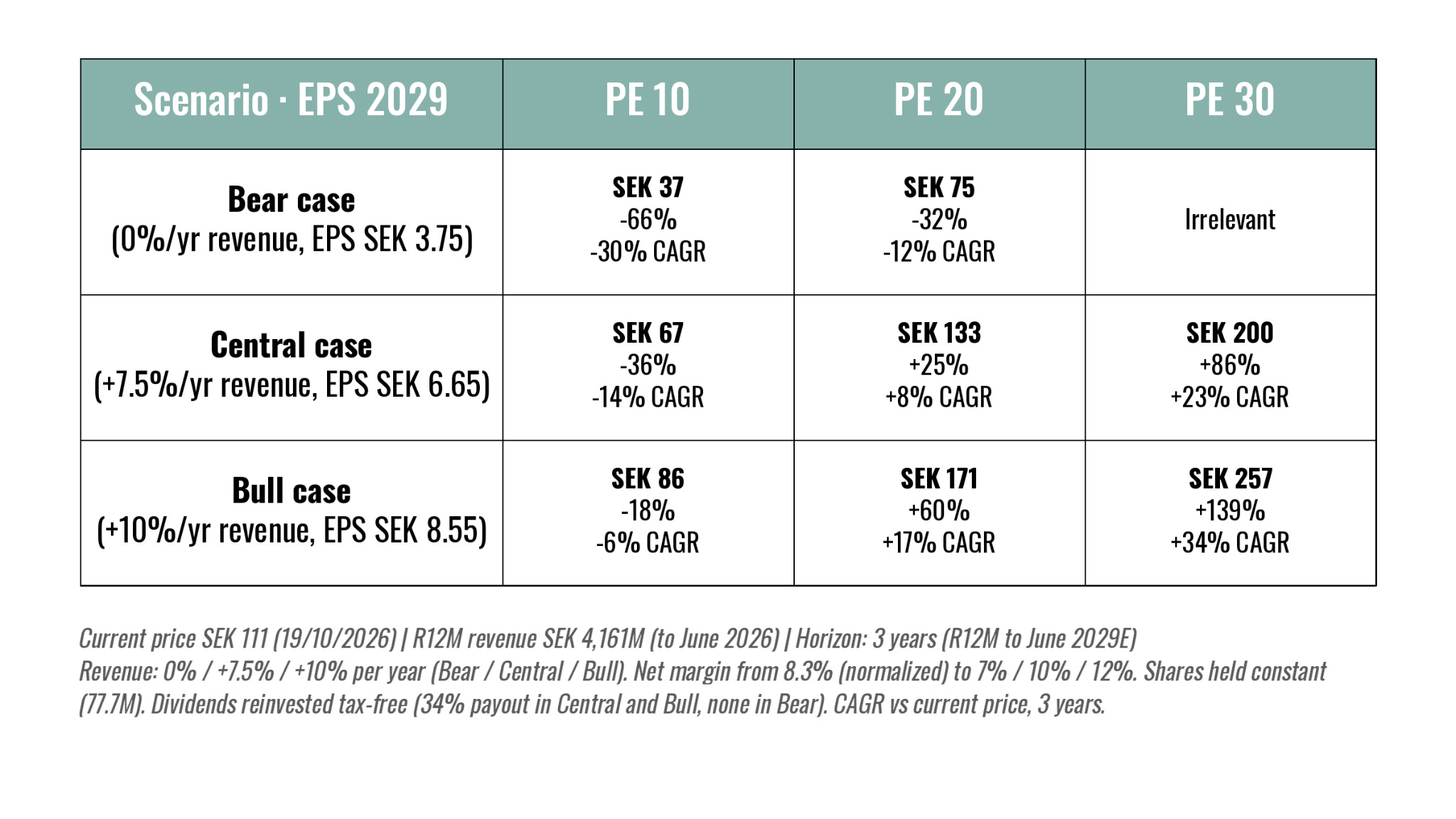
My conviction sits at the SEK 133 scenario, which isn’t enough for me to invest in the company, given the growth assumptions and the factors in the bear thesis.
The re-rating will mainly depend on the catalysts covered in the next section.
6. Momentum
Combining fundamentals (covered above) with momentum is an excellent way to improve your returns compared with using fundamentals alone. You’re never right on your own, especially since a significant part of returns comes from the multiple, particularly if your horizon is under 5 years.
The catalysts are the third-quarter results on 27 October, then the annual results on 10 February 2027.
As mentioned in the bull thesis, the development of acquisitions and the conditions of content distribution will be important.
On the competition side, the Swedish competition authority must rule on Bonnier’s acquisition of Nextory.
The arrival of YouTube in the audiobook field is another possibility in the bear thesis.
Final Thoughts
Storytel is a good example of why I put together my list of 48 quality small-caps. There are some genuinely interesting businesses out there that I would probably never have looked at otherwise.
investments. But the list is full of interesting businesses, across different industries and countries.
I have already invested in Baviera in the past, and I recently exited my position in EverQuote. For more on these companies, have a look at my previous article.
Not all 48 companies are cheap, and not all of them will turn out to be good
I suspect there are still plenty of good discoveries waiting for us. And that’s the whole point of the list: finding businesses worth understanding, and then waiting for the right opportunity.
Disclaimer: This content is for educational purposes only and does not constitute investment advice. See our full disclaimer.
I like the framing of the Buffett one-foot-bars quote before diving into Storytel, since it ties simplicity to a repeatable process. After a fivefold move, what do you look at first to judge if returns on capital can still justify the price?