
We hear a lot about bottlenecks related to the rise of AI, particularly in the areas of electricity supply and memory production.
The other day, I came across an article about INNIO N.V., a company benefiting from the growing demand for decentralized power generation.
It caught my attention, so I decided to take a closer look.
In this article, I’ll walk you through the business, its products, competitors, and competitive advantages.
Then I’ll share what I took away from this research, and the bigger problem it revealed about investing in bottlenecks.
1. What INNIO does
History
INNIO was carved out of General Electric. This is a transaction that separates a business unit from its parent, often through a sale to an outside investor or a separate stock market listing. How does this differ from a spin-off? In a carve-out, the parent company may retain a majority or significant stake. Advent International, a private equity firm, acquired what was General Electric’s Distributed Power business, which includes two brands, Jenbacher, based in Austria and Waukesha Motor Co. in Wisconsin.

The company went public in June 2026 at $27. The principal shareholder (44.6%) is now AI Alpine (Luxembourg) S.à r.l., co-owned by funds managed and/or advised by Advent and ADIA (the Abu Dhabi sovereign wealth fund).
What INNIO sells
INNIO sells gas engines ranging from 220 kW to 10.6 MW, fueled by natural gas, biogas, landfill gas, industrial gases, or mixtures with hydrogen. The group has two segments.
The first is Equipment, which is divided into three business lines:
-The data center business line delivers the prime and backup power required for AI workloads. This is the main area we’ll be focusing on during this Deep Dive, as it’s experiencing very strong growth.
Due to the massive growth of data centers, connecting to the power grid has become a major bottleneck. It takes years to connect a new site to the existing grid.
To bypass these delays, data centers can generate electricity on-site without relying on the public grid, and we call it “behind the meter”. These installations can serve as temporary solutions or remain in operation over the long term. Once supplied through the public network, we refer to it as “in front of the meter”
-The Power Solutions business line provides baseload and peaking power to stabilize utility grids (in-front-of-the-meter) and power independent microgrids (behind-the-meter). There are three main uses:
Electric utilities and independent power producers, to adjust to peaks of demand or low supply due to low wind or sun.
Factories, hospitals, and airports generate their own electricity, often through cogeneration. In this system, the heat generated by the engine is used to heat buildings or power an industrial process.
A third group of buyers recovers the gas that would otherwise escape or be flared. Engines convert this gas into electricity.
-The compression business line includes the engines that drive natural gas compressors to force gas through wells, gathering lines, and gas pipelines. I won’t develop much on this one, as it is just 8% of the total revenue and its part will shrink over time.
The second segment is the Services segment. To deploy and maintain the installations in the Equipment segment, it is necessary to provide services through qualified technicians and to organize the implementation. This segment includes spare parts (approximately 85% of service revenue), maintenance, overhauls, and multi-year contracts indexed to inflation.
Here is a summary from the company’s prospectus:
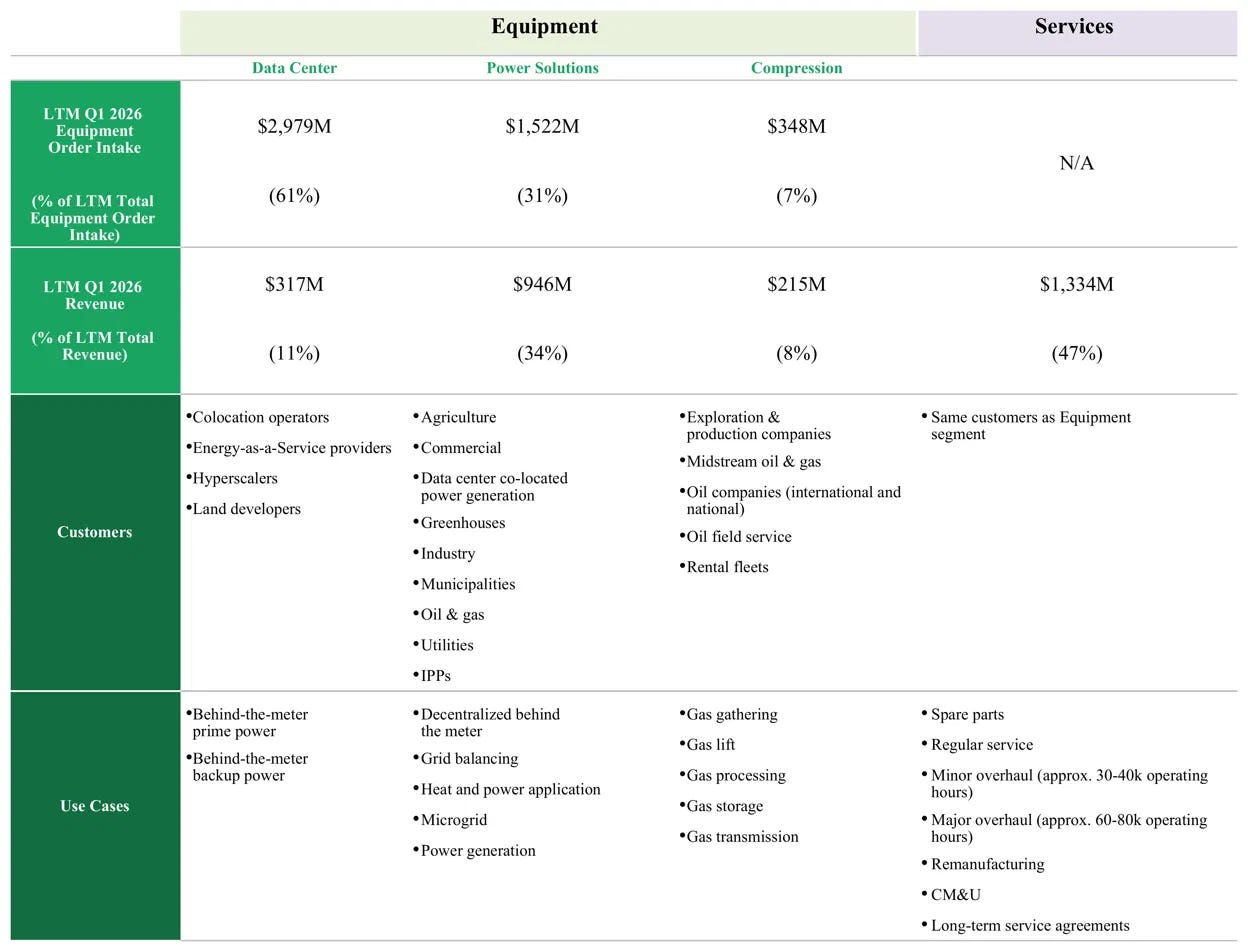
Clients
All of the clients are businesses.
In the Data Center segment, INNIO sells directly to hyperscalers, colocation providers, data center developers, and “Energy-as-a-Service” providers.
For Compression, INNIO sells exclusively through indirect channels, such as system integrators or distributors. Customers include operators of landfills, wastewater treatment plants, livestock farms, and oil fields.
For Power Solutions, INNIO’s subsidiaries sell directly, and distributors resell under the INNIO brand. Most have an exclusive contract limited to a specific territory, lasting one to three years. Major customers (“key accounts”) are not subject to exclusivity agreements. The customer base is very broad: electricity producers, public utilities, municipalities, factories, hospitals, airports, greenhouses, and operators of landfills, wastewater treatment plants, livestock farms, and oil fields.
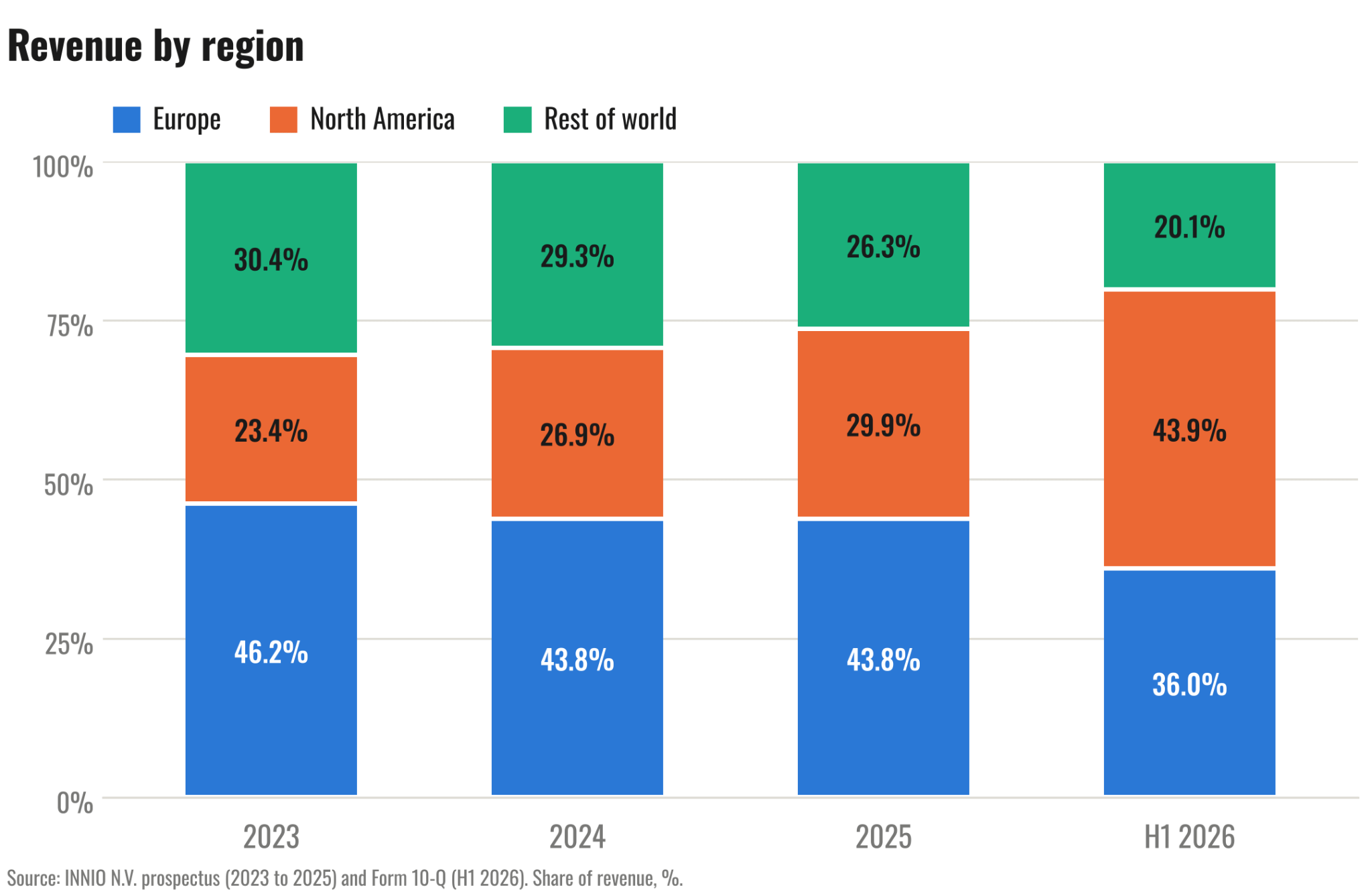
Concentration on a few customers is increasing:
The top five customers account for approximately 39% in the first quarter of 2026; Clarke Energy, the top indirect customer, accounts for 15% of 2025 revenue;
VoltaGrid, an Energy as a Service Provider, accounted for approximately 41% of Équipement’s order intake in 2025.
Data centers accounted for 63% of equipment orders as of June 30, 2026, even though they represented only 21% of revenue for the half-year.
Management states that no single customer accounts for a disproportionate share of the order book and indicates most hyperscalers as customers.
Suppliers
INNIO uses two suppliers for most components and three for some, and manufactures critical parts in-house. Some equipment comes from a single supplier. Steel is the primary raw material, followed by copper, aluminum, rubber and plastics.
In most cases, INNIO does not purchase raw materials itself; its suppliers handle that. Their prices often include a cost-pass-through mechanism or an indexation clause.
Rare earth elements are needed in the manufacture of equipment. Restrictions on Chinese exports are a key risk.
The names and weights of the main suppliers are not disclosed.
Since August 2025, INNIO’s equipment has been subject to tariffs of up to 200 percent, corresponding to the proportion of aluminum and steel imported into the United States.
In response, the company launched the “local-for-local” initiative, which involves producing and purchasing within the markets it serves to minimize customs duties. This limits tariffs on trade between regions.
Competitors
Competition Overview
Here is a list of competitors ranked by how similar their technologies are.
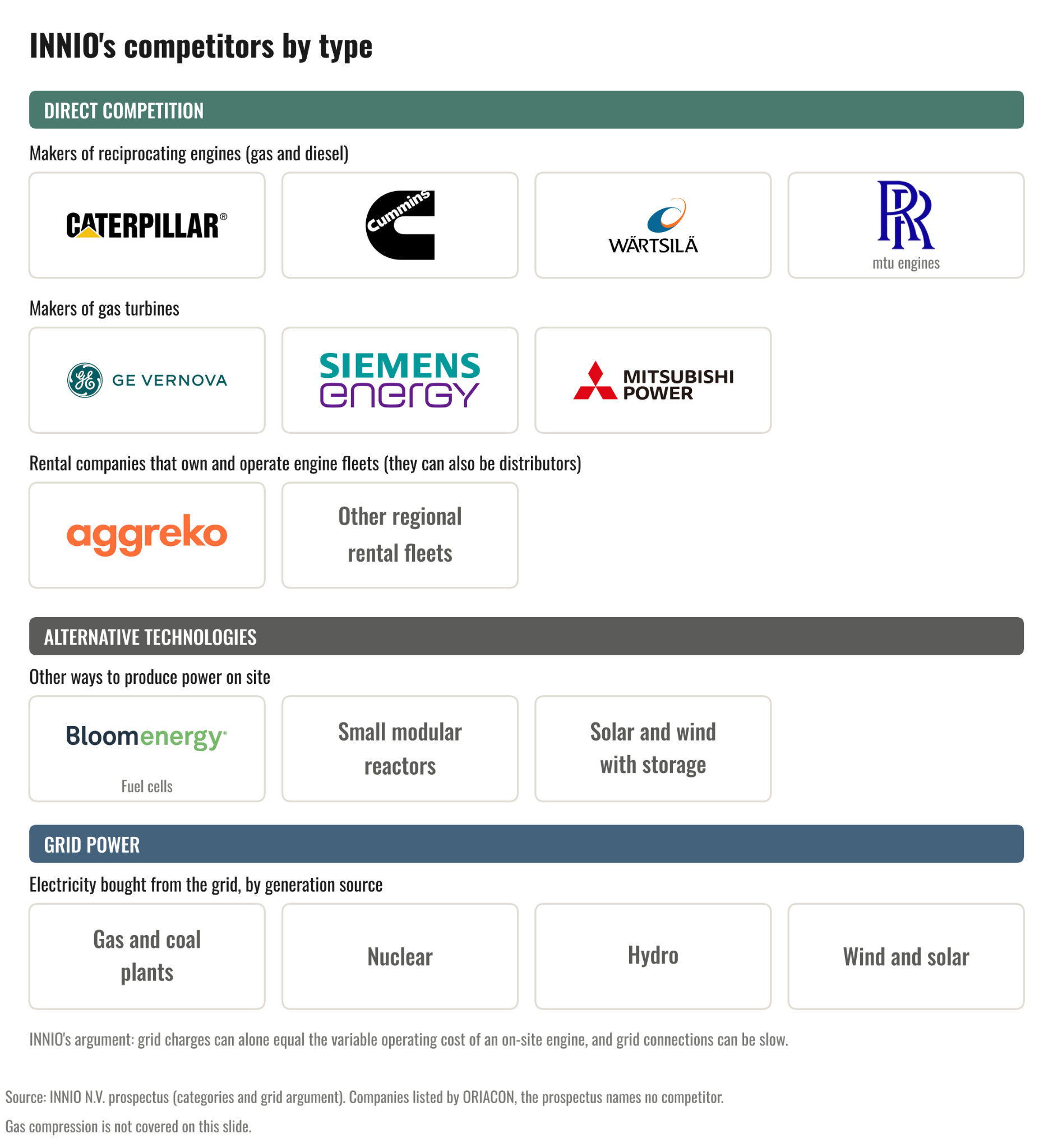
Customers are looking for time-to-power, reliability (99.9% availability in data centers), fast startup (approximately 15 seconds), resilience to sudden load fluctuations, part-load efficiency, modularity, and the service network.
As long as there is a bottleneck in the electrical grid connection, the customer is paying for speed and reliability of power, and the price is less important.
Goldman has raised its forecast for on-site capacity to 67 GW by 2030, including approximately 18 GW of fuel cells worldwide, or about 27 percent.
Why gas engines, and not turbines, other engines or fuel cells?
The image below is from INNIO:
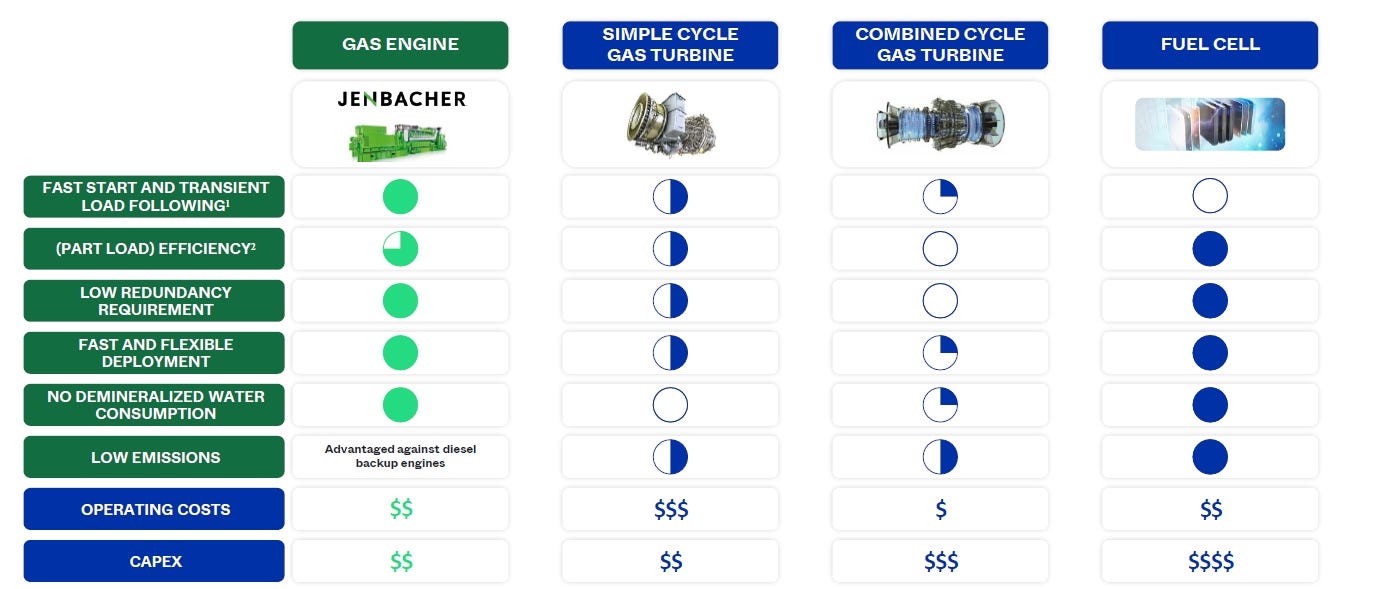
(1) Transient capability: ability to rapidly change power output in response to sudden changes in load or grid conditions while maintaining stable operation.
(2) Part load efficiency: calculated as the electrical output divided by the fuel energy input at a defined load level. It is commonly assessed by comparing efficiency at partial and total load.
With a gas-powered engine, an AI-based data center is essentially buying time. This allows the data center to start operating without waiting years for a grid connection. These engines aren’t the best in every aspect. Their strength lies in the balance they offer between delivery times, flexibility, and cost, especially compared to gas turbines, whose order books are full.
Here is another comparison chart of the different technologies:
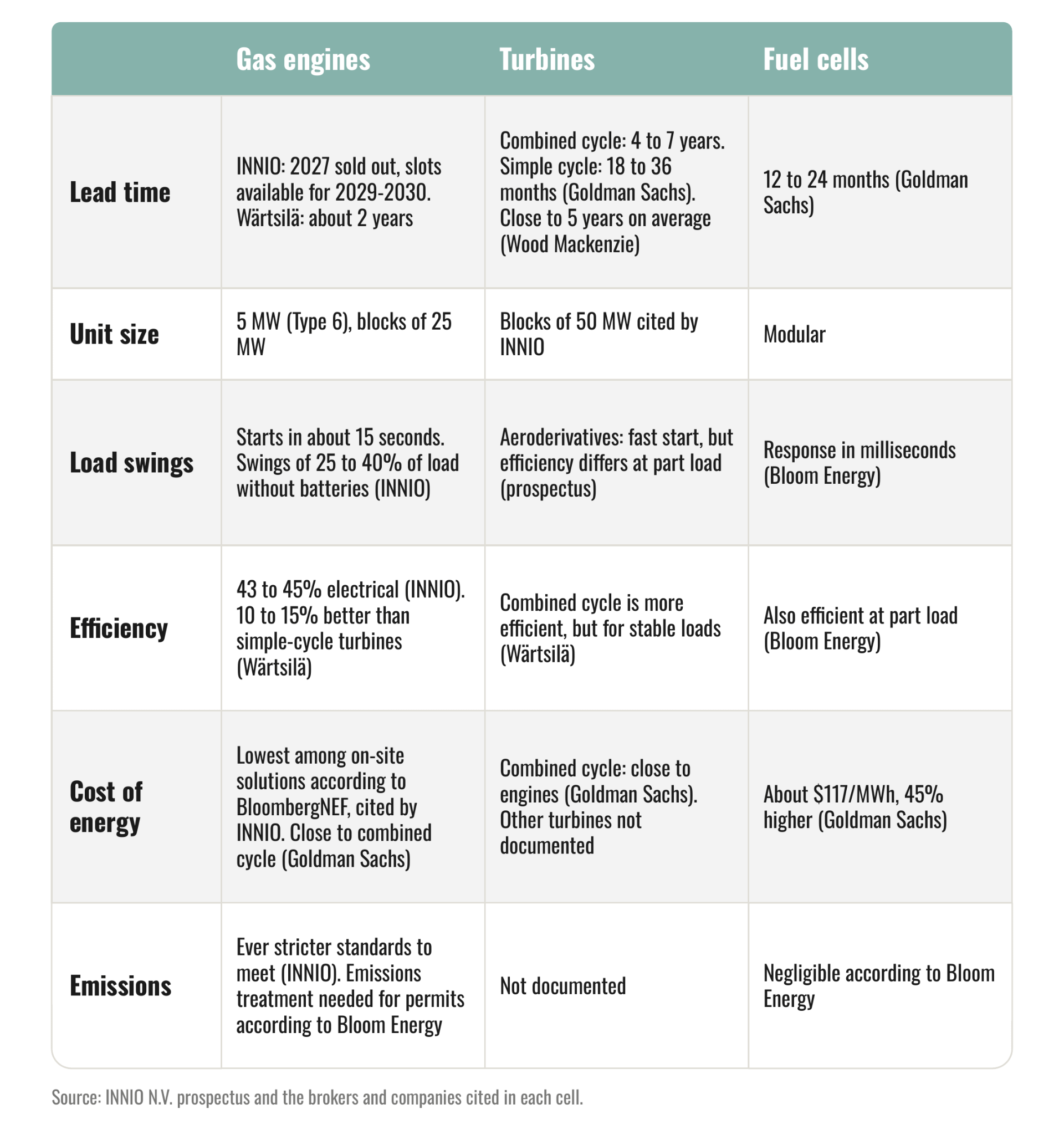
A combined-cycle power plant is a facility that generates electricity in two stages using the same gas. First, a gas turbine burns the gas and drives a generator. This is the simple cycle. Next, the (very hot) exhaust gases pass through a boiler that produces steam. This steam drives a second, steam-powered turbine connected to a second generator.
The benefits cited by INNIO, Wärtsilä, and Bloom Energy come partly from the manufacturers themselves, so these comparisons deserve some caution.
Compared to turbines, gas engines are faster, more adaptable, offer better tuning performance, are available more quickly, and are less expensive.
The prospectus cites SemiAnalysis, which states that the larger the production unit, the more reserve capacity must be planned for: a factor that gives 5 MW engines an advantage over 50 MW turbines.
Large-scale and combined-cycle turbines remain better suited for centralized generation, larger installations and stable loads. Aeroderivative turbines compete with engines for peak load and rapid response.
Fuel cells can be more expensive (around $117/MWh, approximately 45% above the gas-turbine and combined-cycle alternatives), but offer higher efficiency, faster response times, and potentially shorter delivery times.
In short, there is no perfect solution here.
The best choice depends on what customers need, when they need it, and how much they’re willing to pay. And these choices may look very different in a few years.
Compared to other gas engines
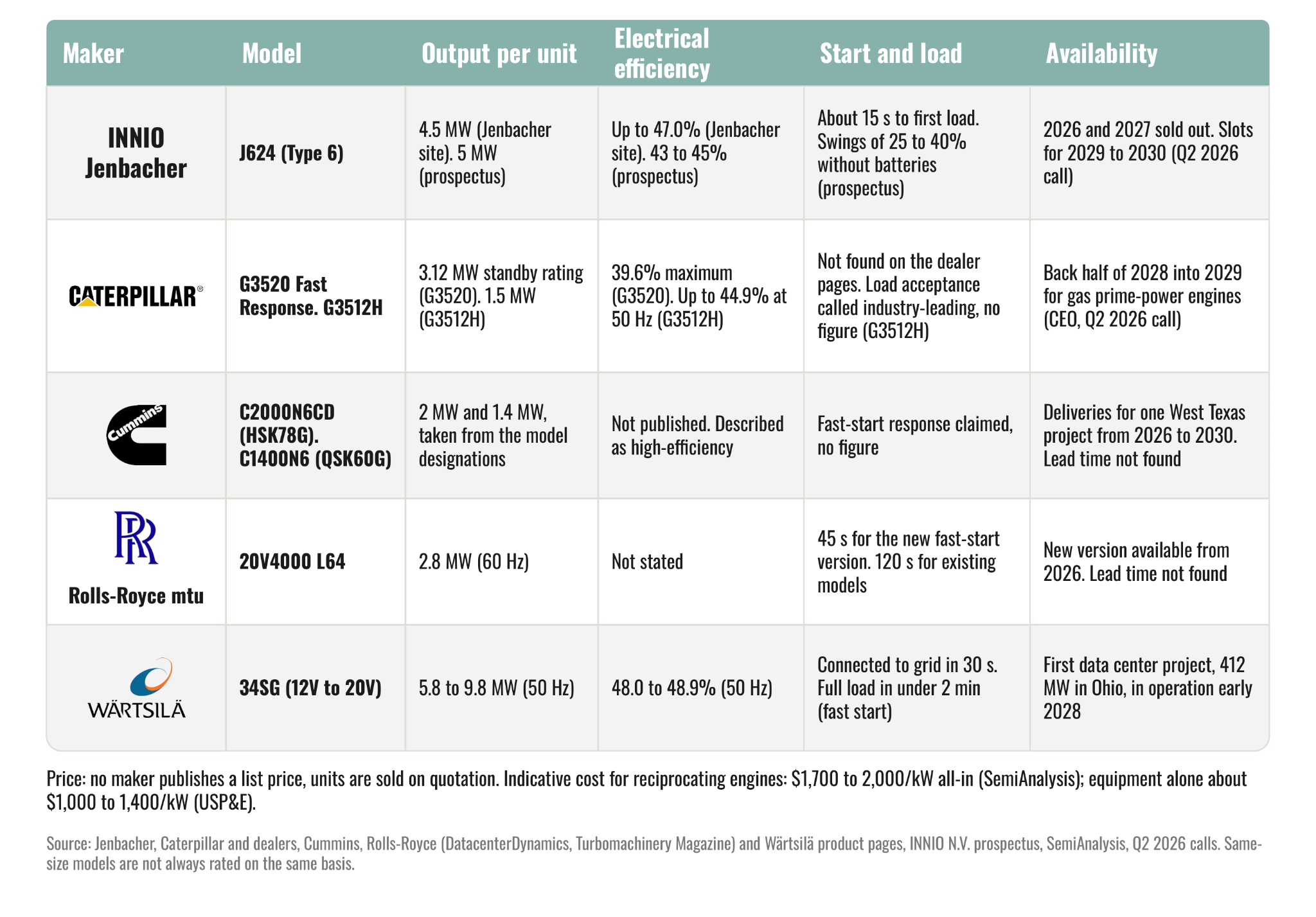
Even within gas engines, the competition is tough and so is finding a decisive technological advantage in this group.
Competitive advantage
Here are the five typical sources of a moat.
Intangible assets: low to moderate; no patents are essential.
Switching costs: high after installation; this is the core of the moat (Services account for 48% of 2025 revenue).
Network effect: none.
Cost advantage: low compared to other engines.
Efficiency scale: average, depending on the market.
INNIO’s products are good, but not unique.
Its competitive moat is narrow and comes primarily from the switching cost of the service segment.
The equipment order backlog and production slot reservations exceed 15 GW, more than four times the power delivered over the past twelve months.
According to the CEO, 2026 and 2027 are nearly fully booked; available slots are in 2029 and 2030; and projects are already being discussed for 2030 and 2031. He also explained that if demand is strong and supply is limited, the company is always in a strong position when it comes to pricing, and he sees no signs of a decline.
But this strong position could be temporary and linked to a surge in business. How long these conditions will last is another question.
That’s not enough for me to invest in this company, as there are too many questions.
I usually devote the rest of my deep dives to examining the financials, management, bear and bull cases, and then to setting a price and reviewing catalysts.
However, bottlenecks are among the most discussed investment opportunities on Substack and X, from electricity and memory to photonics.
So I think it’s worth going a step further.
Why am I passing on INNIO despite its impressive growth? And more importantly, how should investors approach these bottlenecks in the first place?
That’s what I’ll explore in the second part of this article.
Subscribe for free to discover the six questions I believe every investor should ask before investing in a bottleneck and how I decide between stock picking, ETFs, and simply staying away.
Substack needs more articles like these. Too many articles read like sales pitches, rather than research projects.
Your conclusions are sound (I think anyways). Eventually supply will catch up with demand and then things will look very different. Sure that could be years away, but I think it's very reasonable to say that there are too many ifs there for now. I drew the same conclusions looking at 2g energy last year.
The power constraint is becoming a real part of the AI investment story. But a shortage alone doesn’t guarantee attractive returns — capital costs, equipment utilisation and the timing of new supply matter just as much.