
One of the most hotly debated questions among investors is how many stocks to hold in a portfolio. A good investor should diversify to avoid taking counterproductive risks. This article provides an overview of the topic, covering diversification, research on the subject, how a portfolio reacts when a stock’s price fluctuates, correlation, the line not to cross, and a suggestion for those building a portfolio.
1. The Benefits of Diversification
Diversification involves spreading your money across investments that do not all react the same way to the same events, so that no single event can wipe out your entire portfolio. The goal, therefore, is to reduce risk.
This discussion is limited to diversification within a 100% equity portfolio; the topic will also be addressed in the broader context of asset allocation.
Risks can be classified into two types: specific risks and market risk.
The first type is tied to a specific company and can be diversified. In particular, diversification provides protection against fraud, the loss of a market, a contract, or a key player. The following quote is attributed to Harry Markowitz, winner of the “Nobel Prize in Economics”: “Diversification is the only free lunch in finance.”
What cannot be diversified is market risk. A recession will affect all businesses, since it leads to a loss of purchasing power among all of their customers. If it were possible, insurance companies would offer a policy to cover this eventuality, but that is not the case.
One way to hedge against market risk is to diversify your asset allocation (for example, into gold, bonds, real estate, and so on) which typically respond differently over time.
However, after a while, diversification will reach its limits. The question, then, is how many stocks are needed until the company-specific risk stops mattering?
2. What the Studies Say
In 1968, Evans and Archer, link to the study, in their founding paper showed that most of the benefit comes from the first 8 to 10 stocks, and beyond that the curve flattens. This is where the old rule of thumb comes from.
In 1987, Statman, link to the study, argued the earlier work ignored costs and the ability to borrow. His conclusion was that the optimum is about 30 stocks for a leveraged investor and 40 for an unleveraged one. But a later version of his work suggested that hundreds of stocks might be needed before the extra benefit fell below the extra cost. I assume that maximizing this diversification would be absurd for a retail investor.
In 2001, Campbell, Lettau, Malkiel and Xu, link to the study, showed that individual stocks became more volatile relative to the market over the previous decades. To reach the same level of diversification, you needed to increase the number of stocks from roughly 20 in the 1960s to around 50 in the late 1990s.
In 2007, Domian, Louton and Racine, link to the study, looked at long holding periods and found that most of the benefit requires 30 to 50 stocks. You can also mitigate the worst outcomes with more stocks.
A 2021 review in the Journal of Risk and Financial Management, which went through the whole literature, concludes by saying that a generalized optimal number of stocks does not exist. It varies by market, by period and by investor.
A summary of the diversification analyzed in this study is shown in the image below:
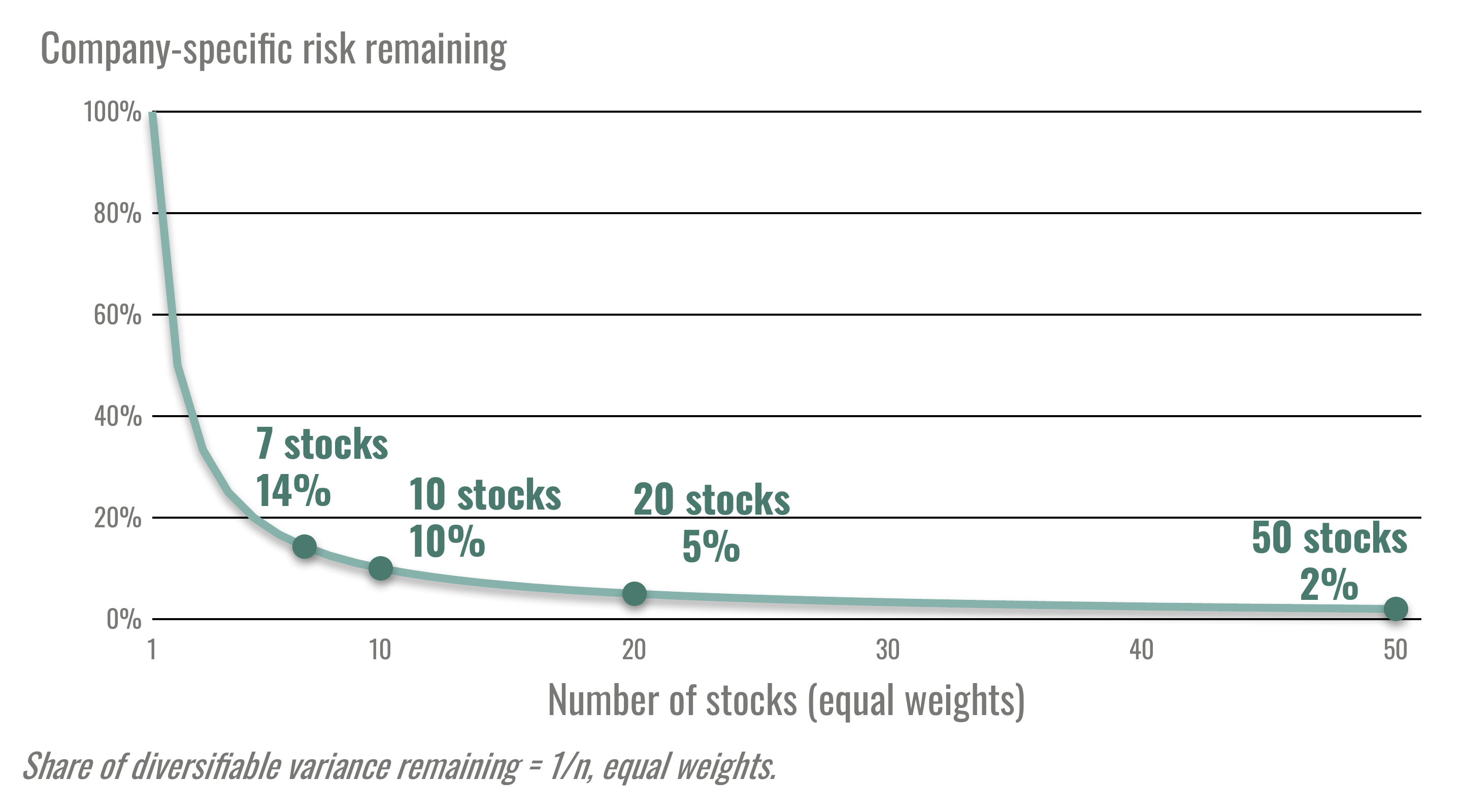
The first steps toward diversification do almost all of the work. Going from 1 to 10 removes 90% of the avoidable risk. The more stocks you add, the lower the benefit becomes, with marginal benefit beyond 20 stocks. The sweet spot of diversification would be between 7 and 20.
3. The Impact of a Stock’s Price Change on the Portfolio
To better plan for the future, let’s ask ourselves what happens when a stock’s price fluctuates by 50%. The more concentrated the portfolio is, the greater the impact on it will be.
The goal is to see how much volatility you can handle without selling everything at the low point.
The ideal amount depends on how much your stomach can handle.
The graph shows what happens to your portfolio if you endure a 50% drawdon on one line:
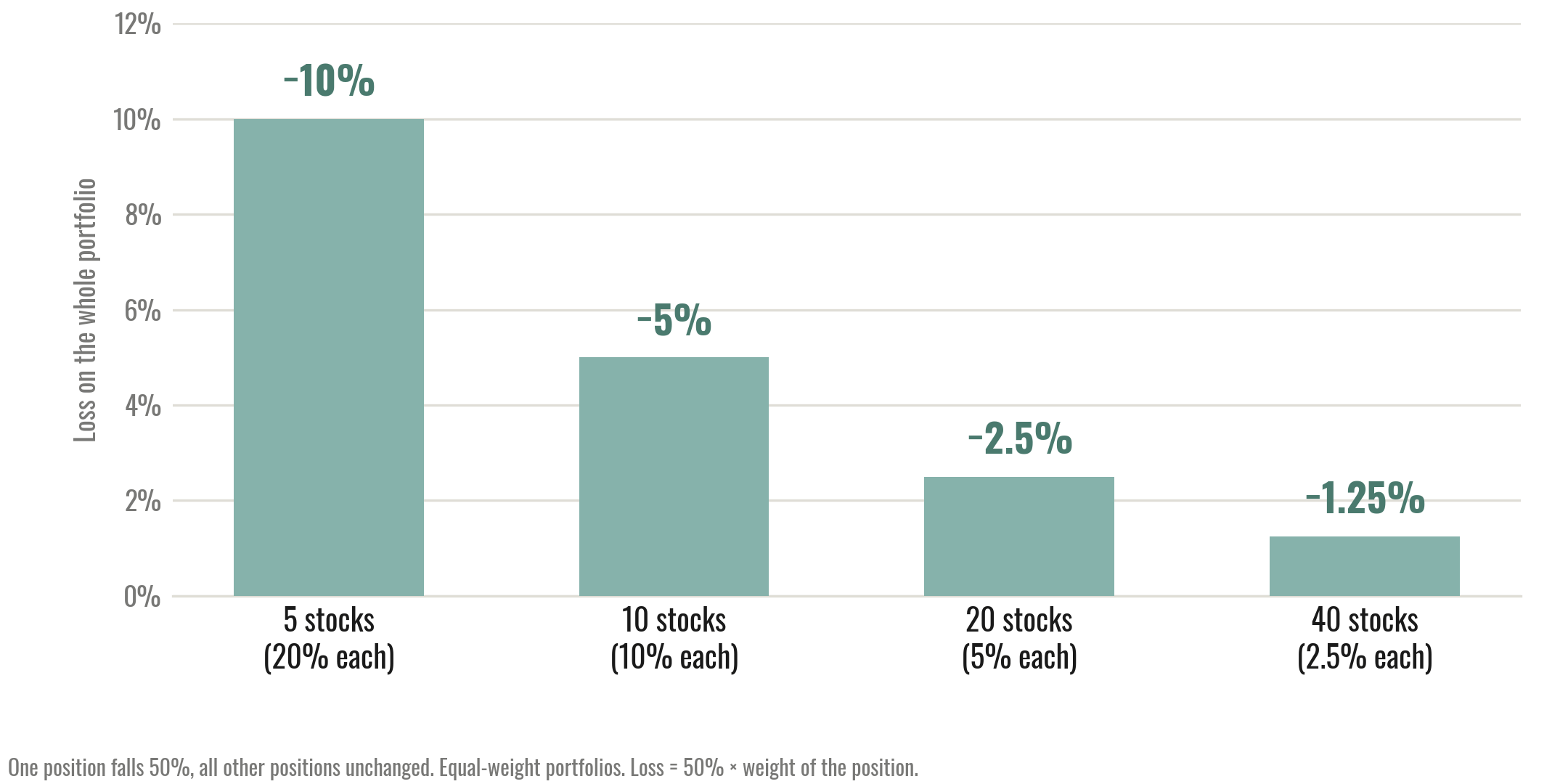
This chart provides information about an equally weighted portfolio, which is never the case unless you rebalance your portfolio very frequently.
4. Statement of equal-sized positions
The number of tickers in your account is a poor measure.
Let’s take a portfolio of 10 stocks. After one year, one has doubled in value, two are down 50%, two are up 20%, two are down 20% and three stayed flat. The portfolio is still worth the same amount, but its weightings have changed. You can calculate how many equally weighted positions this corresponds to by dividing 1 by the sum of the squared weights.
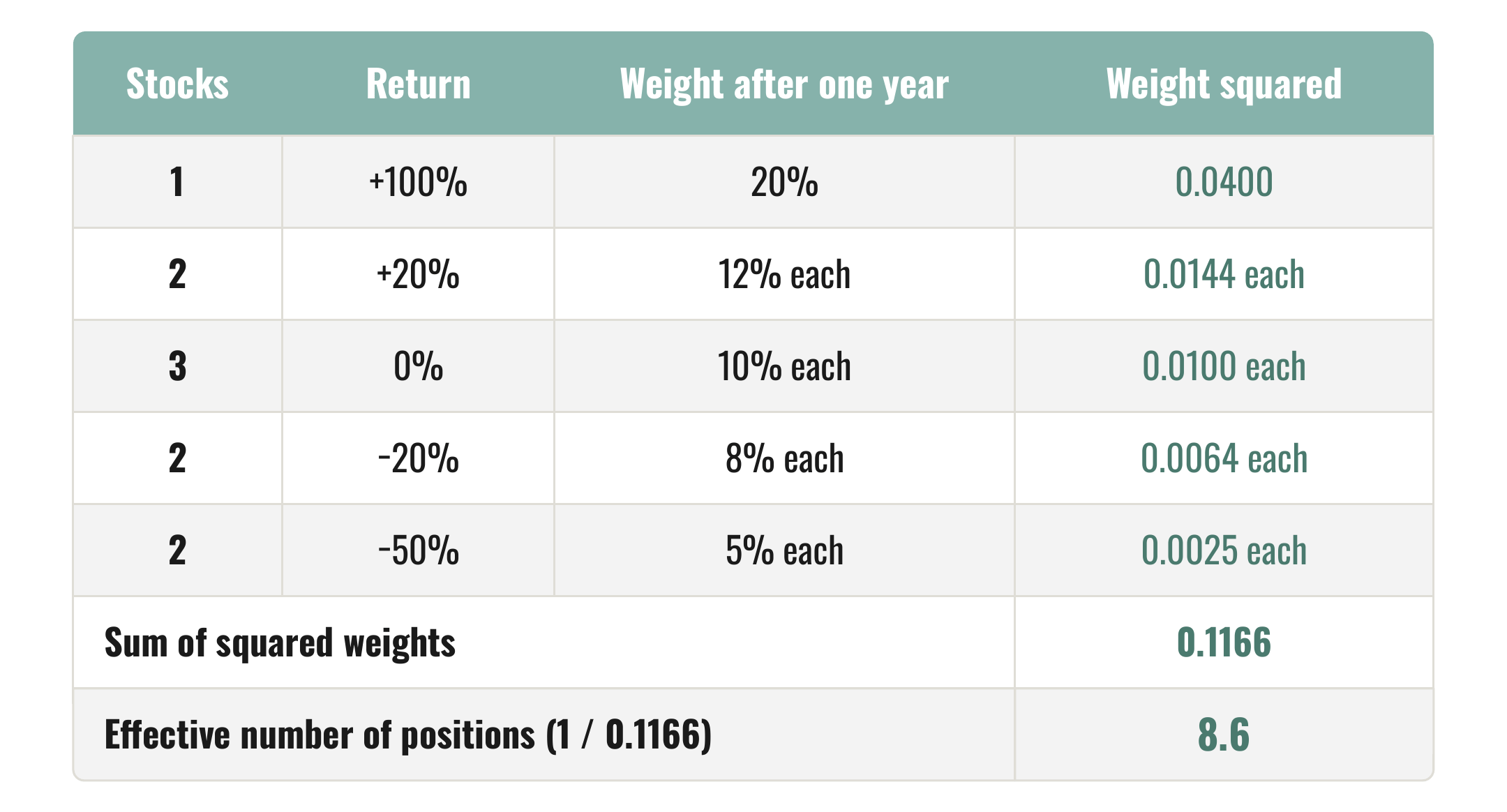
In the end, your portfolio, which had led a fairly normal life, became more concentrated.
A portfolio has a natural tendency toward concentration.
But that isn’t necessarily a bad thing. It’s simply the result of the winners gaining ground and the losers losing it.
5. Asset Correlation
You can own 30 stocks without diversification. For example, if you own all the “hot names” in AI, such as Nvidia, Micron, SanDisk, Super Micro Computer, Nebius, CoreWeave, etc., you’re not diversified. That’s because they’re all based on roughly the same investment thesis. Those who show you spectacular annual results usually fail to mention this point.
When this theme falls apart, they all fall apart together.
True diversification relies on assets being uncorrelated across different sectors, different clients, and different sensitivities to interest rates and the economic cycle.
For example, a software company, a luxury perfume manufacturer, and a pharmaceutical company are each influenced by different factors. Three stocks like these provide better diversification than ten stocks in the semiconductor sector. If all your stocks are listed in the United States, you are exposed to the dollar.
It should be noted that investors generally tend to favor their home country, which means they tend to invest only in their own country.
6. The cost of owning too many
I once held 25 stocks. I was diversified, but something I hadn’t expected came knocking at the door. Time and a 10% market drop to all my stocks.
Finding, getting to know, and keeping track of 25 companies is a sport—or even a profession.
And what happens if the price drops by 30% for 5, 10, or 20 of them?
Do you know enough about them to feel at ease and not have to keep revising your plans just to check your portfolio and your hard-earned money?
Each time the price falls, you must be able to hold your position, and so you must know your stocks well enough to do that. There is more risk in owning fifty lines you do not know than ten you do, because in the first case you end up reacting to the price, and in the second you hold steady.
And in my case, I don’t think I have unlimited good ideas, so every new position dilutes my best ideas and convictions.
7. A Few Quotes from Superinvestors
Warren Buffett:
« If you are a know-something investor, able to understand business economics and to find five to ten sensibly-priced companies that possess important long-term competitive advantages, conventional diversification makes no sense for you. »
« There is less risk in owning three easy-to-identify, wonderful businesses than there is in owning 50 well-known, big businesses. »
« Diversification is a protection against ignorance. »
Peter Lynch:
« In small portfolios I’d be comfortable owning between three and ten stocks. »
« There is no use diversifying into unknown companies just for the sake of diversity. A foolish diversity is the hobgoblin of small investors. »
Joel Greenblatt:
« One of the reasons I can have a concentrated portfolio is because I understand what I own…. If you own six or eight great things, or at least great bets, that’s more comforting if you actually know what you own. If you don’t know what you own, if you don’t know how to value a business, you’re just going to react to the emotions, because you don’t actually understand what you own. But if you actually understand what you own, and the premise that you bought those things with is still intact, that’s actually the only way I think you can deal with the emotion, because you realize what you own is still good. »
8. A simple way to choose your number
No one knows in advance how they will react to a market decline, especially when it is widespread and prolonged. The best way is still to experience a market decline firsthand.
That’s why, in my “Investing 101” series, I suggested starting with a pilot phase—buying three stocks and one ETF and holding them for one year—to get used to market volatility and see how well you can weather market shocks.
The next step is to build a portfolio in which you choose the number of stocks.
Starting with 20 stocks rather than 10 is actually better from an educational standpoint, because each mistake is spread out, and you learn more from 20 stocks than from 10.
This will also teach you to close out positions that haven’t gone as planned. Not necessarily because the stock has lost 40%, but because the investment thesis didn’t play out as expected.
I suggest two starting points:
15 stocks make up 50% of the portfolio, and 3 ETFs make up the remaining 50%. Each stock accounts for about 3.3%. If one loses half its value, the portfolio loses about 1.7%. If it triples in value, the portfolio gains about 6.7%. The ETFs (see Part 2) collectively hold hundreds of stocks and provide diversification while you learn, for just a few basis points per year.
20 stocks, excluding ETFs. Each stock accounts for 5%. If one loses half its value, the portfolio loses 2.5%. If it triples in value, the portfolio gains 10%.
The real difference is the workload. For a position in your portfolio, it can easily take 2 days to develop the investment thesis if you do it yourself, followed by 2 hours of monitoring per quarter. If you spend less time on the investment thesis, you risk having serious doubts about your position because you didn’t lay a solid foundation for it in the first place. If you only have six companies that you understand and whose declines you can withstand, stick with just those and put the rest into ETFs.
Next, decide on your investment theses:
After an initial period, review each position and compare what has happened with the reasons you bought it. If the thesis is broken, sell, because it will be worse later. If the thesis holds, including those that have fallen in price (you have a better price now) and those that have risen significantly (there is still room to grow, plus momentum).
This only works if you noted, at the time of purchase, what would make you sell, aka in my articles the bull and bear theses. Otherwise, every decision after a 30% drop is based on price.
Disclaimer: This content is for educational purposes only and does not constitute investment advice — see our full disclaimer.
Very good article. The idea to start out with more stocks and get to know yourself, risk appetite etc is very good advice for people starting out.
The Markowitz line everyone quotes is that diversification is the only free lunch in finance, and Evans and Archer 8-to-10 stock curve is why people stop adding names. Extending your thirty-stock point: owning thirty correlated compounders in the same factor is not thirty independent bets. I care more about what those names share in a drawdown than the headcount.