
In the previous articles, we had covered setting aside a safety amount in the first Investing 101 article, then diversifying among stocks within a portfolio in this article:

It assumed a 100% stock portfolio, which is not the case for everyone.
But we still need to look at allocation across assets. This point is essential because it will guide your returns and the volatility of your portfolio.
1. Diversification and performance
In 2000, Roger Ibbotson and Paul Kaplan asked the following question: does asset allocation explain 40, 90, or 100% of performance?
As it turns out, all three figures are correct, but they answer three different questions.
The study covers 94 US balanced funds, 1988–1998, and 58 pension funds over five years (1993–97). This tells us nothing about an all-stock fund or a concentrated portfolio.
To better understand, let’s imagine 100 funds that all mix stocks and bonds, but in different proportions: some with 30% in stocks, others with 70%.
90% of the variability of a fund’s returns over time is explained by its allocation policy: its performance mainly reflects the markets to which it is exposed.
40% of the differences in returns between funds are statistically explained by differences in their allocations. The rest depends, in particular, on security selection, timing, and fees.
100% refers to the level of annualized return actually achieved by the funds, which is on average close to that of their benchmark allocation. In other words: on average, the manager does neither better nor worse than their own allocation, after fees. On average, active management did not add value after costs.
The conclusion I understand from it: your share of stocks in your portfolio largely shapes your average return and your drawdowns, and which stocks you pick explain the difference of your returns with the market’s return.
Which means if you are 100% in stocks, your results can be above the index, below it, or the same.
A few other studies to corroborate these results:
Vanguard (Davis, Kinniry, Sheay, 2007) finds a similar contrast across 189 US balanced funds: allocation explains, on average, 82.1% of a fund’s variations over time, but around 20% of the differences between funds.
A passive portfolio with the same composition delivers, on average, 108% of the fund’s return: active management therefore did not add value on average. Note that Vanguard sells ETFs, which may influence the results…
Xiong, Ibbotson, Idzorek and Chen (2010) distinguish market movements, investment styles (size, growth, value, etc.), and active management.
The market explains 74 to 88% of variations in returns; the remaining differences are attributed, in comparable proportions, to styles and active management. Their definition of allocation therefore also includes choices made within the stock asset class.
2. What each asset class does
Each class has a role in a portfolio.
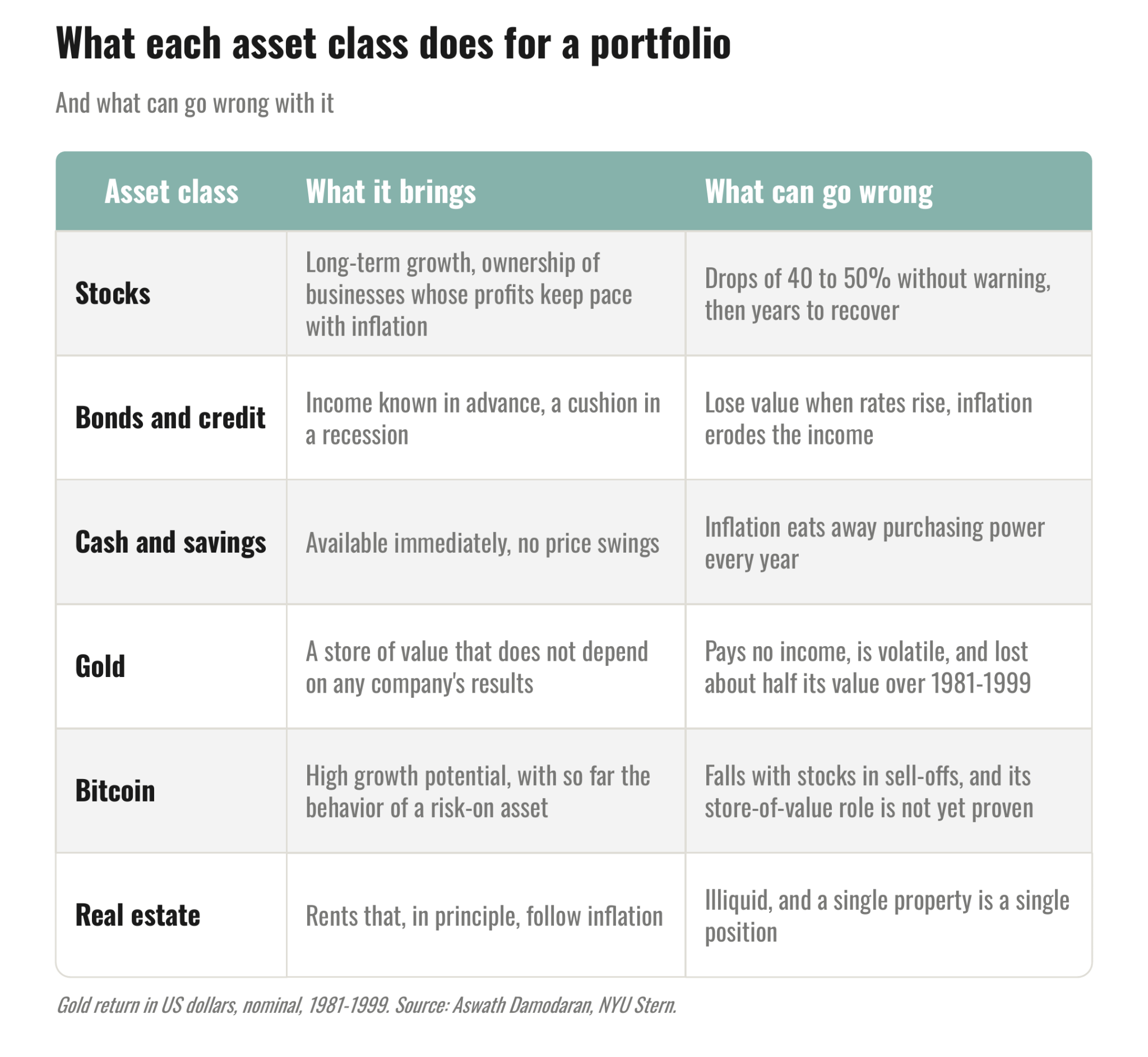
Their returns and volatility vary across periods
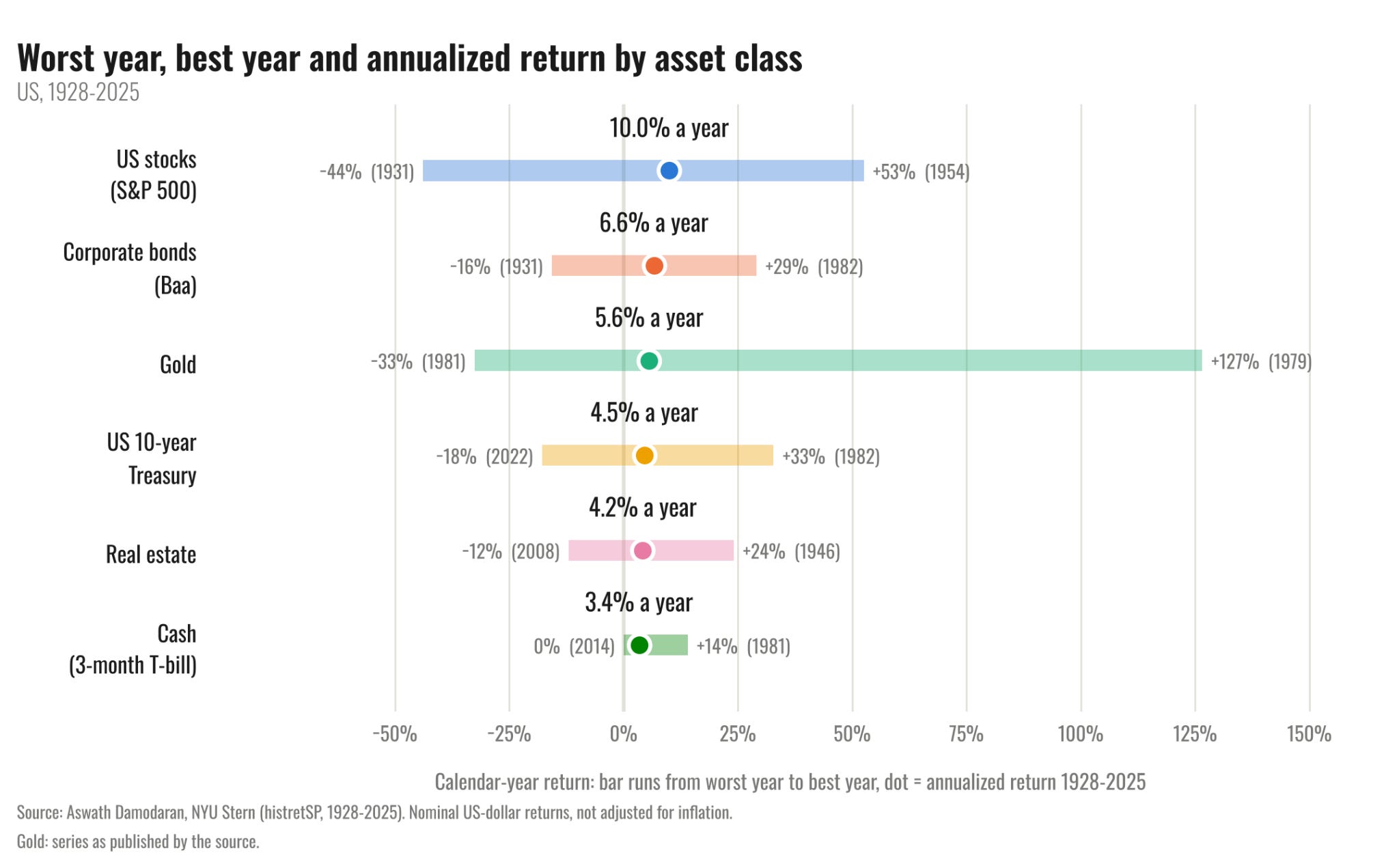
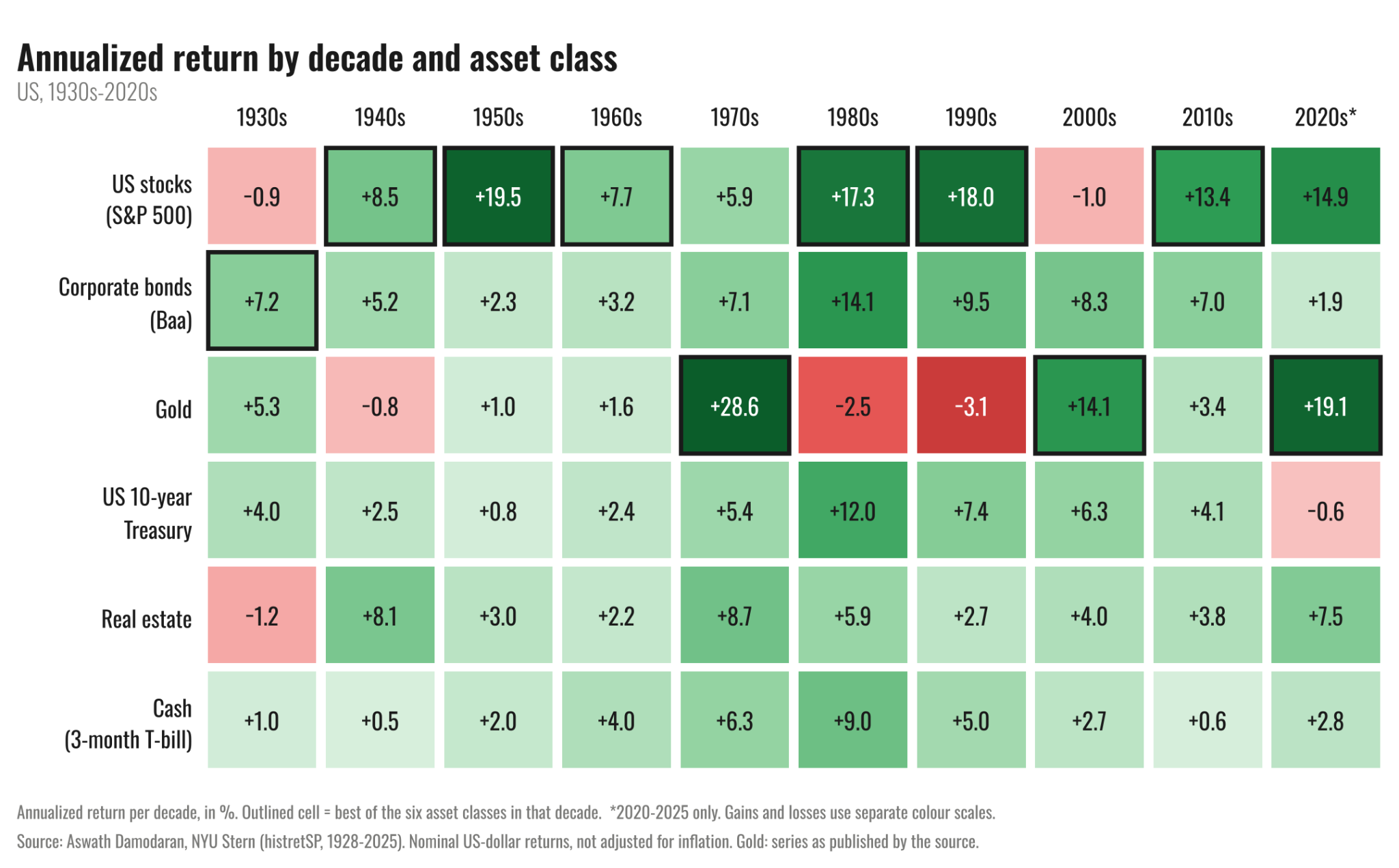
Over the long term, we can see that cash and short-term bonds earn almost nothing in real terms, over the period observed, because inflation eats away at their returns. They often buy you protection, notably the ability not to sell stocks at the worst moment or to take advantage of a dip in the stock market. Which could take a long time to arrive.
3. What caution costs
Here is what different allocations between stocks and bonds produced in the United States between 1926 and 2019 (high-quality US bond indices, whose composition changed over the period).
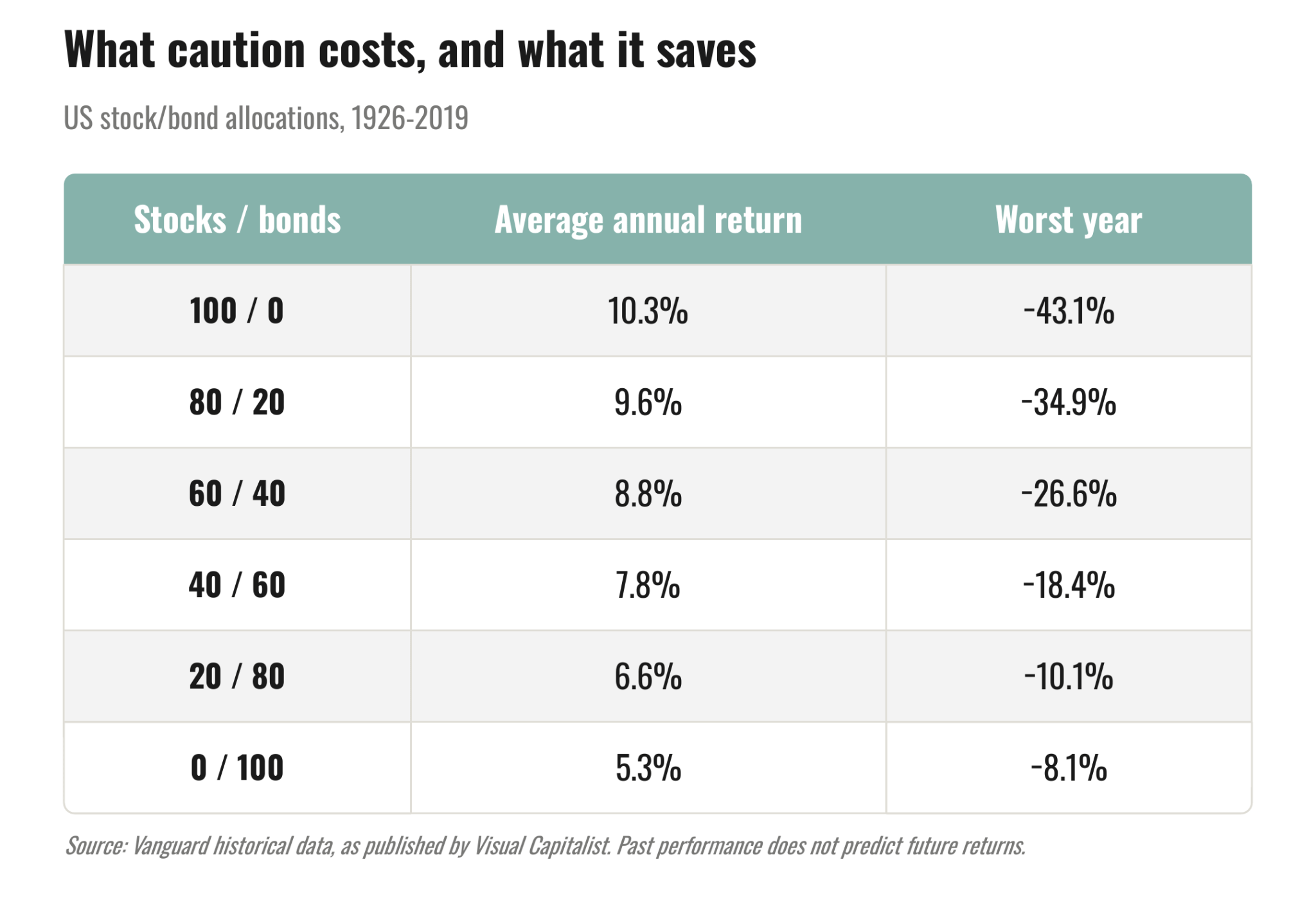
Going from 100 / 0 to 60 / 40 costs about 1.5 percentage points of return per year. In exchange, the worst year goes from -43% to -27%, or 16 percentage points less to endure. For example, in 2008, government bonds cushioned the fall in stocks.
There are several limitations to this:
These are US data from an exceptionally strong period for US equities. US Treasury bonds have traditionally been considered the risk-free benchmark in the global financial system, although the sustainability of US government debt is increasingly being questioned.
The theoretical long-term optimum is where the annual return is highest. But if you sell at the worst moment, everything falls apart. The practical long-term optimum is the one you can stick with psychologically.
In 2022, unlike usual, stocks and bonds fell at the same time. Inflation had pushed interest rates higher, and both portions fell together. That year, the S&P 500 fell by about 18%, the broad Bloomberg U.S. Aggregate bond index by a little more than 13%, and a 60/40 portfolio using these two indices by about 16%.
4. How to do it in practice
Calculating your share of stocks
The share of stocks will depend on several factors:
Time in the market: the longer you plan to remain invested, the more you can increase your share of stocks. At 30, you can wait at least 10 years for a recovery; at 60, much less.
Tolerance for drawdowns: to be 100% invested in stocks, you must be able to endure portfolio declines of 50% (or even more).
The point above is difficult to assess, hence my proposal in the Investing 101 series to start with a pilot test by investing in an ETF for one year and in several stocks to see your real reaction.
Keeping the allocation on track: drift and rebalancing
The share of stocks you have chosen does not remain static: in a bull market, stocks rise, sometimes sharply. Imagine a portfolio of 50% stocks and 50% bonds. If stocks gain 30% during the year and the rest 3%, you end up with about 56% in stocks, without having bought anything.
The simplest approach is to rebalance back to your standard allocation once a threshold is crossed. For example: “if my portfolio reaches 65% in stocks, I sell stocks to buy bonds.”
When you go above it, start by directing new contributions toward the rest. Sell as a last resort.
That also means giving up some of the pure performance of stocks to protect against a possible decline.
With the possibility that all assets fall together during a crash, as was the case for stocks and bonds in 2022. That does not mean diversification was useless: stocks and bonds can fall together without falling by the same amount, and their behavior depends on the nature of the crisis. Bonds change the risk of the portfolio, without providing automatic protection.
Final Thoughts
The best allocation is the one you will be able to maintain when markets fall, without having to sell at the wrong time.
Diversification across asset classes does not eliminate risks. It allows you to change their nature and magnitude, with trade-offs to accept in terms of returns. Before looking for the best stocks, you must therefore decide what place they should occupy in your portfolio.
Disclaimer: This content is for educational purposes only and does not constitute investment advice. See our full disclaimer.