
The previous part covered the study of individual stocks, with the goal of determining whether investing in a given company made sense. Only the work required to do this was significant, taking hours or days of study before making any investment.
But when building a portfolio, you’re not going to scrutinize every publicly traded company in such detail to determine the optimal mix. No one can seriously analyze the entire public market. World Bank data indicated a total of nearly 53,000 companies in 2025.
You’ll see that day-to-day investing can be broken down into two parts:
Monitoring its portfolio companies,
Monitoring everything else, including potential investments.
To make investing actionable, we’ll need to make some choices and simplify things for ourselves. In this article, we’ll discuss the concepts of the investment universe, information gathering, checklist, and watchlist.
1.Investment Universe
The investment universe describes what you limit yourself to seeing and studying.
Some investors prefer emerging markets, others favor U.S. turnarounds, while still others prefer blue-chip quality stocks or European small-caps. Anything is possible, but as Michael Porter, a professor at Harvard Business School, once said, “the essence of strategy is choosing what not to do.”
This reduction can be achieved in several ways:
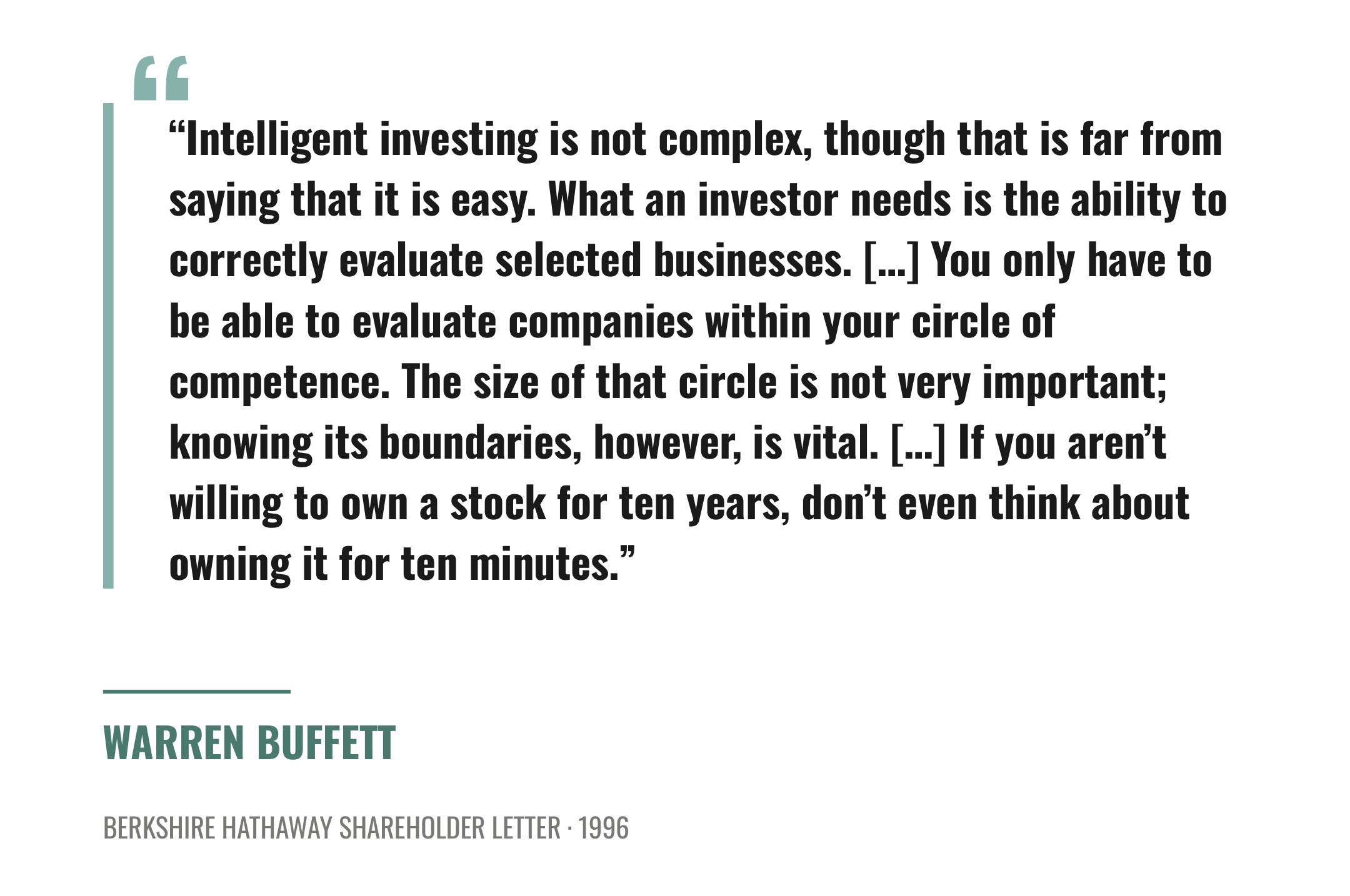
-Warren Buffett coined the term “circle of competence”: Which industries and companies do you understand? Better yet, which ones do you understand better than others?
You’ll have a much deeper understanding of your industry than a financial professional who simply waits for the numbers.
-You may be eligible for tax incentives or disincentives in certain markets. For my part, as a French tax resident, I have access to a typically French investment vehicle, the PEA, which is a tax-deferred account that allows me to reduce my tax liability on stocks within the EU. As a result, given equal returns, I would prefer this economic zone.
-Another possible limitation is of an ethical nature, which is a strictly personal matter. For example, no weapons, no tobacco, etc.
-Some investors will choose to limit risk by excluding micro-caps and small-caps (with market capitalizations under $150 million and $1 billion, respectively). Others will seek them out as market segments rife with inefficiencies.
-You can also filter by investment style, including a few well-known categories:
Quality
Value
Momentum
Dividend
-Another economically relevant criterion is to target sectors based on their intrinsic profitability. The image below provides a sector-by-sector overview of the past 10 years in the U.S.
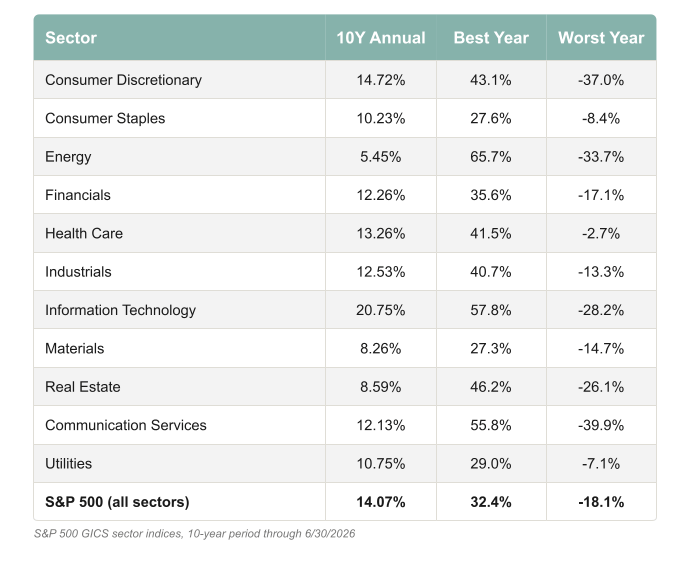
As you can see, there is a wide range of returns and volatility across sectors. The IT sector leads the pack due to its scalability (adding an additional user incurs almost no additional cost and is essentially pure profit).
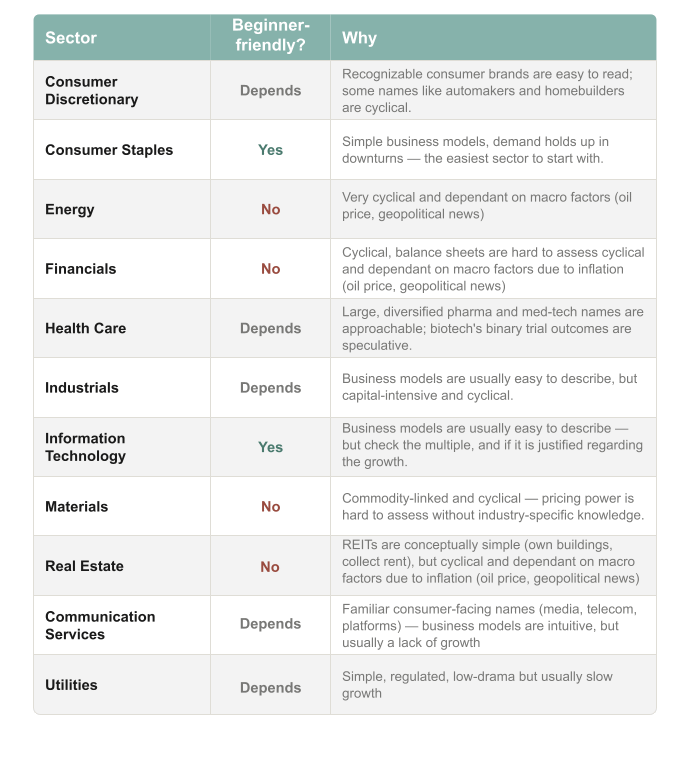
The table below lists the sectors to favor and those to avoid when starting out. As a general rule, avoid cyclical sectors when starting out because it is difficult to assess where the cycle stands, the fundamentals vary in quality, and valuations can be high.
2. Where to Find Information
There are many websites where you can find the financial information you need. Among them, here are a few useful resources specifically geared toward publicly traded companies:
Marketscreener.com, which provides information on both the economy and publicly traded companies
https://www.alphaspread.com/ to find figures and ratios about a company and its competitors
https://finance.yahoo.com/, as free general-interest media outlets that serve as alternatives to the major (paid) business newspapers.
Your broker. I started by shortlisting a lot of companies through my first broker, deGiro, whose company profiles are well-done—and, in my opinion, better than Interactive Brokers’.
There are several ways to find stocks:
The list of major indices (S&P 500, Stoxx 600 in Europe, Nasdaq 100)
Screeners, including TradingView, which lets you customize just about every possible setting. WARNING! Using this method to find good companies is a great way to get taken advantage of: often, if a company is undervalued, it’s because there’s a problem.
3. The checklist
The idea in the previous section was to come up with names. Let’s say you come across a new company. My suggested approach is to spend a few minutes checking whether it meets your initial criteria:
Sector
Geographic Area
Ethical criterion
Level of Indebtedness
Investment Style
Market Capitalization
If that’s OK, you can move on to a more in-depth screening process. The simplest approach is to use an investment checklist and eliminate any stocks that don’t meet your criteria. You’ll find a suggested checklist at the link below, which you can adapt to your own criteria.
Download the latest annual report and quarterly results from the Investor Relations section of the company’s website.
Run the checklist below through your favorite AI, first instructing it: “Answer the following questions using the attached documents, indicating which parts come from your own knowledge and which parts come from the documents.”
You can find the checklist at the following link : https://docs.google.com/document/d/1jZ8-08bBfUore1amb94KmYsr_LVF3dBc4WzYb18p9ds/edit?usp=sharing
If you like it, the idea is to keep an eye on it—often because the price is too high—until you’re ready to conduct a detailed analysis. That’s the whole point of the “Watchlist” section below.
4. The Watchlist
Just because a company checks all the boxes doesn’t necessarily mean it’s a company you should buy right away. The most common issue is price. An excellent company bought at too high a price is still a bad investment. That’s exactly what the watchlist is for: keeping a top-tier company under surveillance, before engaging any capital.
A useful watchlist includes the following for each name:
The ticker and a checklist, for an overview
Price tracking, to identify when a buying zone appears to be forming.
Monitoring momentum to avoid entering the market at the wrong time—after a sharp rally to a temporary valuation peak or during a falling knife.
Here’s a link to the watchlist template I use every day:
https://jbpeter.substack.com/p/portfolio
Before concluding that a company you wish to acquire meets a price criterion, you must first conduct the detailed analysis described in Part 3 to define your investment thesis and verify whether the expected return justifies the risks involved.
Final thoughts
This article concludes the Investing 101 series. You now have the basic items: why invest, how to choose an ETF, how to analyze an individual stock, and finally, how to organize your daily routine so you don’t get overwhelmed by the 53,000 publicly traded companies.
Let’s return to the goal set in Part 1: to find one ETF and three stocks. You now have everything you need to get started on this pilot phase.
The next step in this progression will be to broaden your range of knowledge and delve deeper into each of the topics already mentioned in other modules.
The best is yet to come.
Disclaimer: This content is for educational purposes only and does not constitute investment advice — see our full disclaimer.
I particularly liked the long-term sector specific performance and the breakdown of what to look for in each sector.
I am surprised that Healthcare looks like it doesn't have much volatility over the ten years, given that most had a huge COVID spike and then a big sell-off afterwards.