
1. Performance
Over the trailing twelve months, the portfolio is up 8.71% against +16.25% for the S&P 500 (total return).
Year-to-date, 11.66% against +13.12% for the index.
Since inception (2nd of October 2023): 72.9% vs S&P 500 80.57%.
All figures are pretax, net of fees, and exclude the effect of any cash contributions or withdrawals. This is a pure return on capital already at work.
I don’t use options and I’m currently unlevered.
My job here is to own and follow around 15-20 stocks closely enough that you don’t have to — so you can track your portfolio in 1-2 hours a week, and still get access to the great buys when they show up.
2. Sentiment
My year-over-year performance is well below that of the S&P 500 due to the strong base effect from last year, when I was up 33% during the same period.
My sense is that outperforming the index this year depended largely on your exposure to semiconductors in the first half of the year—a period during which my portfolio had no such exposure; in fact, it was the opposite, with a focus on software.
Furthermore, my strong conviction in Atos Group means that my portfolio does not move in tandem with the S&P 500. My relative performance is largely attributable to the company’s stock price. I remain very confident in the company’s ability to turn things around, as it has already successfully overcome two of the three challenges necessary for the turnaround: the balance sheet simplification, which will be completed by the end of the year, and the improvement in the operating margin. The final step before a re-rating is the ongoing business recovery.
It’s also a message for all those who are underperforming the index or hovering around it. You always need to wait and see if your investment thesis plays out. It may be held back by investor sentiment, but in the long run, if your thesis plays out, the market will prove you right.
Peter Lynch, one of the greatest investors of all time, famously wrote: “There’s always something to worry about. But if you own good companies, you’ll do well over time.”
3. Positions
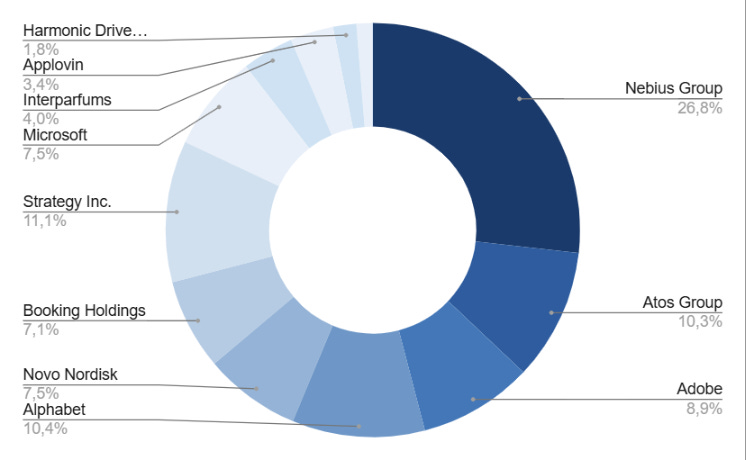
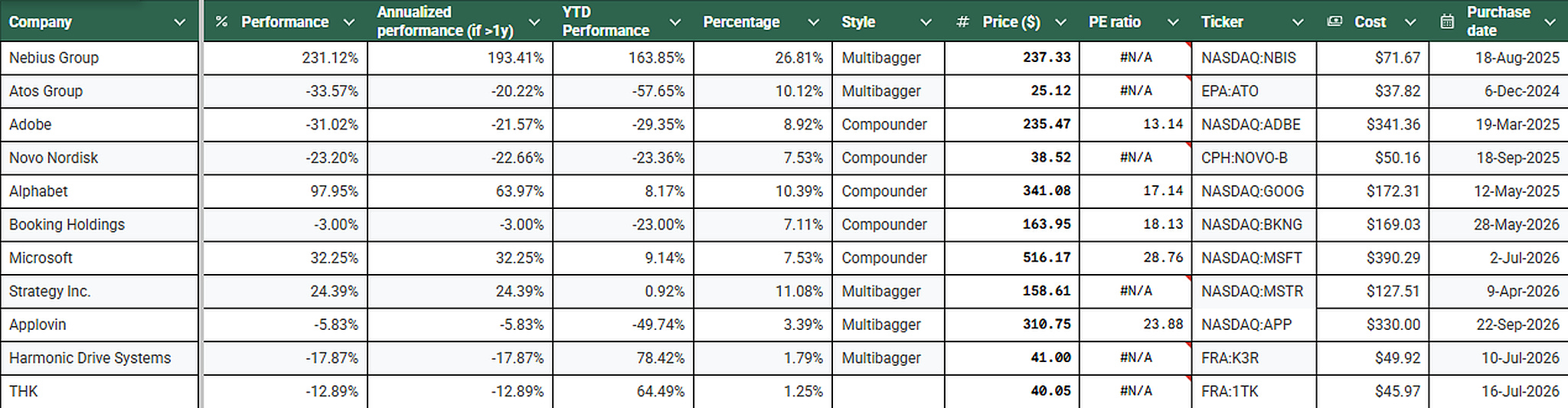
Nebius Group, 26,76% of the portfolio
On September 8, Palantir named Nebius its preferred sovereign AI infrastructure partner. Nebius compute and inference will now sit inside Palantir’s enterprise perimeter, available to Palantir’s commercial customers.
Palantir owns the software and the customer relationships, Nebius owns the hardware.
Palantir brings its Ontology, AIP, Foundry and Apollo stack. Nebius brings AI-native compute, built for AI workloads from the ground up rather than repurposed general-purpose cloud. Together they let a company fine-tune its own models on dedicated infrastructure, without handing proprietary data to a public cloud.
This agreement is a clear win-win:
-clients get the performance of large-scale AI infrastructure and keep control of their data and models.
-Nebius gets a direct channel into Palantir’s commercial customer base: enterprise and government accounts with sovereignty requirements Nebius could not reach alone, plus the credibility of being named “preferred” infrastructure partner by a company with deep ties in defense and regulated industries.
-Palantir gets the compute layer: AI-native infrastructure, GPU access and power contracts, letting it deliver on its sovereignty pitch to clients without taking on the capital cost of data centers itself.
For the moment, this agreement doesn’t disclose any financial terms, but the moat is widening for both.
My question: Will other regions of the world accept that Palantir, an American company, might have access to key information regarding their intelligence and security? Is just sovereignty requirements enough to agree on it?
Palantir is a US company, subject to the CLOUD Act, which lets Washington compel access to data a US company controls, regardless of where it is physically stored. For clients seeking independence from Big Tech hyperscalers, that is likely enough. For governments seeking genuine independence from US jurisdiction on intelligence or defense data, it probably is not. Nebius, domiciled in the Netherlands, does not carry that specific liability — and can be sold directly to sovereignty-sensitive clients Palantir cannot fully reassure.
Whatever the answer, it’s yet another brilliant move by Nebius.
Separately, SemiAnalysis’s ClusterMAX 3.0 report (Sept 23) rated Nebius Platinum, up from Gold last edition, alongside CoreWeave. That’s evidence the market’s “just another neocloud renting Nvidia chips” framing misses real pricing power.
Nebius has also announced plans to increase the rates for its GPU cloud services by an average of approximately 20%. Their pricing power is real.
One flagged risk to watch: construction delays at the Béthune and Vineland sites, but it doesn’t change the thesis.
Strategy Inc., 11,06%
Resumed bitcoin buying on August 31 after a 10-week pause: 4,603 BTC for $369.7M, average price $80,318, up from $67,068 on the last purchase in June. Total holdings sit around 845,050 BTC at a $75,412 average cost. Net leverage is 0.1%; the cash reserve grew from $3.75B in July to $5.10B in August. Saylor didn’t return because bitcoin got cheaper. He returned to reassert the playbook, at a higher price than his last trade.
The stock also had a sharp move up this month on the back of bitcoin’s rally: BTC jumped from $76,400 to $80,935 in under an hour on Sept 18, as roughly $183M in short positions got liquidated, worth about $3.8B in paper value on Strategy’s holdings alone. MSTR tends to move roughly twice as much as bitcoin in either direction, and the position is up 32% since April 9.
Alphabet, 10,37%
On September 9, Google announced 13B euros for AI infrastructure in Finland, its largest single investment in Europe, including a 22-year power purchase agreement for 50% of the Loviisa nuclear plant’s output starting in 2030 (Fortum says the plant “would not have been able to keep running past 2030” without the deal).
Separately, Google is putting 4 Trillium TPUs on a demo satellite with Planet Labs, launching Oct 1 on SpaceX’s Transporter-18, the first orbital test under Project Suncatcher: orbit gets up to 8 times the solar output of ground panels, no grid queue, no permitting fight. Four chips on one satellite won’t move the P&L, but a 2027 network of interconnected satellites might. Thesis holds from August’s record bond deal and the Berkshire stake disclosure.
Atos Group, 10,28%
Certified an SAP Sovereign Cloud Partner on September 16, cleared for sovereign SAP workloads in Germany, France, the Netherlands and the UK, building on the sovereign cloud Atos launched itself in July. The turnaround story keeps improving operationally even as the stock is still down roughly 53% YTD. Still not adding or trimming.
Out of that, it is still at the point from the H1 followup, and as described in the sentiment section.
Adobe, 8,90%
Q3 FY26 results, published Sept 11: revenue $6.76B (+12.9%) and non-GAAP EPS $6.13 both beat estimates, but RPO growth decelerated to single digits for the first time since early FY23, and net new ARR fell 36-37% YoY.
Management frames this as the deliberate cost of the freemium funnel, a pricing lever they chose not to pull yet. A new CEO was named September 3, an internal pick.
None of the three invalidation criteria from the original deep dive triggered:
-gross margin at 88.7% stayed above the 87% floor,
-Creative & Marketing Professionals grew 13% reported (12% cc), well past the 5% floor.
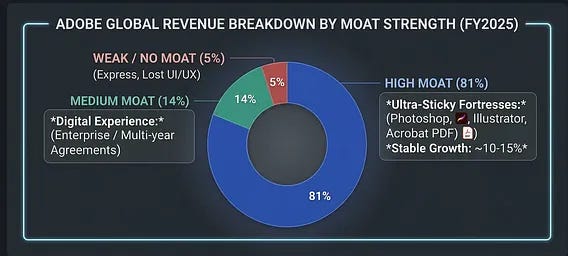
Verdict: the thesis is intact. This is a short-term-for-long-term trade-off worth watching over the next two or three quarters. My investment thesis in a nutshell is in the continuation of the company based on the high moat parts, and described in the picture below.
Novo Nordisk, 7,53%
It is renaming itself simply “Novo,” announced Sept 15.
Two licensing deals this month: Orbis Medicines (Sept 17, up to $1.4B) for an AI-driven platform designing oral macrocycle drugs, and Nanexa’s PharmaShell platform (Sept 25, up to €1.165B), which could turn weekly obesity injections into monthly or quarterly ones across up to five programs. That’s a direct answer to the market pricing Novo on the TrumpRx price war rather than on pipeline depth.
Since they completely missed their Capital Market Days I plan to write an update on the deep dive soon.
Microsoft, 7,51%
They cut 268 more Xbox roles on September 22 and handed the next Halo game to Activision, following 3,200 cuts in July and a 10% drop in Xbox content and services revenue last quarter. Cost discipline on the gaming side, peripheral to the core Copilot/Azure thesis. No change to the position.
Booking Holdings, 7,10%
The EU’s General Court upheld, on September 9, the 2023 block of Booking’s $1.9B Etraveli acquisition; the stock fell 3.81% the same day on “blow to growth strategy” headlines. The commercial partnership with Etraveli, running through December 2028, is untouched by the ruling. Booking can still appeal to Europe’s top court, and Flights, up 28.5% last quarter, keeps running either way.
The standard pitch for an online travel agency is a data moat, decades of booking behavior feeding an algorithm nobody else can replicate. But the moat is in Genius, the loyalty program. Over 30% penetration among active users, capturing roughly half the room nights of high-value customers. Penetration capped on purpose, as hotels fund the discount because incremental occupancy flows almost entirely to their bottom line. Push Genius to 100% and that math breaks, so Booking keeps it short of that.
Same theme on AI. Three consumer brands running parallel experiments, plus two startup-style ventures, one led by former Kayak CEO Steve Hafner. Fogel’s own words: “not there yet” on full personalization.
It lines up with what I argued in the June deep dive: rather than data, the moat is trust infrastructure, verified reviews, cancellation guarantees, fraud protection, built over decades and impossible to download, plus a behavioral habit that keeps travelers opening the app instead of running a new search.
High oil prices represent a minor headwind for the company’s business and have a greater impact on the stock price than its fundamentals. Currently, with a P/E ratio of 18, it’s a good entry point, provided investors keep a close eye on Meta. The market has, in fact, just credited Meta with the positive sentiment surrounding the launch of Muse, and Booking has been impacted as a result.
Interparfums, 4,03%
The company just signed a new contract with PUMA on Sept 22: an exclusive worldwide fragrance license through Dec 31, 2037, first launch in 2027. Five days earlier it extended Roberto Cavalli through 2046. The July deep dive argued the market was pricing Interparfums like its growth engine broke. That’s still good results for a broken engine.
AppLovin, 3,39% (new position, entered September 2026)
I entered this month, with a cost basis of $330. I give you the link to the deep dive.A restack last week gave me more visibility and a bunch of new subscribers, amazing news!
Harmonic Drive Systems, 1,81% and THK, 1,24%
No September-specific news found. The last substantive update remains the August 10 report (yen-intervention fears, sector-wide AI/semiconductor selloff, both stocks beat-and-raised but fell anyway on valuation reset).
Next checkpoints unchanged: HDS’s H1 FY2027 results in early November, THK’s H2 FY2026 results in February.
Sell of the month : EverQuote ($EVER)
I sold it at the market open around September 22, locking in a 50% gain over five months. About an hour later the stock dropped roughly 15% on Meta-related news. There was no issue on the company, but as I made a deep dive on Applovin, I wanted to show you skin in the game.
4. Outlook
I have the following companies on the radar:
Micron and SanDisk: both are good buys at these prices. I am looking for a continuation of the selloff considering the risk of cyclicity.
Netflix: a good buy at current price. I wrote a deep dive on it recently.
Super Micro Computer: a very attractive PE of 13, with risk of commoditization vs opportunity of bottleneck.
Dino Polska: A genuinely beautiful Polish compounder, sitting on my watchlist. I’m waiting for signals that the Polish grocery price war is ending before entering. I need to watch it more closely, as the price war could be at the end.
DLocal: a good buy at current price. Very good long-term outlook I write “good buy” meaning that the long-term outlooks are very good, but the stock could go in any direction within a year.
Anti-radar :
Nvidia: The PE has been compressing quarter after quarter, which on the surface looks like the same setup as Adobe or Novo — a quality business getting cheaper. It isn’t. I suppose that as the AI supercycle progresses, the P/E ratio declines due to investors’ fears of the end of the cycle. In the absence of strong conviction, I prefer to sit on the sidelines and wait.
Eli Lilly has captured over 30% of new US patients for oral obesity treatments per a September note, and trades at a PE of 38 against Novo’s 10.4. Both companies hold oral GLP-1 exclusivity until 2031. The anti-thesis (efficacy claims dispute vs. Wegovy) is being tracked alongside this.
Visa and Mastercard: Circle launched Arc on September 16, a blockchain built for stablecoin payments, and Visa and Mastercard joined as 2 of its 11 validators. On this rail, Circle sets the rules and fees are paid in USDC. Visa and Mastercard don’t own the toll booth here, they help run it. This reinforces the anti-thesis: both networks racing to stay relevant on rails they don’t control, echoing the earlier BVNK/stablecoin-settlement-RFP story from August.
Final thoughts
September’s one position change was on the sell side: EverQuote, out for a 50% gain in five months, funding the AppLovin entry at $330. Everything else stayed put, but kept generating the same kind of news all month: control over infrastructure rather than ownership of it. Nebius raised its GPU cloud prices by roughly 20% while becoming Palantir’s preferred sovereign compute partner, Google committed 13B euros to Finnish AI infrastructure and put TPUs into orbit, Novo licensed two external drug-discovery platforms instead of building them in-house, and Visa and Mastercard joined Circle’s Arc as validators rather than as owners.
Nebius alone is now above a quarter of the portfolio, and this is such an exceptional company that I don’t plan to trim any time soon. Atos is still the position holding back this year’s relative performance, one step from a re-rating: the business recovery itself, the only piece of the turnaround not yet delivered. Once that shows up, the stock should follow.
Next month: I’ll consider an update on the Novo’s deep dive and release an article if there is significant change, and a first look at a small cap I love. Otherwise, the focus will be on educational articles who gave me good results in terms of view and subscription.
Disclaimer: This content is for educational purposes only and does not constitute investment advice — see our full disclaimer.