
Most investors look for the next big winner among stocks everyone already knows. A very crowded trade usually comes priced accordingly. So it’s pretty hard to beat the market if you get in a little late.
Small companies that few people follow get far less attention, and some of them have the numbers of a future giant.
I ran the screen across 21 Western countries and 48 companies passed.
Small-cap stocks are among the best opportunities in the market: they are covered by fewer analysts and often too small for an institution to build a position.
Less attention leaves more room for mispricing.
They start with a liquidity discount and become more closely tracked as they grow, and the discount vanishes.
Warren Buffett has pointed this out many times in the past:
Anyone who says that size does not hurt investment performance is selling.
As an investor, you should go where competition is weak. The competition is significantly weaker in the micro-cap and small-cap space.
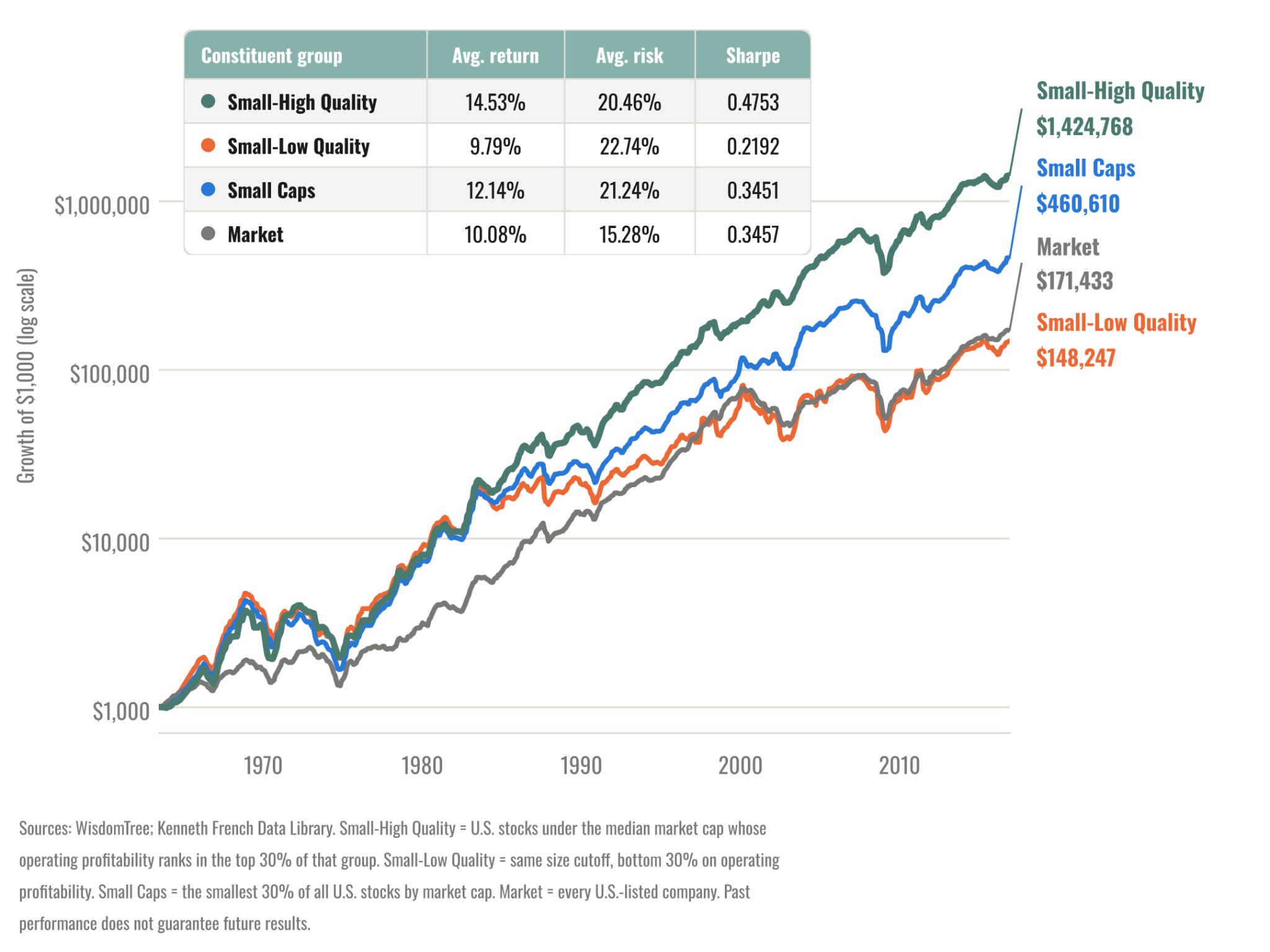
Small-caps are interesting, but not all small companies are equal. The higher-quality end of the universe has historically outperformed over long periods.
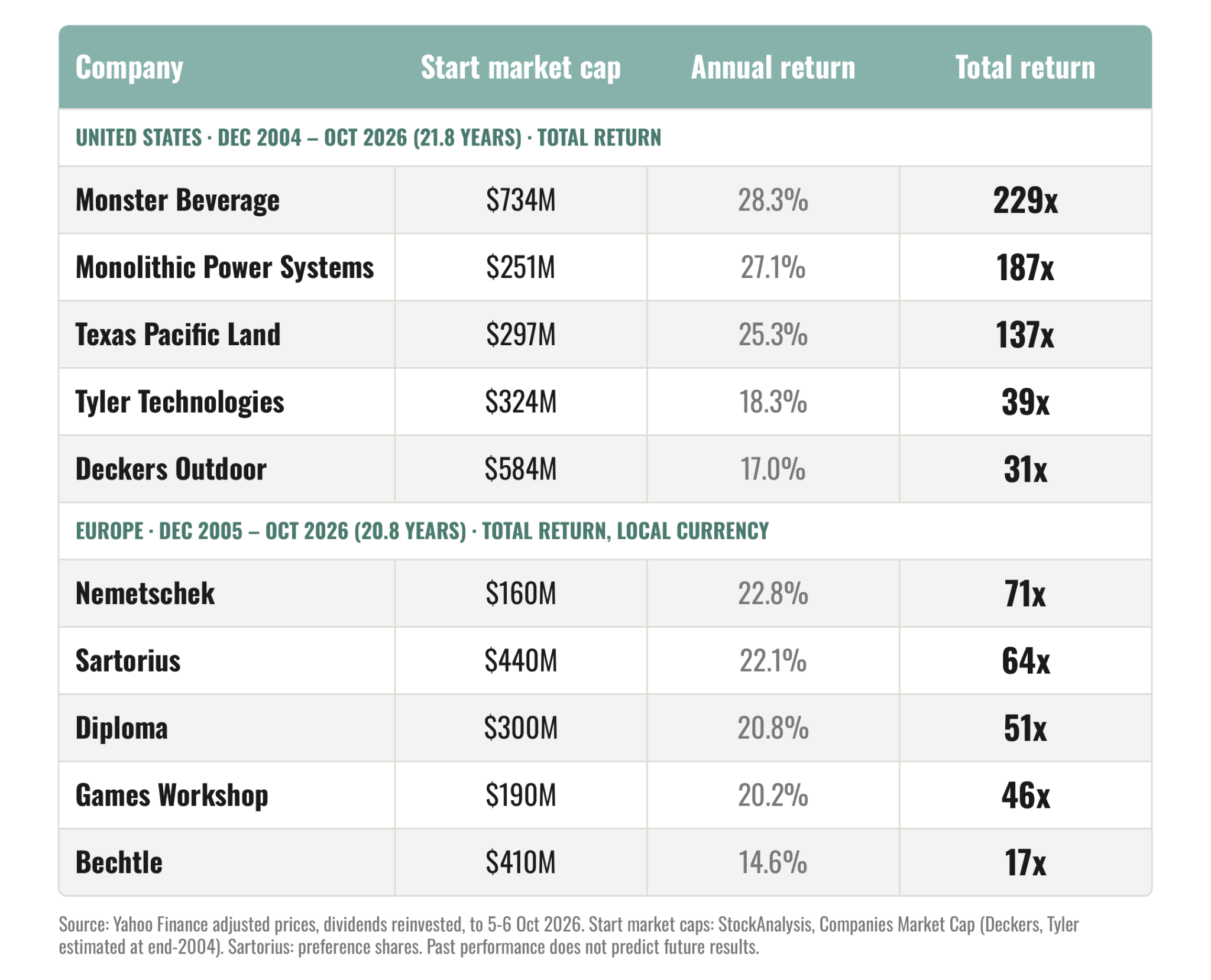
The result is even more striking when you look at some of the best individual winners that grew significantly over time.
In Berkshire Hathaway’s early years, Warren Buffett also invested in a high-quality small-cap: See’s Candy, in 1972.
If we hadn’t bought See’s, we wouldn’t have bought Coke.
We made a lot of money from certain investments because the lessons we learned from See’s led us to them.
We bought See’s for $25 million when its sales were $30 million and pre-tax earnings were less than $5 million. The capital then required to conduct the business was $8 million. (Modest seasonal debt was also needed for a few months each year.) Consequently, the company was earning 60% pre-tax on invested capital. [...] [In 2006] See’s sales were $383 million, and pre-tax profits were $82 million. The capital now required to run the business is $40 million. This means we have had to reinvest only $32 million since 1972 to handle the modest physical growth – and somewhat immodest financial growth – of the business. In the meantime pre-tax earnings have totaled $1.35 billion.
That is the kind of profile I am looking for: a small business that can grow without needing proportionally more capital.
What’s Included in the List
I left out entire industries for several reasons:
Too complex, like banks, asset managers or too speculative, like biotechnology.
Too risky, like passenger airlines and commodity producers, with low pricing power, or chemicals and trading companies, where margins swing with the cycle.
Against my principles. Tobacco, defense, and gambling.
The idea is to keep the list understandable, especially for newer investors, without filling it with businesses where a screen can look great right before the cycle turns.
Here are the selection criteria for the Tier 1
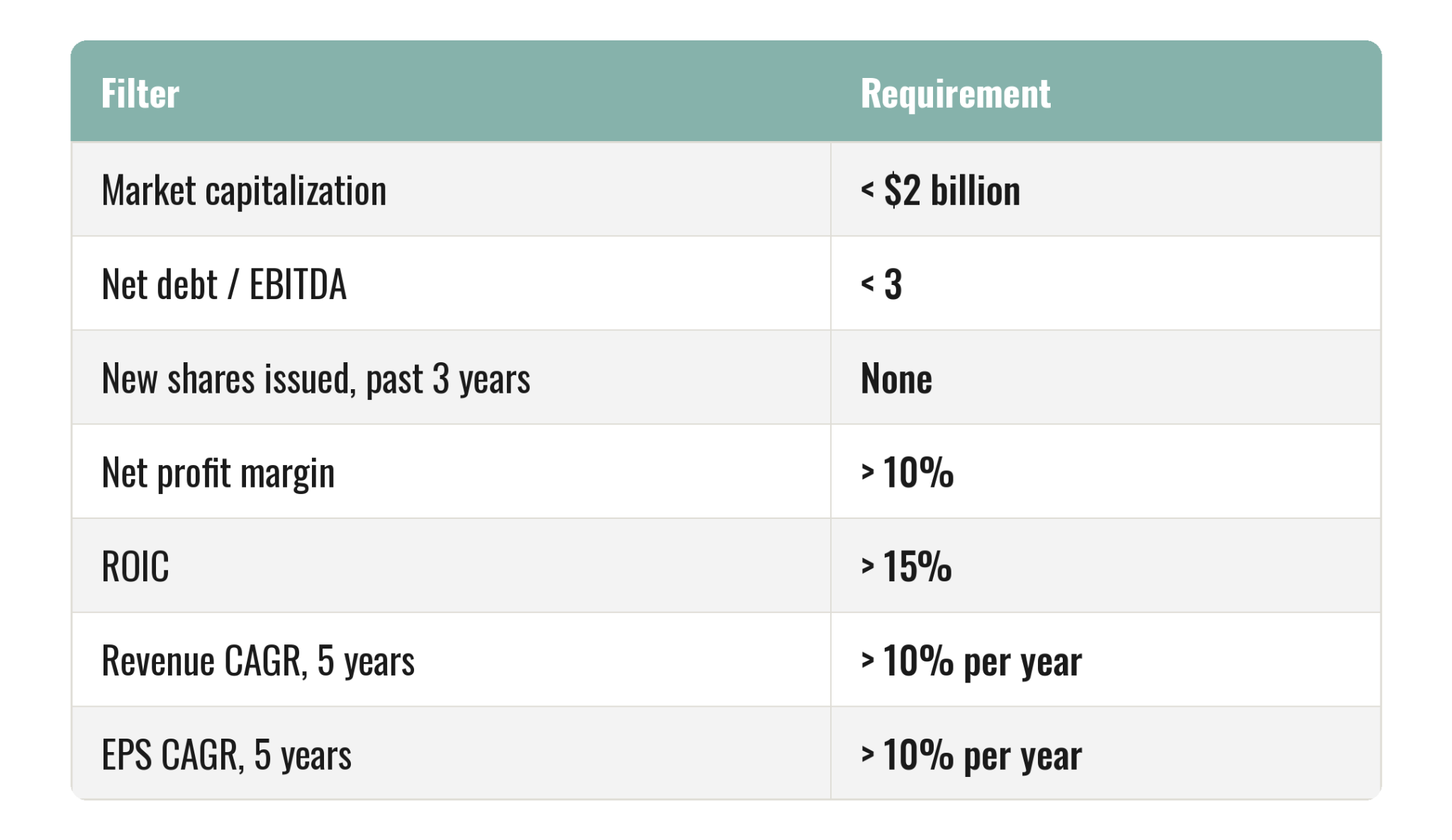
It is deliberately restrictive. This selection naturally excludes cyclicality, or companies that could also perform well, but with more risks, like value or deep value.
I also provide a Tier 2 for companies that meet the other criteria, but have increased their share count by less than 2% per year over the past three years. That still leaves room for some excellent businesses while keeping dilution limited.
Moat Score
The screen gets me to the first group of companies, but good numbers are only the starting point.
I also give each company a Moat Score, a personal assessment of the competitive advantage of the firm, which explains how the company will be able to protect its future profits. I use it to rank the companies that pass the financial filters.
The screen tells me whether the numbers are good; the Moat Score asks why they might stay good.
The companies are ranked by Moat Score, then alphabetically.
Three names already covered
Baviera: I recently published a full deep dive on the company.
EverQuote: I owned it and followed the company quarterly. I sold in September for reasons unrelated to the fundamentals.
Kri-Kri: Here is a link to an excellent article by Joe | Goldman Won’t Cover This.
I will also publish a new deep dive on one of the other companies on this list over the coming quarters.
Why I won’t keep the full list public forever
Many of these companies have a market cap under $1B, and most trade only a few hundred thousand dollars a day. So an article that became too popular would end up backfiring on its readers, and I need to prevent too many buyers from driving up the price because they all come from the same source.
That’s why the full list is free for the first 500 subscribers.
After that, it will move behind the paywall and remain available to paid subscribers only.
You’ve seen 3 of the 48 companies. The other 45 are below.
SUBSCRIBE FOR FREE TO SEE THE OTHER 45