
Introduction
Last June, I published a deep dive on Booking Holdings, whose valuation was under pressure due to fears of disruption from AI. Then the Q2 results came out: no disruption in sight.
Then, on September 8, Meta launched Muse, and Booking’s stock price fell nearly 10%, with its PE ratio under 18, one of its lowest levels in recent years.
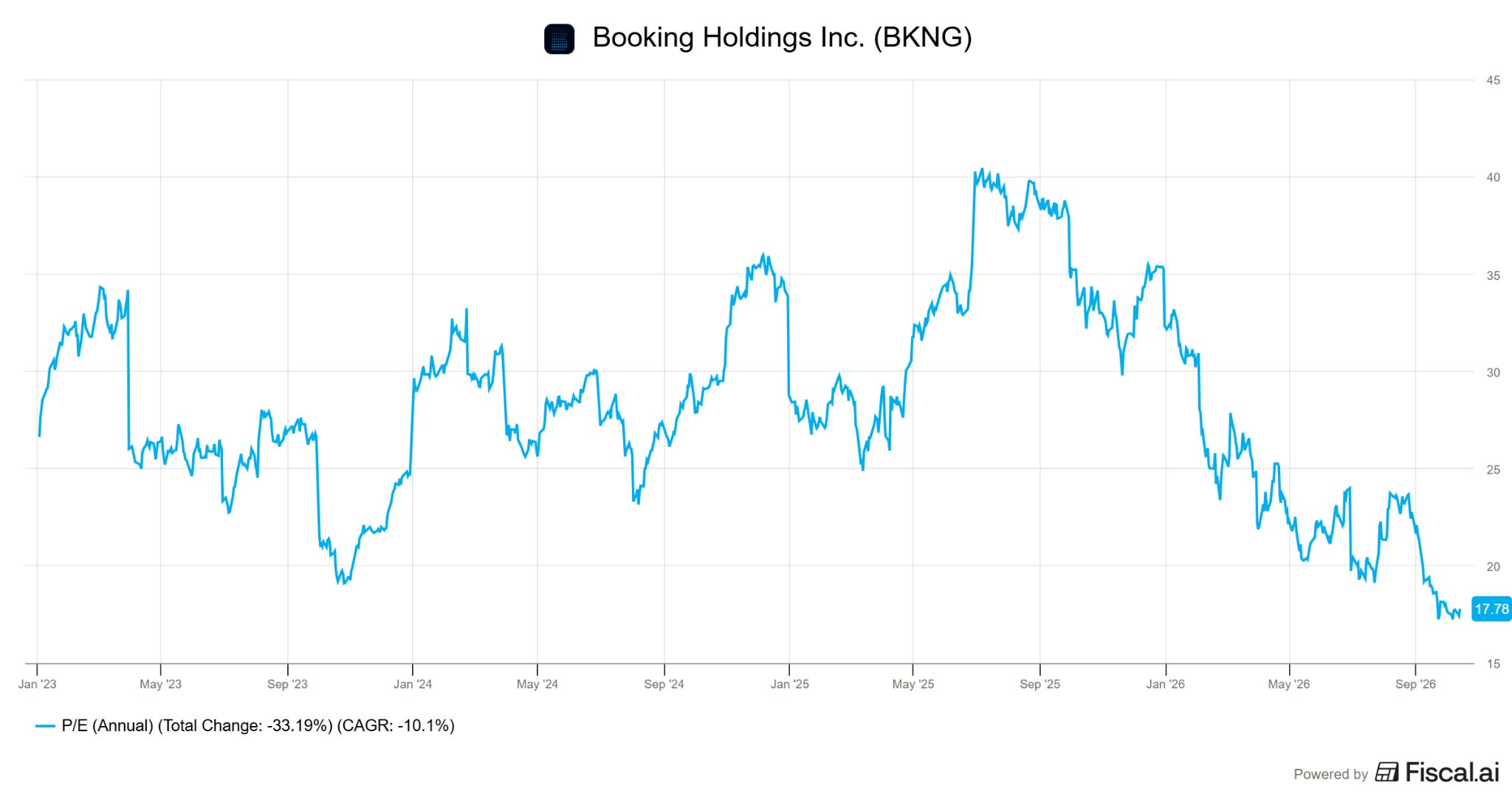
The purpose of this article is to see the threats that Muse and AI agents pose to Booking.
1. Muse AI
What it does
Muse is Meta’s personal assistant, launched on September 8, 2026, initially in the United States. It can be accessed via an app, on the web, or through WhatsApp. It is powered by Muse Spark, Meta’s model.
Each user has a dedicated computing environment, and Muse takes action for the user, even when the app is closed. It can also connect to their email, calendar, or Instagram and Facebook accounts.To process payments, it uses Stripe Link, which provides a one-time virtual card limited to the approved amount. Each purchase must be approved by the user within the conversation.
Here’s a video from Meta showing how it works:
The app has been downloaded more than 9 million times since its launch. For now, it is only available in North America.
How Muse Books Trips
For flights, Muse connects to Duffel, a company that provides API access to airline inventory.
It allows users to search for, book, cancel, and manage flights through Muse, with human assistance available in case of any issues.
The reservation is issued through Duffel, while the airlines generally remain the primary merchant.
For hotels, Muse opens a browser and visits websites (like Expedia or Hotels.com), just like a human would. Expedia announced on September 22 that it would join Muse.
Duffel said that accommodations would come later. Booking, for its part, has not partnered with Muse.
Performance
Gizmodo published a test earlier this week, where the agent booked a restaurant (but one that was over budget) and failed to book flights: it couldn’t connect to Expedia; United Airlines (and Amazon) blocked bots, and the conversation proved slow and confusing.
Its performance could improve very quickly. For now, however, the experience is still far from perfect.
2. The easier the purchase, the more prone it is to disruption
To assess the risk of disruption, I distinguish between three levels of purchasing and how a personal agent can transform each one.
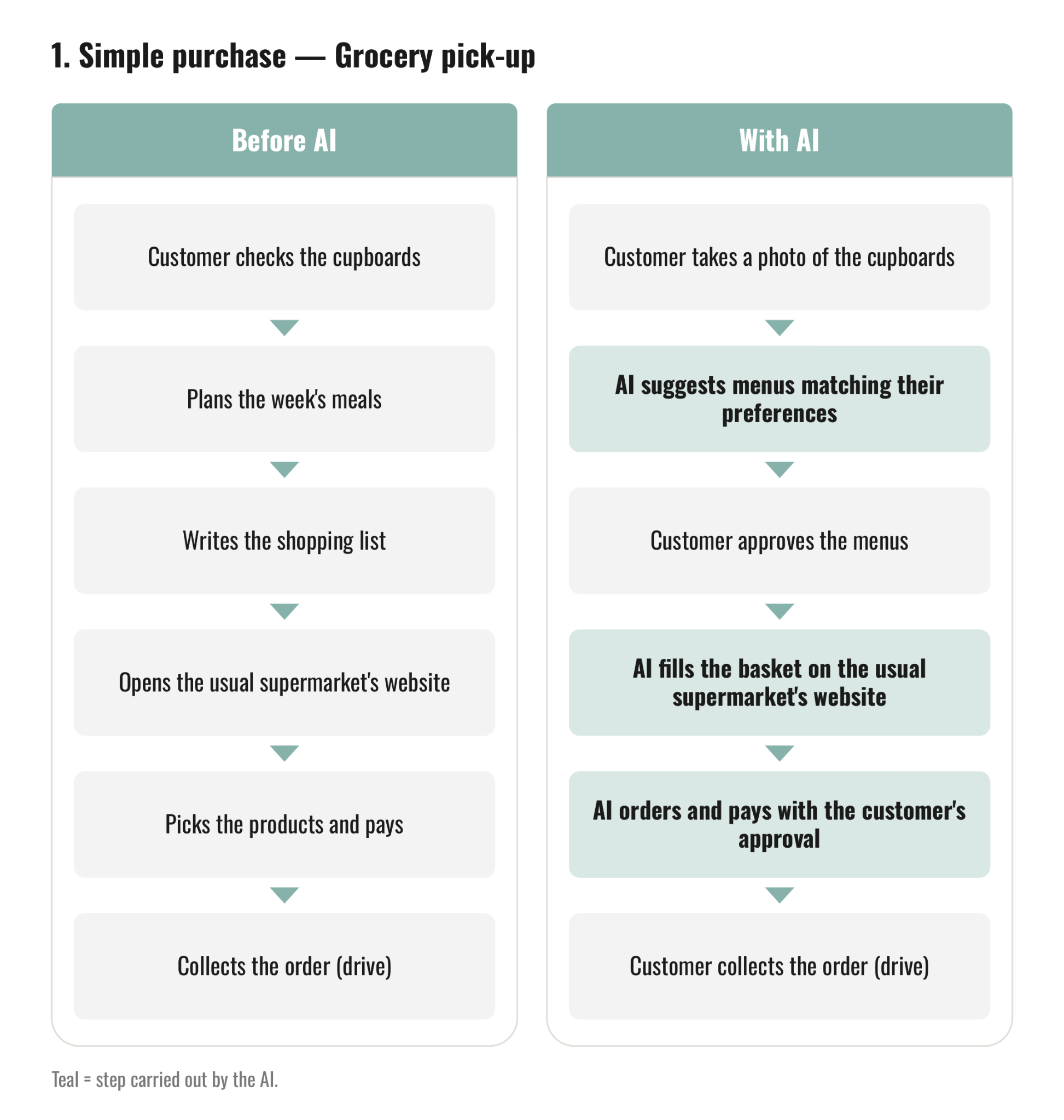
The first category includes routine purchases and changes in commoditized products, like curbside grocery pickup (Meta just partnered with Walmart), standardized products, cell phone plans, or basic insurance. Here, the products are comparable, and you know what you will get. This is where the agent can operate almost independently.
In case of error, the stakes are low. This is the area most prone to disruption.
In the case of travel, this would mean returning to a hotel where you are a loyal customer for a repeat stay.
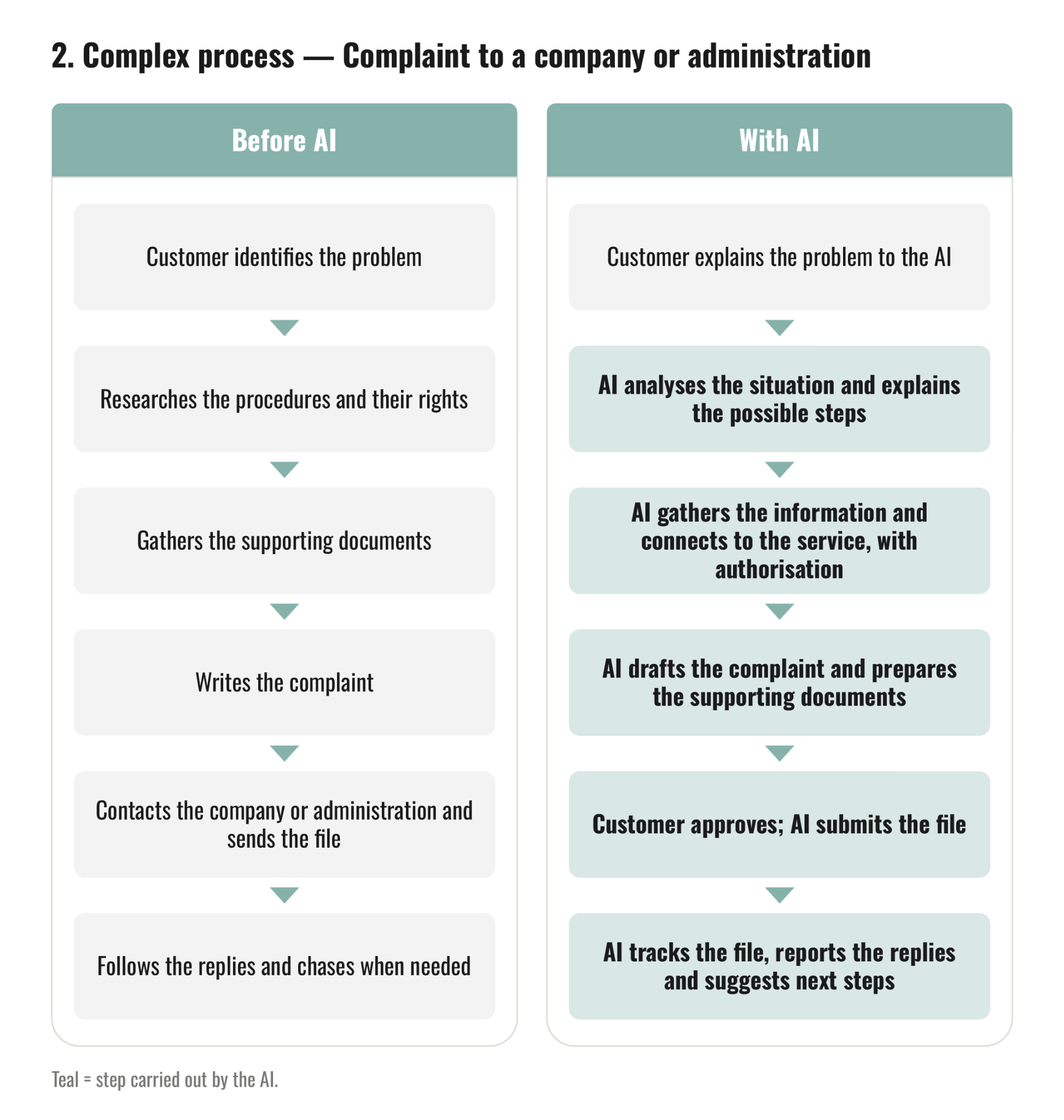
The second level involves more complex processes and decisions, like comparing insurance policies, or switching providers when the procedures are more difficult, or filing a complaint with a company or government agency. The AI can run almost the entire operation, but this requires more interaction with the user, and the AI must be reliable. The potential for disruption is moderate, and many see this as a step forward for users.
The third level involves high-stakes purchases, like vacations, cars, or healthcare.
Here, the decision is too important and the information sometimes too sensitive to be entirely entrusted to an AI.
Booking a two-week family vacation involves a large budget, personal preferences, and the risk of a bad experience. Personally, I don’t want to ruin what is often the best time of the year (and the memories that go with it) because an AI that’s still in its early stages might have misunderstood or mishandled my requests. Especially when several thousand euros or dollars are at stake.
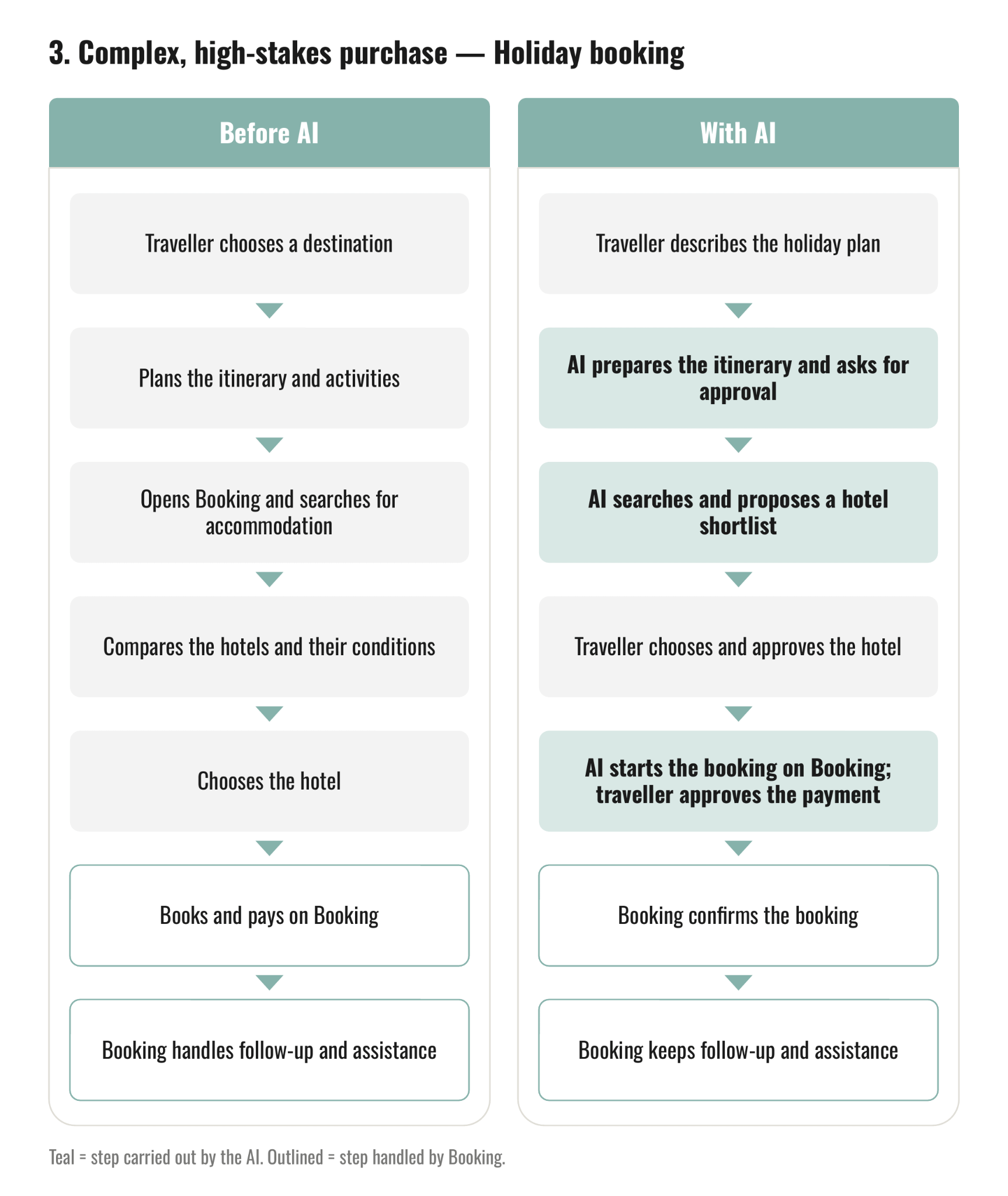
AI could become the universal consumer interface without necessarily replacing the companies that carry out transactions and provide services.
My core scenario is that AI plans and compares options, the traveler chooses and confirms, and then Booking makes the reservation and provides support. The agent can even process the payment through Booking. Other scenarios are also possible.
3. Booking’s Moat Evolution
The advantage of Genius remains the same
In the second quarter, Genius members at Levels 2 and 3 accounted for nearly 60% of Booking.com’s room nights, up from a year ago. Travelers still have every reason to take advantage of these benefits, which should be reflected in Muse’s comparison.
Brand Erosion
In my deep dive, I explained that Booking’s customers often return to the platform out of habit. This is a distribution moat, and likely the one that Muse could weaken the most.
If a traveler starts their search with a personal assistant, they may no longer think to open Booking. AI can influence which hotels are displayed and how they are displayed. Booking may still process the reservation, but it loses visibility early in the journey.
To counter this, Booking may need to invest more in its brand through ads and pay to increase its visibility among travel agents.
Direct Access to Hotels
Even though Booking continues to list 4.4 million properties, the temptation for a hotel to accept direct bookings with no commission is very real. European regulations already limit Booking’s use of rate parity clauses, and hotels can offer lower rates on their own websites. An agent could highlight these differences more prominently.
The risk for Booking is that hotels will have a new channel to reach their customers and thus gain greater bargaining power, even if they continue to sell their services through Booking. They could also use SiteMinder.
However, the hotel would have to handle sales and manage the service, which isn’t a problem for large chains but is more complicated for an independent hotels, the Booking’s core target market.
Trust and Problem-Solving: A Reason to Stay
I once tried to contact Abritel (Vrbo, part of Expedia Group) on a weekend because of a booking issue, but no one answered. I had to wait half a day to check out because the host didn’t respond to my messages. I swore to myself I’d never use that platform again. It was a bit less expensive than Booking, but in the end, it wasn’t worth it.
With Booking, I only had one issue out of more than ten reservations: I was billed twice. It was quickly resolved by customer support. I was actually glad to have a real person on the other end of the line who understood my situation and followed up with me to confirm the resolution.
My only major incident happened last year with Airbnb, at a beachfront house. Right in the middle of summer, we had an electrical problem. Despite our host’s reassuring words, the issue wasn’t resolved quickly. Airbnb refunded our reservation and added 10% so we could book another place to stay on the platform. That allowed us to bounce back without too much trouble.
For me, one of the main advantages of platforms like Airbnb and Booking is their ability to step in when a reservation goes wrong. An agent couldn’t provide that.
AI replaces part of the pre-booking process
Today, the “standard” process is to search on Google, then make a selection on Booking, then book the hotel on Booking. Tomorrow, the search and selection could take place on Muse, ChatGPT, or Gemini, followed by the reservation on Booking. That’s what I was explaining in the third image. The acquisition cost could change, depending on the scenario.
If the agent brings a customer who previously came through an ad, it is only a change in the type of acquisition.
If the agent brings a customer who was too lazy to book, it’s a new business.
If the agent directs the customer to the hotel’s website, and Booking is removed from the transaction, Booking loses a customer. That’s the worst-case scenario.
4. Competitors’ Response
Agentic AI and the commoditization of a competitive industry
I remain skeptical about the existence of a sustainable competitive advantage based only on automated web browsing. Google, OpenAI, and others are certainly also developing agents that will have similar capabilities in the future.
Agent-based transactions are likely to become a low-margin commodity.
In this case, Meta’s potential strength lies instead in the distribution and customization enabled by its applications. But a stronger distribution than its competitors? And if the brands and applications of Meta stop growing while others continue to grow, that marks the end of its distribution advantage.
Lola: the recommendation agent
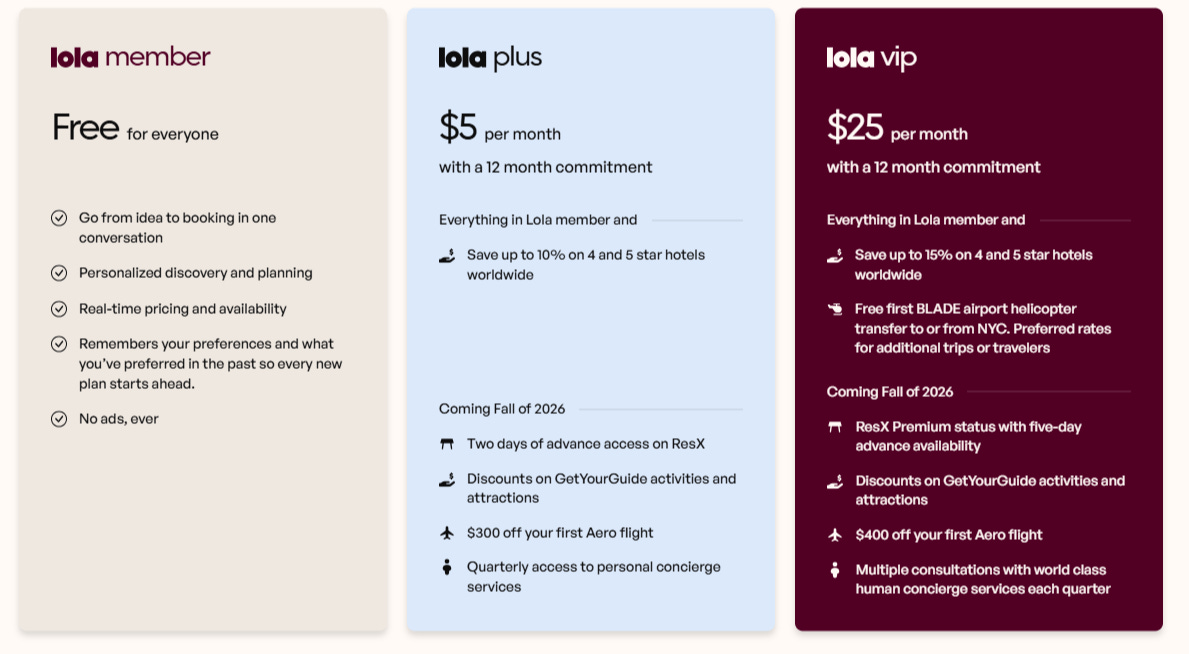
Booking now offers Lola.com, which provides access to travel and experience bookings, with offers that remain within the group.
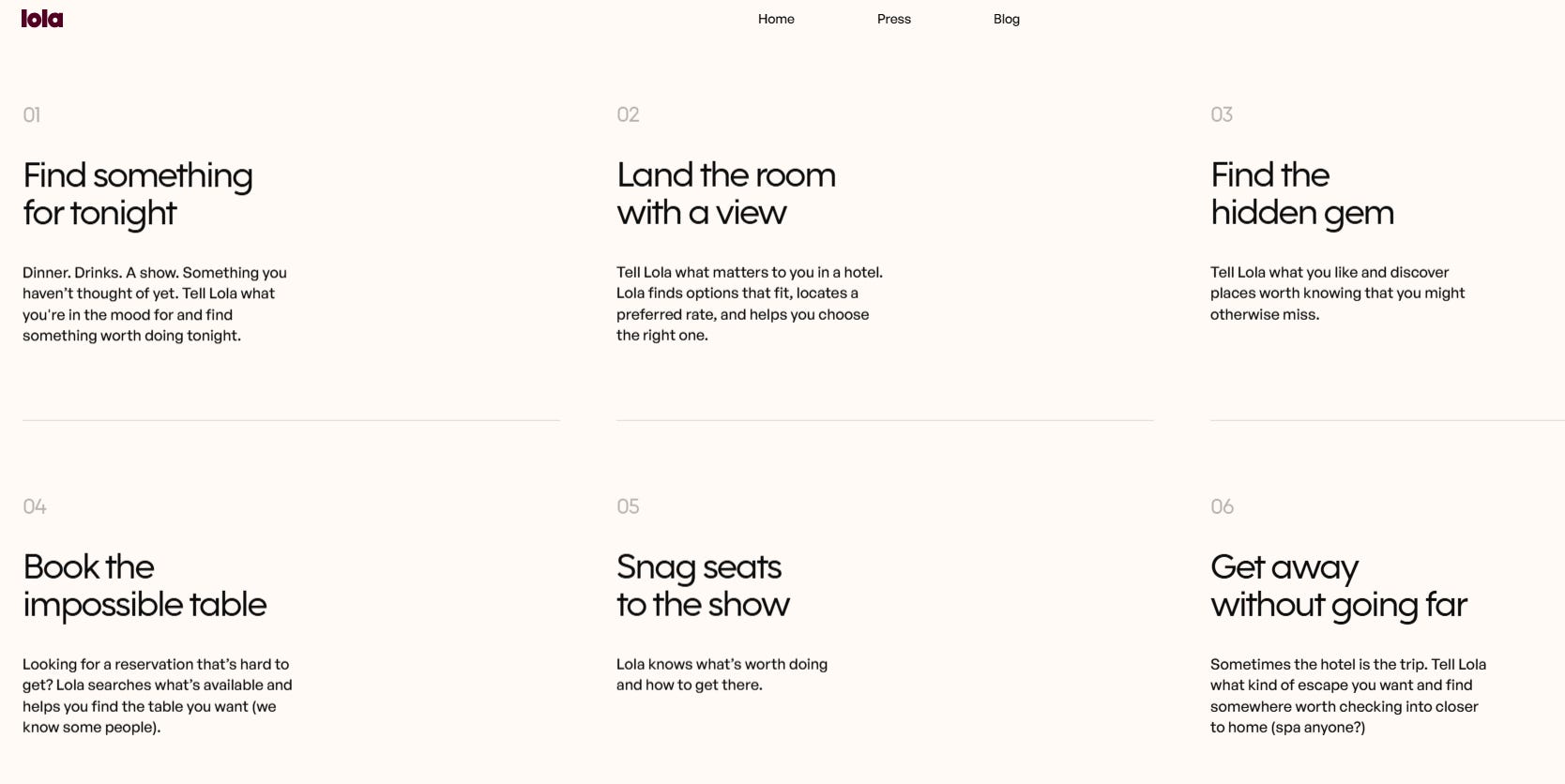
Lola is free for most uses, with a freemium model.
Vayo: Booking’s latest response
Yesterday, October 14, Booking announced a planned investment of $100 million in Vayo, a personal travel assistant.
According to the website, it uses the booking history in your email inbox to understand your preferences and offer you a personalized trip, without feeding your data to an AI.
It will allow users to book hotels and flights directly, and will redirect them to the hotel’s website or another platform if a better deal is available. Thus, Booking is seeking to maintain its customer relationships through this tool and appears to be engaging in a price war to preserve its distribution network.
A price war is never good for shareholders, at least in the short term.
How will Vayo be funded? It could be through subscriptions, advertising or transaction fees. Today, the question remains open.
Metrics
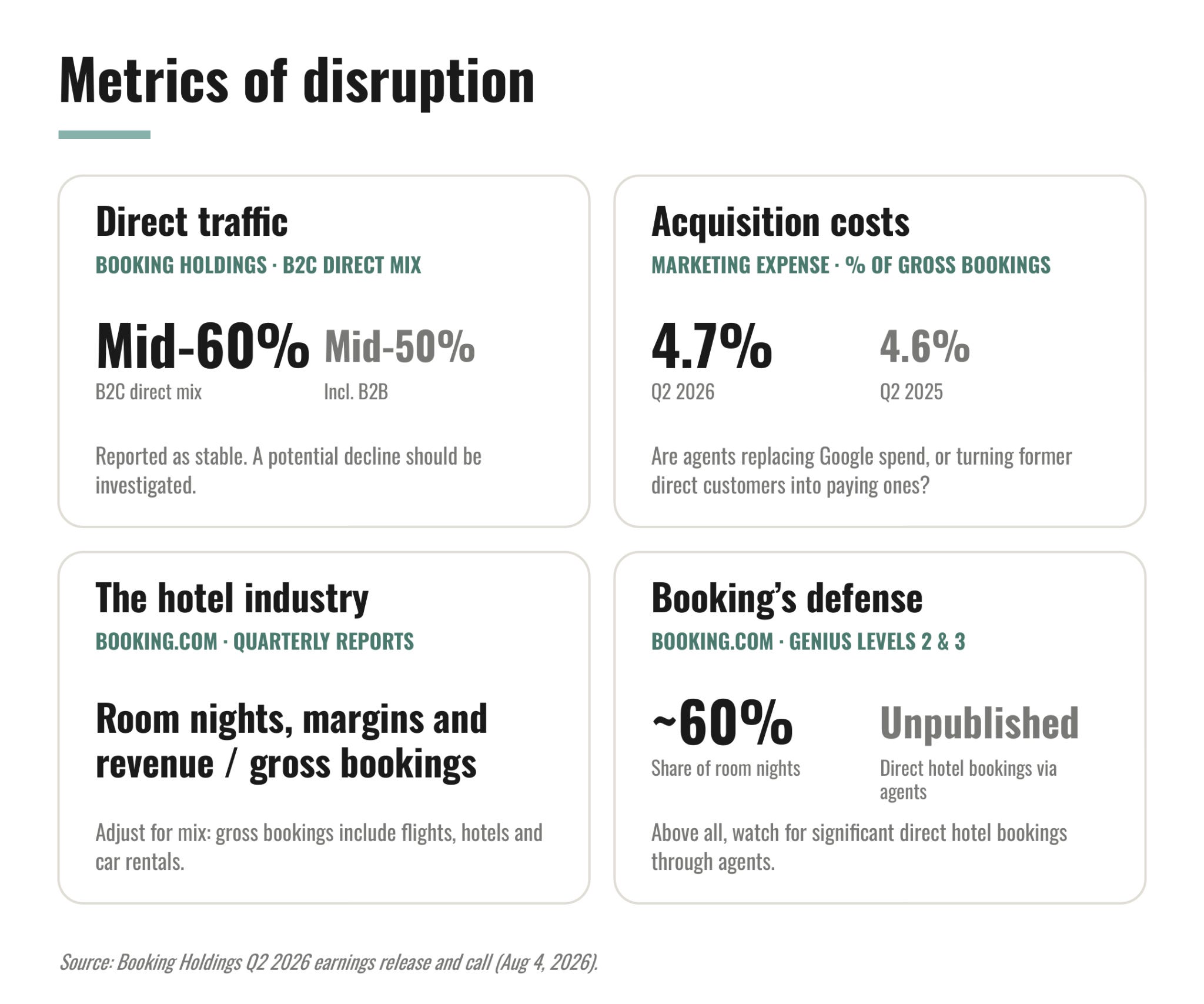
It will be important to monitor how these trends develop, particularly through upcoming reports from Booking, Airbnb, and Expedia, which are scheduled for November 3, 5, and 5, respectively. For Booking’s initial report, you can check out my latest Q2 update. The metrics to track are in the picture below:
Since Muse has just been launched and Vayo is still in private beta, these figures are likely to fluctuate in either direction over the next few quarters.
Here are the metrics to track:
Final thoughts
Muse shows that agents are at the dawn of a new way of making choices and placing orders, which will impact the travel industry. While there are certainly threats to its competitive moat, Booking has all the tools it needs to maintain or strengthen its competitive advantage over time. The risk of disruption is well offset by the platform’s security advantages and its ability to support the AI agent revolution within its ecosystem.
Valuation poses another problem, because as long as investors fear future disintermediation, they may refuse to quickly restore this multiple for Booking, despite solid results or the announcement of a promising product. It may take years to dispel this uncertainty, with no guarantee that the stock price will rebound any time soon.
I think Booking can remain a solid company in the age of AI agents. Whether investors will share my view next quarter, next year, or three years from now remains the unknown factor in this investment. But I’m in no rush.